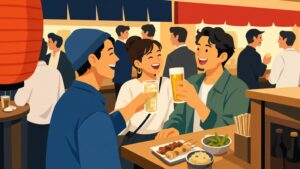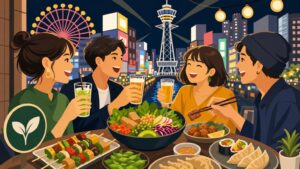
You’re out with your new colleagues from the office in Osaka. The first stop is a buzzing izakaya in Namba, steam rising from plates of takoyaki, the clatter of beer mugs hitting the table a constant, joyous rhythm. The conversation flows, the food is fantastic, and you’re just hitting your stride. You’re thinking, “This is great. I could stay here all night.” And right then, as you’re about to order another highball, the department head claps his hands together with a decisive thud and declares, “Saa, nikenme iko ka?” — “Alright, shall we head to the second spot?”
Everyone starts gathering their things. A wave of confusion washes over you. Leave? Now? But we just got comfortable. Is the food bad? Did someone say something wrong? The answer is no. Welcome, my friend, to one of the most fundamental, unwritten laws of Osaka social life: the sacred art of the hashigo-zake, or bar hopping. And its core component, the nikenme, the second location, is not just a change of scenery; it’s a change of philosophy. This isn’t just about drinking. It’s about movement, variety, and a deeply ingrained approach to life that sets Osaka apart from the rest of Japan. Forget settling in for the long haul at a single pub. In Osaka, the night is a journey with multiple chapters, and the story only gets interesting when you turn the page and walk out the door.
For those looking to balance the city’s energetic bar hopping with a tranquil change of pace, exploring Osaka’s rural escape offers a refreshing alternative.
The ‘Ikkenme’ Illusion: The Warm-Up Act
To understand the nikenme, you first need to grasp the role of the ikkenme, the initial stop. For many foreigners, the first place feels like the main event. In truth, it’s often merely the opening act, where the essential groundwork for the evening is laid. It serves as a base camp, not the summit. The choice of ikkenme is usually strategic, often a larger venue such as a reliable izakaya chain or a local favorite known for its okonomiyaki or kushikatsu. The purpose is straightforward: gather everyone, eat some solid food to build a foundation for the drinks ahead, and perform the all-important toriaezu biiru (“beer for now”) ritual.
This initial stop sets a baseline. The atmosphere is generally lively but not yet chaotic. It’s a controlled space for initial greetings and catching up. However, for the experienced Osaka local, a subtle timer always ticks in the back of their mind. They’re not unpacking their night’s plans mentally; they’re lacing up their walking shoes. This mindset sharply contrasts with a night out in, say, Tokyo. In the capital, an evening might center around a single, carefully chosen reservation at an elegant restaurant. The location is the destination. The reservation itself is the plan, and the night is a self-contained experience within those four walls. In Osaka, the plan is to remain flexible. The plan is to move. Staying put feels like a missed chance. The city itself is the venue, and the individual bars are merely points of interest along the way.
The Psychology of the Hop: Why Osakans Can’t Stay Still
So, why the constant movement? Why leave a perfectly good bar for the uncertainty of the next? The answer is embedded deep in Osaka culture, a mix of economic pragmatism, a thirst for novelty, and a distinctive approach to social interaction.
The ‘Akinsho’ Mindset: A Desire for the New
There’s a term in the Osaka dialect, akinsho, which roughly means “someone who gets bored quickly.” While it might seem like a flaw, in Osaka, it fuels the culture. Osakans seek stimulation, variety, and fresh experiences. Remaining in one bar for three or four hours, staring at the same four walls and talking to the same people in the same setup, feels… well, dull. Static. Changing venues is like hitting a reset button for the evening. The stroll to the nikenme, even if just fifty meters down a narrow yokocho (alleyway), acts as an essential palate cleanser. It breaks the rhythm. A lagging conversation is instantly revitalized simply by moving. New topics arise. The energy changes. Each new bar is a fresh chapter, with different lighting, new faces, and a distinct soundtrack. It keeps the night lively and unpredictable.
The Merchant’s Logic: Maximize Value, Minimize Cost
Never underestimate the economic engine behind Osaka culture. This city, built by merchants, takes pride in securing the best deals possible. This principle applies perfectly to a night of hashigo-zake. Why stick to one izakaya and pay marked-up prices for sashimi when a tiny, specialized fish shop-turned-standing-bar two blocks away offers fresher cuts at half the cost? Why settle for mediocre karaage when a renowned fried chicken spot is nearby? Bar hopping is a form of economic curation. An Osaka local isn’t just out for drinks; they are crafting their ideal evening, piece by piece, from the best-value offerings in the neighborhood. They might start at a tachinomiya (standing bar) for a 300-yen beer and a plate of doteyaki (slow-cooked beef sinew), then move to a sake bar for a premium pour unavailable elsewhere, and finish at a gyoza specialist. Each stop is a quest to achieve maximum quality for minimum yen. This exemplifies the famed Osaka kechi (frugal) spirit. It’s not about being cheap; it’s about being clever. It’s a game, and winning tastes sweet. This sharply contrasts with the often brand-driven, image-focused nightlife in Tokyo, where the goal can be simply to be seen at the trendiest expensive spot.
The Urban Landscape as a Playground
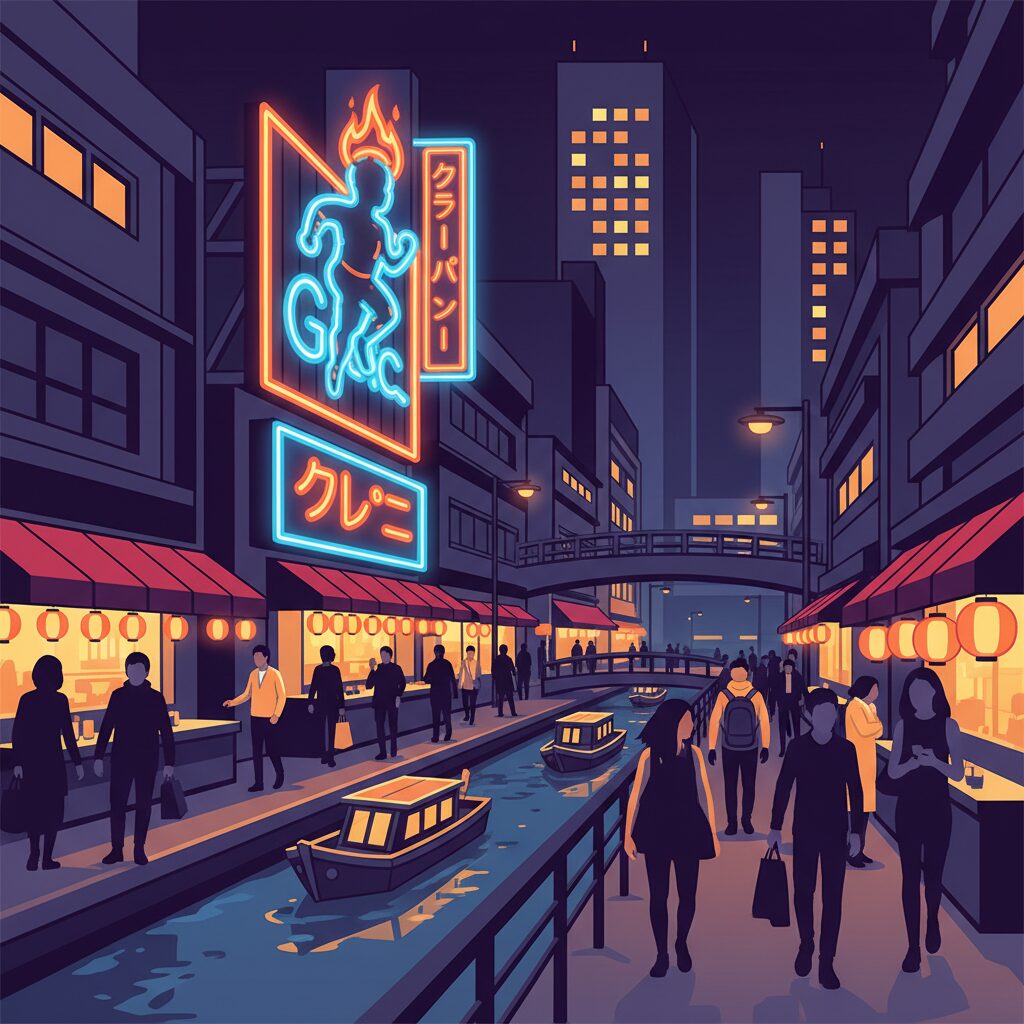
This culture couldn’t thrive without a city designed to support it. Osaka is a bar-hopper’s dream. Areas like Tenma, Kyobashi, Ura-Namba, and Shinsekai are packed with dense clusters of small, independent, affordable establishments. Covered shotengai (shopping arcades) and shadowy back alleys are lined with tiny bars, many seating only six to eight people. The city’s layout encourages and rewards exploration. The barrier to entry is low—both in price and formality. No reservation is needed; you just find an open stool. This creates a fluid, vibrant nightlife where the streets themselves form part of the experience. The walk between bars—dodging crowds, inhaling the scent of grilled food, hearing the blend of different storefront sounds—is as much fun as the drinking itself. It’s an interactive, immersive way to soak in the city’s lively, chaotic energy firsthand.
A Field Guide to the Osaka Bar Crawl
A proper Osaka hashigo-zake is like a multi-act play, with each venue playing its own unique role. Knowing the key characters will guide you as you weave through the city’s intoxicating tapestry.
The ‘Tachinomiya’: The Pulse of the Crawl
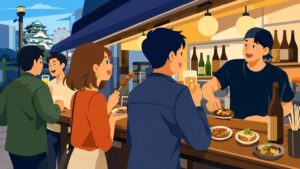
The standing bar is the essential link in the hashigo-zake chain. With no chairs, a cramped space, and lightning-fast service, comfort is not the goal. A tachinomiya is a place of lively, transient energy. You stand at the counter, order a drink and a few small, inexpensive, and tasty snacks—think skewers of kushikatsu or a modest bowl of simmered treats. Usually, you pay as you order (kyasshu on deribarī), placing cash on the counter in front of you. The unspoken rule is clear: drink, snack, then move on. Lingering is a rookie mistake. Yet, within this quick exchange, a distinct sense of community flourishes. You’re literally shoulder-to-shoulder with strangers, sharing a brief moment of camaraderie over an affordable beer. It’s the perfect, low-commitment stop to bridge the gap between the ikkenme and nikenme, or to serve as the nikenme itself.
The ‘Senbero’ Promise: The 1,000 Yen Thrill
Senbero perfectly captures the Osaka spirit. The term fuses sen-en (1,000 yen) and berobero (to get drunk). It’s both a challenge and a guarantee: you can enjoy a gratifying time for just a crisp ¥1,000 note. Many bars, especially in working-class neighborhoods, offer senbero sets. For a thousand yen, you might get three drinks and a small dish, or two drinks and two dishes. It’s the ultimate expression of budget-friendly fun. Hunting for the best senbero set in a neighborhood is a popular weekend pastime. It’s not about getting wasted cheaply; it’s about the thrill of the search and the satisfaction of uncovering one of the city’s best-kept gems. It’s a badge of pride for both the customer and the spot that delivers such quality at a low price.
The ‘Shime’: The Final, Carb-Powered Grand Finale
An Osaka night doesn’t begin and end in a single spot, nor does it fade away quietly. It finishes with a deliberate, satisfying final act: the shime. Meaning “to close” or “to finish,” this reflects a final, starchy dish meant to soak up the alcohol and bring the night to a deeply fulfilling close. This is almost never eaten at the last bar you visited. Instead, the shime demands its own dedicated stop—a sankenme (third place) or yonkenme (fourth place). The undisputed champion of shime is a steaming bowl of ramen. The rich, salty broth is considered the perfect cure after drinking. Other favorite options include ochazuke (a simple bowl of rice topped and doused with hot tea) or a comforting bowl of udon noodles. The shime ritual is non-negotiable. It’s the final communal gesture that signals the night’s true end, offering a warm, savory landing after a long, exhilarating journey.
More Than a Drink: A Reflection of the Osaka Character
When you take a step back, you realize that hashigo-zake perfectly encapsulates the broader Osaka personality. It highlights the city’s core values and spirit in a way that visiting a castle or a temple never could.
It’s a celebration of flexibility over rigid planning. A common phrase among Osaka locals is nanto ka naru (“it’ll work out somehow”), and this mindset fuels a good bar crawl. You don’t need a detailed schedule—just a starting point and an openness to follow where the night leads. This spontaneity offers a refreshing contrast to the more structured and formal social scenes often found elsewhere in Japan.
It embraces pragmatism over pretension. The best nights rarely happen in sleek, minimalist cocktail bars. Instead, they take place in worn, cramped, smoke-filled joints where the food is straightforward, the prices are reasonable, and the laughter is hearty. There’s no dress code and no judgment. It’s a decidedly democratic and unpretentious way to socialize, where a company president might share the counter with a construction worker, both enjoying the same 300-yen beer.
Finally, it’s about connection through movement. While it might appear as a series of passing encounters, the shared journey of a hashigo-zake night forges a unique bond. You’re not only sitting across from your friends; you’re actively exploring the city together, making spontaneous group decisions, and sharing dozens of small, distinct moments. At a tiny counter bar, you’re also more likely to strike up a conversation with the bar master (taisho) or the person next to you, creating those small, human connections that make the city feel like a village.
Foreigners often misunderstand this practice as a persistent pursuit of intoxication, but that misses the point entirely. It’s a social ritual. It’s a culinary adventure. It’s an economic strategy. And most importantly, it’s how Osaka locals engage with the living, breathing soul of their city.
How to Join the Flow
Ready to try your first hashigo-zake? Here’s the right way to do it. First, let go of any need for a strict plan. Choose a promising neighborhood—Tenma for its maze-like market streets, Kyobashi for its gritty, old-school atmosphere, or Ura-Namba for its trendy yet approachable spots—and simply show up. Look for the unmistakable signs of a great place: a red lantern (akachochin) hanging outside, steam fogging the windows, voices spilling onto the street. Don’t be shy. Slide open the door and see if there’s a seat available.
Keep your orders simple at each spot. One drink, one or two signature dishes. This helps you stay on the move. When your friend or colleague gives the cue—the familiar “Saa, tsugi iko ka?” (“Alright, shall we head to the next one?”)—don’t hesitate. Don’t resist. Just smile, pay your share, and follow them out the door into the vibrant Osaka night. You’re not just hopping to another bar. You’re learning to experience the city like a local: not as a set of fixed destinations, but as a flowing river of endless, delicious possibilities. Just go with the current.