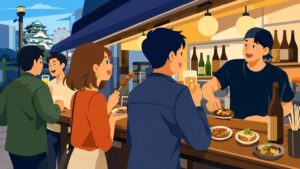
Step off the train at Umeda Station, unfold a map, and let a flicker of confusion cross your face. Before you can even pinpoint your location, it’ll happen. A woman with a leopard-print tote bag and a perfectly coiffed perm might materialize by your side. She’ll tap your arm, lean in close, and launch into a torrent of advice in rapid-fire Osaka-ben. “Where ya headin’? Shinsaibashi? Ah, no, no, you’re on the wrong platform for that line! You gotta take the Midosuji Line, it’s over there, the red one. See? C’mon, I’ll show ya to the ticket gate.” She won’t wait for an answer. She’ll just start walking, expecting you to follow. This isn’t a scam. It’s not an intrusion in the way you might think. This is your first, unfiltered encounter with ‘osekkai,’ the lifeblood of Osaka’s social landscape. It’s a form of kindness so proactive, so assertive, it often feels like meddling. For anyone coming from the polite distance of Tokyo or the reserved personal space of a Western culture, this experience can be jarring. It feels like a rule has been broken, a boundary crossed. But here in Osaka, the rules are just different. This city, a sprawling, energetic metropolis, operates on a different frequency—one that’s louder, warmer, and unapologetically in your business. Understanding ‘osekkai’ isn’t just about learning a new word; it’s about decoding the heart of Osaka itself. It’s the key to transforming from a visitor who is simply observing the city to a resident who truly feels its rhythm. Forget what you think you know about Japanese reserve. Here, connection happens in the open, whether you’re ready for it or not.
Embracing the spirit of spontaneous local advice means you can also delve into mastering Osaka’s escalator etiquette to navigate the city’s everyday interactions with even more confidence.
What Exactly is ‘Osekkai’? Decoding the Definition
To truly understand Osaka, you need to grasp the concept of ‘osekkai’. This term doesn’t have a straightforward English equivalent. If you look it up, you might find words like “nosy,” “meddlesome,” or “officious.” While these hint at part of its meaning, they carry a negative connotation that misses the essence entirely. In Japan, there’s a different word for kindness: ‘shinsetsu’. This represents the polite, gentle kindness you usually expect—it’s helping someone when asked, or offering your seat to an elderly person. It’s quiet and respectful. On the other hand, ‘osekkai’ is what happens when ‘shinsetsu’ has had three espressos and decides you need help before you even realize it yourself. It’s a proactive, unsolicited effort driven by a sincere, if sometimes misguided, desire to assist. It’s the kindness of someone who spots a problem and simply can’t resist trying to fix it for you.
Consider it like this: ‘shinsetsu’ is a friend asking, “Do you need a hand with that?” while ‘osekkai’ is your auntie walking into your apartment, declaring your spice rack chaotic, and reorganizing it while explaining why her system is better. Her intentions are good and genuine, but her approach completely ignores the idea of personal boundaries. That’s ‘osekkai’. It assumes a familiarity, a shortcut to intimacy. The person practicing ‘osekkai’ doesn’t see you as a stranger, but as a temporary member of their flock who needs looking after. They take it upon themselves to be your guardian for the next few minutes, carrying out their task with enthusiasm and no self-consciousness.
This is often where cultural misunderstandings arise. For many foreigners, unsolicited advice from a stranger can feel like criticism. When an older man in a ramen shop points at your bowl and says, “You should add more garlic; it’s better that way,” it might seem like he’s implying you’re eating incorrectly. But in the language of ‘osekkai,’ he’s saying, “I want you to have the best experience possible, and I have the knowledge to help you get there.” He’s sharing a piece of local wisdom, inviting you—albeit in his own way—into the community. Recognizing this shift in perspective is the key first step to appreciating, and perhaps even enjoying, life in Osaka.
The Anatomy of an Osaka ‘Osekkai’ Encounter
‘Osekkai’ is not merely an abstract idea; it’s a concrete, everyday act you will observe and take part in. These interactions have their own rhythm, cast of characters, and unspoken scripts. Learning to identify them is part of your orientation to the city.
The Setting: Everyday Public Spaces
This isn’t something that takes place behind closed doors. The primary stage for ‘osekkai’ is the public sphere. It flourishes in train stations, supermarkets, shopping arcades (‘shotengai’), and local eateries. These are the spaces where the community’s connective tissue is most apparent. In a busy supermarket in Tenma, for instance, the aisles are teeming with unsolicited consumer advice. You might be staring blankly at a wall of different miso pastes when a woman pushing a cart slows down beside you. “That one’s too salty for soup,” she might say, pointing at your choice. “You want the one with the dashi already in it. This one. It saves you a step. And it’s on sale today, see?” She’s not a store employee; she’s just another shopper who has taken it upon herself to be your personal miso consultant.
Likewise, the winding, covered ‘shotengai’ such as the one in Shinsaibashi or Tenjinbashisuji are prime areas. Here, shopkeepers don’t just remain behind their counters. They’re part of the street’s living ecosystem. The fruit stand owner will shout to you, “Those melons are perfect today, sweetie! The best you’ll get all week!” The butcher will spot you eyeing some pork and offer, “If you’re making tonkatsu, you need a thicker cut. Let me get you the right one.” It’s an ongoing, flowing dialogue of commerce and community advice that blurs the boundary between customer and neighbor.
The Key Players: Masters of Meddling
While anyone can take part in ‘osekkai,’ there is a definitive archetype: the Osaka ‘obachan’ (a familiar term for a middle-aged or older woman). She is the grandmaster of meddlesome kindness. Often recognizable by her brightly colored clothes, practical walking shoes, and an aura of unstoppable forward energy, the ‘obachan’ acts as the self-appointed guardian of public order and efficiency. She is the one who will correct your train route, show you how to use the complicated ticket machine, and tell you to put on a sweater because you look cold. Her delivery is quick, direct, and utterly confident. There’s a stereotype that she always has candy in her purse (‘ame-chan’), and it’s not entirely untrue. This candy is part of the ‘osekkai’ toolkit—a small offering to soften the impact of her unsolicited but well-meant advice.
Her male counterpart, the ‘ojisan’ (older man), is also a common practitioner. His ‘osekkai’ typically centers on practical skills or shared interests. He’s the one at the local standing bar who will show you the “correct” way to dip your kushikatsu (fried skewers) in the communal sauce—only once, never double-dip!—or the guy in the park who offers unsolicited tips on your golf swing. He’s less nurturing and more instructive, a gruff yet caring coach you never signed up for.
The Script: A Predictable Pattern
An ‘osekkai’ encounter usually follows a three-act sequence.
Act I: The Observation. The ‘osekkai’ provider spots an issue. You look lost. You’re fumbling with your change. You’re using the wrong kind of soy sauce for your sushi. You appear as a perceived inefficiency in their world.
Act II: The Intervention. This is the crucial moment. Suddenly, they invade your personal space. This might be verbally (“Hey, you!”) or physically (a tap on the shoulder). They immediately diagnose your problem and offer the solution, often at the same time. The information comes in a dense, concentrated burst. There’s no preamble, no “Excuse me, I hope you don’t mind me saying…” It’s straight to the point.
Act III: The Resolution. Once the advice is given, the encounter usually ends as quickly as it started. The ‘obachan’ who rerouted your entire journey will nod with satisfaction, say “Ja ne!” (See ya!), and blend back into the crowd, her civic duty momentarily complete. There’s no expectation of a lengthy conversation or deep gratitude. You were a problem to be fixed, and now you are fixed. The system is restored.
Understanding this pattern helps you realize it’s not personal. You are simply a brief blip on their community-oriented radar. They noticed a nail sticking up, and their hammer was ready.
Why Osaka? The Historical and Cultural Roots of Meddlesome Kindness
This behavior isn’t random; it’s deeply embedded in the city’s identity. Osaka’s distinctive, bold friendliness stems directly from its historical and economic background, which sharply contrasts with Tokyo’s. To understand why an Osakan might strike up a conversation at a bus stop while a Tokyoite probably won’t, you need to look back centuries.
A City Built on Business, Not Bureaucracy
Tokyo, formerly Edo, was the shogun’s city. It was the political power center, structured around a strict samurai hierarchy and complex bureaucracy. Social interactions were governed by formality, hierarchy, and a strong respect for protocol. Speaking out of turn or approaching a stranger could lead to serious consequences. This culture of reserve and minding one’s own business has been passed down through generations, shaping modern Tokyo into a place where public anonymity is the default social norm.
Osaka, by contrast, was known as the nation’s kitchen (‘tenka no daidokoro’). It was the commercial center, home to merchants (‘akindo’), artisans, and entrepreneurs. Here, success wasn’t defined by status but by one’s hustle. Business relied on building relationships, making quick connections, and communicating efficiently. Merchants needed to be outgoing, persuasive, and a bit assertive to close a deal. They had to haggle, joke, and quickly establish rapport with customers. This mentality—that communication is a tool for connection and survival—spread from the marketplace into everyday life. The direct, practical, and occasionally theatrical style of communication you see in Osaka today is a direct legacy of this merchant culture. ‘Osekkai’ is socially equivalent to a savvy merchant spotting a potential customer and not letting them leave without offering a bargain—in this case, friendly advice.
The Power of the Close-Knit Community
Osaka has always been a city of densely packed neighborhoods where life unfolded in close quarters. In the old ‘nagaya’ (long row houses), families lived side by side. Privacy was scarce; community was essential. Neighbors knew everything about each other. This wasn’t mere nosiness but a survival strategy. In cases of fire, illness, or a struggling business, the community was the first and often only safety net. This deep-rooted sense of shared responsibility—that “your problem is my problem”—fuels ‘osekkai’. It originates from a time when ignoring a neighbor’s need was a serious social failure.
Even today, in a modern metropolis filled with high-rises, this communal spirit persists, especially in older neighborhoods and shopping arcades. The belief that “we’re all in this together,” and that even a stranger’s small inconvenience chips away at the community’s social fabric, remains a strong influence. When someone offers you ‘osekkai,’ they are, in a sense, following this age-old script of communal care—treating you, a stranger, with the same meddlesome kindness they’d extend to a neighbor.
The Fine Line: When ‘Osekkai’ Becomes a Burden
Honesty is essential: ‘osekkai’ isn’t always a warm and comforting experience. Although the intention is almost always positive, the effect can sometimes be grating, overwhelming, or simply annoying. Recognizing this is part of living in Osaka without becoming cynical.
For those from cultures that value independence and privacy, the constant flow of unsolicited advice can feel patronizing. It can seem as if the world assumes you’re incapable. When you’re an adult fully capable of reading a map or selecting your own groceries, a stranger’s interference can be frustrating. It may feel less like assistance and more like a critique of your abilities. The brisk pace and volume of advice, often given in a dialect you’re still trying to understand, can also cause sensory overload. You’re just trying to buy a train ticket, and suddenly you’re caught in a rapid, one-sided discussion about the pros and cons of express versus local trains.
Sometimes, the advice is simply unhelpful or even incorrect. The person giving directions might rely on outdated information, sending you on a wild goose chase. The ‘obachan’ urging you to buy a particular vegetable might be unaware of your allergy. Since the exchange is so quick, there’s rarely room for nuance or correction. You end up with a piece of well-meaning but useless advice.
At its worst, ‘osekkai’ can feel intrusive. Remarks about your appearance (“You’re too thin! Eat more!”) or personal choices, though intended to show concern, can cross a boundary into territory that feels too personal for a stranger. For foreigners especially, this can be draining. It’s yet another cultural code to decode when you’re already exhausted from navigating a new language and environment. Some days, you simply don’t have the energy for it and just want to buy your miso in peace.
How to Navigate and Even Embrace Osaka’s ‘Osekkai’
So, how do you cope with this constant, well-meaning interference? You learn to dance with it. You develop a set of responses that help you handle the interaction gracefully, protecting your own sanity while respecting the local culture. It’s not about rejecting it, but about learning to receive it on your own terms.
The Art of Receiving
Your reaction is crucial. A defensive or irritated response will only cause friction and misunderstandings. The key is to master the art of gracious reception, whether or not you decide to follow the advice.
First and foremost, always assume good intentions. This is the golden rule. Remind yourself that the person is trying to help, not criticize. They are engaging in an act of social bonding, Osaka-style. Viewing it from this perspective instantly defuses potential frustration.
Next, a smile and a simple acknowledgment are your most effective tools. There’s no need to engage in a lengthy debate. A cheerful “Arigatou gozaimasu!” (Thank you!) with a nod is often the perfect response. It validates their effort and closes the loop on the interaction, allowing both parties to move on. Another great phrase is “Ah, sou nan ya!” (the Osaka-ben version of “Oh, is that so!”). It expresses interest and gratitude without committing you to anything.
If you have the time and social energy, engaging just a little can turn a brief interruption into a memorable and genuinely warm moment. If someone recommends a different brand of soy sauce, you might ask, “Hontou ni? Oishii?” (Really? Is it delicious?). This small show of curiosity is often met with enthusiasm and might even lead to more tips or a friendly chat. You could end up making a new, temporary friend.
Setting Gentle Boundaries
There will be times when you truly don’t need the help or the advice is unhelpful. At these moments, you need a polite way to disengage. The key is to be gentle but clear. Rejection in Japan can be delicate, so you want to decline the offer without offending.
A simple, smiling “Daijoubu desu, arigatou” (I’m okay, thank you) is the standard, all-purpose phrase for this. The “daijoubu” (I’m okay / It’s okay) signals the issue is already resolved, while “arigatou” shows appreciation for the gesture. This combination is both polite and effective.
Sometimes, the ‘osekkai’ is persistent, and the person insists. In this case, the easiest way forward is often the best. Just nod, smile, accept the advice, and then quietly do your own thing once they’ve moved on. For example, if someone insists on walking you to a specific train platform, you can walk with them, thank them sincerely, and then, once they leave, turn around and head to your original platform. It’s a small, white lie in the service of social harmony.
Seeing ‘Osekkai’ as a Superpower
Once you become comfortable with it, you can start seeing ‘osekkai’ not as a flaw, but as a feature of life in Osaka. It’s essentially a city-wide, human-powered help desk that’s always available. This can be incredibly handy. Can’t figure out which bus to take? Just look puzzled for thirty seconds, and your personal transit guide will likely show up. Not sure how to use the washing machine in your new apartment? The building manager or a neighbor will probably be happy to give you a full, unsolicited tutorial.
More than just a practical tool, it constantly reminds you that you are not invisible. In the overwhelming anonymity of many large global cities, it’s easy to feel isolated. In Osaka, the constant, low-level hum of ‘osekkai’ is the city’s way of saying, “We see you. You’re part of this.” It shows that people are paying attention to one another. For a foreigner trying to build a life in a new country, this can be a powerful antidote to loneliness. It’s a strange, noisy, and intrusive form of welcome, but it’s a welcome all the same.
The Language of ‘Osekkai’: Key Osaka-ben Phrases You’ll Hear
‘Osekkai’ is spoken in the local Osaka dialect, Osaka-ben, which is quicker, more straightforward, and more melodic than standard Japanese. Recognizing a few key phrases can help you better grasp what’s going on when you suddenly become the focus of attention.
“Nee, anata!” (Hey, you!) – This is often the initial call. It’s direct and informal, meant to grab your attention right away.
“Doko ikun?” (Where are you going?) – The classic question for someone who seems lost. It serves as the conversational gateway to offering directions.
“Chotto, chotto!” (Hey, wait a minute!) – Used to halt you abruptly. You might hear this if you’re about to board the wrong train car or drop something unknowingly.
“Chanto tabeterun?” (Are you eating properly?) – A caring, almost parental inquiry you might hear from a local shop owner or neighbor. It’s their way of checking on your well-being.
“Akan de!” (No, don’t do that! / That’s no good!) – A common friendly exclamation of prohibition. You’ll hear this if you’re about to make a mistake, like using the wrong ticket at the gate. It may sound harsh but is simply a quick, effective way to stop an error.
“Maketoke!” (I’ll give you a discount!) – The ultimate example of commercial ‘osekkai’ in a market. It’s a friendly command, not a question, indicating the vendor’s desire to build a good relationship with you.
Paying attention to the tone is just as important as the words. The delivery is often musical and rhythmic, full of warmth even when the words seem blunt. It reflects the city’s unique personality.
Final Thoughts: Osekkai as the Heartbeat of Osaka
Living in Osaka is like engaging in a full-contact sport, with ‘osekkai’ as the signature move. It can be confusing and even irritating at first. It challenges deeply rooted beliefs about privacy, independence, and how strangers should interact. Yet, if you learn to embrace it and recognize the warm intentions behind its sometimes awkward execution, you will uncover the true spirit of this remarkable city.
‘Osekkai’ is more than mere nosiness. It is the audible, tangible proof of a community that refuses to let people remain anonymous. It acts as the social glue—however sticky and messy—that binds the city together. It embodies Osaka’s loud, chaotic, and fiercely affectionate personality expressed through countless small, everyday interactions. It’s a shopkeeper slipping an extra orange into your bag, an elderly man shouting directions from across the street, a woman on the train adjusting your coat collar.
In Tokyo, you could live beside someone for years without ever learning their name. In Osaka, within a week, you’ll know your neighbor’s thoughts on your cooking, your detergent choice, and your television preferences. For better or worse, you will be known. To thrive here means accepting that you are part of a larger, louder family—one you didn’t choose, but that has chosen you. It means understanding that Osaka’s greatest gift is its attention. The city pulls you close and offers a firm, loving pat on the back, whether you expected it or not.