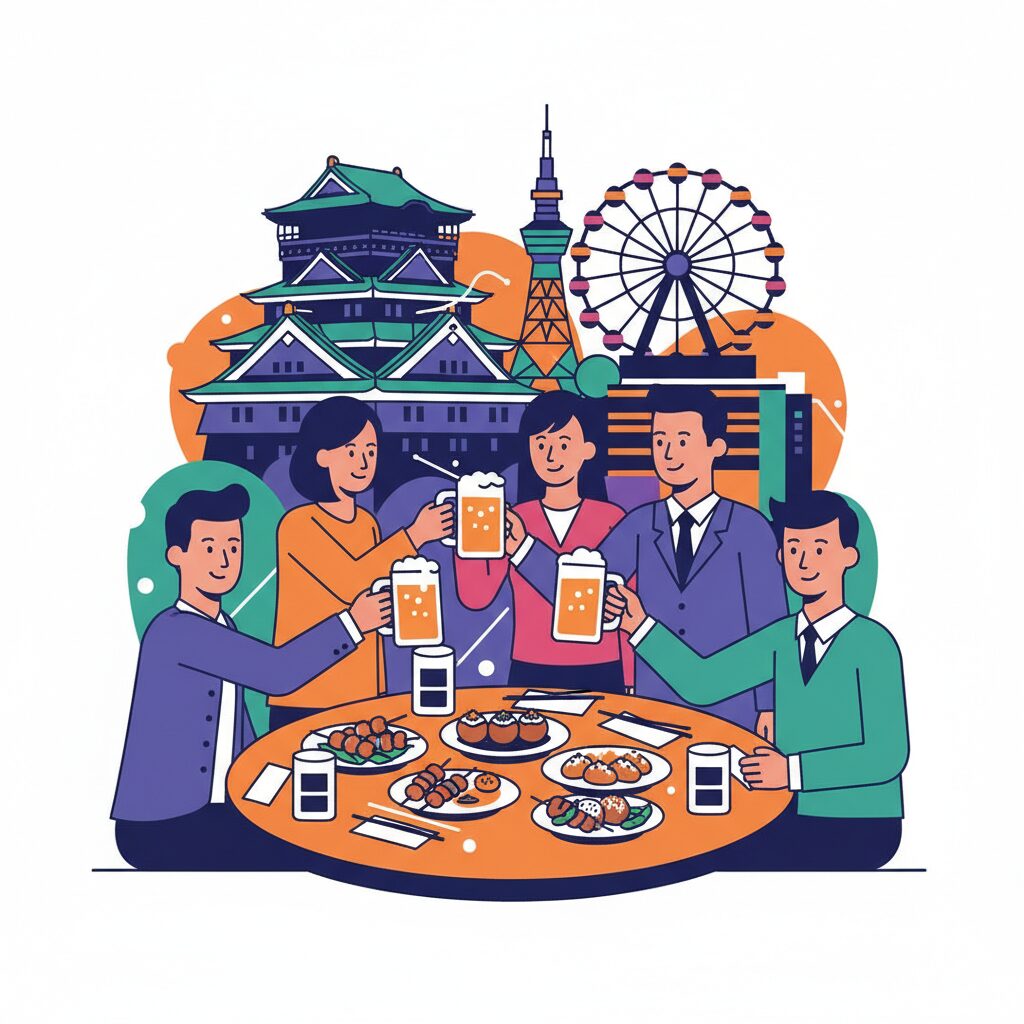
You got the email. Or maybe it was a casual tap on the shoulder from your section chief, his eyes twinkling with an expectation you can’t quite decipher. “We’re going for drinks tonight. You’re coming, right?” This isn’t phrased as a question. It’s a statement of impending social gravity. Welcome to the Japanese work-life ritual known as the ‘nomikai,’ or drinking party. For any foreigner navigating the corporate landscape here, this invitation is a milestone, a cultural crossroads paved with equal parts opportunity and anxiety. You wonder if it’s truly optional, what you’re supposed to talk about, and whether you’ll commit some catastrophic etiquette blunder after one too many highballs. But here in Osaka, the nomikai takes on a rhythm all its own. It’s louder, looser, and arguably more vital to the fabric of office life than anywhere else in Japan. This isn’t just about after-work drinks; it’s the city’s primary tool for melting the rigid hierarchies of the office into a bubbling pot of communal camaraderie. It’s where your impossibly stoic boss reveals his obsession with vintage denim, and the quiet accountant from the third floor unleashes a killer karaoke rendition of a classic rock ballad. To understand the Osaka nomikai is to understand the city’s very soul—its love for honest communication, its disdain for pretense, and its unwavering belief that the strongest bonds are forged over shared laughter and grilled skewers. Forget what you think you know about stiff, formal Japanese business culture. We’re about to dive into the controlled chaos that truly powers this city’s engine.
As the nomikai unites colleagues in a celebration of Osaka’s unique work culture, it’s interesting to consider how rising oil prices affect Kansai travel and hint at broader regional shifts.
The Unspoken Rules of the Osaka Office Party
At first glance, a nomikai appears to be a simple gathering: food, drinks, colleagues. Yet beneath the surface, it operates according to a complex system of social codes and rituals. This isn’t just an informal happy hour; it’s a carefully structured event aimed at achieving a specific goal: group harmony. Grasping this framework is essential not only to survive but to thrive in the Osaka workplace.
More Than Just a Drink: The True Purpose of Nomikai
The entire occasion is an exercise in navigating ‘honne’ and ‘tatemae’—a fundamental concept in Japanese society. ‘Tatemae’ is the public facade, the polite and professional mask worn during office hours, serving as the engine for efficiency and respectful interaction. ‘Honne’ represents one’s true feelings, the candid thoughts and opinions kept hidden. A nomikai is the designated space where the ‘tatemae’ mask is permitted to fall away. Alcohol serves less as a social lubricant and more as a ceremonial key, opening the door to more genuine communication. In this setting, the hierarchical barriers, so rigid during the nine-to-five, are intentionally broken down. The aim is to see your ‘bucho’ (department head) not only as a figure of authority but as someone who struggles with his golf swing or worries about his children’s exams. This shared vulnerability forms the foundation of trust. It’s a collective exhale after a day of holding your breath and is considered absolutely vital for a team to function cohesively.
Navigating the Rituals: From Kanpai to Shime
Every nomikai follows a predictable, almost theatrical progression. It has a beginning, a middle, and a definitive end, each with its own set of expectations. Mastering this rhythm allows you to blend in smoothly.
The Opening Ceremony: Kanpai!
The event doesn’t start until everyone has a drink in hand, and no one takes a sip before the official signal. Typically, a senior member, such as a manager or director, delivers a brief speech thanking everyone for their efforts, followed by a loud, unified shout of “Kanpai!” (Cheers!). The clinking of glasses marks the initial cracks in the ‘tatemae’ barrier. A key early ritual is ‘oshaku,’ or pouring drinks for others. Junior employees are often seen diligently keeping their superiors’ glasses full. While this may seem deferential, it also offers a valuable chance to engage in one-on-one conversation. In Osaka, this ritual tends to be somewhat more relaxed than in Tokyo; your boss might even pour a drink for you, a gesture of goodwill. The important thing is to be attentive. Offering to pour when glasses are empty shows respect and awareness, which will be appreciated.
The Flow of Conversation: Beyond Work Talk
Although the first ten minutes might include a light review of the workday, there’s an unspoken rule against serious work discussions. The nomikai is a safe space free from job stress. Conversations are expected to shift toward neutral, personal topics. This is your opportunity to deploy your secret weapon: questions. Ask about their hometown, favorite Hanshin Tigers player, best takoyaki spot, or weekend plans. Osakans especially enjoy talking about themselves and their city. Demonstrating genuine curiosity matters more than having a witty story ready. This approach helps you uncover hidden layers of your colleagues. The quiet woman from sales might be an avid street photographer. The gruff IT guy could be a passionate home cook. These discoveries reframe your daily interactions, adding depth to the professional facades you encounter every day.
The Closing Act: Ippon-jime and the Nijikai
As the allotted time at the first venue draws to a close, a senior member calls for the ‘shime,’ or closing ritual. This often involves a ceremonial clap, such as the ‘ippon-jime’ (a rhythmic three-three-three-one clap pattern), symbolizing unity and a successful conclusion. But the night rarely ends here. This is just Act One’s finale. The call will go out: “Nijikai, iku hito?” (Who’s headed to the second party?). The ‘nijikai’ is where the real magic often unfolds. The group splits, with a smaller, more dedicated crowd moving to another location—often a karaoke box, cozy snack bar, or standing bar. Participation is optional, but if you’re having a good time, joining is highly encouraged. It signals that you’re truly part of the inner circle. The atmosphere grows even more relaxed, and conversations turn more personal. Frequently, this is followed by a ‘sanjikai’ (third party), which might simply be a final bowl of ramen before catching the last train—a ritual that seals the night’s shared experiences with a comforting meal.
Osaka vs. Tokyo: The Nomikai Divide
While nomikai is a tradition observed nationwide, its practice differs significantly from region to region. The contrast is most pronounced between Osaka and Tokyo, highlighting the fundamental differences in their urban characters. A foreigner who has only attended a Tokyo nomikai might be taken aback by the high energy and loud boisterousness of an Osaka nomikai.
The Vibe: Calculated Networking vs. Genuine Merriment
A Tokyo nomikai often feels like a strategic extension of the workday, with a typically more subdued and polished atmosphere. Conversations tend to resemble careful networking, underscored by professional positioning. Attendees are keenly aware of their audience and how their words might be interpreted back at the office. It’s about reinforcing professional relationships within a controlled setting. In contrast, an Osaka nomikai puts genuine, uninhibited fun first. The main aim is to laugh loudly and frequently. Building relationships happens naturally as a result of enjoying good times together, rather than as an explicit objective. It’s less about company rank and more about the ability to share humor and savor the moment. The mood resembles a lively family gathering rather than a corporate mixer.
The Conversation: Understated Banter vs. Roaring Laughter
Tokyo’s social rhythm revolves around ‘kuuki wo yomu,’ or “reading the air,” where communication is often indirect, polite, and carefully moderated. In Osaka, they do more than just read the air—they change the weather. Communication is remarkably direct, honest, and steeped in humor. The city’s comedic tradition, rooted in manzai (stand-up comedy), influences every exchange. People engage in fast-paced ‘boke’ (funny man) and ‘tsukkomi’ (straight man) repartee. Teasing—even superiors—is a common form of affection and camaraderie, as long as it’s delivered with skill and warmth. Foreigners are often surprised at how readily people poke fun at themselves and each other. This isn’t rudeness; it’s the local love language. Simply joining in with a well-timed laugh makes you part of the performance.
The Venue: Stylish Ginza Bars vs. Gritty Umeda Izakayas
The choice of venue reveals a lot. In Tokyo, a company nomikai might be held in a chic private room in Shinjuku or a refined restaurant in Ginza, where the environment is controlled and conversations remain discreet. In Osaka, the venue is integral to the experience. You’re more likely to find yourself in a crowded, noisy, smoke-filled ‘izakaya’ (Japanese pub) beneath the train tracks in Umeda, a ‘tachinomi’ (standing bar) in Kyobashi packed elbow-to-elbow with strangers, or a deep-fried skewer spot in the lively, chaotic streets of Shinsekai. The preference is for places brimming with energy and ‘aji’ (character). The loud, communal, and slightly rough atmosphere encourages everyone to drop their pretenses. It’s hard to keep a corporate demeanor when shouting your order over the noise and sharing a plate of ‘doteyaki’ (beef sinew stew).
What Foreigners Often Get Wrong
For newcomers, the nomikai can be a minefield of potential misunderstandings. Approaching it with a Western mindset may lead to confusion and misinterpretation of intentions. Dispelling these common myths is essential for a positive experience.
Misunderstanding “Mandatory” Fun
The most frequent concern is whether attendance is genuinely optional. The short answer is yes, but the longer explanation is more nuanced. No one will fire you for not attending. However, consistently refusing invitations can be subtly seen as a lack of interest in being part of the team. In Osaka, this feeling is even stronger, as the invitation often reflects a sincere desire to include you. The key is to recognize that your presence matters more than what you consume. You are not required to drink alcohol. Ordering oolong tea or soft drinks all night is perfectly acceptable and increasingly common among Japanese people as well. The aim is to join in the social bonding. Show up, smile, chat, and be part of the group photo. Attending even for just the first hour and then politely excusing yourself is much better than not going at all.
The “Anything Goes” Myth
The casual, lively atmosphere can sometimes be mistaken for a complete free-for-all, where all rules are suspended. This is a risky assumption. While the ‘tatemae’ is relaxed, maintaining professional respect remains essential. The classic rule is “what happens at the nomikai, stays at the nomikai,” but this mostly applies to goofy karaoke acts or slightly tipsy personal confessions. It does not excuse genuinely offensive behavior. Bitterly complaining about the company, harshly criticizing a colleague, or engaging in inappropriate harassment are unforgivable breaches of trust. The goal is to be a more open version of your professional self, not to become disrespectful. The informality tests character, rather than removes it.
The Language Barrier Anxiety
For those still learning Japanese, the thought of fast-paced, Kansai-dialect conversations can be intimidating. You may worry about getting lost, struggling to contribute, or facing awkward silence. This fear is understandable but often exaggerated, especially in Osaka. Osakans are known for being outgoing and patient communicators. They frequently make an effort to include you by speaking more slowly, using simpler words, or relying on expressive gestures. They value effort above all else. Simply listening attentively, smiling, and nodding shows you are engaged. Learning a few simple phrases like “Sou desu ne!” (That’s right!) or “Omoshiroi!” (That’s interesting!) can make a big difference. View the nomikai not as a language test, but as the best language lab you could hope for—a low-pressure environment where mistakes are forgiven and every attempt to connect is appreciated.
A Night Out with Osaka Salarymen: A Practical Walkthrough
To clarify the experience, let’s take a typical nomikai evening step-by-step, from the initial invitation to the final, unsteady journey home. This is the detailed account of how social capital is nurtured during an Osaka night out.
The Invitation and Preparation
It starts around 4 PM. Your boss quickly surveys the room, and a plan takes shape surprisingly fast. Tonight’s destination is a ‘tachinomi’ in Temma. The ‘kaisahi’ (fee) will be roughly 4,000 yen per person, collected in advance by a junior staff member to simplify payment. You contribute your share, grab your bag, and head out with the group, leaving the workday behind with every step away from the office.
The First Stop: A Bustling Izakaya
The first spot is noisy and filled with the scent of grilled meat and lingering cigarette smoke—a familiar and comforting smell for many. You squeeze into a cramped booth. The first round of drinks arrives quickly: mostly draft beer (‘toriaezu biru’—’beer for now’). The ‘kanpai’ shout signals the official start of the evening. Platters of food appear without anyone ordering them; the organizer has selected a course menu. There’s ‘edamame,’ plates of ‘karaage’ (fried chicken), and Osaka specialties like ‘kushikatsu‘ (deep-fried skewers). Conversation flows easily, sparked by the food and drinks, shifting from work chatter to weekend plans and even a lively debate about the best instant ramen brand.
Heading to the Nijikai: Karaoke or Snack Bar
Two hours later, the group spills out onto the street. About half head off to the station, citing early mornings. The remaining core group is rallied by a senior colleague for the ‘nijikai.’ The chosen venue is a karaoke box. Inside the small, soundproof room, a real transformation happens. The division head, a man usually seen only in a stern suit, grabs the microphone and delivers an emotional ‘enka’ (traditional ballad) with surprising talent. Others sing pop songs, anime themes, and Western rock classics. The singing isn’t about skill; it’s about participation and shared, uninhibited enjoyment. You receive the songbook, and the pressure is on. Picking a simple, well-known English song is always a safe and well-liked choice.
Wrapping Up: The Last Train Rush and a Bowl of Ramen
Suddenly, someone checks their phone. It’s 11:35 PM. The last train leaves at 12:05. A frantic energy takes over. Bills are settled quickly, and the group power-walks to the station—a scene familiar in every Japanese city. You just make it on time. But for a small, dedicated trio, the night isn’t over. They detour to a tiny ramen shop, its windows fogged with steam. Slurping a rich bowl of ‘tonkotsu’ ramen serves as the ‘shime’—the closing ritual for the evening. It’s a quiet, savory moment that gently ends the wild night. The next morning at the office, you exchange tired but knowing looks with your fellow survivors. The atmosphere feels different. You now share a dozen inside jokes. Your boss gives a subtle nod and smile. You’re no longer just the foreign colleague; you’re part of the team. You’ve completed the ritual.
More Than a Party, It’s the Pulse of the Osaka Workplace
Ultimately, the Osaka nomikai is much more than just a casual drinking gathering. It stands as a deeply rooted cultural tradition that embodies the city’s fundamental values. It rejects the cold formality often seen in corporate settings elsewhere in Japan, favoring instead a more personal, straightforward, and communal approach. It’s a space where professional facades are left behind, fostering candid conversations and authentic connections that no corporate team-building event could ever achieve. The laughter, shared dishes, and off-key karaoke are the elements that transform a group of individuals into a strong, unified team. So when you receive that invitation, don’t approach it with reluctance. Recognize it for what it truly is: a backstage pass—a sincere chance to leave the audience and join the lively, chaotic, and beautifully human drama of daily life in Osaka.