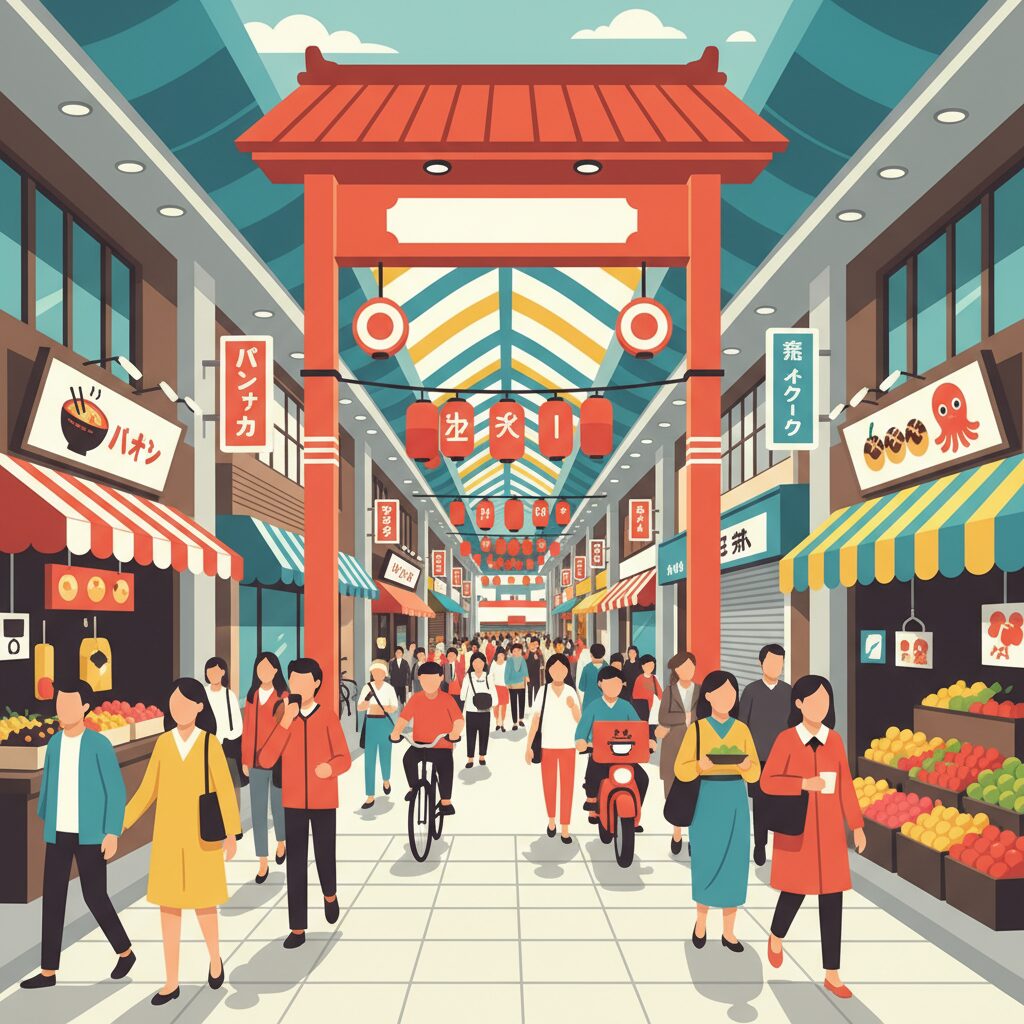
When you picture life in Japan, you might conjure up images of silent, orderly train cars or the polished, anonymous efficiency of a Tokyo high-rise. And in many parts of the country, you’d be right. But then there’s Osaka. Here, life pulses on a different frequency, and nowhere is that rhythm more audible, more tangible, than in the city’s countless shotengai—the covered shopping arcades that act as the arteries of local neighborhoods. They are a sensory explosion: the sizzle of takoyaki, the rhythmic thump of a butcher’s cleaver, the cheerful, almost sing-song calls of vendors hawking their wares. On the surface, living near a shotengai seems like the ultimate urban dream. Everything you could possibly need, from fresh tofu to a new pair of socks, is just a few steps from your door. It’s a life of unparalleled convenience, a throwback to a time when communities were truly local. But this convenience is built on a foundation of human connection that is both the system’s greatest strength and its most challenging aspect for outsiders, especially those of us from cultures where privacy is paramount. The shotengai isn’t just a place to shop; it’s a stage, and when you live there, you’re part of the daily performance. Your life, in small, incremental ways, becomes public knowledge. The question for any foreigner thinking of making their home here isn’t just about location, but about a fundamental choice: Are you willing to trade the cool anonymity of the modern metropolis for the warm, sometimes suffocating, embrace of a village tucked inside a city?
The bustling energy of these local corridors often reveals a distinctive shotengai pulse that encapsulates Osaka’s vibrant fusion of tradition and modernity.
The Allure of the Arcade: Life Within Arm’s Reach
The irresistible charm of shotengai living embraces you the moment you step beneath the arcade’s shelter. Instantly, the atmosphere shifts. Weather no longer matters. Rain or shine, the arcade thrives as its own vibrant ecosystem, humming with a steady, gentle energy. It feels worlds apart from the sterile aisles of a chain supermarket. Here, commerce is personal, intimate, and remarkably efficient. You don’t do one large, weekly shop; instead, you engage in a daily ritual, moving seamlessly from one specialty store to the next, curating your dinner as you go.
Your Daily Routine, Simplified
Picture this: It’s five in the evening, and you’ve decided to make sukiyaki. You leave your apartment carrying only a small tote bag and your wallet. First, you stop by the niku-ya, the butcher. The owner, a cheerful man with flour-dusted hands, notices you approaching. He doesn’t just ask what you want; he inquires about what you’re cooking. “Sukiyaki?” he guesses, eyes sparkling. “Then you need the good stuff.” He slices the beef fresh, arranging it on a tray with the precision of a jeweler. He may even include a few extra bits of fat “for flavor.” Next, you drift over to the yao-ya, the greengrocer. The vegetables are heaped high in a vibrant array, fresh from the morning market. You pick up napa cabbage, spring onions, and shiitake mushrooms. The woman weighing your selection mentions the spinach is especially sweet today and suggests grabbing some for a side dish of goma-ae. A few shops down is the tofu store, the tofu-ya, where clouds of steam rise into the street. You buy a block of firm, grilled tofu, still warm, handed to you in a plastic tray filled with water. Everything is specialized, everything is fresh, and every interaction includes a bit of advice, a friendly comment, or a shared laugh. Within fifteen minutes, you’re home, your bag full, having had half a dozen pleasant human encounters. This is more than shopping; it’s a ritual. It represents a fundamentally more sustainable way of living, both environmentally and socially.
The Economic Logic of Local Life
Beyond its charm, the shotengai offers a practical economic benefit. Although it might appear as a collection of small, traditional businesses, it’s a highly competitive environment. The vegetable stands often offer significantly lower prices on seasonal produce than supermarkets. Buying directly from local markets and maintaining low overhead costs allows them to pass the savings on. This encourages a culture of purchasing fresh, seasonal goods, which is not only cheaper but also tastier. You begin to think less in terms of fixed recipes and more like a local chef: what looks good today? This micro-shopping approach also greatly reduces food waste. You buy exactly what you need for the next day or two, avoiding large bags of carrots that will inevitably spoil in the back of your fridge. It’s a system ideally suited to compact city living, a perfect blend of convenience and conscience that big-box stores, with their sprawling parking lots and bulk packaging, simply cannot match.
The Unspoken Contract: When Your Face Becomes Your ID
This elegant and efficient system operates on an invisible currency: recognition. When you visit the same shops day after day, you stop being an anonymous customer. You become a kao-najimi, a familiar face. This status is earned over time and brings with it a variety of unspoken privileges. It’s the unwritten agreement of the shotengai: you give them your loyalty, and in return, they offer you a place within the community.
“Kao-najimi”: More Than Just a Familiar Face
Becoming a kao-najimi is when the true magic begins. It’s in the small gestures. The baker might set aside your favorite melon pan without you asking. The fishmonger calls you over excitedly to show off the freshest cut of fatty tuna, knowing your fondness for sashimi. The woman at the fruit stand offers you a discount on a slightly bruised apple, confiding, “It’s still perfect for a pie.” This goes beyond good customer service; it’s a relationship. They understand your tastes, habits, and rhythm. They remember you were feeling under the weather last week and check if you’re feeling better now. After a long day at work, the owner of the tiny tempura stand might slip an extra shrimp into your order, giving you a knowing nod and a gruff “Ganbatte ne” (Hang in there). This network of weak ties forms a powerful social safety net. It’s a sense of being seen, of belonging in a way that’s increasingly rare in our transient, digital age.
The Neighborhood Watch You Didn’t Sign Up For
Yet, there is another side to this coin. Being seen means exactly that: you are always seen. The warmth of the community can sometimes feel like a spotlight. Your comings and goings do not escape notice. The line between care and curiosity is razor thin, and for someone used to the comforting anonymity of a big city, this can be unsettling. If you come home late after karaoke, Mrs. Tanaka from the dry cleaners will notice. She’ll probably smile and say, “You had a fun night!” the next morning—a remark that’s 90% friendly greeting and 10% gentle surveillance. If you begin dating someone new, the whole arcade will learn within a week. You’ll receive sly grins from the butcher and pointed questions from the lady at the flower shop. This isn’t out of malice. Usually, it’s a sincere, if sometimes awkward, expression of community care. It’s the village mindset, where everyone’s business is, to some extent, everyone else’s. People genuinely look out for one another. If an elderly resident misses buying their daily newspaper, someone checks on them. If a child walks home alone, many eyes ensure their safety. You’re part of this system, whether you wish it or not. The price of safety and belonging is a portion of your privacy.
The Osaka Difference: Why This is a Hyper-Local Phenomenon
This intense, community-oriented lifestyle is not found throughout all of Japan. In fact, it sharply contrasts with the dominant culture in Tokyo. The capital follows a different social code, one that emphasizes privacy, formality, and a clear division between public and private life. Living in a shotengai in Osaka is an experience unique to Osaka, deeply rooted in the city’s history and the distinctive character of its people.
Tokyo’s Anonymity vs. Osaka’s “Akan” Culture
In Tokyo, you might live for years in an apartment building without ever knowing your neighbors’ names. Interactions tend to be polite, reserved, and efficient. The convenience store clerk will carry out their duties with impeccable precision but is unlikely to inquire about your day. For many, this is the charm of Tokyo: you can be anyone, or no one, moving through the city with complete freedom. Osaka, on the other hand, was built on trade. It served as the nation’s kitchen—a city of merchants where your reputation and relationships were your most valuable assets. Business was, and remains, conducted on a personal level. This history has infused a particular attitude into the city’s DNA. Osakans are known for being direct, pragmatic, and less bound by strict formality. This attitude is captured in the local dialect’s frequent use of “akan,” a wonderfully flexible word that can mean “no good,” “don’t,” or, more philosophically, “ah, it can’t be helped, let’s just move on.” The “akan” mindset fosters a more fluid, human, and frankly, messier form of social interaction. A shopkeeper asking why you look tired is not a breach of etiquette; it’s an invitation to converse. Teasing, or ijiri, is a common way of showing affection. This can be quite puzzling for foreigners and even for Japanese visitors from other areas. What might seem like a rude or intrusive remark in Tokyo is often a sign of friendly engagement in Osaka.
The Foreigner’s Role in the Ecosystem
As a foreigner, you enter this ecosystem as a novelty. At first, you’ll be met with curiosity. However, the path to becoming a kao-najimi is open to everyone, regardless of nationality. The key is participation. If you maintain a Tokyo-style wall of polite distance, you’ll remain an outsider. People might misinterpret your reserve as coldness. The biggest misunderstanding lies in intent. The shop owner’s barrage of questions about your job, your home country, and your dinner plans isn’t an interrogation; it’s an invitation. They want to find common ground, to bring you into the community, to make you part of the neighborhood’s story. The secret is to lean in. Answer their questions, then ask some of your own. Compliment their produce. Ask for cooking tips. Once they see you’re willing to engage on their terms, the dynamic changes. You’re no longer just a customer; you become part of the daily banter, a thread in the arcade’s living tapestry.
Navigating the Goldfish Bowl: Practical Tips for Thriving
So, can a privacy-conscious foreigner truly flourish in this environment? Absolutely. However, it demands a deliberate shift in mindset and communication style. You need to learn the local social rules and find ways to navigate them without compromising your identity.
Setting Your Boundaries, Osaka-Style
Living in the shotengai doesn’t mean you must share everything with everyone. Privacy is still attainable, but it requires protecting it through local customs: humor and gentle evasion. When faced with a question that feels overly personal, a blunt refusal can seem rude. A much smoother tactic is a playful sidestep. If the laundry lady asks why you’re dressed up, instead of saying “It’s private,” you might chuckle and reply, “It’s a secret mission!” or “I’m off to meet the Prime Minister!” This acknowledges the question and the person’s curiosity in a friendly manner while revealing nothing. It turns the exchange into a lighthearted joke—a style Osakans appreciate. Mastering this art of witty non-responses is key to managing your social interactions gracefully.
Choosing Your Shotengai Wisely
It’s also crucial to recognize that not all shotengai are the same. They range widely in intensity. On one extreme, you have large, sprawling arcades like Tenjinbashisuji, so long and bustling that it provides a measure of anonymity. You can have your favorite shops where you’re known, yet still vanish into the crowd easily. On the other end are small, one-block shotengai tucked in quiet residential areas. These are the places where everyone truly knows everyone, and your every action becomes neighborhood news. Before renting an apartment, spend ample time in the neighborhood. Walk the shotengai on a weekday afternoon and a weekend morning to gauge the vibe. Is it a lively commercial center or a quiet, close-knit village? Pick the environment that matches your personality best.
The Ultimate Payoff: A Built-In Support System
Living with less privacy can be difficult. Some days, you might wish you could just buy milk without a ten-minute chat. But the rewards outweigh this inconvenience considerably. It’s a level of community support nearly lost in modern urban life. Belonging to the shotengai means you have a built-in support network. If you fall ill, it won’t take long before someone notices you’re missing and shows up with a bag of oranges at your door. If you leave your wallet at the vegetable stand, they’ll keep it safe for you until you return. This offers a profound sense of security beyond locks and alarms. It’s the comfort of being known and cared for, of knowing that if something goes wrong, you won’t be alone. This, ultimately, is what truly defines the cliché that “Osaka is friendly.” It’s not just about smiles and greetings. It’s about a deep, underlying social contract of mutual support, a willingness to be involved in one another’s lives, in good times and bad. It’s a messy, beautiful, deeply human way of living, and for the right person, there’s no better place to call home.