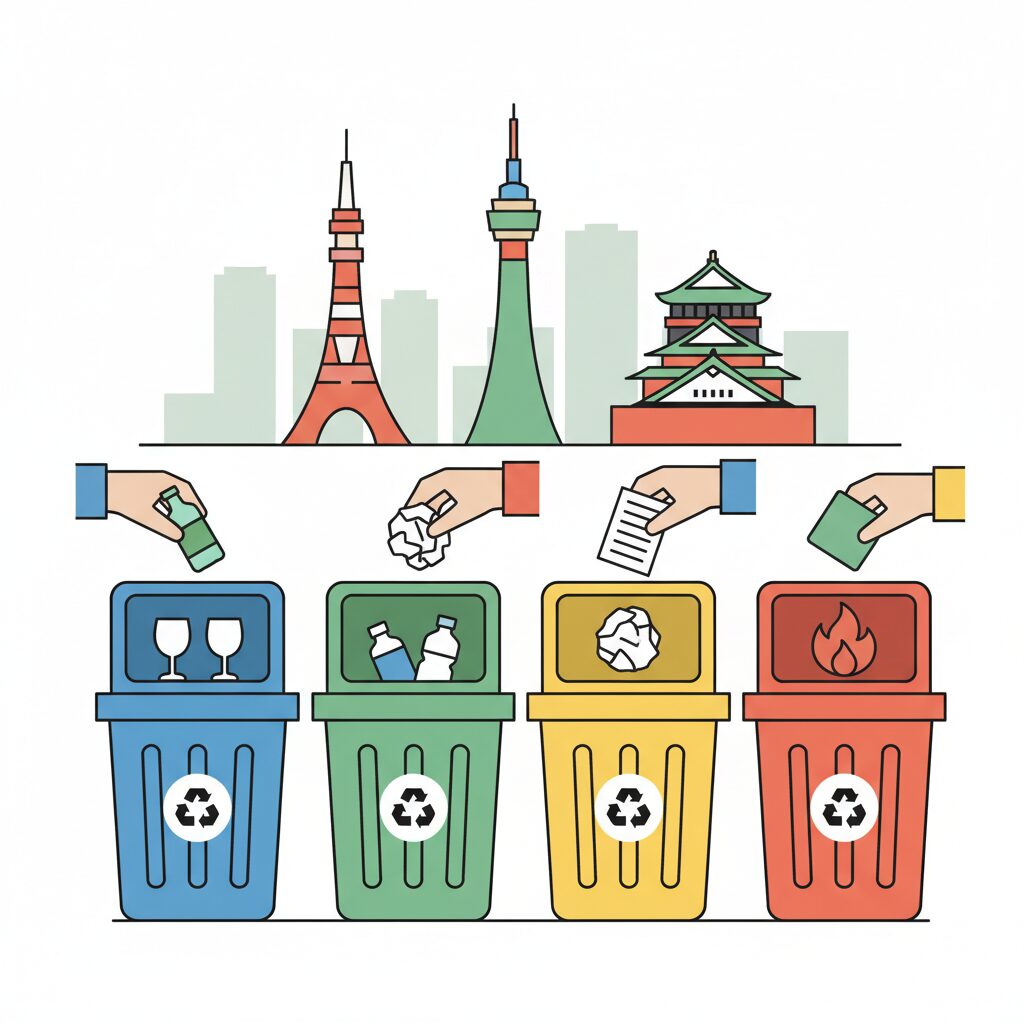
Welcome to Osaka. You’ve found an apartment, navigated the train system, and maybe even mastered the art of ordering from a ticket machine at a ramen shop. You’re feeling pretty good. Then, you encounter it. A multi-colored, densely-packed sheet of paper covered in tiny Japanese text and perplexing diagrams. This is the garbage sorting schedule, your official induction into the unwritten social contract of living in this city. My first encounter with this document sent me into a spiral of domestic anxiety. Could I really be trusted to differentiate between “Containers and Packaging Plastic” and just, well, regular plastic? The fear of public shaming via a bright yellow sticker on a wrongly-sorted bag of trash felt incredibly real. But here’s the secret: mastering this system isn’t just about keeping the streets clean. It’s your first real lesson in understanding how Osaka works. It’s about community, pragmatism, and a surprising level of detail-oriented precision hiding beneath a famously boisterous exterior.
This isn’t just about rules; it’s about the rhythm of the neighborhood. It’s a system managed with civic pride and neighborly oversight, all coordinated from the heart of the city’s administration.
Embracing Osaka’s intricate systems means also appreciating its neighborhood contrasts, so exploring choosing your home reveals even more about the city’s unique balance of modernity and tradition.
Cracking the Code: The Main Categories of Chaos

At first glance, the system appears designed to overwhelm. However, once you break it down, a clear logic starts to emerge. Each ward in Osaka has its own collection days, but the categories are thankfully consistent citywide. Think of it less as a set of rules and more as learning a new language—you just need to master the vocabulary.
Ordinary Garbage (Futsu Gomi – 普通ごみ)
This is your main category, the one you’ll deal with most often. Collected twice a week, it’s for items that cannot be recycled and aren’t hazardous. Kitchen scraps, soiled paper towels, plastic wrap stuck to cheese slices, old rubber boots, a broken ceramic mug—all go here. The key is the bag. Osaka City requires transparent or semi-transparent bags of a specific size. This isn’t about aesthetics; it’s a tool for social accountability. Neighbors, and more importantly, collectors, can get a general idea of what’s inside. It’s a gentle reminder not to sneak in cardboard boxes or collections of PET bottles into the wrong bin. This visible compliance is a major part of Japanese civic life—completely opposite of anonymity. Your trash becomes a small public statement that you’re part of the community.
Containers and Packaging Plastic (Yoki Hoso Purasuchikku – 容器包装プラスチック)
This is where most newcomers get confused. Collected once a week, this category is not for all plastics but specifically for plastic items used to contain or wrap products. The magic symbol is the “プラ” (Pura) mark, usually inside recycling arrows. It includes supermarket plastic food trays, shampoo and detergent bottles, yogurt cups, instant noodle bowls, and plastic film around new electronics. But here’s the catch—and it’s an important one—everything must be clean. Not just rinsed, but truly free of food residue and dry. I’ve spent more time than I’d like scrubbing natto containers and patting tofu trays dry. This rule separates casual participants from seasoned residents. It contrasts sharply with Osaka’s rough-and-tumble reputation: people might jaywalk freely, but they meticulously wash yogurt pots. It’s not about fussiness; it’s about protecting the integrity of the recycling process. Contaminated plastics can spoil entire batches, reflecting Osaka’s practical, no-waste mindset.
Paper and Clothing/Textiles (Koshi/Furugi – 古紙・古着)
Collected weekly, this category feels like a nod to simpler times. It includes newspapers, magazines, cardboard boxes, and other clean paper products. But you can’t just throw them in a bag—they must be sorted by type and neatly bundled with paper string. Flattened cardboard stacked, newspapers piled separately. Bundling is a quiet ritual showing care for the collectors; it’s efficient and orderly. Old clothing and textiles also belong here but must be clean and put in a separate transparent bag. This practice reflects the deeply rooted “mottainai” (もったいない) culture—a sense of regret over waste. Each neatly tied bundle is a small tribute to this principle of valuing resources.
Bulky Garbage (Sodai Gomi – 粗大ごみ)
Disposing of a broken chair or old microwave isn’t as simple as leaving it on the curb. It’s a multi-step process. You first call the Sodai Gomi center or apply online to schedule a pickup, specifying the items. They inform you of the cost, which you pay by buying a special sticker (手数料券 – tesuryoken) at designated convenience stores or post offices. You write your name or reception number on the sticker, attach it to the item, and place it at the designated location on the appointed day. There’s no spontaneity here. This process perfectly illustrates Japanese bureaucracy: rigid, precise, and requiring advance planning. It’s a culture that values procedure over improvisation. For Osakans, known for their “get it done” attitude, this strict system is accepted because it’s fair and effective. Everyone follows the same steps, keeping the city free of abandoned furniture.
The Special Cases: Cans, Bottles, and PET Bottles
Depending on your neighborhood, these may be collected on a specific day or, more commonly, dropped off at a local collection point—often bins or crates near the official garbage station. The process is detailed here as well. PET bottles must have their caps and plastic labels removed (these go into Containers and Packaging Plastic), be rinsed, and ideally crushed. Cans and glass bottles should also be rinsed. This level of sorting can feel excessive, but it’s what drives Japan’s high recycling rates. It becomes a mindful daily habit, a tangible way to contribute to the system.
The Osaka Mindset: Why the Rules Matter (Even When They Seem Arbitrary)
Understanding the “what” of garbage sorting is only half the story. The “why” is what truly reveals the local culture. It’s not merely about environmentalism; it reflects the core principles of living in a densely populated society.
Community Over Convenience
The local garbage station, or gomi-basho, serves as more than just a collection spot. It’s a communal space, with its condition mirroring the neighborhood itself. A clean, orderly station signals strong social cohesion, while a messy one points to a breakdown in that silent understanding. This is where the famed neighborhood watchfulness comes in. The gentle correction from an elderly neighbor who notices you using the wrong bag isn’t intrusive; it’s about upholding community standards. In Tokyo, you might receive a cold glare or an anonymous note. In Osaka, however, you’re more likely to hear a direct, practical, and kindly offered tip: “Ah, that one goes out on Thursday.” This straightforwardness is typical of Osaka. It’s less about strict formalities and more about a shared, pragmatic aim to keep everything running smoothly for all.
Pragmatism in a Crowded City
Osaka is a city of millions, concentrated in a relatively small area. Effective waste management is essential for public health and quality of life. The rules, complex as they may be, represent a logical response to a logistical challenge. Without this system, pests, odors, and street clutter would quickly overwhelm the streets. Osakans are, at heart, pragmatic. They are merchants, artisans, and negotiators, willing to adopt any system that effectively solves a problem, no matter the inconvenience. The meticulous sorting is simply the most efficient way to manage the immense volume of waste the city produces. It’s a solution, not a penalty.
The Grumble and Comply Culture
A distinctive trait of Osaka residents is their tendency to grumble good-naturedly while fully complying. You will often hear people say, “Mendokusai naa” (“What a pain!”) as they rinse out a milk carton. This is not an act of defiance but a form of social release. Unlike the more reserved, composed demeanor often found in Tokyo, Osakans express life’s small frustrations openly. They complain about the hassle, share a laugh with neighbors over the absurdity of washing a potato chip bag, and then follow the rules exactly. This vocal, human approach to civic duty is quintessentially Osaka—it’s compliance with character.
Navigating the System: Practical Tips for Survival
Feeling ready to take on the challenge? Equip yourself with the right tools and knowledge, and you’ll become a sorting samurai in no time.
Your Secret Weapon: The Official App and Calendar
When you move in, you should receive a paper copy of your ward’s garbage collection calendar. Protect this carefully. Even better, download the city’s official app (many wards use an app called さんあーる – San R). By entering your neighborhood, you’ll get notifications the night before each collection day, telling you exactly what to put out. It’s a digital lifeline that removes all the guesswork. You can also use its search feature to look up specific items if you’re unsure where they belong. Technology has made navigating this traditional system surprisingly foolproof.
The Convenience Store Is Your Friend
The local konbini is more than just a spot for late-night snacks. It’s a key part of the civic infrastructure. This is where you can buy stickers for your Bulky Garbage. Many also have small collection boxes near the entrance for used batteries and sometimes small electronics like old mobile phones. They serve as quiet, unassuming hubs in the city’s extensive recycling network.
When in Doubt, Ask!
Humility is your best asset. If you’re genuinely confused, don’t just guess and hope for the best. Ask your building manager (kanrinin), a friendly neighbor, or visit the local ward office. Approaching someone with a phrase like, “Sumimasen, gomi no koto de, chotto wakaranakute…” (“Excuse me, about the garbage, I’m a bit confused…”) will almost always be met with kindness. People appreciate the effort—it shows you respect the system they work hard to maintain. They’d much rather spend thirty seconds explaining something than see the neighborhood gomi-basho spoiled by a sorting mistake.
Decoding the Labels
Start paying attention to packaging when you shop. You’ll begin to see the world through recycling marks. The key ones to remember are the symbols for Plastic (プラ), Paper (紙), Steel (スチール), and Aluminum (アルミ). Recognizing these at a glance will make sorting second nature, turning a confusing task into a quick, automatic routine.
What Foreigners Often Get Wrong
There are a few common pitfalls that can trip up even the most well-meaning resident. Avoiding them is essential for a peaceful, sticker-of-shame-free experience.
“It’s Just a Suggestion, Right?” – Wrong.
If you come from a culture with more relaxed garbage rules, it’s easy to think the detailed chart is a guideline rather than a strict mandate. This is a crucial misconception. The rules are compulsory. If you put out the wrong type of garbage on the wrong day or in an incorrect bag, it will be refused. Marked with a yellow sticker explaining your mistake, your bag will remain as a reminder of the error until the next proper collection day. It’s an embarrassing situation. Repeated violations can trigger complaints and become a serious issue with your landlord or building association. This system relies on full compliance.
“Why Can’t I Put This Pizza Box in Paper Recycling?”
Contamination rules are absolute. A cardboard pizza box stained with grease and cheese is no longer recyclable paper; it counts as Ordinary Garbage. The same applies to plastic bento boxes that aren’t perfectly clean. Any item contaminated with food waste is automatically excluded from recycling. This strict adherence to cleanliness is a fundamental principle of the Japanese system and a common stumbling block for foreigners used to more lenient single-stream recycling systems. When it comes to recycling, cleanliness isn’t just recommended; it’s mandatory.
“The Bags Don’t Matter as Long as It’s Transparent.”
Although the rule for Ordinary Garbage generally requires “transparent or semi-transparent” bags, the visual clarity of the bags matters greatly. Using a fully opaque bag is absolutely prohibited. For items like clothing or certain plastics, a clear bag allows collectors to quickly identify the contents, speeding up their work. The system is designed for immediate visual understanding. Your choice of bag serves as the first and most crucial indicator of what’s inside.
The Bigger Picture: Your Garbage, Your Community
It’s easy to view the garbage rules as just another annoyance, a frustrating piece of life admin in a new country. But after some time, your perspective begins to shift. You start to appreciate the satisfying tidiness of the collection point on your morning walk. You experience a small sense of achievement when you neatly bundle your cardboard. You might even find yourself instinctively rinsing a plastic tray without giving it a second thought.
Mastering Osaka’s garbage system is a rite of passage. It’s a quiet, daily ritual that connects you to your neighbors and the rhythm of your ward. It’s a tangible way of taking part in the social contract that keeps this vast, vibrant, and wonderfully complex city running smoothly. It’s a system founded on shared responsibility, practical thinking, and a profound respect for communal space. And when you finally stop needing to check the chart on your fridge, you’ll know you’re not just living in Osaka—you’re truly a part of it.