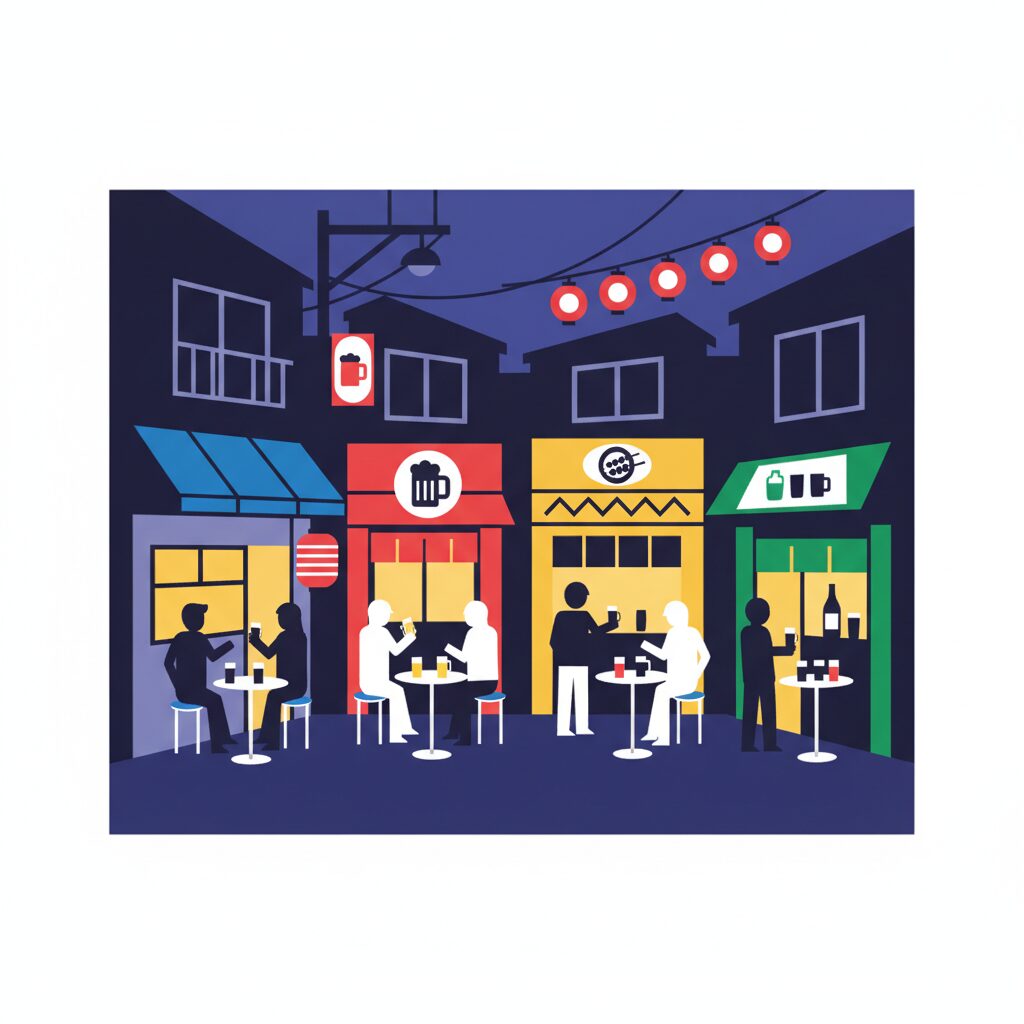
You’ve seen them. Tucked under railway arches in Kyobashi, spilling onto the covered arcades of Tenma, or squeezed between gleaming storefronts in Umeda. They are the tachinomi, the standing bars of Osaka. Through the steam-fogged windows, you see a flurry of motion: salarymen loosening their ties, old-timers nursing sake, young couples sharing plates of fried delights. There’s a raw, kinetic energy that’s both alluring and intimidating. It’s a world that operates on a different frequency, a social ecosystem with its own unwritten constitution. For many foreign residents, the question isn’t just what they are drinking, but how they are doing it with such effortless grace in such a confined space. It feels like a private club, and you’re not sure you have the password.
This isn’t just about grabbing a cheap drink. The tachinomi is a microcosm of Osaka itself. It’s fast, efficient, unpretentious, and built on a foundation of mutual, unspoken understanding. It’s where the city’s commercial soul—the pragmatic, value-conscious spirit of the merchant—comes to unwind. Unlike a seated izakaya where you can claim a table and retreat into your own world for hours, the tachinomi forces a kind of fleeting, anonymous intimacy. You are literally rubbing shoulders with the city. Mastering the subtle etiquette of this institution is more than a party trick; it’s a profound step toward understanding the rhythm of daily life here. It’s where you stop being a visitor looking in and start becoming a participant, a small, temporary part of the living, breathing organism of an Osaka evening. Forget the tourist guides; this is your practical induction into the city’s authentic social bloodstream.
Discover how Osaka’s early-day cafe culture complements the city’s lively tachinomi scene by exploring Osaka’s morning kissaten culture.
The Unspoken Rules of the Standing Bar
The magic of the tachinomi lies in its smooth flow, a choreography honed through decades of daily practice. This dance follows a set of unspoken rules, as strict as any law, though never posted on the wall. For newcomers, the entry barrier may seem high, but once you grasp the core principles—efficiency, spatial awareness, and mutual respect—the whole experience becomes accessible. It’s not about memorizing a long list of prohibitions; it’s about tuning into the room’s rhythm and the shared aim of enjoying a good, quick, and affordable time without inconvenience to others. These are the fundamental steps of the dance.
Finding Your Spot: The Art of Entering
Your first challenge occurs before ordering a drink. You can’t just walk into a crowded tachinomi and expect a space to appear. Entering is a delicate social maneuver that reveals your awareness. Scan the counter for a gap—not a large opening, but a narrow space between two patrons. Consider it a seam in the crowd’s fabric. Approach carefully, with respectful body language. Don’t push or shove. Make eye contact with the person you’ll stand beside, offer a slight nod and a quiet “Sumimasen” (Excuse me). This isn’t an apology but a signal that you recognize the shared space and intend to respect their territory.
In many Western bars, securing a spot at the counter may be a show of assertiveness. Here, it’s a communal negotiation. Watch a regular handle it: they slip into place with minimal disruption, like a missing puzzle piece clicking into its proper spot. They don’t clear a path with a swinging backpack. They momentarily shrink to blend into the whole. This single act illustrates a key part of Japanese urban life, intensified by Osaka‘s density: everyone helps maintain the harmony of the shared environment.
The First Order: Quick and Decisive
Tachinomi operate at high volume and speed. The staff behind the counter, often the owner or a seasoned veteran, performs a constant dance of pouring drinks, plating food, and handling payments. They have no time for hesitation. Once you’ve found your spot and made eye contact with the staff, be ready. Any pause disrupts the flow.
Here, a magical phrase is essential: “Toriaezu biru.” It means “Beer for now” or “I’ll start with a beer.” This is the universal opening line. It’s efficient, gets a drink in your hand, and buys you time to study the menu—often handwritten strips of paper pasted on the wall. As you sip your beer, you can calmly decide if you want doteyaki (slow-cooked beef tendon) or sashimi.
Payment methods vary but two are common. The first is kyasshu on deribarī (cash on delivery), often shortened to kyasshu on. A small tray or bowl is placed before you. When your drink arrives, place exact change or a larger bill there. The staff takes it and returns your change on the same tray. Never hand money directly; the tray serves as the intermediary. The second system is a running tab, settled when you leave. In either case, have cash ready. While some modern tachinomi accept electronic payments, cash remains king in these traditional spots. It’s faster, simpler, and keeps commerce flowing smoothly—a key priority in Osaka.
Space is Sacred: The One-Person Zone
In a standing bar, your personal space is minimal and must be zealously guarded—by you, against yourself. Your territory roughly includes the width of your shoulders and the small counter patch before you. This is no place to spread out. Your phone, wallet, and keys should stay close and not scattered across the bar. If there’s a hook beneath the counter, hang your coat there, or keep it on. Your bag goes on the floor, tucked safely between your feet or on a low shelf if available.
This principle of spatial minimalism is vital. Every inch of the counter is prime real estate. Taking more than your share is not only rude but disrupts the business model, which depends on serving as many customers as possible. This reflects a wider social contract in a densely populated country. It’s the same logic guiding how people line up for trains or walk crowded sidewalks. Your personal comfort doesn’t trump the smooth operation of the group. In Osaka, a city built on commerce, this rule is paramount. Wasting space is akin to wasting money, and that’s a cardinal sin.
Socializing, Osaka Style: Read the Room
The cliché that “Osaka people are friendly” often gets misunderstood by foreigners. It doesn’t mean everyone in the bar is eager to become your best friend or practice English. The friendliness in an Osaka tachinomi is more ambient—a shared warmth signaling you’re part of a temporary community. Direct conversation with strangers happens but naturally, not forced.
Don’t be the person who loudly tries to engage everyone nearby. Instead, sense the social currents. Conversations often arise from a shared stimulus: a dramatic moment in the baseball game on the corner TV, a delicious-looking dish arriving for your neighbor, or a comment on the weather. A simple “Oishisou desu ne” (That looks delicious) to the person next to you can be a great icebreaker. If they respond warmly, continue. If they offer a polite nod and return to their drink, take that as your cue to do the same. Respect their wish for a quiet moment to unwind after a long day.
In Tokyo, a tachinomi can feel more solitary, a place for almost monastic reflection. In Osaka, connection potential quietly simmers beneath the surface. The people aren’t unfriendly; they simply honor each other’s unspoken boundaries. Friendliness arises when those boundaries are mutually and consensually relaxed—not when they’re crossed.
The Philosophy of Tachinomi: Why Stand?
Why would anyone choose to stand in a crowded bar after a long day at work when a comfortable seat is available? The reason goes far beyond simple economics. Standing is not a compromise; it is the whole point. The tachinomi philosophy perfectly captures the Osakan mindset, blending pragmatism, egalitarianism, and a distinctive way of social interaction. To grasp why people stand is to understand the city’s core values.
Speed, Efficiency, and the ‘Senbero’ Dream
The main purpose of a tachinomi is to enable a quick, efficient shift from work to leisure. Standing naturally discourages lingering. It keeps you literally on your toes. You’re there with a goal: to have a drink or two, some small bites, and then move on. The average visit lasts well under an hour. This transient nature is reflected in its physical design. It serves as a pit stop for the soul, not a final destination.
This efficiency is connected to one of Osaka’s most beloved concepts: senbero, the art of getting tipsy for just 1,000 yen. A senbero set might include two drinks and a small dish for this price. It’s the ultimate expression of value for money, a principle deeply rooted in Osaka’s history as Japan’s merchant capital. You get maximum satisfaction with minimal time and cost. It’s a beautifully pragmatic way to achieve daily catharsis. Standing supports this by ensuring fast customer turnover, allowing bars to keep prices incredibly low. It’s a symbiotic relationship between consumer and establishment, a perfectly balanced economic formula.
A Level Playing Field
Perhaps the most striking feature of the tachinomi is its role as a social equalizer. When everyone stands at the same simple wooden counter, hierarchies vanish. The CEO of a major firm might stand next to a construction worker, who stands beside a young university student. There are no VIP sections, no private booths, no status-reinforcing comfortable chairs. The bar itself acts as the great equalizer.
This reflects a fundamental trait of Osaka’s character. While Japan is known for its hierarchical society, Osaka has always been a place where money and business savvy often mattered more than birthright or title. It was a city built by merchants, not samurai. At the tachinomi counter, your value is not measured by your business card but by your ability to share a small space respectfully, order efficiently, and enjoy a good, affordable drink. It’s a democratic space where the shared human desire to unwind outweighs social rank. In this small standing world, everyone is simply another customer, and that shared identity forms a powerful, if fleeting, bond.
Common Mistakes and How to Avoid Them
Observing the unspoken rules will help you feel like a local. On the other hand, breaking them, even unintentionally, can disrupt the delicate balance of this finely tuned environment. These are not serious offenses that will get you kicked out but rather subtle missteps that reveal you as an outsider who hasn’t yet learned to read the room. Avoiding them is the final polish on your tachinomi education.
Don’t Linger: The Graceful Exit
Just as there is an art to arriving, there is an art to leaving. The biggest mistake a newcomer can make is overstaying their welcome. A tachinomi is not your living room. Once you’ve finished your last drink and your plate is empty, it’s time to go. Nursing a single glass of water for half an hour while scrolling through your phone is a serious breach of etiquette. You’re occupying valuable space that another paying customer could be using.
This idea can be hard for those from cultures with a more leisurely pub or café tradition to understand. It can feel transactional, even rushed. But it’s not rude; it’s the system working as intended. The bar offers low prices, and in return, you, the customer, provide quick turnover. The exit should be as swift and smooth as the entrance. Catch the staff’s eye, say “Okanjo onegaishimasu” (The bill, please) or simply “Okaikei” (check). Once you’ve paid, gather your belongings, nod to your neighbors, and offer a clear “Gochisousama deshita” (Thank you for the meal/drinks) to the staff as you leave. The entire process, from deciding to go until departure, should take no more than a minute.
Mind Your Volume
Osaka is known for being louder and more boisterous than other parts of Japan, and in many situations, that’s true. However, a tachinomi is a confined space where sound carries. The ambient noise of a busy bar is a collective hum, a tapestry of dozens of quiet conversations, the clinking of glasses, and the sizzle of the grill. It’s not a contest to see who can be the loudest.
Foreign visitors, especially in groups, often don’t realize how much their voices stand out. A conversation normal in a spacious American or European bar can sound like shouting in a small Japanese tachinomi. The key is to modulate. Pay attention to the ambient noise and try to blend in. Speak to the person next to you, not the one three spots down the counter. This isn’t about silence but about consideration. It’s about adding your thread to the tapestry of sound, not tearing a hole in it.
Ordering Etiquette Revisited
When placing a second order or asking for the bill, patience is key, even in this fast-paced environment. Waving your hand frantically or repeatedly calling out “Sumimasen!” is rude and disruptive. It suggests your needs are more important than others’ and implies the staff is incompetent.
The staff at a tachinomi are masters of situational awareness. They constantly scan the entire counter, mentally tracking who needs what. They see you. The proper way to get their attention is through eye contact. If they’re busy, wait for a moment when they look your way. A slight raise of the hand or a small nod is enough. It’s a quiet, respectful signal. Trust the system. Trust the staff’s professionalism. They will come to you, and the entire bar will continue to run smoothly thanks to this shared, unspoken trust.
Tachinomi as a Microcosm of Osaka
Stepping out of a tachinomi and back into the neon-lit streets of Osaka, you realize you haven’t merely had a drink. You’ve engaged in a cultural ritual. The standing bar isn’t an anomaly; it is the perfect reflection of the city that created it. Every rule, every gesture, every transaction inside its walls embodies a core aspect of Osaka’s identity.
The unwavering emphasis on value, embodied in the senbero ideal, is the legacy of a city of merchants who have always taken pride in their financial savvy and their rejection of pretension. The remarkable efficiency of the space—the rapid turnover, the minimalist personal zones, the decisive ordering—is the result of pragmatic people living in a dense, competitive urban setting. There is no time or space to waste.
The distinctive social dynamic—the mix of a communal atmosphere with respectful distance, the possibility of spontaneous connection balanced by an unspoken right to privacy—reflects the Osakan character. It’s a friendliness that is practical rather than effusive. It’s a community built on the shared understanding that everyone is simply trying to get through the day and find a small moment of affordable pleasure.
For the foreign resident, the tachinomi is more than just a place to grab a cheap beer. It’s a classroom. It teaches you how to navigate public spaces, how to communicate non-verbally, and how to appreciate the beauty of efficiency. It’s where you learn that in Osaka, community isn’t about grand gestures, but the small, quiet accommodations people make for one another, side-by-side, at a simple wooden counter.