
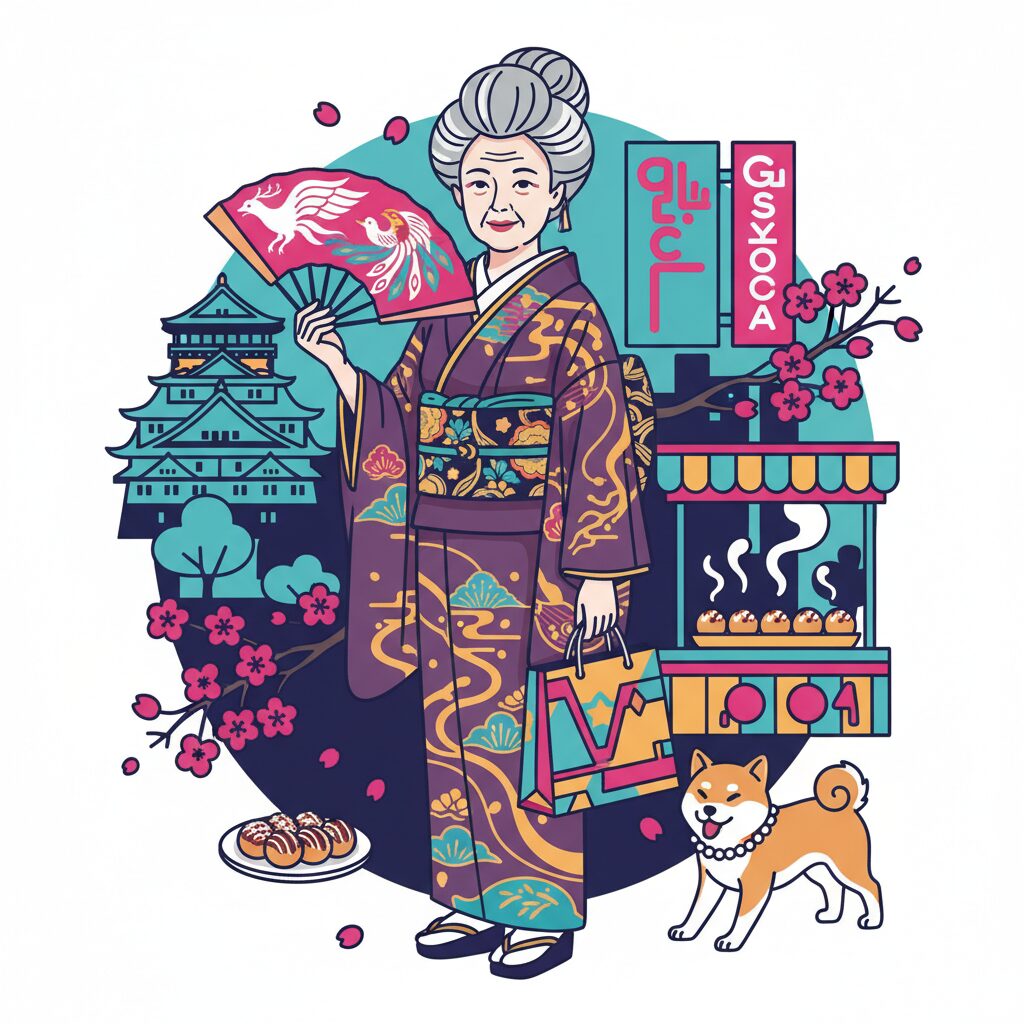
Walk through any bustling shotengai in Osaka, from the electric alleys of Namba to the residential arteries of Tennoji, and you’ll feel it. It’s a certain energy, a palpable hum that’s different from the polite, measured rhythm of Tokyo. At the center of this energy, you will invariably find them: the Osaka obachan, the middle-aged and elderly women who are the city’s undisputed matriarchs. The stereotype precedes them, a vibrant splash of leopard print, a perm set with the structural integrity of a helmet, and a voice that can cut through the clatter of a pachinko parlor. They are often portrayed as a comical cliché, a walking, talking caricature armed with a purse full of hard candies, known as ame-chan, ready to be deployed at a moment’s notice. But to dismiss them as mere comedic relief is to fundamentally misunderstand Osaka. As someone who has spent time observing the intricate dance of East Asian cultures, I see them not as a caricature, but as the fierce, pragmatic, and deeply caring guardians of this city’s soul. They are the living embodiment of Osaka’s core values: practicality over pretense, community over anonymity, and a hearty laugh over quiet reservation. To understand the Osaka obachan is to unlock the operating system of the city itself. They are not just residents; they are the infrastructure. Their daily habits are not quirks; they are the unwritten laws that govern public space, local commerce, and social cohesion. This isn’t about a fashion choice; it’s about a philosophy of life lived out loud on the city streets.
Their unmistakable irreverence extends into the business sphere, where workplace humor transforms daily challenges into opportunities for meaningful connection.
The Anatomy of an Encounter: Decoding the ‘Ame-chan’ Ritual
More Than Just Candy
The first time it happens, it can catch you off guard. You’re on the Hankyu line, going about your day, perhaps looking a little weary after a long one. Suddenly, a hand appears in your peripheral vision, offering a small, brightly wrapped candy. You look up to see an obachan, a complete stranger, smiling warmly and nodding, insisting you take it. This is the famous ame-chan offering, the most basic social exchange in the Osaka playbook. In Tokyo, such an unsolicited gesture from a stranger would be met with suspicion. It would be unusual, a breach of the unspoken rules of urban anonymity. But here, it’s routine. The ame-chan is more than just sugar; it’s a social gesture. It’s a silent way of saying, “Hello. I see you. We’re sharing this space, this moment, this commute.” It’s a subtle attempt to break down the barrier between strangers. Accepting the candy is important. Refusing it feels like rejecting a handshake. Once accepted, you’re part of a brief but genuine social contract. A short conversation might follow. “Where are you from?” “It’s hot today, isn’t it?” “Your bag is nice.” The topic doesn’t matter. The connection itself is the purpose. This ritual is a constant, low-key exercise in community building. It reminds everyone that the city isn’t just a collection of individuals, but a shared space where small acts of recognition count.
The Art of the Approach
The ame-chan is only the beginning. The Osaka obachan operates with a sense of personal space that is much more flexible than what you might be used to, especially if you come from Tokyo. They are experts in friendly intrusion. Waiting in line at the post office, one might lean over to check the contents of your shopping basket. “Oh, you got the good daikon today! They were sold out at my usual spot.” It’s not intrusive in a negative way; it’s an expression of shared experience. She’s not judging your purchase; she’s connecting with your life, finding common ground in the everyday act of grocery shopping. They will adjust your clothing without hesitation. A loose tag on your sweater will be tucked in. A crooked collar will be straightened. A loose thread will be pointed out and sometimes even pulled off. This is communal grooming, an extension of the belief that we are all responsible for the care of the community, including the appearance of its members. For a foreigner, this can feel invasive. For a Tokyo native, it can be downright startling. But the intent is rarely, if ever, critical. It comes from a place of practical care. In their eyes, a messy appearance reflects badly on the collective, and they’re simply doing their part to keep things neat. It’s their city, and you, for the moment, are under their care.
The Economics of Common Sense: Masters of the Bargain
The ‘Shotengai’ as a Battlefield of Wit
To truly grasp the obachan’s economic philosophy, you need to see her in her natural environment: the shotengai, or local shopping arcade. This is far from the sterile, fixed-price setting of a department store. The shotengai is a lively ecosystem of relationships, where the currency is as much witty banter as it is yen. Shopping here is a performance, a sport, with the obachan as a seasoned champion. The phrase you’ll hear most often is a drawn-out, melodic “Chotto makete~!”, meaning “Come on, give me a little discount!” This is not a plea born of poverty or stinginess but a conversational opening and an invitation to play a game. The shopkeeper, likely familiar with her for years, is expected to join in. He might offer a dramatic sigh, saying, “Oh, but you’re my best customer; I’m already giving you a special price!” She’ll respond, “Don’t give me that—I saw you give Mrs. Tanaka next door an extra onion yesterday!” This playful exchange can last several minutes and is a ritual that strengthens their relationship. The actual discount might be minimal, perhaps a few yen off or a small piece of fruit thrown in for free. The victory lies not in the monetary savings but in the successful dance of social interaction. It reflects a healthy, functioning community market where people are more than just consumers.
Value Beyond Price: The ‘Omake’ Philosophy
This focus on getting a good deal ties into the deeply rooted Osaka concept of being smart with money, which differs from simply being cheap. The negative term is kechi (stingy), implying selfish hoarding of wealth. The celebrated terms shibui or kenjitsu denote being shrewd, pragmatic, and securing the absolute best value for your money. The obachan is the high priestess of shibui. She knows which butcher offers the best cuts for the price, which fishmonger can be persuaded to add an extra shrimp (omake), and which vegetable stand offers the freshest produce on any given Tuesday. The omake—a small extra—is often more valuable than a discount. It symbolizes a good relationship, recognition from the vendor that she is a valued, regular customer. This mindset contrasts sharply with the Tokyo consumer, who often values brand names, elegant packaging, and the prestige of shopping in a fancy Ginza department store. The Osaka obachan cares little about the bag it comes in; she values quality, price, and the human connection that sweetens the deal. This is the essence of Osaka’s merchant culture: everything is a negotiation, and a good relationship is the greatest asset you can have.
The Language of Directness: No Filter, All Heart
‘Honesty’ vs. ‘Rudeness’: A Tokyo-Osaka Divide
One of the most striking cultural shocks for anyone relocating from Tokyo to Osaka is the difference in communication style. Tokyo is guided by the concepts of tatemae (the outward expression, what is said) and honne (the true feelings, what is thought). There is a strong emphasis on politeness, indirectness, and avoiding conflict at all costs. In contrast, the Osaka obachan shows much less separation between her honne and tatemae. She speaks her mind openly, which can be surprising. She might greet you with, “Anta, kyo chotto tsukareteru kao shiteru na,” meaning, “You look tired today.” In Tokyo, this would be seen as extremely rude. However, in Osaka, it is simply a matter-of-fact observation, possibly even concern. She isn’t trying to insult you; she’s just stating what she notices. This reflects a raw honesty. She might also comment on your weight, your new haircut, or the odd color combination of your outfit. Foreigners often misunderstand this directness as aggression or rudeness, but that interpretation stems from a different cultural perspective. From her viewpoint, staying silent or offering a fake, empty compliment would be colder and more distant. Her straightforward remark, no matter how blunt, signals that she has noticed you. She is engaging with you as a real person, not a stranger passing by. This attention is, in many ways, a form of acceptance.
The Power of Humor and the ‘Tsukkomi’
This frankness is almost always lightened by a strong sense of humor. Osaka is the birthplace of manzai, a style of stand-up comedy based on the interplay between a boke (the silly, absent-minded one) and a tsukkomi (the quick-witted straight man who highlights absurdities). This dynamic goes beyond the stage; it forms the foundation of everyday conversation in the city, with the obachan naturally taking the role of the tsukkomi. She is swift with a clever retort or teasing remark that keeps dialogue engaging and prevents anyone from taking themselves too seriously. If you stumble on the sidewalk, a Tokyoite might look away to spare your embarrassment. But an Osaka obachan is likely to laugh and call out, “Daijoubu ka? Asoko ni ana aita de!” (“Are you okay? You just made a hole in the ground!”). This joke quickly eases the embarrassment, turning your fall into a shared moment of amusement. Humor serves as a vital tool in this scrappy, business-focused city. It acts as social glue, a way to navigate conflict, and a means to build immediate rapport. Embracing and even joining in this rapid-fire exchange is key to fitting in with Osaka’s culture.
The Neighborhood as a Kingdom: Social Order and Unspoken Rules
Guardians of the Garbage Station
To witness the obachan’s role as a community enforcer in its purest form, one only needs to visit a residential garbage collection station on the designated morning. In Japan, garbage disposal is a complicated, strictly scheduled ritual with intricate rules for sorting combustibles, plastics, cans, bottles, and oversized items. In Tokyo, this system is upheld by signs and the fear of anonymous social shame. In Osaka, the obachan enforces it. She will be present, watching. She knows the schedule by heart. She recognizes who is putting out their trash on the wrong day or who has failed to properly rinse their PET bottles. And she won’t hesitate to correct you. This is not the behavior of a busybody. It is a profound act of civic duty. Proper management of the garbage station reflects the well-being of the entire neighborhood. It’s a matter of public hygiene, order, and mutual responsibility. Her vigilance ensures the shared space stays clean and functional for all. She is the unofficial but universally acknowledged manager of the local commons. Her authority comes not from a title, but from her consistent presence and steadfast commitment to the community’s standards.
The Information Network
Long before the internet, the obachan network was the city’s most efficient information distribution system. They serve as the nodes and hubs of a hyper-local social network based on face-to-face communication. Whether standing in the checkout line, chatting at the local bathhouse, or tending to plants on the sidewalk, they are constantly sharing information. They know which clinic has the shortest wait time, where to find the best sale on soy sauce, that the family in apartment 3B is expecting a baby, and that the new foreign resident on the second floor seems to be struggling with the recycling schedule. This “gossip” is not mere idle chatter; it is a community welfare system in action. It’s how support is mobilized when someone is ill. It’s how newcomers are gently monitored and guided. It’s how the community regulates itself and cares for its own. In the sprawling, anonymous apartment blocks of Tokyo, you might not know your next-door neighbor’s name for years. In many parts of Osaka, thanks to the obachan network, your neighbors will know your life story before you’ve even finished unpacking. This can feel intrusive, but it also provides a powerful safety net.
Beyond the Stereotype: Style, Substance, and Adaptation
The Leopard Print Explained
So, what’s the deal with leopard print? It’s impossible to overlook and has become a visual symbol of the Osaka obachan. But it’s not merely a random fashion choice. The pattern’s popularity in Osaka traces back to the city’s post-war boom. As the merchant class regained stability, there was a desire for items that felt bold, a bit exotic, and conveyed confidence. Animal prints, especially leopard, fit this need perfectly. It was a statement of flamboyant strength, an accessible luxury that said, “I’m not afraid to be noticed or heard.” It’s the sartorial embodiment of Osaka’s personality: loud, proud, and unapologetically itself. In contrast to the understated, neutral tones that dominate Tokyo fashion—a style meant to blend in—the leopard print is designed to stand out. It became a kind of uniform, a badge of identity for a generation of women who ran households, managed family businesses, and held their communities together through sheer determination. Wearing it signals belonging to this powerful sisterhood. It says you are pragmatic, not to be underestimated, and you probably have some candy tucked away in your purse.
The Modern ‘Obachan’
Naturally, the city is evolving. Younger Osaka women may not adopt the classic perm and leopard-print ensemble. They are more exposed to global trends and Tokyo-centric Japanese media. Still, the core spirit of the obachan endures. The fundamental software is still running, even if its user interface has been refreshed. The instinct to be economically savvy, the straightforward communication style, and the deep-rooted belief in community remain integral to Osaka’s DNA. The woman in her forties today might wear minimalist clothing from Muji instead of flashy animal prints, but she will still instinctively haggle for a better price at the local market. The young mother pushing a stroller may not speak the same thick Osaka dialect as her grandmother, but she won’t hesitate to share snacks with another child at the park. The spirit of the obachan is less about a specific age or look, and more about a functional role women in Osaka inhabit. It’s the role of the practical, tough, and warm-hearted community manager. While leopard print may eventually fade into history, the impulse to offer candy to a stranger on a crowded train is a legacy that will continue to define this city for years to come.
Navigating the ‘Obachan’ World: A Foreigner’s Guide
For a non-Japanese resident, interacting with the Osaka obachan can be one of the most challenging yet ultimately rewarding parts of living here. The key is to understand their way of thinking and engage accordingly. Here are a few practical tips. First, always accept the ame-chan. It’s a peace offering and an invitation. Second, don’t be intimidated by their directness. When an obachan tells you that you look tired, the right response is not to take offense but to laugh and say, “I am! It’s been a long week!” This shows you get the game and aren’t overly sensitive. Third, join in the market banter. Try saying “chotto makete!” yourself. Even if your Japanese is imperfect, the effort will be appreciated and will likely earn you a smile, and maybe even an extra potato. Don’t be overly formal or shy away from their friendliness. In their world, politeness is expressed through genuine engagement, not stiff, formal distance. Winning the approval of the neighborhood obachan is like unlocking a special achievement in the game of life in Osaka. Once they accept you, you’re no longer an outsider—you become part of their flock. They’ll look out for you, offer unsolicited but often helpful advice, and feed you whenever you seem even a little hungry. They are the gatekeepers to a deeper, more authentic experience of the city. Look past the leopard print, and you’ll discover the true, beating heart of Osaka.








