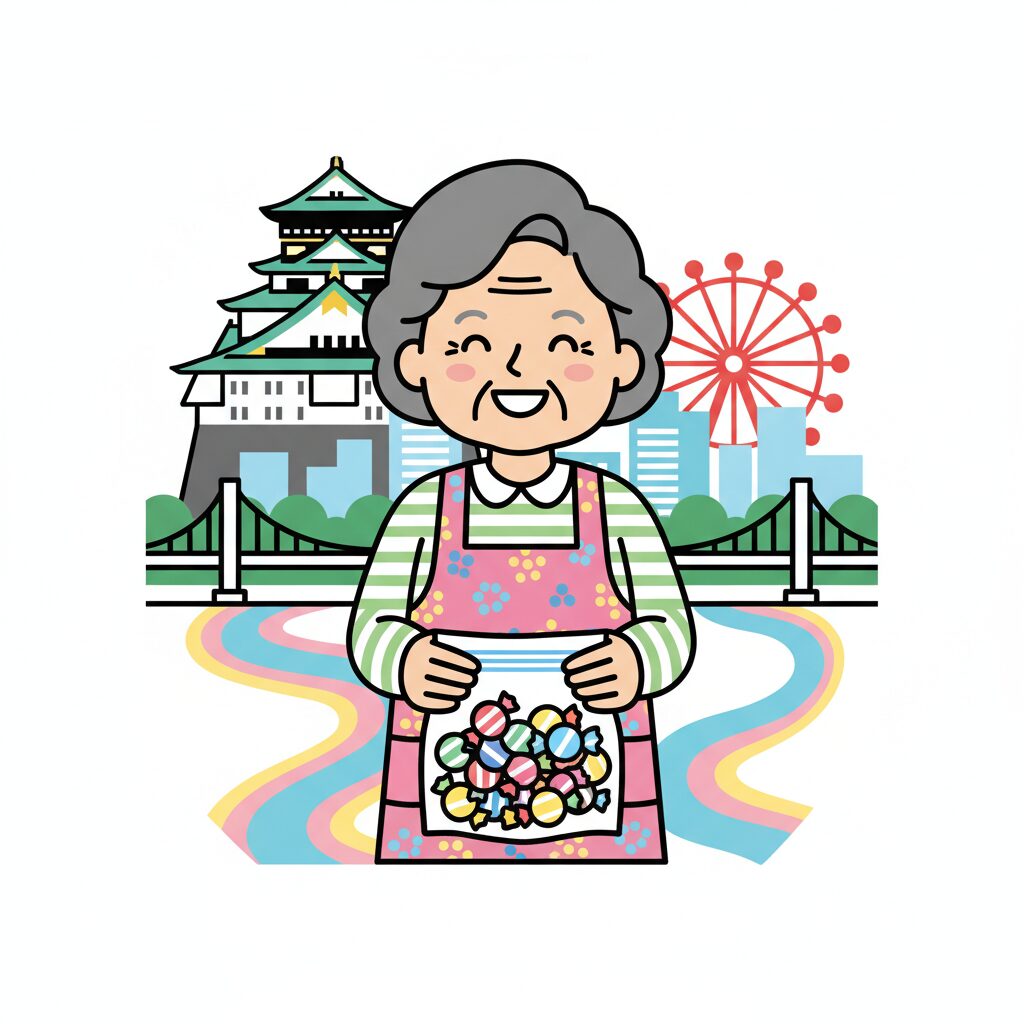
So, you’re standing on the platform for the Midosuji Line, the artery pumping life through Osaka. It’s humid. The air is thick with the scent of takoyaki from a nearby stand and the low rumble of an approaching train. You’re minding your own business, maybe scrolling through your phone, when you feel a gentle tap on your arm. You look up. A woman, probably in her late sixties, with a perfectly coiffed perm and a dazzlingly bright leopard-print blouse, is holding out a small, crinkly-wrapped piece of candy. She smiles, a network of fine lines crinkling around her eyes, and says something like, “Here, have one.” This, my friend, is your initiation. You’ve just had your first encounter with ‘Ame-chan’ culture, Osaka’s unofficial, unwritten, and utterly charming social contract. It’s a gesture that feels impossibly small yet speaks volumes about the city’s soul. In Tokyo, a stranger offering you food might trigger alarm bells. In Osaka, it’s just Tuesday. It’s a micro-interaction that dissolves the sterile anonymity of city life, replacing it with a fleeting moment of shared humanity. This isn’t just about sugar; it’s about connection, a sweet, unspoken language that says, “I see you. We’re here together.” Understanding this simple act is your first real step to understanding the rhythm and pulse of daily life in this vibrant, wonderfully unpredictable city.
This heartwarming ritual is just one facet of Osaka’s vibrant social fabric, where even the pragmatic energy behind the Akindo Code reflects a blend of commerce and community.
The Anatomy of a Social Currency
Before we explore who should or shouldn’t partake, let’s analyze this cultural artifact. What exactly is ‘Ame-chan’? On the surface, it’s straightforward. ‘Ame’ (飴) means candy, and ‘Chan’ (ちゃん) is a diminutive suffix, a term of endearment often used for children, close friends, or cute things. The name softens the word, turning it from a simple object into a gesture of affection. But this isn’t just any candy picked up at a convenience store checkout. The classic ‘Ame-chan’ is typically a hard candy, individually wrapped. Think golden-hued kuro-ame (black sugar candy), strong nodo-ame (throat lozenges), or basic fruit-flavored drops. The type matters less than its purpose.
The undisputed experts and distributors of ‘Ame-chan’ are the Osaka ‘Obachan’—a formidable group of middle-aged and elderly women. Their handbags are more than simple accessories; they are mobile distribution hubs, treasure troves filled with a seemingly endless supply of these small sugary units of social currency. They hold the keys to this tradition. The gesture belongs to them, a tool they skillfully use to navigate the urban environment.
The act itself is a beautiful piece of social theater. It almost always happens spontaneously during the in-between moments of life: waiting for a delayed bus, sharing a bench in a crowded department store, or sitting beside someone on a long train journey. There is no agenda, no expectation for a long conversation. It serves as a communication tool to break the ice, ease a moment of shared inconvenience, or simply add a bit of warmth to the impersonal nature of public spaces. It’s a non-verbal acknowledgment, a brief pact that says, “This moment, right here, is a little better because we’re sharing it.” It’s Osaka’s response to the cold, rigid logic of the city—a small act of defiance against urban anonymity.
Navigating the Sweet Exchange: Givers, Receivers, and the Awkward In-Between
So, you’ve been offered an ‘Ame-chan.’ What happens next? This is where unspoken rules come into play—a subtle dance of social etiquette that distinguishes locals from newcomers. Understanding your role is essential for navigating life in Osaka smoothly.
Who Should Accept the Gesture
Most likely, you will be the receiver. This is your primary and most important role. When an Obachan offers you that small, shiny parcel, the proper response is straightforward and significant. You smile. You make eye contact. You accept the candy with a slight bow and a warm, “Sumimasen, arigato gozaimasu.” Here, “sumimasen” isn’t an apology; it’s a polite expression—a courteous way of saying, “thank you for your kindness.” It conveys humility and gratitude. Declining is a social faux pas. While not a serious offense, it creates an awkward moment. It’s akin to refusing a handshake. You’re not just turning down candy; you’re gently pushing away a hand extended in friendship. Acceptance is the whole point. Whether you eat the candy or not is secondary. You might tuck it into your pocket or discreetly dispose of it if you don’t like it. The social contract is fulfilled the moment it passes from her hand to yours.
Now, for the advanced level: should you, as a foreigner, try to become a giver? The answer is: proceed with great caution. This role isn’t one to adopt lightly. Offering ‘Ame-chan’ is closely linked to the Osaka Obachan’s persona. She possesses the age, gender, and cultural authority to perform this gesture naturally and without awkwardness. For a young person, a man, or a non-Japanese resident to offer candy to a stranger can miss the mark. It might come across not as charming but as odd, or even suspicious. Social context is everything. A middle-aged man offering candy to a child would raise alarm anywhere, and Osaka is no different. This doesn’t mean you can’t engage in sharing culture. Offering a snack to a coworker or a neighbor you know well is an excellent way to foster connection. But spontaneously handing out ‘Ame-chan’ to strangers is a move best left to the experts.
Who Might Feel Uneasy (And Why That’s Okay)
It’s completely normal to feel a bit uneasy about this exchange at first. If you come from a culture where personal space is sacred and interactions with strangers are rare and purposeful, the ‘Ame-chan’ gesture might feel like breaking protocol. You’ve been taught not to speak to strangers, especially not to accept food from them, so your internal caution alarm might go off. This is a natural reaction. The key is to recognize it as a cultural difference in how public interactions are perceived. The Obachan isn’t trying to lure you into danger; she’s trying to make the world a friendlier place, one candy at a time.
People from other parts of Japan, especially Tokyo, often feel just as puzzled. The idea of striking up casual, friendly conversations with strangers on public transport is foreign to the Kanto mindset. It can feel invasive. Additionally, the health-conscious might hesitate when offered a pure sugar candy. Again, remember the principle: acceptance matters most. Take the candy, say thank you, and what you do with it afterward is entirely your choice. The gesture’s purpose is to build a connection, not to force you to consume sugar. Showing appreciation for the kindness is far more important than the candy itself. Over time, the outstretched hand offering candy will feel less intrusive and more like a warm welcome.
A Tale of Two Capitals: Personal Space in Osaka vs. Tokyo
The ‘Ame-chan’ phenomenon vividly highlights the deep cultural divide between Osaka and Tokyo. It’s about more than just a piece of candy; it embodies fundamentally different philosophies of how to exist in a crowded urban space. Picture the scene from the introduction set on Tokyo’s Yamanote Line. A woman offers a stranger a piece of candy. The typical response would be a mix of confusion, suspicion, and polite avoidance. The recipient might force a tight smile, shake their head quickly, and immediately return their gaze to their phone. Other passengers would pretend not to notice, creating a bubble of silence around the awkward exchange. It would be seen as an anomaly, a social misstep.
In Tokyo, social order is upheld through a mutual, unspoken understanding to respect personal boundaries and minimize intrusion. In such a densely populated city, privacy is precious, and leaving others alone is a key civic courtesy. The invisible bubble around each person is larger and more rigid. You don’t make small talk in the elevator. You don’t comment on a stranger’s cute dog. Instead, you maintain a polite, professional distance. This isn’t coldness; it’s an effective system for millions to coexist peacefully in a confined space.
Osaka operates on a completely different system. Its history as a merchant hub, a place of trade and negotiation, has fostered a culture where communication, rapport, and a bit of good-natured nosiness are not only accepted but essential. The boundaries between public and private are more fluid. The ‘Ame-chan’ acts as a means to briefly dissolve those boundaries, creating a shared space for a moment. It’s a holdover from when the person beside you wasn’t just a stranger but a potential customer, neighbor, or fellow human navigating the market’s hustle. This mindset values human connection over strict distance. An Osakan might argue that ignoring the person next to you is actually colder. For them, sharing a laugh, a weather complaint, or a piece of candy is what makes city life bearable. It’s a constant, low-level hum of community that Tokyo has traded for quiet efficiency.
Your First Encounter: A Practical Field Guide
Theory is one thing, but real life moves quickly. Let’s walk through a scenario so you’re ready when your moment arrives. You’re sitting on the orange seat of the JR Osaka Loop Line, traveling from Tennoji to Kyobashi. The train rocks gently. An Obachan takes the seat beside you, placing her shopping bags at her feet. She sighs, then starts the familiar rummage inside her large handbag. This is the signal. Stay calm.
Her hand appears, holding a small, brightly wrapped candy. It might be a classic Botan Ame with its edible rice paper wrapper, or a creamy Ichigo Miruku candy. She looks at you. Her eyes are warm. She offers it and says, “Kore, douzo” (Here, please have this) or the more casual, “Ame-chan, taberu?” (Wanna eat a candy?).
This is your cue. Do not panic. Do not look away. Do not pretend you didn’t hear her.
Step 1: The Smile. Your initial response should be visual. Let a genuine, warm smile spread across your face. This instantly signals that you are open and friendly.
Step 2: The Acknowledgment. Make eye contact and give a slight nod or a small bow of your head. This shows respect and recognizes her kind gesture.
Step 3: The Verbal Response. Use the magic words: “Ah, ii desu ka? Sumimasen, arigato gozaimasu!” (Oh, is it okay? Excuse me, thank you very much!). The phrase “ii desu ka?” expresses polite hesitation, a gentle “are you sure?”—a classic Japanese conversational softener. It shows you’re not greedily grabbing the candy.
Step 4: The Acceptance. Take the candy softly from her hand. Don’t snatch it. The brief physical contact seals the friendly exchange.
Step 5: The Aftermath. You are now the proud owner of one ‘Ame-chan.’ You are not required to unwrap and eat it immediately. Simply give another small nod and smile, then place it in your bag or pocket. The interaction is complete. You have successfully navigated one of Osaka’s most important social rituals. You are no longer merely a tourist or a passing resident; you are a participant in the city’s daily life. You’ve shared a moment—that’s what truly matters.
More Than Just Sugar: The Philosophy of the ‘Ame-chan’
It might be easy to overlook the ‘Ame-chan’ as a quaint, trivial little habit, but doing so would mean missing the point entirely. This small piece of candy is a powerful symbol, a key that unlocks the core ethos of Osaka. It embodies a worldview that is deeply pragmatic, human-focused, and refreshingly informal—a philosophy that trusts in the power of small gestures to create a better, kinder community.
The culture of ‘Ame-chan’ stands in direct contrast to the sterile, transactional nature of city living. It represents a non-reciprocal act of kindness. The Obachan who offers you candy expects nothing in return—not a conversation, not your life story, nor even a candy back. It is a pure, self-contained gift. This nurtures a sense of casual, low-pressure community that is increasingly rare in major cities worldwide. It serves as a reminder that the urban landscape is more than just buildings and infrastructure; it’s a network of human connections.
This attitude is woven into the city’s fabric. It explains why a shopkeeper in the Tenjinbashisuji Shopping Arcade is more likely to strike up friendly banter, and why strangers often offer directions if you look lost—sometimes even walking part of the way with you. It’s linked to Osaka’s renowned comedy tradition, manzai, which thrives on the quick, back-and-forth rhythm of everyday conversation. It’s all part of the same drive: to connect, to communicate, to break down formal barriers and discover the shared humanity beneath. The ‘Ame-chan’ is the most distilled, most portable, and sweetest expression of this spirit. It quietly reminds you that in Osaka, you are never truly alone. There’s always someone with a leopard-print blouse and a purse full of candy, ready to brighten your day just a little.