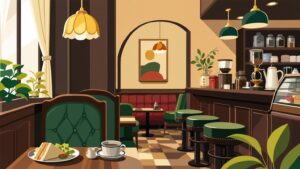
Step off a quiet residential street in Osaka, sometime around 8 AM. Push open a heavy wooden door with a small brass bell that jingles your arrival. The air inside is thick, a comforting blend of dark-roast coffee, yesterday’s newsprint, and the faint, sweet ghost of Showa-era cigarette smoke. An old man in the corner, who looks like he’s been part of the furniture since 1978, glances up from his sports daily, gives you a brief, neutral once-over, and returns to the box scores. Behind the counter, a man with neatly combed hair and a starched white shirt—the “Master”—offers a short, efficient nod. This is the neighborhood kissaten, Osaka’s unofficial community center, and you’ve just walked into the middle of its most sacred daily ritual: “Morning Service.”
On the surface, “Morning,” as it’s simply known, is just a breakfast special. You order a coffee, and for the same price—or maybe a hundred yen more—you get a thick slice of toast, a hard-boiled egg, and maybe a tiny salad. It’s a deal that seems almost suspiciously good, an economic anomaly in a country known for its high cost of living. But if you think this is just about a cheap meal, you’re missing the point entirely. This isn’t Starbucks. It’s not about grabbing a latte and a laptop-friendly table. The Morning Service is a social contract. It’s a daily check-in, a neighborhood census, and a quiet performance of Osaka’s most defining cultural values. It’s here, in these dimly lit time capsules, over a 500-yen set meal, that you can truly begin to understand the city’s heartbeat—a rhythm far different from the frantic, high-speed pulse of Tokyo. To live in Osaka is to understand the unspoken language of the morning kissaten.
Beyond serving as intimate community hubs, Osaka’s kissaten are also evolving into modern workspaces, as shown by the trend of transforming these traditional coffee houses into remote offices that effortlessly blend heritage with innovation.
More Than a Meal: The Anatomy of a Morning Set
Let’s break down the offer, as it’s the hook that draws you inside. The classic “Morning Set” is a holy trinity: coffee, toast, and a boiled egg. The coffee is typically a dark, syphon-brewed blend—strong and straightforward. The toast is almost always shokupan—fluffy Japanese milk bread—sliced impossibly thick, toasted to a perfect golden-brown, and served with a pat of butter or margarine alongside a small packet of jam. The egg is simply a boiled egg, providing a straightforward protein boost to start your day. For about the price of a single, fancy paper-cup coffee in Tokyo, you get a full, sit-down breakfast.
This is where the famed Osaka keizai kankaku, or economic sensibility, comes into play. People from Osaka are often stereotyped as being money-obsessed or cheap. That’s a crude misunderstanding. It’s not about stinginess; it’s about value. An Osakan will happily splurge on an extraordinary meal but has zero patience for overpaying on everyday items. The Morning Set perfectly embodies this mindset. It’s a high-value offer, a sensible, satisfying transaction that says, “This is a smart way to start your day.” It’s practical, filling, and makes good sense. You won’t find many neighborhood kissaten offering avocado toast specials with microgreens for 1,800 yen. That’s not good value. That’s a Tokyo notion.
The Kissaten as the Neighborhood’s Living Room
Once the value proposition has pulled you in, you quickly realize the food comes second. You’re paying for your seat. You’re renting a small piece of social real estate for an hour. The kissaten serves as a neutral third space — neither home nor work. It’s the community’s living room, with the Master as its quiet, observant patriarch.
Look around. The decor is likely a nostalgic throwback to the 1970s or 80s: dark wood paneling, perhaps some stained glass, plush velvet chairs in shades of burgundy or forest green, and abstract oil paintings of questionable origin. The lighting is low and warm. The soundtrack is the gentle clinking of ceramic on saucer, the rustle of newspapers, the low murmur of conversation, and the steady, comforting gurgle of the coffee syphon. It’s a sensory cocoon designed for comfort, not Instagram.
At the center of this world is the Master. He (and it’s almost always a he) knows everyone. He knows who takes sugar, who reads the financial pages first, and who is having trouble with their daughter-in-law. He’s bartender, therapist, and community switchboard operator all rolled into one. He rarely speaks much, but he sees everything. His presence is a stabilizing force, the anchor holding this entire social ecosystem together. For the regulars, his nod of acknowledgment is as essential as the coffee itself. It’s a confirmation: you are here, you belong, all is right with the world.
The Unspoken Social Code of the Morning Ritual
This is where things become challenging for outsiders. A neighborhood kissaten functions within a complex, unseen network of social rules. Breaking these rules won’t get you kicked out, but it will label you as someone who simply doesn’t understand. Mastering this code is your gateway to experiencing a deeper layer of life in Osaka.
The Law of “Itsumo no”: The Power of ‘The Usual’
The highest status a customer can attain is not having to place an order. A true regular enters, sits down, and their preferred Morning Set—black coffee, toast with butter only, egg cooked to a perfect medium-boil—appears before them as if by magic. This is the power of “itsumo no” (the usual). It’s a wordless conversation. It communicates, “I know you. I remember you. You belong here.”
For an Osakan, this is the pinnacle of customer service. It’s not the fawning, overly polite service you might encounter in a high-end Tokyo department store. It’s service rooted in relationship and recognition. It’s deeply personal. In a world dominated by impersonal transactions and automated checkouts, being known is a precious currency. Ordering loudly and explicitly as a regular would be like shouting your name at a family dinner. It’s simply not done.
The Geography of Belonging: Where You Sit Matters
Pay attention to where people choose to sit. It’s never random. The seating arrangement forms a living social map of the neighborhood’s hierarchy and relationships.
The Counter: This is prime territory. It’s reserved for the hardcore regulars, solo diners who share an easy, established rapport with the Master. This is the inner circle. Conversations here are direct, familiar, and often consist of ongoing commentary on the morning news playing on the small TV in the corner. A newcomer should never, ever just sit down at an empty counter spot between two regulars. That’s like crashing a private conversation.
The Booths: The cozy, semi-private booths are the domain of the local obachan (older ladies). Here, information is exchanged, gossip is dissected, and the neighborhood’s social fabric is woven and mended. They speak in the distinctive, rhythmic Osaka-ben dialect, their talk a lively performance for anyone nearby.
The Two-Tops: The smaller tables are for newspaper readers, couples, or newcomers. They offer a measure of anonymity. This is likely where you’ll begin your kissaten journey. From this vantage point, you can observe the room’s flow safely. Your goal is to eventually move from a two-top to a familiar nod, and perhaps, one day, to the counter.
The Art of Benevolent Nosiness: “Chotto Osekkai”
In Tokyo, ignoring those around you is seen as civic courtesy. On a crowded Tokyo train, everyone retreats into their own private bubble. In Osaka, and especially in a kissaten, that bubble doesn’t exist. People show genuine interest in each other. What might be considered nosiness elsewhere is a form of connection here. This is chotto osekkai, which roughly means “a little meddling,” but its true meaning is closer to “caring enough to get involved.”
The Master might ask why you look so tired. The woman at the next table might comment on your new haircut. The old man at the counter might offer unsolicited advice about which baseball team will win the pennant. For a foreigner accustomed to personal space and privacy, this can feel intrusive. But it usually stems from genuine, if awkward, community spirit. They’re not judging you; they’re acknowledging you as a fellow human sharing the same space. This is the essence of the “friendly” Osaka stereotype—but it’s an active, engaged friendliness, not a passive, hands-off politeness. It’s the difference between a polite “good morning” and a concerned “You’re out early today, is everything okay?”
The Osaka-Tokyo Divide, as Told by a Cup of Coffee
Nothing underscores the cultural divide between Osaka and Tokyo more distinctly than their respective morning coffee rituals. A trendy Tokyo café serves as a stage for individual performance. It’s about the artistry of the latte, the minimalist interior, and the brand of the laptop on the table. It’s a place to be seen, though not necessarily to connect. The interactions are transactional, efficient, and anonymous: you order, pay, consume, and leave.
An Osaka kissaten is quite the opposite. It’s a collective experience where comfort takes priority over aesthetics. The value lies in relationships rather than branding. It’s a place that values consistency over novelty. The menu likely hasn’t changed in thirty years, and that’s a source of pride. In Tokyo, you visit a café to work on your individual project; in Osaka, you go to the kissaten to be reminded you’re part of a collective.
This difference explains a common point of friction. Foreigners and Tokyoites in Osaka sometimes find the kissaten slow, old-fashioned, and inefficient. They’re applying the logic of a transactional space to a relational one, trying to use a laptop in a living room where people converse. The kissaten’s purpose isn’t to be a hyper-efficient productivity zone; its role is social cohesion—a process that cannot be rushed.
Becoming a Part of the Scenery

So, how do you move from being a curious outsider to a welcomed regular? It’s a gradual process of observation and consistency.
First, simply show up. Choose a spot close to where you live. Avoid the one featured in magazines. Instead, go to the place with faded plastic food models in the window and steamed-up glass. That’s the authentic one.
Be consistent. Try to visit around the same time, even if it’s only once or twice a week. Let your face become familiar. The Master and the regulars are creatures of habit who notice patterns.
Keep it simple. Order the Morning Set without asking for complicated customizations. Read the newspaper provided by the shop or just sit quietly and listen. Take in the rhythm of the place before trying to engage with it.
Use the magic words. A clear “Ohayou gozaimasu” (Good morning) upon entering and a sincere “Gochisousama deshita” (Thank you for the meal) when leaving, directed to the Master, work wonders. It shows respect to both the place and its keeper.
Patience is key. Don’t force conversation. The first sign of acceptance won’t be a warm chat but a slightly more familiar nod from the Master. It might be the old man at the counter holding your gaze a moment longer than usual. This subtle shift—from anonymous customer to “the foreigner who comes in on Tuesdays”—is a big step. Eventually, a small comment will come your way, and when it does, you’ll know you’ve arrived.
The Morning Service Is the Soul of the City
The unassuming Morning Set is more than just toast and coffee. It’s a daily ritual. It stands as a testament to a city that still values the power of shared spaces, familiar faces, and honest, good deals. It’s a quiet defiance of the anonymous, hyper-individualized pace of modern life. It’s a reassurance that no matter how vast and overwhelming the world becomes, there is a small, warm spot where someone knows exactly how you take your coffee.
If you really want to understand what living in Osaka feels like, look beyond the bright lights of Dotonbori and the rich history of Osaka Castle. Find a neighborhood kissaten at 8 AM. Order the “Morning.” Put your phone aside. And just listen. Listen to the rhythm of the Osaka dialect, observe the subtle exchanges, and feel the comforting weight of a ritual repeated day after day, year after year. You’re not just having breakfast—you’re witnessing the soul of the city, served hot on a thick slice of toast.