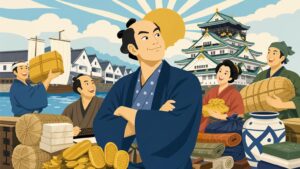
Step off the train in Osaka, and the first thing you feel isn’t just the humidity—it’s a different kind of energy. It’s faster than Kyoto, looser than Tokyo. It’s a city that talks to you, literally. Walk through a covered shopping arcade, a shotengai, and you’ll hear it: the gravelly calls of vendors, the sizzle of takoyaki batter, and the clatter of a shopkeeper’s abacus, even if it’s just a digital one now. But listen closer, and you’ll hear the city’s true language, a dialect built not just on words, but on a unique philosophy of money, community, and value. This is the language of the Akindo no Machi—the Merchant City. For centuries, Osaka was Japan’s commercial heart, the ‘Kitchen of the Nation’ where rice and goods from across the country were traded. This history isn’t tucked away in a museum. It’s alive, breathing in the way people greet each other, the way they shop, and the way they build their lives. To a newcomer, especially from the polished, reserved world of Tokyo, this can be baffling. Is everyone obsessed with money? Why is bargaining a sport? Why does the woman at the fruit stand know all about her customer’s son’s school exams? To truly live in and understand Osaka, you have to get a feel for this merchant’s pulse. It’s the key to everything, from making friends to getting the best deal on groceries. It’s a mindset that values pragmatism over pretense, human connection over sterile transactions, and a good laugh over stiff formality. Let’s peel back the layers of this vibrant, complicated, and utterly fascinating city.
Osaka’s pragmatic approach even extends to everyday practices, as its distinctive garbage sorting methods mirror the city’s enduring blend of tradition and innovation.
The Real Meaning of “Moukarimakka?”
You’re likely to hear it—perhaps from the owner of the local coffee shop or the elderly man tending his small garden next door. It’s the classic Osaka greeting: “Moukarimakka?” Literally, it means “Are you making a profit?” For a foreigner, or even someone visiting from Tokyo, this question can be surprising. Are they really asking about my financial situation? Is it rude or intrusive? The answer is a definite no. This phrase is one of the most commonly misunderstood parts of Osaka culture. Think of it less as an inquiry and more as a handshake. It’s Osaka’s version of “How’s it going?” or “What’s up?” The customary, almost obligatory, reply is “Bochi bochi denna,” which roughly translates to “So-so” or “Getting by.” You say this even if you’ve just closed the biggest deal of your life. The exchange isn’t about collecting financial information; it’s a ritual, a cultural password signaling you belong to the same community. It’s a conversation starter rooted in a time when the whole community’s fortune rose and fell together. In a city of merchants, your neighbor’s success meant your own prosperity. If the fishmonger was thriving, it meant people had money to buy fish, which was good for the rice seller, the sandal maker, and everyone else. Asking “Moukarimakka?” was a way to gauge the economic wellbeing of the entire community. It was a subtle expression of solidarity: “I hope things are going well for you, because that benefits all of us.” In Tokyo, money is a deeply private matter, and openly discussing finances is considered impolite. The social code values privacy and a clear boundary between personal life and business. In Osaka, however, that line is blurred. Life is business, and business is life. This greeting perfectly embodies that mindset. It’s warm, communal, and a bit playful. So when you hear it, don’t worry. Just smile, give a slight nod, and say “Bochi bochi denna.” You’ll have just passed your first Osaka culture test.
Negotiation as a Spectator Sport
One of the most enduring clichés about Osaka is that everyone haggles. The reality, however, is a bit more nuanced. You don’t walk into a Uniqlo or a high-end department store and start negotiating the price of a sweater. But in the right setting—a lively shotengai, an independent electronics shop in Den Den Town, or a flea market—the price tag can be more of a guideline than a fixed rule. This isn’t about being cheap or trying to scam someone. In Osaka, bargaining is a form of communication. It’s a game, a performance, and a way to build rapport with the seller. A successful negotiation leaves both parties satisfied. The buyer feels smart for scoring a good deal (the gratifying feeling of etokushita), and the seller has made a sale while enjoying a bit of human connection. It’s a dance. It often begins with a compliment. “This is a beautiful bag! I love the color.” Then, a moment of hesitation follows. “It’s just a little over my budget…” This is the opening move. The shopkeeper might laugh and launch into a talk about the bag’s exceptional quality. You listen, agree, and express your admiration. Then you might gently suggest a different price, or ask, “Kore, chotto dake makete kureru?” (Can you give me just a small discount?). Sometimes the reply is a friendly but firm no. But often, it’s the start of a conversation. The shopkeeper might knock off a few hundred yen or, more commonly, throw in a little extra. This is the art of omake, the freebie. You buy a shirt, they give you a pair of socks. You buy three apples, they slip a fourth into your bag. The omake is an essential part of the transaction. It’s a gesture of goodwill, a token that turns a simple purchase into a personal exchange. What foreigners often miss is the spirit behind it. It’s not an aggressive confrontation like you might find in some markets worldwide. It’s lighthearted, full of jokes and laughter. Trying to bargain too hard or showing anger will get you nowhere. The aim is to connect, to share a moment. The few yen you save is just a memento of a successful social interaction.
The Gospel of ‘Cost Performance’
If Osaka had a religion, its core principle would be kosupa, or cost performance. This Japanese term, borrowed from English, has been perfected here as an art form. Osakans are not stingy—let’s be clear about that—but they strongly dislike being overcharged. They excel at recognizing value, with an almost instinctive sense for quality relative to price. They are willing to pay a premium for genuine excellence but have zero tolerance for anything both mediocre and costly. This philosophy seeps into all parts of daily life.
Food: The Ultimate Proving Ground
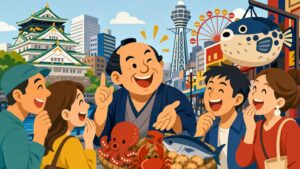
Nowhere is the passion for kosupa more apparent than in Osaka’s culinary scene. The city’s famous slogan is kui-daore, often translated as “eat until you drop,” but more precisely meaning “to ruin oneself by extravagance in food.” This doesn’t imply splurging on Michelin-starred meals, although Osaka boasts plenty of those. It’s about seeking the best tasting food at the fairest price. That’s why you’ll often find long queues outside tiny shops where customers patiently await a 500-yen bowl of ramen said to be life-changing. It’s the spirit behind konamon—flour-based dishes like takoyaki and okonomiyaki—which are famously affordable but held to extremely high standards. Locals passionately debate which takoyaki stand has the crispiest exterior, the creamiest interior, and the most flavorful octopus pieces. In Tokyo, a café might thrive on stylish interiors and Instagram-worthy decor, even if its coffee is just average. In Osaka, such a café wouldn’t survive a month. When charging 800 yen for coffee, it must offer a transcendent experience. The discerning local palate ensures bad kosupa reputations spread swiftly—a commercial death sentence.
Shopping and Daily Life
This mentality goes well beyond food. When buying clothes, an Osakan carefully examines the fabric and stitching. Is this trendy T-shirt really worth three times the price of one at a nearby shop that seems just as durable? They prioritize tangible quality over brand names. They know exactly when their local supermarket offers discounts on bento boxes, and keep mental tabs on which drugstore has the best laundry detergent deals each week. This isn’t about being poor; it’s about principle. Wasting money is foolish. Getting good value is a mark of intelligence and resourcefulness, qualities deeply respected in a merchant city. It’s a practical, no-nonsense outlook on life that values substance over style and smarts over status.
The Shotengai: A Community’s Living Room
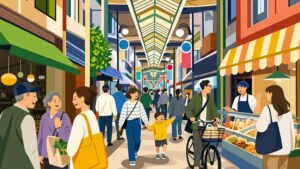
To witness the merchant city spirit in its purest form, you need to spend time in a shotengai. These covered shopping arcades serve as the heart of Osaka’s neighborhoods. More than just a collection of shops, they are vibrant ecosystems of commerce and community. They are places where grandmothers swap gossip over pickled vegetables, where the butcher inquires about your children, and where the tofu vendor saves your favorite type because he knows you’ll stop by after work. This sharply contrasts with the often anonymous experience of life in a large Tokyo ward, where you may never speak to your neighbors. In Osaka, particularly in areas with a strong shotengai, community is interwoven into the fabric of everyday transactions. This fosters a powerful sense of place and belonging. Relationships are built on mutual support that feels almost tribal. You remain loyal to your local shops, and in return, they look out for you. The shopkeeper might give your child a free candy, and the fishmonger might share a new recipe for the mackerel he just sold you. This system of small interactions creates a dense social safety net—a remnant from a time when trust and reputation were a merchant’s most valuable assets. Your word was your bond, and your relationships with customers and fellow merchants meant everything. This spirit persists today. Need a recommendation for a reliable electrician? Don’t Google it. Ask the lady at the fruit stand. She knows a guy—her cousin, in fact—who’ll give you a fair price because you’re a friend of a friend. This web of informal connections is incredibly powerful, making many Osaka neighborhoods feel like small villages within a sprawling metropolis. It’s a pragmatic and deeply human way of organizing life, where your daily shopping also serves as an act of community building.
Finding Your Place in the Network
For a foreigner moving to Osaka, connecting with this network is the quickest way to feel at home. Don’t just rush in and out of the supermarket. Take a walk through your local shotengai. Buy your vegetables from one vendor, your meat from another. Try to use a few words of Japanese, even if it’s only a simple “Konnichiwa” and “Arigato.” Ask questions like, “What’s in season?” or “How do you cook this?” People will be happy to chat with you. They take pride in their products and their community. Before long, you’ll no longer be an anonymous face in the crowd. You’ll become the “American-san who likes eggplants” or the “French-san who always buys the good coffee beans.” That’s when Osaka truly begins to feel like home.
The Modern Face of the Merchant Spirit
It’s easy to view the merchant mindset as outdated, something tied to traditional shopping arcades and elderly shopkeepers. However, the spirit of the akindo is very much alive and has simply evolved for the 21st century. This can be seen in Osaka’s notably resilient startup scene. The city’s entrepreneurs are recognized for being pragmatic, agile, and consistently focused on developing a viable product rather than merely pursuing venture capital hype. They embody the old merchant values: a good idea is only valuable if it sells. There is a readiness to take calculated risks, a trait passed down from merchants who once staked their fortunes on shipments of rice and silk. This is also evident in Osaka’s renowned straightforwardness. While Japanese communication is often stereotyped as indirect and layered with unspoken meanings (tatemae and honne), in Osaka there is a stronger tendency to speak plainly. In business, this is a significant advantage. Negotiations tend to be faster and more transparent, with less time spent deciphering polite ambiguity. For foreigners who sometimes find Japanese business etiquette nuanced elsewhere, this directness can be particularly refreshing. It is often accompanied by a self-deprecating and disarming sense of humor. People in Osaka love to laugh, frequently at themselves. Humor serves as a tool to break the ice, build rapport, and ease potentially awkward situations. It acts as the social lubricant of the merchant city, making transactions and interactions more enjoyable. This blend of pragmatism, directness, humor, and emphasis on human relationships represents the modern legacy of the Akindo no Machi. It is a mindset that has enabled Osaka to endure economic challenges and continually reinvent itself, all while maintaining the core belief that business, and life, ultimately revolve around people.