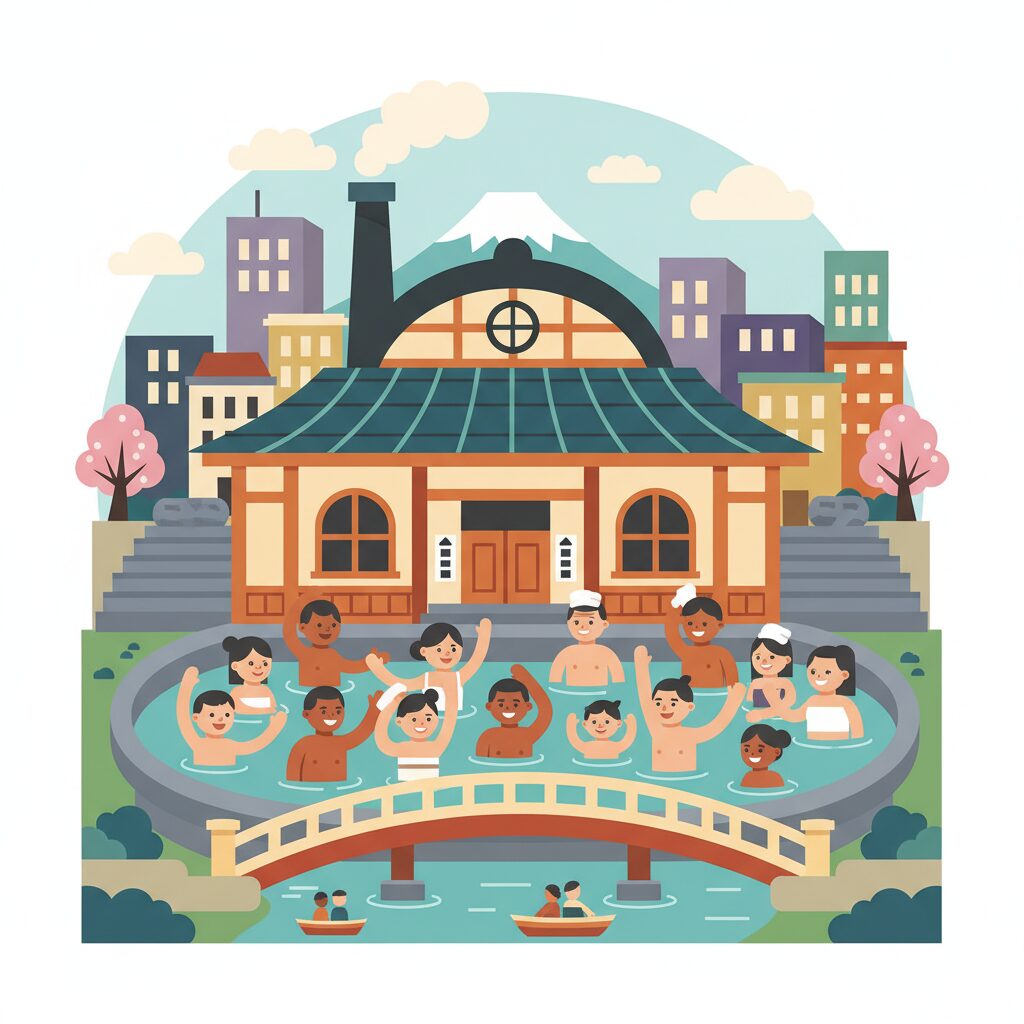
When I first moved to Osaka from Tokyo, I carried with me a certain set of assumptions. I figured cities were cities; a collection of people living private lives in close proximity. In Tokyo, my neighborhood was a place of quiet corridors and polite, distant nods. You could live next to someone for years and never learn their name. Community was something you actively sought out, a deliberate choice made in hobby clubs or curated social circles. It wasn’t something that just… happened. Then I was invited to a ‘sentō’, a public bathhouse, and my entire understanding of urban life began to unravel, dissolving in the steam and chatter of a world I never knew existed. I thought, doesn’t everyone have a bath at home these days? Why would anyone trek down the street, basket of soap in hand, to bathe with strangers? The question seemed simple, but the answer revealed the very soul of Osaka. This wasn’t about hygiene. It was about connection. It was about a social infrastructure that Tokyo had long since replaced with convenience stores and anonymous apartment lobbies. To understand why Osaka feels so fundamentally different, why its neighborhoods pulse with a life that can seem almost intrusive to an outsider, you have to look past the gleaming towers of Umeda and the neon glow of Dotonbori. You have to step into the humid, welcoming embrace of the local sentō.
Exploring the vibrant communal spirit of Osaka also invites you to delve into the nuances of boke and tsukkomi culture, which adds a unique layer to the city’s social fabric.
The Bathhouse as Osaka’s Living Room
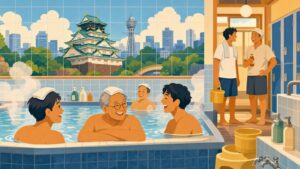
In Tokyo, a third place—that social space between home and work—is often a stylish café or a quiet bar. It’s a spot where you can be alone together. You slip on your earbuds, open your laptop, and soak in the ambient hum of a city that deeply values personal boundaries. The Osaka sentō, however, is the complete opposite of this idea. It’s not a sanctuary for quiet reflection. Rather, it serves as the neighborhood’s communal living room, its town square, its information hub—all combined in one steamy, tiled hall. The instant you slide open the door, you’re greeted not only by the heat but by a wall of sound. It’s the lively laughter of older men debating the Hanshin Tigers‘ latest game, the high-pitched squeals of children splashing wildly, and the constant, overlapping chatter of the local ‘obachan’ (aunties) network, sharing the day’s essential news. There’s a rhythm to it—a chaotic symphony of life expressed openly. Plastic stools scrape across the wet floor, showerheads hiss, and the vast echo of the cavernous room magnifies every conversation into a public proclamation. Privacy isn’t the currency here; participation is. People don’t just come to get clean; they come to be seen, to be heard, and to belong to something bigger than their own four walls. It’s a place where you can’t help but get involved, where the boundaries between your life and your neighbor’s blur in both profound and everyday ways. It’s where you learn who’s getting married, whose cat is sick, and which grocery store has the best deal on daikon radishes this week.
Where Everyone Knows Your Name
At the core of this whole setup is the ‘bandai’, the raised platform near the entrance where the owner sits, collecting money and keeping an eye on the comings and goings. In a Tokyo sentō, this might be a brief transaction with a polite but distant employee. In Osaka, the bandai serves as the neighborhood’s memory keeper. The owner acts as the matriarch or patriarch of this extended family, greeting regulars by name, asking about their grandchildren, and holding their ‘my-furo’ sets—the personal plastic baskets filled with soap, shampoo, and razors that patrons leave at the bathhouse, showing how frequently they visit. These baskets, lined up like tiny personalized lockers, symbolize something powerful: this isn’t just a place people visit; it’s a place they belong to. The owner senses the community’s heartbeat because they witness it daily. They notice when an elderly regular hasn’t appeared for a few days and will ask another neighbor to check on them. This informal welfare system is one of the sentō’s most crucial yet invisible roles. It’s a safety net woven from casual chats and daily watchfulness, sharply contrasting the formal, often impersonal social services of a big city. The sentō lobby, with its worn sofas, buzzing vending machines selling cold milk and beer, and a perpetually-on television, functions as a post-bath gathering spot. Here, freshly scrubbed and relaxed, the community lingers, prolonging the experience. It’s not a quick stop; it’s the main social event of the day.
‘Hadaka no Tsukiai’: The Great Equalizer
There’s a Japanese concept you often hear mentioned: ‘hadaka no tsukiai‘. It literally means ‘naked communication’ or ‘naked fellowship’. Across most of Japan, it remains a somewhat abstract notion, typically brought up in relation to corporate bonding trips to hot spring resorts. The idea is that by stripping off your clothes, you also shed your titles, status, and pretensions, enabling a more honest and straightforward form of communication. In an Osaka sentō, however, this is not just an abstract idea. It’s a lived, everyday reality. Here, the concept truly comes alive, fueled by Osaka’s practical and anti-authoritarian spirit. Osaka was founded by merchants, not samurai, so status has traditionally been based more on results and personality than on formal titles or rigid hierarchies. The sentō perfectly embodies this mindset. The CEO of a small local company bathes beside the person who runs the corner takoyaki stand. A housewife chats with a high school teacher. In the bath, everyone is equal—simply neighbors sharing a moment of relaxation. There’s no ‘buchō’ (department manager) or ‘sensei’ (teacher), only ‘Tanaka-san’ and ‘Yamamoto-san’. This setting encourages a distinctive style of communication. People are blunt, direct, and often hilariously straightforward. They’ll comment on everything—from your back tattoo to the brand of shampoo you use. For someone from Tokyo, where indirectness is an art, this can feel startling. But it’s rarely meant to offend. It stems from genuine curiosity and a shared belief that everyone is in this together. In the nude, there’s no room for posturing. It serves as a strong social equalizer, reinforcing the idea that at the end of the day, everyone is simply human.
The Body Unburdened
Foreigners often feel uneasy about the public nudity involved in sentō and onsen culture, which is understandable. In many cultures, the naked body is either sexualized or associated with vulnerability and shame. What is frequently misunderstood is that within the context of an Osaka sentō, the body is almost entirely desexualized and de-politicized. It’s just a body. It gets dirty, it gets tired, and it needs washing. There is a profound absence of judgment regarding physical appearance. Young or old, fat or thin, toned or soft—no one cares. This casual acceptance is incredibly freeing. It is a space where people, especially women, can escape the constant pressure to maintain a certain image for the world. No makeup, no stylish clothing, no carefully crafted persona. This freedom from aesthetic judgment is a crucial element of the ‘hadaka no tsukiai’ experience. It enables a vulnerability that encourages genuine connection. An elderly woman might casually ask a young mother to help scrub her back—a simple gesture of communal trust that would be unthinkable in nearly any other public environment. This is the true magic of the sentō: it creates a rare space in modern urban life where people can be completely and unselfconsciously themselves, and be accepted as such by their community.
The Unspoken Rules of the Neighborhood Hub
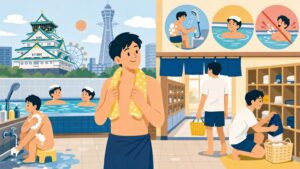
Every visitor quickly learns the basic sentō rules: thoroughly wash your body before entering the tubs, keep your small towel from touching the bathwater, and avoid splashing or running. These guidelines are about hygiene and safety. However, the rules that truly govern the Osaka sentō are social and unwritten. They are learned through observation and participation. The first unspoken rule is that engagement is encouraged. Silence invites suspicion more than small talk does. Unlike a quiet temple or a tranquil mountain onsen, the neighborhood sentō thrives on noise. It’s perfectly fine to strike up a conversation with a complete stranger by commenting on the water’s heat (“ee oyu desu na”) or the weather. In fact, it’s expected. Sitting in silent stillness marks you as an outsider, someone who doesn’t understand the place’s purpose. The second rule is to respect the established territories and routines of the regulars. Many older patrons have their favorite shower station or particular spot in the jacuzzi, earned through years of daily visits. Newcomers should pause to observe the flow before choosing a spot. This isn’t about exclusion, but about recognizing that you’re a guest in a well-established ecosystem. Showing this small respect is appreciated and will ease your acceptance within the community. It’s a subtle social dance that defines life in a dense, interconnected Osaka neighborhood.
Why Osaka Clings to its Sentō Culture
Traditional sentō are vanishing rapidly throughout Japan. Confronted with an aging clientele, rising fuel expenses, and the fact that nearly every household now has its own private bath, thousands have permanently shut down. Yet, in Osaka, sentō endure with a stubbornness that reflects the city’s unique character. Their persistence boils down to this: in Osaka, the sentō was never solely about bathing. Its role as a community hub is too important to be replaced by a private bathroom. This highlights a fundamental difference between Osaka and Tokyo. Tokyo is a city of transplants, a vast urban sprawl where anonymity is often embraced rather than avoided. People relocate there for work and personal goals, and neighborhood connections tend to be weak. Osaka, though a large city, fosters a much stronger sense of local, multi-generational identity. Many residents spend their entire lives in the same area, with the neighborhood serving as the central unit of social life. The sentō anchors that community. It is where the deeply rooted culture of ‘sewa’—caring for one another—is practiced daily. Osaka residents can be nosy or meddlesome, but this usually stems from genuine concern. They believe in being involved in each other’s lives. This sharply contrasts with Tokyo’s ideal of ‘meiwaku wo kakenai’ (not bothering others), which can sometimes result in a culture of polite detachment. In Osaka, choosing not to get involved would be seen as cold and stranger-like. The sentō drives this involvement, physically bringing people together and encouraging interaction, making sure no one becomes truly isolated.
A Tokyoite’s Field Guide to the Osaka Sentō
Coming from the capital, my initial visits to an Osaka sentō were lessons in cultural re-education. If you’re unfamiliar with this, here’s some advice from my experience. First, leave your Tokyo-style personal space bubble at the door. People will sit closer to you and speak more directly than you’re accustomed to. Don’t take this as rudeness; it’s a sign of acceptance. Second, embrace small talk. Compliment the mural of Mount Fuji on the wall (a classic sentō feature), ask about the various baths (like the ‘denki buro,’ or electric bath—approach with caution!), or simply offer a friendly greeting. Your effort will be appreciated. Third, take your time. The social aspect is just as important as the bathing. After your bath, grab a cold coffee milk from the vending machine, find a seat in the lobby, and just observe and listen. This is where you’ll see the community at work. You’ll witness friendships that have lasted decades, all centered around this humble institution. Lastly, understand that you’re entering a living piece of history. These aren’t retro theme parks; they are vital, functioning elements of the neighborhood’s social fabric. Treat the place and its people with the respect you would show when visiting someone’s home, because in many ways, that’s exactly what you’re doing.
Not Just a Relic, But a Living Tradition
It’s easy to romanticize the sentō as a fading relic from a past era. While their numbers may be declining, the ones still standing in Osaka are far from sad, empty museums. They are lively, bustling, and absolutely vital. They have endured because their social role remains crucial in a city that prioritizes human connection over impersonal efficiency. Naturally, there are modern ‘super sentō‘ located on the outskirts, featuring upscale restaurants and massage chairs. However, these are destinations you drive to for a leisure day. They do not fulfill the same role as the ‘machi no o-furo-ya-san’—the small neighborhood bathhouse within walking distance, the one that has stood on the same corner for eighty years. To truly understand life in Osaka, you must realize that community is not just an abstract concept. It’s a practical, everyday reality, built through small moments, shared spaces, and casual conversations during a soak in hot water. The sentō is more than merely a place to clean oneself; it is the heart of Osaka’s neighborhood identity, a space where the city’s loud, warm, and deeply human spirit comes alive.