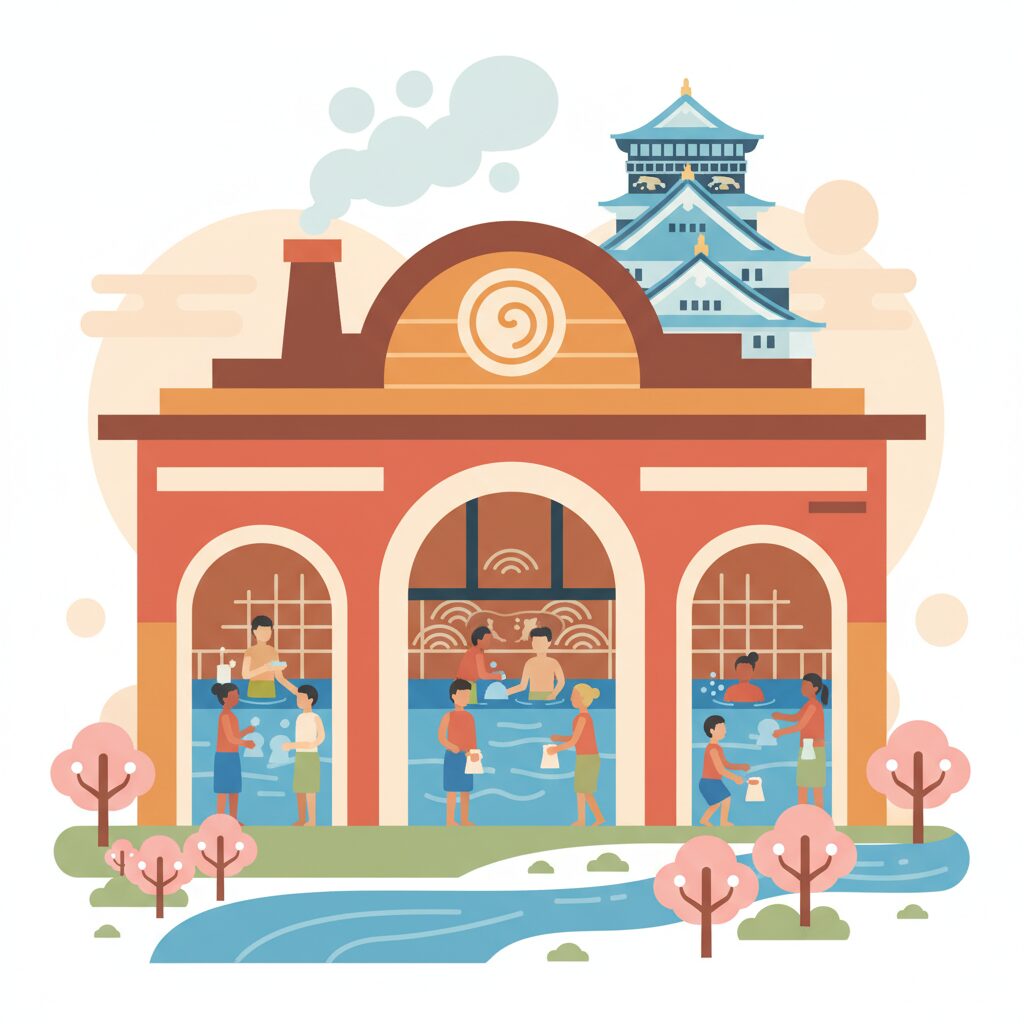
You see the pictures online, the ones with the grand Mount Fuji mural painted above a steaming tub. You hear the word—sento—and maybe you think of it as a relic, a quirky cultural experience to check off a list, Japan’s version of a vintage spa. Or maybe you confuse it with an onsen, assuming it’s all about natural hot springs and serene mountain views. That’s the postcard version. In Osaka, especially in the winding, low-slung neighborhoods that don’t make the travel blogs, the sento is something else entirely. It’s not a destination. It’s the destination at the end of every day. It’s not quiet. It’s the buzzing, echoing, gloriously loud heartbeat of the community. It’s the neighborhood’s living room, its newsroom, and its unofficial safety net, all rolled into one steamy, tiled hall.
Forget the glossy image of modern Japan, of silent subways and polite, invisible neighbors in high-rise apartments. To really understand Osaka, you need to walk the backstreets of places like Ikuno, Taisho, or Nishinari as the sun goes down. You’ll see fluorescent lights flicker on above faded noren curtains, a bicycle propped against the entrance, and hear the unmistakable sound of life—clattering plastic stools, running water, and a chorus of booming, Kansai-ben chatter that spills out into the street. This isn’t a performance for tourists. This is the raw, unfiltered social fabric of the city. Stepping into an Osaka sento is stepping into a conversation that has been going on for generations. It’s where you see how this city, so often misunderstood as just loud and brash, is built on a foundation of profound, practical, and deeply human connection. It’s where the city washes off the day’s grime and reveals its true, unvarnished self.
Embrace the evening’s lively atmosphere and explore the Hokusetsu secret to Osaka sanity to uncover how local weekend escapes deepen the city’s enduring community vibe.
The Unspoken Rules of the Neighborhood Living Room
The first thing that strikes you isn’t the heat, but the noise. A Tokyo sento might be marked by a respectful hush, a place for quiet reflection. An Osaka sento, however, sounds like a family reunion echoing through tiled walls. It’s a lively chorus of everyday life. Amid the steady drumming of showers and the rush of water filling the tubs, you’ll catch snippets of the day’s conversations. An obaachan (grandma) with a plastic basin balanced on her head good-naturedly complains about the price of cabbage. Two middle-aged men, submerged up to their necks in the hot bath, loudly analyze the Hanshin Tigers’ most recent loss. There’s no pretense of privacy; the whole room is a shared space, and the chatter is as much part of the atmosphere as the steam itself.
This is the realm of the regulars. They have their preferred spots at the washing stations, set times, and unspoken social rules. They are the caretakers of this place. For them, the sento is an indispensable part of their daily routine, as vital as eating or sleeping. Here, the idea of hadaka no tsukiai—literally “naked communication”—comes alive, but in a distinctively Osakan way. This concept exists throughout Japan, implying that without the status symbols of clothing, people can connect more genuinely. In Tokyo, this might take the form of a quiet, shared moment of vulnerability. In Osaka, it means a 70-year-old retired factory worker feels perfectly at ease telling a young salaryman that his scrubbing technique is all wrong.
There’s an intense intimacy here that may feel startling if you’re accustomed to Western notions of personal space or the more reserved norms of other Japanese cities. Someone might suddenly ask you directly: “Where you from? You live ‘round here?” This isn’t an interrogation—it’s a way to place you. They’re trying to figure out where you fit within the neighborhood map in their minds. An old man might notice you struggling with a faucet and come over to wrestle it into submission, grumbling a wordless explanation. An auntie might push her own bottle of luxury shampoo your way with a gruff “Tsukai” (“Use it”), not because you look like you need it, but as a sign of temporary inclusion in the community. Accepting these small, informal gestures is crucial. To refuse is to reject the connection and insist on remaining an outsider. In the Osaka sento, the unspoken rule is to relax, accept, and blend into the background noise.
Why Sento Culture Thrives in Osaka (and Fades Elsewhere)
You might wonder why this tradition remains so firmly rooted here. Throughout Japan, sento are shutting down at an alarming pace. Modern apartments come equipped with their own advanced bathrooms. The need has vanished. In a city like Tokyo, where efficiency and redevelopment are relentless forces, an old neighborhood bathhouse often becomes prime real estate destined for condominiums. While Osaka isn’t exempt from this trend, the cultural significance of the sento is simply stronger, its roots penetrating more deeply into the city’s unique social fabric.
To grasp why, you need to examine how Osaka was established. This has always been a city of merchants, craftsmen, and laborers, rather than samurai and bureaucrats. The city developed around markets and workshops, organized into dense, tightly-knit communities. For centuries, people lived in nagaya, long wooden row houses with shared walls and often shared facilities. Your life was deeply connected to your neighbors. Their business was your business, and community wasn’t a lifestyle choice but a survival necessity. The sento was not a luxury; it was an essential facility that soon became the focal point of this highly localized social network.
This working-class, practical mindset persists. While a Tokyoite might prioritize the privacy and convenience of their own apartment, an Osakan is more inclined to consider practicality. For many elderly residents on a limited pension, the 490 yen entry fee for a sento is an affordable alternative to the gas bill required to heat a bath at home every night. It’s a warm, safe place to visit. It’s a certain human connection in a world that can feel increasingly isolating. This isn’t about romanticizing the past; it’s an ongoing economic and social decision made every day. The loyalty to the local sento reflects a deeper loyalty to the neighborhood itself—a sense that the community is a genuine, tangible entity worth preserving, not just a group of addresses.
Reading the Social Cues: From Gossip to Mutual Support
If you sit quietly in the bath and simply listen, you’ll realize the chatter is more than mere idle gossip; it’s a finely-tuned information network. The conversations serve as a live, crowd-sourced update on the health and well-being of the neighborhood. You’ll hear who’s in the hospital, whose son just passed his university entrance exams, which local shop is running a sale on mackerel, and who is feuding with whom over a misplaced potted plant. At the heart of this information web, you’ll often find the bandai, the attendant seated on a high platform overseeing both the men’s and women’s changing rooms. From this vantage point, they observe and hear everything. They know who comes and goes, who appears unwell, and who hasn’t shown up in several days.
What a foreigner might dismiss as nosiness is actually a form of collective care. This is the community’s early-warning system. If Mrs. Sato, who never misses her 4 PM bath, is absent for two days in a row, it doesn’t go unnoticed. Someone will bring it up. The attendant at the bandai might ask, “Have you seen Sato-san?” By the next day, another regular living down the same alley will have checked on her to make sure she’s alright. This is the invisible safety net of the shitamachi. In an anonymous Tokyo high-rise, you could be sick for a week and no one would know. In a Nishinari neighborhood, your absence at the sento rings a silent alarm throughout the community.
I once overheard two grandmothers discussing a neighbor who had just returned home after a hip operation. They weren’t merely expressing sympathy; they were coordinating. Within minutes, between scrubbing their backs and soaking in the medicinal bath, they had arranged a loose schedule for who would bring her a small bento for lunch over the next few days. There was no committee or formal request. It was an organic, instantaneous response to a community need, made possible by the shared space of the bathhouse. This is what people mean when they say Osaka is “friendly.” It’s not about surface-level smiles. It’s about a deeply rooted, practical sense of mutual obligation—a belief that you are all, quite literally, in it together. The sento is where this belief is reaffirmed, night after night.
The Sento Experience for a Foreigner: An Insider’s Guide
For a non-Japanese person, stepping into this deeply local space can feel intimidating. The rules appear arcane, the language a challenge, and then there’s the ever-present question of tattoos. Let’s break it down, Osaka-style: straightforward and without any fluff.
Your First Visit: A Practical Walkthrough
First, bring a small towel for washing, a larger one for drying, along with soap and shampoo. Many sento sell these items, but regulars often bring their own in a small plastic basket. At the entrance, you’ll find shoe lockers; place your shoes inside and take the wooden key. Payment is made at the bandai or via a vending machine—it’s a set price, usually under 500 yen. Proceed to the correct changing room (男 for men, 女 for women). Find an empty locker or basket for your clothes, and keep the locker key on your wrist. The only things you bring into the bathing area are your small wash towel and toiletries.
The cardinal rule is straightforward: you must wash your body thoroughly before entering any tubs. Take a small plastic stool and a basin, find a free shower station, and scrub yourself clean. Avoid splashing others around you. Once clean, feel free to soak. And please, for the love of all that is holy, don’t put your small wash towel in the bathwater. The customary practice is to place it on your head or on the side of the tub.
The Tattoo Question
This one’s tricky. Officially, many places still display “No Tattoo” signs, a holdover from their association with the yakuza. However, Osaka tends to be more relaxed than other parts of Japan. In an old neighborhood sento, the rule is often about maintaining harmony rather than strict dogma. If you have a small, non-threatening tattoo and behave quietly and respectfully, chances are nobody will mind. Regulars are usually more concerned with proper washing etiquette than your ink. But if you have extensive tattoos, it may still be problematic. The best advice is to check for signs at the entrance or simply observe. This isn’t a place to make a statement; it’s a place to blend in.
Post-Bath Ritual
The experience doesn’t end when you leave the water. The changing room serves as the sento’s cool-down lounge, where the real charm can be found. Old men in their underwear stand in front of fans with hands on hips, weighing themselves on ancient scales. People sit on vinyl benches, chatting as they dry off. Almost everyone partakes in the sacred post-bath drink. Look for classic glass-doored refrigerators stocked with small bottles of milk—plain, coffee, and the delightful fruit milk. Drinking an ice-cold bottle of one of these is an essential part of the ritual. It’s the perfect, simple conclusion to the experience. This is another small, shared moment of community, the final punctuation mark on the day.
The Future of the Neighborhood Hub
Let’s be honest: this world is fragile. The number of sento in Osaka is decreasing every year. The owners are aging, their children are reluctant to take over the demanding business, and the economics are tough. Each closure represents more than just a lost business; it’s a tear in the social fabric of the neighborhood. A vital community hub disappears, and the invisible safety net grows weaker.
But the story isn’t finished. A new movement is emerging, led by a younger generation that recognizes the cultural importance of these spaces. Throughout Osaka, old sento have been rescued from demolition and reimagined. Some have been carefully restored to their Showa-era splendor, becoming retro-chic destinations. Others have been boldly modernized. You might find a sento that now serves craft beer in its lobby, hosts live music, or doubles as a contemporary art gallery. These revitalized bathhouses are intriguing social experiments. They attract a new, younger crowd—including students, artists, and foreigners—while often striving to keep prices low and the atmosphere welcoming for the original elderly patrons.
In these spaces, you can observe a beautiful cultural exchange. You’ll see groups of young creatives sipping IPAs on a bench next to grandfathers enjoying classic fruit milk. They are creating a new kind of community space, one that bridges the gap between old Osaka and new. They demonstrate that the sento doesn’t have to be a museum relic; it can evolve.
Ultimately, visiting a neighborhood sento offers a profound glimpse into the soul of Osaka. It serves as a reminder that in a world racing toward digital connection and urban anonymity, the strongest social networks remain analog. It’s where you learn that community isn’t built on grand gestures, but on small, daily rituals of showing up, sharing space, and checking in on your neighbors. It’s the city’s heart, beating steadily behind a simple noren curtain, in a room filled with steam and stories.