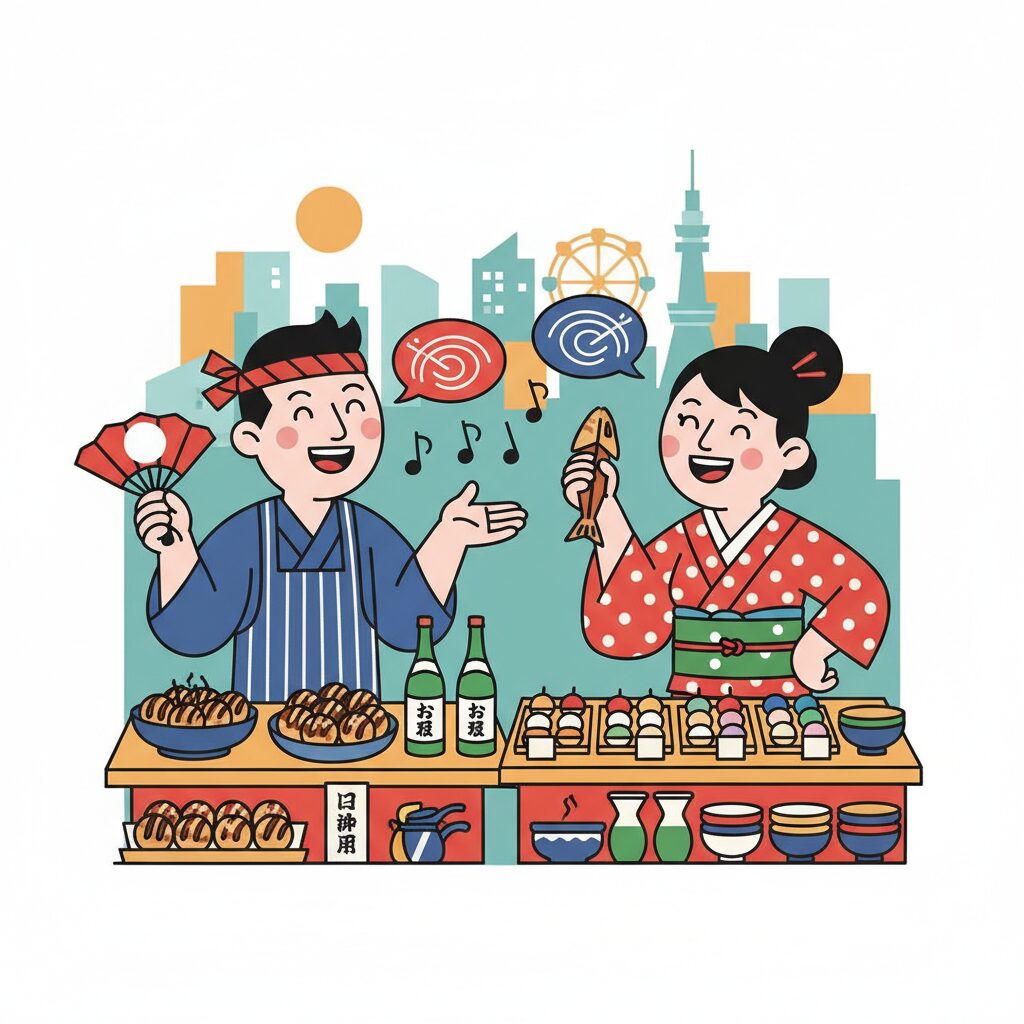
I still remember my first week in Osaka, wandering through a shotengai, one of those long, covered shopping arcades that feel like the city’s arteries. I was trying to buy some fruit from a tiny shop run by a woman who looked like she’d been selling apples from that same spot since the invention of gravity. I picked up a pear, a nice-looking one, and handed it to her. She squinted at me, then at the pear, then back at me. “Hontou ni sore de ii no?” she asked, her voice a gravelly mix of suspicion and amusement. “Are you really okay with that one?” My Japanese was shaky, but the meaning was clear. Was there something wrong with the pear? Was I being tested? I stammered a bit, pointing to another one, and she just laughed, a loud, throaty cackle that turned heads. “This one’s much better for a young fella like you!” she declared, bagging it up. I paid and walked away, utterly bewildered. In Tokyo, a shopkeeper would have praised my choice as if I’d just selected the holy grail of pears. Here, I felt like I’d just failed a pop quiz.
That simple, baffling interaction was my introduction to the real soul of Osaka’s commerce. It’s a world that exists beyond the simple exchange of money for goods. It’s a performance, a conversation, a game of wits played out a thousand times a day under the fluorescent lights of the shotengai. For foreigners accustomed to the polite, polished, and often distant customer service of the rest of Japan, this can be a shock. Is it rude? Is it aggressive? Why is the takoyaki vendor making fun of my shoes? These are the questions that bubble up when you dive into daily life here. The truth is, it’s neither rude nor aggressive. It’s a language of connection, a unique brand of street-level intimacy that defines what it means to live in Osaka. Forget what you think you know about Japanese customer service; we’re not in Tokyo anymore. This is the art of the deal, Osaka-style, where the prize isn’t just a bag of groceries, but a shared laugh and a feeling that you actually belong.
This vibrant street culture is echoed in the way locals bond over community sento baths, underscoring Osaka’s unique approach to building neighborhood connections.
The Unwritten Rules of the Osaka Banter Game

Exploring an Osaka shotengai for the first time feels like being thrust into a theater production without having read the script. The atmosphere is alive with vendors’ calls, the sizzle of frying oil, and a lively buzz of conversation that sweeps you along. The key to navigating—and eventually enjoying—this experience lies in recognizing that the unwritten rules here are entirely different. This isn’t a sterile exchange; it’s a social contract rooted in centuries of merchant tradition.
It’s Not Haggling, It’s a Conversation
Many foreigners, especially those familiar with other parts of Asia, interpret the spirited back-and-forth as an opportunity to haggle. They attempt to shave a few yen off the price of some vegetables, only to be met with a firm, sometimes theatrical, refusal. This is the first major misconception. In Osaka, prices are generally fixed. The point isn’t to change the price tag’s number; it’s to deepen the connection between you and the seller.
The true currency in a shotengai is connection. The shopkeeper doesn’t want to debate fifty yen; they want to learn about you. They’ll ask where you’re from, what you’re cooking for dinner, and why you’re buying a single green pepper when a three-pack offers better value. These questions go beyond small talk. They’re an invitation—an informal test to see if you’re just another passerby or someone willing to engage on a personal level. The reward isn’t a discount. It’s an “omake,” a little extra added to your bag—a bonus onion, an extra piece of fried chicken, a handful of candies. This isn’t a prize won through bargaining; it’s a gift given for joining the conversation. It’s the shopkeeper’s way of saying, “I see you. We connected. Come back soon.”
Welcome to the World of Tsukkomi and Boke
To truly understand the flow of conversation in Osaka, you need to grasp the foundation of Japanese comedy: Manzai. This traditional two-person stand-up act features the “boke,” a goofy, air-headed character who makes absurd remarks, and the “tsukkomi,” the sharp-witted straight man who corrects them, often with a light slap or a witty retort. In Osaka, this isn’t limited to the stage; it’s embedded in everyday communication, with the shotengai serving as its prime venue.
More often than not, the shopkeeper assumes the tsukkomi role, while you, the unsuspecting customer, become the boke. You might hold up a loudly patterned shirt, and the shopkeeper will deadpan, “You’re not seriously going to wear that, are you?” You ask for a small portion of croquettes, and they reply, “What are you, dieting? You should eat more!” This isn’t an insult; it’s a comedic setup. They’re commenting on your “boke” move—your questionable fashion choice or small appetite—and waiting for how you respond. The wrong response is to take offense or get embarrassed. The right one is simply to laugh. Acknowledging the joke is enough. A more advanced approach is to respond with a boke comeback. But just smiling and appreciating the exchange is more than sufficient. You’ve shown you understand—you’re in on the joke. The barrier between customer and seller falls away, replaced by a shared moment of humor.
Decoding the Language of Osaka Commerce
While standard Japanese will suffice, the shotengai communicates on an entirely different linguistic wavelength. It’s a dialect shaped not only by words but by attitude. The expressions you hear are deeply rooted in the city’s merchant heritage, reflecting a worldview that is practical, straightforward, and unsentimentally honest. This contrasts sharply with the honorifics and polite evasions that often define Japanese communication elsewhere.
“Mokarimakka?” and “Bochi Bochi Denna” – The Merchant’s Greeting
When you enter a shop in Tokyo, you’ll typically be met with a crisp, uniform “Irasshaimase!” (Welcome!). It’s polite, professional, and a wall of sound that doesn’t expect a reply. In Osaka, especially among older shopkeepers, the greeting often takes the form of a hearty “Mokarimakka?” which literally means “Are you making a profit?” This blunt question would be considered rude in almost any other setting. Imagine stepping into a shop in London and hearing the owner ask, “So, you making good money at your job?” You’d likely be startled.
However, in Osaka, this is the typical icebreaker. It’s a conversation rooted in a shared identity of people familiar with business and the daily hustle. The customary, almost obligatory, reply is “Bochi bochi denna,” meaning roughly “Yeah, so-so” or “Can’t complain.” It’s a modest, non-committal response that conveys a sense of shared effort and endurance. This exchange instantly creates a distinctive dynamic. It’s not a faceless customer welcomed into a corporate environment; it’s two individuals on the street, acknowledging the everyday grind before engaging in commerce.
The Art of the Playful Insult
Undoubtedly, this presents the biggest challenge for foreigners. The teasing in Osaka can seem personal and brutally candid. The elderly woman at the vegetable stall might tell you that you look tired. The butcher might comment on your weight. The lady selling second-hand clothes might hold up a pair of pants and loudly declare they won’t fit you. From a Western perspective, this can feel like an insult. We are taught that the customer is always right, and that service personnel should be nothing but flattering.
In Osaka, this playful banter is a strong sign of acceptance. A shopkeeper teases only those they feel comfortable with. It’s a way to break down social barriers and treat you not as a respected “okyakusama” (customer), but as a neighbor, a regular, almost family. Consider this: you wouldn’t let a complete stranger criticize your cooking, but your grandmother can, and you take it in stride. Through teasing, the Osaka shopkeeper is drawing you into their inner circle, signaling, “You’re no longer a stranger to me. You’re part of this community, so I can give you a hard time.” The key is to look beyond the literal words and catch the sparkle in their eye, the hidden grin. The criticism isn’t genuine; the warmth behind it is.
How to Play Along (and Why You Should)
Grasping the theory is one thing, but applying it in practice can feel daunting. The fear of saying something wrong or misunderstanding a joke is very real. Yet, the charm of the Osaka system is that the entry barrier is extremely low. You don’t have to be a comedian or speak Japanese fluently to join in. All you need is the willingness to be part of the moment.
Your Role as the Customer-Performer
The key shift in mindset is crucial. You’re not just a consumer completing a transaction. You are an audience member and a potential supporting actor in a small, improvised play. Your main job is to show appreciation for the performance.
The simplest way to do this is by smiling and laughing. Even if the joke isn’t completely clear to you, a good-natured chuckle indicates friendliness and acknowledges that this is a positive interaction. That alone will earn you points. If you feel more confident, respond to their questions. When they ask where you’re from, share your answer and perhaps add an interesting little fact. When they comment on your purchase, ask for their recommendation. “You think this one is no good? Okay, master, you pick for me!” Yielding to their expertise through this kind of interaction builds tremendous goodwill.
If you want to take it a step further, try offering a simple tsukkomi yourself. If the butcher jokes that you’re buying too much meat, you can reply with a smile, “Well, I wouldn’t have to if you didn’t make it so delicious!” This kind of lighthearted, complimentary comeback closes the comedic loop. It shows that you not only understand the game, but you can play along too. The response is almost always a big, surprised laugh, and you might even find a little extra in your bag when you get home.
Reading the Room: When Banter Crosses the Line (and When It Doesn’t)
Of course, it’s natural to wonder if there’s a limit. Is it always just a joke? The answer is that 99% of the time, yes, it is. Genuine rudeness is extremely rare. The entire interaction is based on a shared sense of playfulness. The key signals are in non-verbal cues. Look at their eyes. Are they crinkled with a smile? Is their body language open and relaxed? Is their tone light and teasing instead of sharp or angry?
Context is also important. This culture thrives especially among the older generation of shopkeepers in traditional shotengai or local markets like Kuromon Ichiba (though it’s become quite touristy, the spirit remains). These are the “obachan” and “ojisan” (aunties and uncles) who have spent their lives honing this art. You’re much less likely to find this behavior from a young part-time worker in a chain store or a trendy boutique in Shinsaibashi. They’ll typically provide the standard polite service found elsewhere in Japan. The banter belongs to the independent, often family-run businesses that lie at the heart of Osaka’s community life.
Shotengai as a Living Room, Not Just a Marketplace

To truly understand why Osaka is the way it is, you must view the shotengai not simply as a cluster of shops, but as the city’s communal living room. It is where people exchange gossip, check on their neighbors, and handle the daily affairs of life. The commercial aspect is almost secondary to the social purpose of the space. Here, the profound contrast between Osaka and Tokyo becomes unmistakably clear.
Why This Culture Thrives in Osaka
For centuries, Osaka has served as Japan’s kitchen and its commercial center. It was a city of merchants, artisans, and negotiators. Status was gained not through samurai heritage but through business savvy, wit, and the ability to cultivate strong relationships. This history nurtured a culture of practicality, straightforwardness, and a certain theatrical charm. A skilled merchant knew how to read people, charm them, and turn a one-time buyer into a lifelong customer. The banter and teasing you hear today are modern echoes of this tradition. It remains a highly effective, time-honored method for building trust and community in a commercial setting.
The shotengai physically embodies this spirit. Unlike an impersonal supermarket, where you pick up items and leave without a word, the shotengai encourages interaction. The fishmonger knows your preferred way to prepare mackerel. The fruit seller remembers that your child loves strawberries. The banter provides the soundtrack to these connections. It’s the steady, low-level murmur of a community looking out for one another.
A Tale of Two Cities: The Tokyo vs. Osaka Service Mentality
In Tokyo, the guiding principle is “okyakusama wa kamisama”—the customer is god. This belief demands that service be flawless, smooth, and deferential. Staff aim to anticipate the customer’s needs and meet them with utmost efficiency and politeness, while maintaining respectful distance. It is a commendable, often elegant form of service that prioritizes the customer’s comfort by removing all obstacles.
In contrast, Osaka’s philosophy might be phrased as “okyakusama wa tonari no hito”—the customer is your next-door neighbor. Here, the goal is not to elevate the customer to divine status, but to bring them down to eye level. The shopkeeper is not your servant; they are your equal, your counselor, and your friendly neighborhood sparring partner. They will challenge your choices, question your motives, and joke about your T-shirt—all in the service of creating a genuine human bond. The friction is not a flaw in the service; it is the very essence of it. It’s within these sparks of interaction that relationships are created and community thrives.
Finding Your Place in the Performance
Living in Osaka requires making a choice. You can stick to supermarkets and convenience stores, where interactions are predictable and safe. You can navigate the city with the polite, reserved distance typical elsewhere in Japan. There is nothing wrong with that. But you would be missing out on the true heartbeat of this city.
To genuinely feel at home here, you need to step onto the stage of the shotengai. You must be willing to feel a little confused, a little teased, and more open than you’re used to. It’s a process. Your first few attempts may be awkward. You might just stand there, blushing, while a tiny old woman loudly scrutinizes your life choices based on the three potatoes you’re trying to buy. But eventually, you’ll find the rhythm. You’ll deliver a witty comeback. You’ll get an extra gyoza in your order and a booming laugh from the man behind the counter. In that moment, something clicks. You’re no longer just a resident, a foreigner, or a customer. You’re part of the show. You’re in on the joke. And you’ll realize that your daily errands have turned into one of the most entertaining, frustrating, and deeply human experiences imaginable. This is the real, unvarnished friendliness of Osaka, and it’s worth every bewildering moment.