The laptop clicks shut, but the office doesn’t disappear. It lingers on the dining table, a silent accusation next to your half-eaten dinner. The Slack notifications, though muted, still flash in your mind’s eye. This is the ghost in the machine of modern remote work: a world of infinite flexibility that somehow chains us to our desks, blurring the lines between work and life until they become a single, stressful smudge. We were promised freedom, but many of us found a longer, lonelier leash. And if you’re living in Japan, you might feel this pressure compounded by the country’s legendary, and often intimidating, work culture of long hours and unwavering dedication.
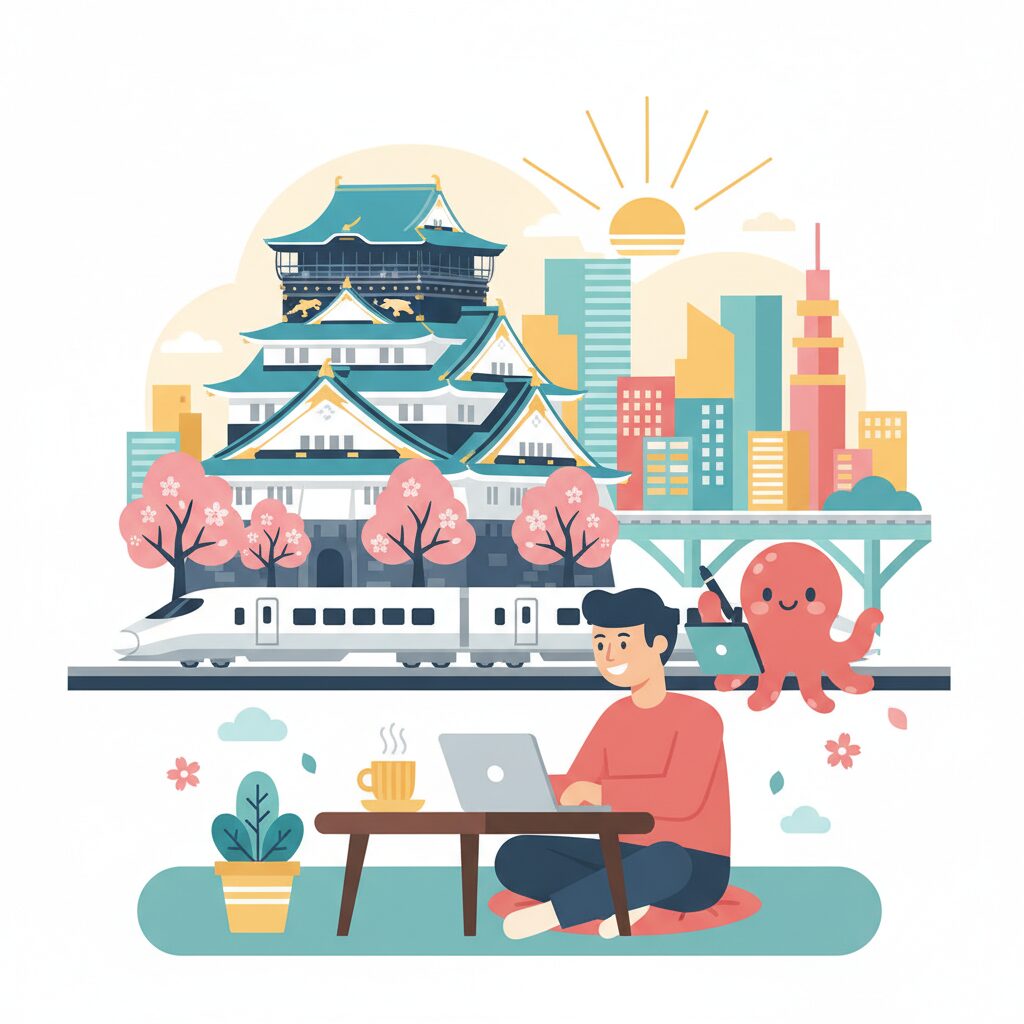
But then there’s Osaka. A city that plays by a different set of rules. While the rest of Japan might march to the rhythm of a meticulously planned corporate drum, Osaka grooves to a syncopated beat of commerce, comedy, and common sense. It’s a city built not by samurai and bureaucrats, but by merchants, traders, and artisans—the akindo. These were the pragmatic, fast-talking, no-nonsense people who made this city the economic engine of Japan for centuries. And their spirit, a unique blend of shrewd efficiency and warm humanity, offers a surprisingly potent antidote to the burnout of our digital age. It’s a mindset that can teach you not just how to work from home, but how to thrive, how to draw a firm, bold line between your keyboard and your kitchen, and how to reclaim your life. This isn’t about productivity hacks from a tech guru; it’s about centuries-old wisdom from the streets of Namba and the covered markets of Tenma. It’s time to stop just working remotely in Osaka and start working like an Osakan.
Embracing Osaka’s spirited blend of efficiency and warmth can also inspire you to recharge with an Awaji Island weekend road trip that redefines your work-life balance.
The Akindo Mindset: More Than Just Business
To truly understand Osaka, you need to grasp the concept of the akindo. The term translates as ‘merchant,’ but that’s like calling a chef simply a ‘cook.’ It overlooks the essence of the idea. The akindo spirit functions as the city’s operating system, quietly driving every transaction, every conversation, and every plate of takoyaki sold on the streets.
What is an ‘Akindo’ Anyway?
For centuries, while Tokyo (then Edo) served as the political center governed by samurai with strict codes of honor and protocol, Osaka was the nation’s warehouse, kitchen, and bank. Known as Tenka no Daidokoro, the Kitchen of the Nation, everything—rice, sake, textiles, and money—flowed through it. Power in Osaka was not determined by birthright or status but by one’s intelligence, reputation, and skill in conducting good business (shobai). The akindo were the masters of this realm. Their culture rested on radical practicality: Does it work? Does it sell? Does it make sense? Those were the critical questions. There was little patience for the formalities and indirect communication typical of the samurai class. In Osaka, you got straight to the point, because time was quite literally money.
This created a deep cultural divide that remains palpable today. A business meeting in Tokyo might resemble a carefully choreographed dance, full of respect for hierarchy and subtle, unspoken signals. In Osaka, it’s more likely to be a direct, lively discussion centered on the bottom line. This isn’t rudeness; it’s efficiency. The akindo spirit values honesty and directness as the quickest paths to mutually beneficial results. It’s a culture that prioritizes results over process and substance over style.
‘Moukarimakka?’ – The Greeting That Defines a City
Nowhere is this mindset more evident than in the city’s iconic greeting: “Moukarimakka?”—which means, “Are you making a profit?”—typically met with the reply, “Bochi bochi denna,” or “So-so, can’t complain.” To outsiders or even those from Tokyo, this might seem blunt or rude. Imagine asking a colleague in London or New York, “Hey, are you profitable today?” You’d likely get puzzled looks. But in Osaka, it’s the standard way of asking, “How are you?” This greeting reveals the city’s fundamental philosophy. It’s not really a nosy question about finances. It’s more a way of saying, “How’s life? Are things going well? Is your effort paying off?”
It frames well-being in practical terms, implying that a good life means your work is bearing fruit. For a remote worker, this is a revolutionary concept. We’re often taught to measure our value by hours clocked or emails sent—by looking busy. The moukarimakka mindset encourages a different question: what is the actual “profit” of my work today? It’s not about simply being online; it’s about creating value, solving problems, or completing projects. It serves as a daily reminder to focus on output rather than input—a crucial step toward reclaiming your time and energy.
Principle 1: ‘Shimatsu’ – The Art of Frugal Efficiency
One of the most common stereotypes about people from Osaka is that they are stingy, or kechi. This label is often used by people from other regions of Japan, highlighting Osakans’ obsession with getting a good deal and not wasting a single yen. However, this reflects a fundamental misunderstanding of the akindo spirit. The real concept isn’t kechi; it’s shimatsu.
The Misconception of ‘Kechi’ (Stinginess)
Kechi means being cheap for the sake of cheapness. It’s buying the lowest-quality item solely because it costs the least, without regard for its value. Shimatsu, by contrast, is a deeply rooted philosophy of resourcefulness and avoiding waste. It’s about maximizing the value of everything you have—your money, time, food, and energy. An akindo practicing shimatsu doesn’t simply buy the cheapest tool; they invest in the tool that performs best for the longest time, delivering the highest return. It’s not about spending less—it’s about spending wisely.
You can see shimatsu in everyday life in Osaka. It’s in the shotengai (covered shopping arcade), where shopkeepers often include an extra green onion (omake) to foster goodwill and prevent waste. It’s in home kitchens where a single daikon radish is used completely—from the root for simmering to the greens for a side dish. It’s embodied in the concept of kuidaore (eat till you drop), which isn’t simply about indulgence, but about a city focused on offering good value food so reasonably priced that you can afford to eat until you drop. Shimatsu is a philosophy rooted in respect for resources.
Applying ‘Shimatsu’ to Your Remote Workday
How does this age-old principle of frugality relate to your life as a remote worker? You need to start seeing your time and focus as your most valuable assets. An akindo wouldn’t let their best merchandise spoil in the backroom, and you shouldn’t allow your most productive hours to be wasted on digital clutter.
First, consider Time Management as Shimatsu. Your workday is a limited resource. An akindo would never squander three hours on a task that should take one. Examine your day rigorously. Where is the waste? Is it the constant flow of notifications? The meetings that drag on without a clear agenda or outcome? Practice time shimatsu. Be ruthless with your calendar. Set aside blocks of time for deep focus and guard them jealously. Reject meetings lacking clear purpose. Write emails that are concise, clear, and aimed at getting quick answers rather than starting long, rambling discussions. An akindo gets straight to the point; your communications should as well.
Next, apply Energy Management as Shimatsu. Your mental energy is even more valuable than your time. Today’s pressure for “digital presenteeism”—the need to always appear online and available—is the ultimate drain on energy. It’s fake work and utterly exhausting. An Osakan merchant closes their shop at the end of the day. You should do the same with your laptop. Once your work is complete, log off. Don’t let work spill into your evenings, stealing energy you need for tomorrow. Shimatsu means investing your energy in what truly matters. Use it on high-impact tasks during your peak hours, then conserve it for the rest of your life. A well-rested mind is a more productive one.
Finally, apply shimatsu to Tool Management. In the digital era, we often accumulate subscriptions and apps like barnacles on a ship. Are you paying for three note-taking apps, two project management platforms, and a cloud storage service you seldom use? An akindo would take inventory, spot redundancies, and cut the waste. Choose one tool for the job and become proficient with it. Simplify your digital workspace. A streamlined set of tools enables a clear, efficient mind.
Principle 2: ‘Shobai’ Logic – The Focus on Results
The akindo mindset fundamentally revolves around shobai—business. However, it embodies a particular type of business logic that values concrete results over performative procedures. This mindset continuously asks, “What are we truly aiming to accomplish here, and what’s the most straightforward path to achieve it?” Such results-oriented thinking is an effective way to navigate the distractions and inefficiencies of corporate life, especially in a remote work environment.
Process vs. Profit: The Tokyo-Osaka Divide
To fully understand the shobai mindset, it helps to compare it with the more bureaucratic culture commonly seen in Tokyo. Many Tokyo-based companies place great importance on adhering to proper procedures, on nemawashi (the informal groundwork and consensus-building before formal decisions), and on showing respect for hierarchy. Sometimes, the process itself can overshadow the actual outcome. Meetings are held just to prepare for other meetings. Reports are endlessly written and revised with an emphasis on flawless formatting. While there’s a certain elegance and order to this, it can also be slow and inefficient.
In contrast, the Osaka shobai approach takes the opposite stance. An akindo cares less about how you arrive at an answer and more about whether it’s the correct answer. They cut through bureaucracy and ask the straightforward questions. Picture a project meeting: The Tokyo approach might feature a lengthy presentation on market research methods, followed by a discussion on proper internal approval channels. The Osaka approach would interrupt after ten minutes to ask, “Alright, but will people actually buy this? And how much can we sell it for?” This isn’t about disrespect; it reflects an unwavering focus on the objective. Why waste time on formalities when you could be discussing what really matters?
Structuring Your Remote Work for ‘Shobai’ Success
Applying this mindset to remote work can be liberating. It means shifting your perspective from “being busy” to “being effective.”
First, Define Your Daily “Profit.” At the start of each day, ask yourself the moukarimakka question. What does “profit” mean for you today? It could be completing a difficult report, closing a deal, solving a tricky coding issue, or simply clearing your inbox to start fresh tomorrow. Identify one to three key outcomes. This is your goal. Everything else is noise. By doing this, your to-do list transforms from a vague task jumble into a clear business plan for the day. You’re not just ‘working on the presentation’; you’re ‘finalizing the presentation for client review by 3 PM.’ This clarity is empowering.
Next, Cut the Unprofitable Tasks. Review your schedule and responsibilities with the same sharp eye an akindo uses on their inventory. What’s just sitting unused, taking up space? Consider low-impact meetings, pointless administrative tasks, or status reports no one reads. Question their necessity. Ask your manager if a meeting can be skipped. Suggest more efficient ways to share updates, like brief, asynchronous messages instead of 30-minute calls. A skilled akindo knows when to discontinue a product line that isn’t selling. You need to learn to eliminate tasks that don’t contribute to your “profit.”
Finally, embrace Direct and Honest Communication. The shobai spirit thrives on clear, straightforward dialogue. In a remote setting, where you lose body language cues, this is vital. Stop softening your language in emails and Slack messages. Instead of saying, “I was wondering if maybe you had a chance to look at the document I sent over?” say, “@colleague, I need your feedback on the document by noon today to move forward. Thanks!” Though it may seem blunt at first, this is actually a form of respect. You’re honoring the other person’s time by being clear about what you need. This directness reduces misunderstandings, cuts down endless back-and-forth, and speeds up progress.
Principle 3: The Human Connection – It’s All About Relationships
It’s easy to misread the akindo’s emphasis on profit and efficiency as cold and calculating. However, doing so overlooks the most crucial—and perhaps most unexpected—aspect of the system. Osaka’s entire commercial framework was rooted in deep human relationships and trust (shinyo). The warmth Osaka is renowned for is not merely a personality trait; it’s an integral business strategy.
Beyond the Transaction
For an akindo, a sale was never just a one-time deal. It marked the start or continuation of a personal connection. They knew their customers by name, were familiar with their families, and understood their preferences. This wasn’t mere small talk; it was the foundation for building loyalty in a competitive market. Satisfied, loyal customers would return repeatedly and recommend the shop to friends. The lighthearted banter, humor, and occasional omake (a small extra gift) were all investments in a lasting relationship. That’s why strolling through a shotengai in Osaka feels very different from shopping in an impersonal supermarket. Here, you’re not just a faceless customer; you’re part of a community.
This emphasis on human connection extended to other merchants as well. A network built on trust and mutual support was essential for survival. You had to know whom you could rely on and whose word you could trust. Reputation was their most valuable asset. This fostered a culture that, while straightforward and pragmatic, was also profoundly warm and communal. The aim was collective success because a prosperous community meant thriving businesses for everyone.
Building Your Remote Work Community, Osaka-Style
Remote work can be deeply isolating. Physical separation from colleagues can lead to loneliness and weaken team cohesion. The akindo spirit provides a powerful example of how to deliberately nurture the connections necessary for success.
First, Combat Isolation by Creating a “Third Place.” Your home is for living. Your company’s Slack is for working. You need a separate, neutral space. For the akindo, this was the neighborhood. For you, it can be the same. Don’t spend every day solely inside your apartment. Take your laptop to a local kissaten (retro coffee shop). Find one you like and become a regular. Learn the owner’s name. Engage in small talk. This simple habit draws a line between home and work, offering a change of scenery and—crucially—casual, low-pressure human interaction vital for mental well-being. You begin to feel part of the neighborhood, not just an apartment resident.
Second, Inject Humanity into Your Digital Relationships. Just because interactions happen through a screen doesn’t mean they must be impersonal. Adopt the akindo mindset: use humor and personality to build rapport. Osakan communication is known for its comedic interplay of boke (the playful fool) and tsukkomi (the straight man who calls it out). You don’t have to be a comedian, but lightening the mood helps. Share a funny GIF. Create a non-work-related Slack channel for pet photos or weekend plans. Ask colleagues about their holidays before jumping into work. These small personal touches mirror the friendly banter over a shop counter, fostering the trust and goodwill that make work more pleasant and collaboration smoother.
Finally, Set Boundaries to Protect Your Personal Relationships. Strong business ties respect limits. The akindo closes their shop and goes home to family. The ultimate aim of all their effort and efficiency is to enjoy life beyond work. One of remote work’s greatest risks is its encroachment on personal time. Guard that time fiercely. Clarify your working hours with colleagues. Turn off notifications outside those hours. Human connection extends beyond coworkers to friends, family, and yourself. The akindo works hard to earn profit that lets them savor life. Your “profit” is the time and energy you reclaim to nurture the relationships that truly matter.
Living the Akindo Work-Life Balance in Osaka
Adopting these principles—shimatsu, shobai, and human connection—is more than just a mental exercise. It’s a lifestyle that the city of Osaka is perfectly designed to support. Here, theory meets practice, allowing you to structure your days to foster a healthier, more productive, and more enjoyable remote work experience.
Your Neighborhood as Your Office and Your Oasis
Unlike Tokyo’s sprawling, specialized districts, most Osaka neighborhoods are wonderfully self-contained and built on a human scale. This is a huge advantage for remote workers. Within a five-minute walk from your home, you’ll likely find a quiet cafe for work, a beautiful park for a midday stroll, a public library for focused silence, and a dozen incredible, affordable restaurants for after hours. Your world doesn’t have to be limited to your desk.
Embrace this. Become an expert on your local work spots. Monday might be dedicated to the cozy kissaten known for its excellent siphon coffee. Tuesday could be spent on a bench in Utsubo Park with a mobile hotspot. Wednesday might involve a few hours at the municipal library. This routine breaks up the monotony of working from the same place every day. It encourages you to get out, explore, and engage with the city. You’re not just working from home; you’re working from Osaka. This ongoing, gentle immersion in city life is the perfect antidote to the sterile bubble of remote work.
The ‘After 5’ Akindo Mentality
When work is finished, it’s truly finished. This is the final, essential piece of the puzzle. The whole point of akindo efficiency is to free up resources—time, money, energy—to enjoy life. And Osaka is a city that knows how to savor life. The culture of kuidaore is the ultimate expression of this. Food isn’t just sustenance; it’s pleasure, community, and a reward for a hard day’s work.
Make your transition from work to life swift and intentional. The moment you close your laptop, the workday ends. Don’t let it drag on. Osaka makes this transition easy. Step outside your door and, within minutes, find yourself at a bustling tachinomi (standing bar) for a quick beer and some skewers. Grab some fresh takoyaki from a street vendor and enjoy it on your walk home. There’s no long, draining commute to unwind from. Life is right there, waiting the second you decide to be done.
This is the ultimate “profit” in the moukarimakka equation. It’s not just about professional success; it’s about living a life rich with good food, good company, and real enjoyment. By applying the practical, efficient, and deeply human spirit of Osaka’s akindo to your remote work, you don’t just become a better worker—you learn to build a better, more balanced, and more fulfilling life.