So you’ve landed in Osaka. You’ve mastered the train map, you can order ramen with a confident nod, and your wallet is stuffed with a crisp ICOCA card. You feel ready. But then it happens. You’re lost, hopelessly tangled in the subterranean labyrinth of Umeda Station, and the digital sign overhead is flashing inscrutable kanji. Your training kicks in. You find a passerby, bow slightly, and utter the magic words you were taught for every conceivable situation: “Sumimasen…” And then Osaka happens to you.
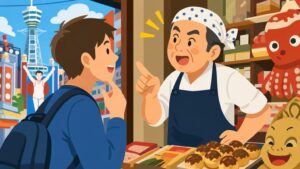
Instead of the quiet, deferential nod you might expect in other parts of Japan, you’re met with a barrage of rapid-fire questions in a dialect that sounds like a completely different language. “Doko ikun?” (Where you goin’?), “Ah, Sky Building? Acchi ya, acchi!” (Oh, the Sky Building? It’s that way, that way!). Before you can process it, an elderly woman might grab your elbow, point emphatically, and start a lively debate with another stranger about the fastest possible route, all while you stand there, a bewildered participant in a social event you didn’t mean to start. This, in essence, is the beautiful chaos of communication in Osaka. It’s a city where the textbook formalities of Japanese interaction often take a backseat to a more direct, pragmatic, and refreshingly human rhythm. To truly live here, you must learn to navigate a social landscape that operates on a different frequency, one where helpfulness is often loud, humor is a currency, and the polite shield of “Sumimasen” is merely the opening note in a much more boisterous symphony. This isn’t just about language; it’s about understanding the soul of Japan’s second city, a place built by merchants, comedians, and people who simply don’t have time for ambiguity.
After embracing Osaka’s boisterous energy, you might find solace in exploring day-trip onsen retreats that offer a refreshing counterbalance to the city’s lively chaos.
The Myth of ‘Friendly’ Osaka: Deconstructing the Cliché
Every guidebook, every travel blog, and everyone who has spent more than 48 hours here will tell you the same thing: “Osaka people are friendly.” While this is not untrue, the word alone falls short as a description. It evokes images of breezy Californian smiles or warm Southern hospitality, which are far from the truth. Osaka’s kind of ‘friendliness’ is less about gentle pleasantries and more about a gritty, pragmatic approachability. It’s a readiness to engage, to solve a problem, to cut through the noise and get things done. To truly understand this, one must look beyond modern stereotypes to the city’s historical roots.
Osaka was, and in many respects still is, Japan’s merchant capital. During the Edo period, it was known as the “nation’s kitchen” (tenka no daidokoro), a center of commerce where rice, goods, and money flowed freely. In a trade-driven world, efficiency, clarity, and quick decisions were essential. There was little room for the elaborate, layered etiquette that characterized the samurai and courtly culture of Edo (modern-day Tokyo). A deal was a deal, a price was a price, and questions warranted straightforward answers. This mindset has been ingrained in the city’s character for centuries, manifesting today as a form of social directness that can be startling to those used to Tokyo’s more reserved atmosphere.
Take the simple act of asking for help. In Tokyo, especially in a business district like Marunouchi, your question is likely met with impeccable, almost rehearsed politeness. You will receive a precise, correct, and respectfully delivered response. The interaction will be smooth, tidy, and contained. In Osaka’s Namba district, the same question might trigger a chain reaction. The person you ask may call out to a nearby shopkeeper for confirmation. That shopkeeper might then involve a customer, and before you know it, you are the focus of a small, impromptu committee determined to solve your navigational challenge. It might feel intrusive, loud, and somewhat overwhelming, but the underlying motive is the same: a genuine desire to help. The difference lies in the execution. Tokyo values social harmony (wa) and keeping a calm exterior. Osaka values solving the problem, and if that process is a little messy or noisy, so be it. The aim is the outcome, not the elegance of the interaction. This captures the essence of Osaka’s ‘friendliness’—it’s not passive and smiling; it’s active, engaged, and sometimes a bit in your face.
The Anatomy of an Osaka Interaction: More Than Just Words
To truly connect with locals, you need to attune your senses to a different set of signals. Communication in Osaka is a full-body experience, featuring a unique rhythm, a distinct sense of personal space, and a cultural acceptance of what might elsewhere be seen as meddling. It’s a performance where the words themselves are just part of the act.
The Sound of Osaka: Pitch, Pace, and Punchlines
The first thing any visitor notices is the sound. Osaka-ben, the local dialect, differs greatly from the standardized Japanese taught in schools. It’s not merely a set of different words—such as akan for ‘no good’ or chau for ‘wrong’—but a distinct musicality. The pitch varies more, the pace is quicker, and sentences often end with an upward, questioning tone that invites a response. It has a rhythmic, nearly percussive quality, accented by expressive interjections that energize conversation.
Expressions like “Nande ya nen!” (a flexible ‘What the heck!’ or ‘No way!’) and “Honma ni?” (‘For real?’) are far from simple filler. They serve as emotional punctuation, expressing surprise, disagreement, or camaraderie. They transform a straightforward statement into a lively exchange, like a rally in a conversational tennis match. For newcomers, this constant, energetic volley can seem argumentative or even aggressive. Yet in Osaka, it’s quite the opposite. It signals active listening and engagement. Silence or hesitation might be mistaken for boredom or disinterest. The local culture prizes a quick comeback, a shared laugh, a spirited dialogue. The aim is to build rapport, and the best way to do so is to dive into the rhythm.
Physicality and Proximity: The Lack of a ‘Tokyo Bubble’
Along with the sound comes a different sense of personal space. Elsewhere in Japan, a respectful personal bubble is strictly upheld. Unsolicited physical contact is uncommon. Osaka, however, follows slightly different rules. The invisible barrier is more permeable, especially in the busy, energetic settings of a shotengai (shopping arcade) or a crowded market.
Don’t be surprised if a vendor at Kuromon Market taps your arm to highlight the freshest tuna, or if someone behind you in line at a takoyaki stand nudges you forward when it’s your turn. This isn’t an invasion of personal space but a form of non-verbal, efficient communication. It says, “Hey, you, right here, pay attention to this.” In the cramped, lively aisles of the Tenjinbashisuji Shotengai, Japan’s longest shopping arcade, such casual physicality is a necessary way to navigate crowds and conduct business. It’s a stark contrast to the invisible pedestrian lanes felt on a Shibuya sidewalk. This closeness is woven into the city’s fabric, reflecting a community that is both literally and figuratively more connected.
The ‘Osekkai’ Culture: Meddling as a Form of Care
Perhaps the most defining and often misunderstood aspect of Osaka’s social scene is osekkai. The term loosely translates as being ‘nosy’ or ‘meddlesome,’ though these negative implications don’t capture its true spirit in Osaka. Here, osekkai is regarded as a virtue—a form of proactive, community-minded care. It embodies the belief that if someone around you is struggling, it’s your responsibility to step in and assist, whether or not they’ve requested help.
Imagine you’re at a train station, staring blankly at a complicated ticket machine. In Tokyo, people typically give you space, politely waiting for you to figure it out or formally ask for help. In Osaka, it’s quite likely an obachan (auntie) will come straight up to you, ask where you’re headed, and start pressing the buttons herself while offering a running commentary on the process. It can feel overwhelming, as if your personal challenge has become a public show. But the intention is genuine. It stems from a communal mindset, a sense of “We’re all in this together, so let’s get this sorted.” It’s the city’s immune system responding to fix a small issue before it grows. Embracing osekkai means recognizing that sometimes the most heartfelt help arrives unsolicited and with considerable volume.
Practical Strategies for Getting By and Getting Help
Understanding the theory is one thing; applying it in your everyday life is another. Thriving in Osaka involves adapting your communication style, letting go of some of the formal habits you may have learned, and embracing the local rhythm.
Ditching Formalities: When ‘Sumimasen’ Isn’t Enough
“Sumimasen” is like the Swiss Army knife of Japanese—it can mean sorry, excuse me, and thank you. It’s perfectly polite and always a safe choice. However, in Osaka, its formality can sometimes create a subtle distance, signaling that a transactional, formal interaction is about to happen. While it will always get the job done, you often receive a warmer, more engaged response by being a little more casual.
Instead of the full, formal “Sumimasen,” try a simple “Chotto ii desu ka?” (‘Got a second?’) with a friendly tone. Often, non-verbal cues work best. Simply catching someone’s eye and holding a look of genuine, friendly confusion can trigger that osekkai instinct. The key is to show openness. You’re not a tourist asking a formal question; you’re someone who’s a bit stuck. This lowers barriers and invites a more human, less rehearsed interaction. The goal is to shift quickly from a formal request to a shared problem-solving moment.
The Power of Humor and Self-Deprecation
If directness is Osaka’s engine, humor is its fuel. After all, this is the city that brought Japan the manzai comedy tradition. Laughter acts as social glue, breaks down barriers, and shows you don’t take yourself too seriously—a highly valued trait. Being able to laugh at a situation, or even at yourself, is one of the quickest ways to connect.
Say you try ordering in Osaka-ben and completely butcher it. Instead of getting flustered and apologizing repeatedly, try laughing and saying something like, “My Japanese is terrible!” or “Kansai-ben is too hard!” This self-deprecation does two things: it expresses humility and invites the other person to share in the joke. More often than not, they’ll laugh with you, gently correct you, and the interaction becomes warmer and more memorable. In a culture that can feel rigid, sharing a laugh is a powerful moment of genuine connection. It shows you’re not just transacting—you’re relating.
Where to Go When You’re Stuck: Targeting Your Ask
Though helpfulness is common, your chances improve if you know whom to ask. Not all Osakans are outgoing extroverts. If you’re truly lost or need help, focus on community hubs where the osekkai spirit thrives most. Your best bet is usually the owner of a small, independent shop, especially in a shotengai. These people know their neighborhoods thoroughly and often serve as unofficial community anchors.
Groups of middle-aged or older women—the legendary Osaka obachan—are another excellent resource. They tend to speak their minds freely, carry practical knowledge, and are happy to take a lost foreigner under their wing. Station attendants and kiosk vendors are also seasoned communicators, skilled at parsing confused questions and providing clear, direct answers. While younger people can be helpful, they may sometimes be more reserved or shy about their English skills. For reliable, straightforward assistance, look to the custodians of the community.
What Foreigners Often Misunderstand
Living in Osaka, one must continually engage in cultural translation. Behaviors and phrases that may appear rude or intrusive elsewhere often signify care here. Understanding the intent behind these actions is the most important skill a foreign resident can develop.
Is It Rude or Just Direct? Reading the Intent
The boundary between directness and rudeness varies by culture. In Osaka, this boundary is set quite differently. A shopkeeper might ask you bluntly, “What do you need that for?” not out of nosiness, but to better understand your issue and recommend a suitable product. Someone overhearing your route discussion might interrupt, saying, “No, no, that way is slow! Go this way.” They aren’t criticizing your decision; they’re trying to save you time and effort.
This can be a significant challenge for foreigners, who are often used to more indirect communication where suggestions are softened with polite language. The common misunderstanding is to take this bluntness as a personal insult. But in Osaka, it reflects respect for your time and intelligence. The unspoken message is, “I won’t waste time on pleasantries; here’s the information you need.” It’s a form of practical kindness. Learning to view directness as efficiency rather than aggression is key to thriving here.
The Transactional Nature of Kindness
Confusion can also arise after a helpful interaction. The same person who just spent several lively minutes escorting you halfway to your destination might simply nod briefly and walk away once their task is done. There’s no lingering chit-chat, no exchange of names, no lengthy goodbye. The interaction ends there.
This might seem cold or dismissive, but it reflects this merchant city’s pragmatic spirit. The problem was identified, a solution provided, and the transaction completed. Lingering would be inefficient. The kindness was genuine and sincere when needed, but fundamentally about solving a problem, not an invitation to friendship. This doesn’t mean Osakans are unfriendly; it means their help often stems from a practical, goal-oriented mentality. Appreciate the assistance for what it is—a moment of effective, straightforward community support—and then move on, just as they do.
To truly live in this city means moving beyond the safe realm of “Sumimasen” and adopting a livelier type of communication. It calls for retraining your social instincts, valuing directness over politeness, and recognizing warmth in a loud, meddlesome, and utterly sincere offer of help. Life in Osaka is a continuous conversation, an improvisation unfolding on busy streets and bustling markets. At first, it can feel overwhelming—a chaotic symphony of sounds and gestures that you don’t quite grasp. But once you learn the rhythm, once you join in and add your own voice, you begin to see what makes the city so uniquely vibrant. You come to understand that the greatest welcome isn’t a polite bow, but a stranger grabbing your arm and saying, “You’re going the wrong way, let me show you.”