You see it the moment you step out of the station in Namba or Umeda. The sweet, savory smell of grilling batter and tangy sauce hangs in the air. You see the lines, the busy hands of vendors expertly flipping dozens of perfect brown spheres in cast-iron pans. Takoyaki. Octopus balls. The quintessential Osaka street food. For a tourist, it’s a must-try snack, a fun photo-op, a checkmark on a travel itinerary. But if you’re living here, or thinking about it, you quickly realize that the takoyaki you see on the street is just the tip of a very large, very delicious iceberg. The real culture, the one that explains so much about how this city ticks, doesn’t happen at a stall in Dotonbori. It happens inside apartments, behind closed doors, on a Tuesday night, when a friend texts you: “Takopa shinai?” (Wanna have a takoyaki party?). This invitation is your entry ticket into the real Osaka, a world where flour and water become the glue of community, and where owning a takoyaki maker is as essential as owning a refrigerator. To understand Osaka, you must first understand its obsession with ‘konamon’—the culture of flour—and the sacred home ritual known as the ‘Takopa’.
This home-centered social ritual is a key part of understanding the city, much like the way Osaka’s neighborhood sentō culture reveals its unique social codes.
First, What Exactly is ‘Konamon’?
Before we jump into the party, let’s clarify our terms. ‘Konamon’ (粉もん) is a broad and wonderful category of Japanese cuisine. The name itself reflects Osaka’s straightforwardness: ‘kona’ (粉) means flour or powder, and ‘mon’ (もん) is a casual local dialect form of ‘mono’ (物), meaning ‘thing.’ Flour things. It’s not poetic, and that’s exactly the point. It’s an unpretentious label for a world of dishes where a batter, usually made from wheat flour, takes center stage.
Naturally, takoyaki and its savory pancake relative, okonomiyaki, are the two giants of the konamon realm. But the family extends far beyond them. There’s ‘negiyaki,’ a thinner, scallion-filled variation of okonomiyaki. There’s ‘ikayaki,’ a simple squid pancake commonly sold at festivals. Then there’s ‘modanyaki’ (‘modern-yaki’), which is okonomiyaki with a layer of fried noodles pressed inside. What unites them all is a shared philosophy rooted in Osaka’s history as Japan’s merchant capital. Konamon is affordable, filling, endlessly adaptable, and offers maximum satisfaction at minimal cost. It embodies ‘kuidaore’—eating until you drop—but on a budget that everyday people can manage. In a city that has long valued practicality and sharp business sense, konamon is the ideal food. It’s not about fancy, expensive ingredients; it’s about the magic of turning humble flour, eggs, and dashi into something warm, satisfying, and deeply communal.
The Sacred Trinity: Home, Takoyaki, and the ‘Takopa’
The tourist views takoyaki as a product to purchase, while an Osakan sees it as an activity to participate in. This fundamental difference explains why the home party, or ‘takopa’ (タコパ), lies at the core of the culture. A takoyaki stand offers you a finished dish, but a takopa draws you into the making process. It’s a messy, chaotic, and incredibly enjoyable ritual that reveals the city’s social dynamics in ways a restaurant meal never could.
Decoding the Invitation: “Wanna Come for Takopa?”
If you receive this invitation from a new friend or colleague in Osaka, understand what it truly means. This is not a formal dinner invite. There is no need to dress up. It’s the most casual, low-pressure social gesture in Osaka’s repertoire. It signifies, “I want to relax and hang out with you, without the formality of a restaurant or the cost of an izakaya.” It’s a signal that you’re being welcomed into their inner circle. Accepting is almost always the right choice.
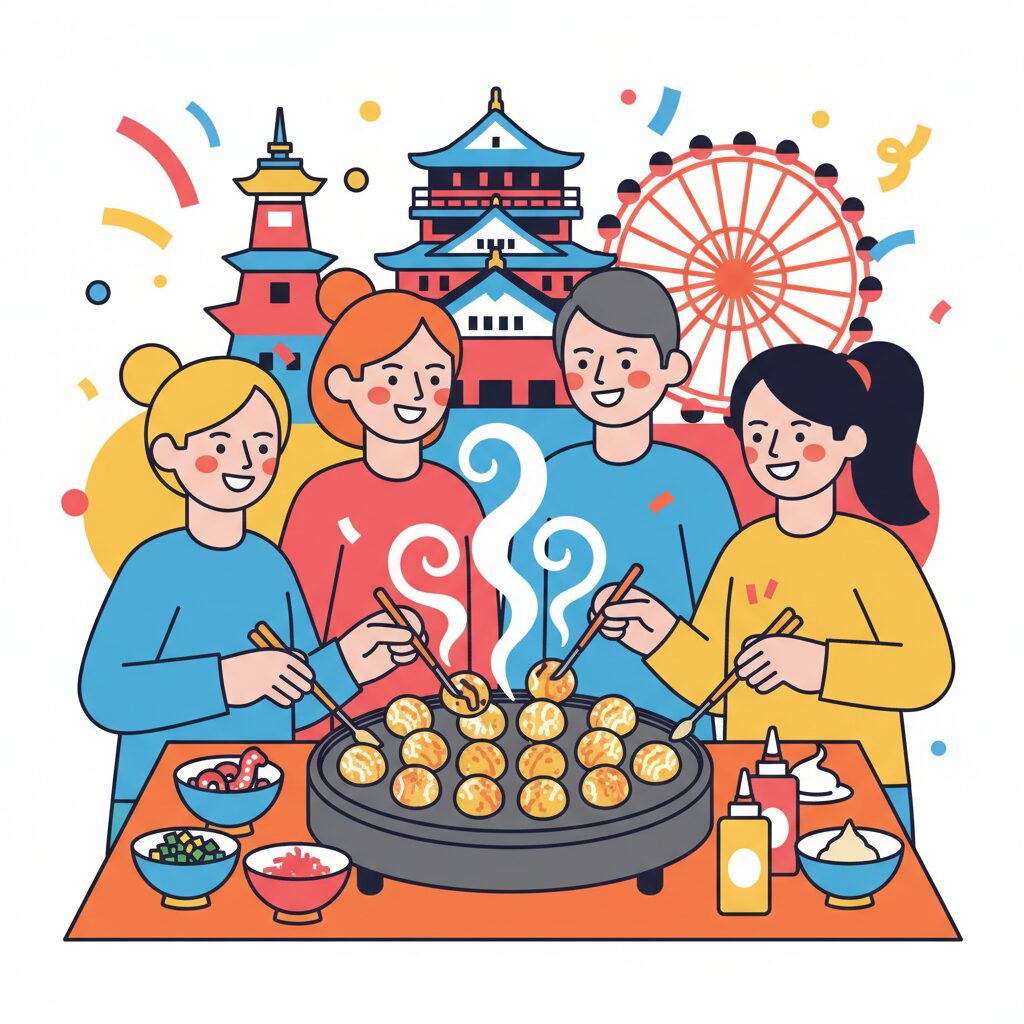
The atmosphere at a takopa is unique. It’s loud. The sounds aren’t just music or conversation but include the constant sizzle of the takoyaki maker, the rhythmic tapping of bamboo picks on the iron plate, and exclamations like “Ah, that one’s burning!” or “I flipped it perfectly!” It’s a complete sensory experience. The air fills with steam from the dashi-infused batter and the sweet, smoky scent of takoyaki sauce. It’s a world apart from the polished, curated feel of a Tokyo home party, which might feature elegant bento boxes or a carefully arranged hot pot. A takopa is inherently interactive. There are no traditional hosts and guests—only participants, all gathered around the sizzling electric altar.
A Household Appliance as Essential as a Rice Cooker
Here’s a fact that often surprises outsiders: nearly every household in Osaka owns a takoyaki maker. This is no exaggeration or funny stereotype; it’s a basic reality. A student moving into their first small apartment will acquire a microwave, a mini-fridge, and a takoyaki maker. It’s a standard wedding registry item. Visit any electronics store like Yodobashi Camera or Bic Camera in Osaka, and you’ll find an entire section devoted to them. There are inexpensive, simple electric plates costing just a few thousand yen, deluxe models with interchangeable plates for okonomiyaki, and for true enthusiasts, powerful gas grills promising crispier outer shells, just like professionals use.
Why such widespread ownership? Because the takoyaki maker is more than a cooking device—it’s a social catalyst. It’s designed for instant, affordable fun. Owning one means you’re always ready to host. Friends drop by unexpectedly? No problem—fire up the takoyaki maker. Looking for a cheap date night? Takopa. Need to entertain your children and their friends? Takopa. It elegantly solves social planning with a batter-based solution. In Tokyo, casual gatherings might default to ordering pizza, but in Osaka, it’s all about making takoyaki. The difference is striking: one involves passive consumption, the other active creation.
The Unspoken Rules of the Takoyaki Battlefield
A takopa might be laid-back, but that doesn’t mean it lacks its own set of rules and rituals. This is where the playful, opinionated, and passionate spirit of the Osaka personality truly shines. Making takoyaki is approached with a serious-but-not-too-serious intensity that can confuse newcomers. It’s simultaneously a craft, a competition, and a collaboration.
The Art of the Flip: A Test of Skill and Spirit
The heart of a takopa is flipping the takoyaki. Each person usually wields one or two ‘senbon’ (千本)—small, sharp bamboo picks. The process involves pouring batter into the rounded molds, adding the fillings, and then waiting for the perfect timing. As the bottom cooks, you use the pick to separate the batter connecting each ball and then, with a quick flick of the wrist, execute the ‘kurun’—a half-turn that tucks the uncooked batter underneath to form a perfect sphere. For beginners, this is often a frustrating endeavor. You’ll make mangled, misshapen lumps, accidentally fuse two balls together, or pierce one so its gooey insides leak out.
Here’s the key unspoken rule: that’s completely fine. In fact, it’s expected. Your Osakan friends will mercilessly tease you for your lack of skill and shout conflicting advice, but it’s all part of the fun. What counts isn’t your ability, but your willingness to give it a try. Sitting back and letting others do all the work is the only real social faux pas. Participating, even poorly, shows you’re a team player. It’s a fantastic icebreaker, as it’s impossible to keep any formal distance when everyone is fumbling with hot batter and bamboo sticks.
Filling Frenzy: The Arena of Self-Expression
While the host supplies the essential batter—and their specific recipe is a source of great pride—the guests are often expected to bring fillings. This is where individuality comes alive. The classic mix is, of course, boiled octopus (`tako`), tempura scraps (`tenkasu`), pickled red ginger (`benishoga`), and chopped green onions. But that’s just the beginning.
The real excitement comes with the unconventional additions. Cheese is nearly universal, melting into a gooey center. Kimchi adds a spicy, fermented edge. Sliced sausages, corn, and mochi (sticky rice cakes) are popular too. The fillings you bring say a lot about you. Are you a purist bringing top-quality octopus? Or an adventurous soul offering avocado or mentaiko (spicy cod roe)? I’ve even attended parties where dessert rounds take over, with chocolate bits and whipped cream making an appearance. The takoyaki grill turns into a canvas for culinary creativity. There are no wrong choices, only delicious discoveries.
The Great Sauce and Topping Debate
Once the golden-brown spheres are cooked, the final—and most heated—stage begins: the toppings. Opinions run strong and loyalties run deep. Everyone has their favorite brand of takoyaki sauce, a thick, sweet-and-savory brown sauce similar to Worcestershire. Otafuku is the national giant, but many Osakans swear by a smaller, local brand. Then there’s the Japanese mayonnaise, typically the iconic Kewpie brand with its soft, squeezable bottle and distinctive star-shaped nozzle. Even the method of application sparks debate: a tidy zigzag or a wild, Jackson Pollock-like splatter?
Lastly, the dry toppings: ‘aonori’ (green seaweed flakes) and ‘katsuobushi’ (dried, smoked bonito flakes). When the katsuobushi hits the hot takoyaki, the thin shavings move and dance with the heat, making the dish seem alive. Yet, even here there are divisions. Some purists argue the best takoyaki doesn’t need all that dressing up. They prefer it ‘su-ppin’ (bare-faced), with maybe just a touch of dashi broth and salt, to truly savor the batter’s flavor. Engaging in these friendly debates, defending your topping choices with mock seriousness, is all part of the experience. It’s how you show your passion.
Why ‘Konamon’ Explains the Osaka Soul
So, it’s simply a fun, affordable meal. Why the fuss? The fuss lies in the fact that this entire culture perfectly reflects the fundamental values of the Osaka identity. It’s more than just food; it’s a social philosophy wrapped in a ball of batter.
Pragmatism and Cost-Performance: The Merchant’s Mindset
At its essence, a takopa is about maximizing enjoyment while minimizing cost. You can entertain a large group for hours with just a few bags of flour, some eggs, and a handful of inexpensive fillings. This strong respect for cost-performance (`kosupa`, as it’s known in Japan) is ingrained in Osaka’s character. As a city of merchants rather than samurai or aristocrats, Osaka has always been rooted in practicality. Value for money isn’t considered cheapness; it’s viewed as smart. Whereas a Tokyo gathering might emphasize aesthetics, trends, or a shop’s reputation, an Osaka gathering prioritizes the quality of the experience and the amount of fun. A takopa is the perfect embodiment of this mentality.
Communication Over Formality
The setup of a takoyaki party naturally breaks down social barriers. Everyone gathers around a single, small heat source. People reach over one another, pass ingredients, and share tools. There’s no head of the table and no strict seating order. This physical closeness encourages emotional closeness. It’s impossible to remain stiff and formal when you’re trying to keep your cheese-filled takoyaki from burning. This setting sheds light on why Osakans are often seen as more direct, open, and friendly compared to their Tokyo counterparts. Their main way of socializing revolves around an activity that erases hierarchy. The CEO and the newest employee stand equal before the takoyaki grill. This is social lubrication, Osaka style.
A Misunderstood Passion: It’s More Than Street Food
Perhaps the biggest misconception among foreigners is seeing takoyaki as merely simple, cheap food. To an Osakan, it represents intense local pride and personal identity. Every family has its secret batter recipe. Does it include dashi? A splash of soy sauce? Grated mountain yam (`nagaimo`) for fluffiness? The debate over what makes perfect takoyaki—crispy outside, トロトロ (`toro toro`, gooey and molten) inside—is endless and deeply serious. To dismiss it as just a snack misses the whole point. It’s a craft, a tradition, and a core part of their identity. The aroma of takoyaki sauce isn’t just the smell of food; for many from Kansai, it’s the nostalgic scent of home, family, and simple joy.
Your Practical Guide to Attending a ‘Takopa’

So, you’ve gotten the invitation. Your adventure into the heart of Osaka is about to start. Here’s how to experience your first takopa like a local.
What to Bring
Never show up empty-handed. While the host takes care of the batter and the grill, a thoughtful guest always contributes. The safest choice is drinks—a six-pack of beer or some canned ‘chuhai’ will always be welcomed. But the top move is to bring a unique filling. Consider what might be a fun surprise. A block of quality cheese, some spicy sausage, or even a specialty from your home country could work (I once saw a German friend bring chopped bratwurst, and it was a huge hit). This effort sparks conversation right away. A small dessert or snack is fine too, but avoid anything too elaborate; the focus should stay on the main event.
How to Act
The golden rule: jump in. Don’t wait to be asked. Grab a pick and start flipping. Ask for help. Laugh when you inevitably make a mess. Compliment the host’s batter. Saying, “This dashi flavor is incredible!” will earn you instant friends. Join in the debates. Take a stand on the mayonnaise debate. Have a strong, if completely uninformed, opinion on the ideal level of crispiness. Your enthusiasm matters more than your skill. Takopa is not a spectator sport.
The Aftermath: The Scent of Belonging
When you leave, hours later, full and laughing, you’ll notice something. The smell of grilled batter and savory sauce will cling to your clothes, your hair, your very being. Anywhere else, this might be unpleasant. But after a takopa, this scent is a badge of honor. It’s the lasting proof of a shared experience. The aroma of community, of being welcomed, of joining in a ritual that is uniquely Osaka. You didn’t just eat takoyaki. You did takoyaki. And in doing so, you’ve taken a step closer to understanding the warm, pragmatic, and wonderfully flour-dusted spirit of this city.