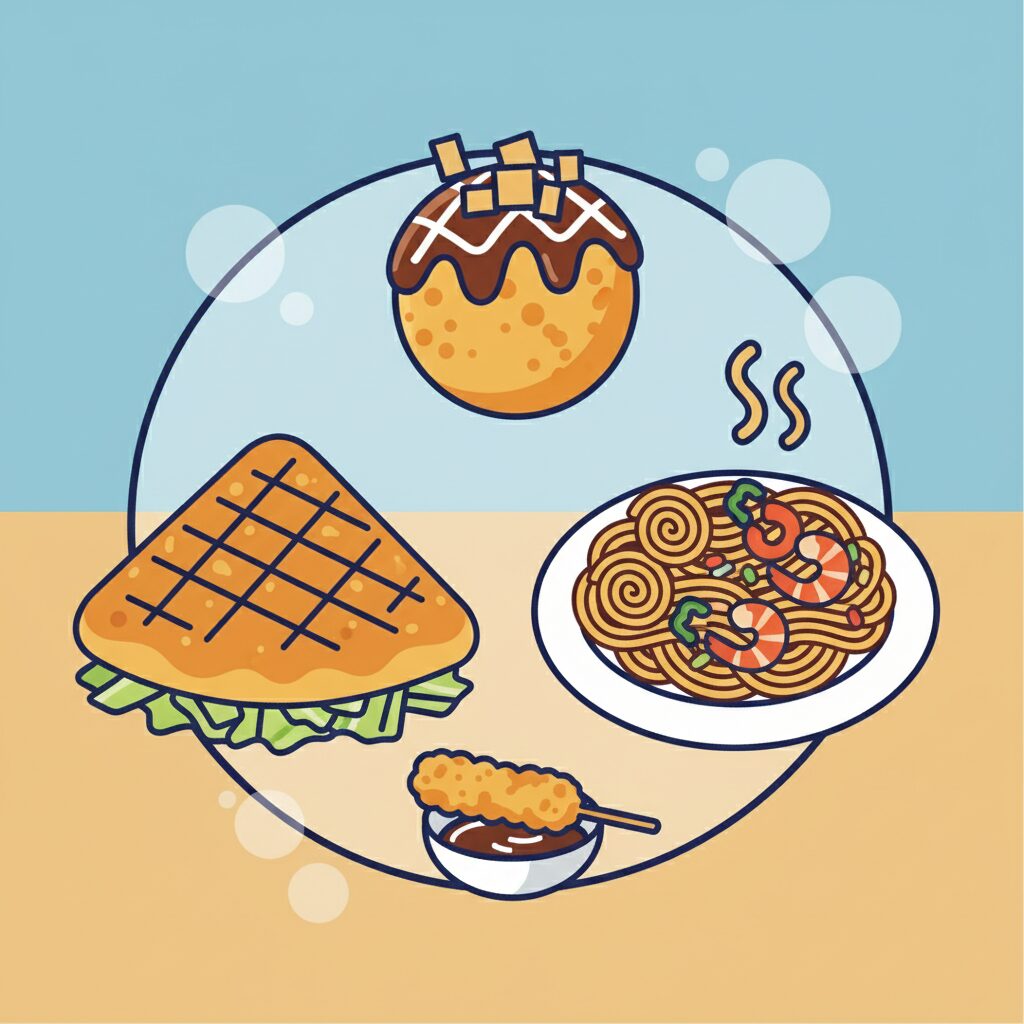
You see the pictures, you hear the hype. Osaka, the city of ‘kuidaore’—eat till you drop. Steam billows from street-side stalls where vendors, with the fluid grace of seasoned performers, expertly flick dozens of golden-brown spheres of takoyaki. Nearby, the sizzle of okonomiyaki on a massive griddle fills the air, the sweet and savory scent of searing batter and rich, dark sauce clinging to the Dotonbori night. For most, this is the beginning and the end of the story. Osaka equals takoyaki. Osaka equals okonomiyaki. It’s a simple, tasty equation that draws millions to its vibrant, neon-lit heart.
But that’s just the show. It’s the flashy opening act for a culture that runs far deeper, a culture that truly defines the rhythm of daily life here. To understand Osaka, you need to look past the street vendor and into the home. You need to understand ‘konamon’—literally, ‘flour things’—not as a tourist snack, but as the bedrock of family meals, social gatherings, and the very mindset of the city. This isn’t just about food; it’s about a philosophy born from a merchant city’s pragmatism and a deep-seated love for communal fun. It’s the reason a Tokyoite might find an Osaka kitchen bewilderingly over-equipped with hot plates, and why a casual Tuesday dinner here can feel like an interactive party. This is the real story of konamon, the flour that binds Osaka together.
Osaka’s deep-rooted culinary heritage is complemented by the practical challenges of everyday living, such as community fees, which further illustrate the city’s blend of tradition and modernity.
The Holy Trinity: Okonomiyaki, Takoyaki, and the Kitchen Counter

In many regions of Japan, a meal prepared right at the dinner table on a portable stove is a special event—especially for nabe (hot pot) during winter. In Osaka, however, the hot plate—the formidable ‘teppan’—is no stranger. It’s a kitchen staple, always ready for action. It serves as the stage for the home dining trifecta: okonomiyaki, takoyaki, and yakisoba. While tourists queue for these dishes, locals in Osaka whip them up at home with a casual frequency that might surprise visitors.
More Than Just a Meal: The ‘Takopa’ Phenomenon
Forget elaborate dinner parties. The quintessential social gathering in Osaka is the ‘takopa,’ or takoyaki party. This isn’t a sit-back-and-be-served occasion. A takopa is interactive, often messy, and immensely enjoyable. The host supplies the essentials: batter, diced octopus, chopped green onions, and red pickled ginger. But the real excitement happens around the takoyaki maker—a specialized griddle with rows of hemispherical molds found in nearly every household in Osaka. Seriously, it’s more common than a toaster. When you move into an Osaka apartment, don’t be shocked if a takoyaki maker is given as a housewarming gift.
The ritual unfolds: batter is poured, ingredients dropped in, and then comes the vital step—flipping. Armed with small wooden skewers, everyone gathers around the griddle, prodding and turning the balls as they cook. There’s a certain rhythm, a practiced wrist flick, to forming the perfect sphere. The first batch is often a mess—some burn, others don’t shape properly. But no one minds; it’s part of the fun. It breaks the ice. Dad, usually reserved, becomes a takoyaki expert, issuing playful commands. Friends compete to craft the most flawless ball. Fillings become a creative playground, reflecting Osaka’s practical, no-waste ethos. Octopus is classic, but soon cheese appears, then kimchi, sausage bits, mochi, even chocolate for dessert. It’s about using what’s on hand and enjoying the experience. A takopa isn’t about impressing guests; it’s about sharing laughter and slightly irregular, piping-hot dough balls.
Okonomiyaki Night: A Family Affair
If takoyaki is the party, okonomiyaki is the family dinner. The name ‘okonomi-yaki’ means ‘grilled how you like,’ and the homemade version fully embraces this idea. Unlike a restaurant where you might order a set ‘pork and egg’ type, an at-home okonomiyaki night is a build-your-own adventure. A large bowl of flour-and-dashi batter sits on the table, surrounded by bowls of shredded cabbage, tenkasu (crispy tempura bits), eggs, and various proteins like thin pork belly slices, squid, or shrimp.
Everyone gets their own bowl. They scoop in batter, pile on cabbage, mix in their preferred ingredients. It’s a chance for individuality within a group setting. One child might add cheese and corn; a parent might stick with classic pork. Then, everyone pours their mixture onto the shared hot plate in the center. Together, they cook, flipping the thick pancakes and chatting as the cabbage softens and the pork sizzles. The teppan’s sizzle creates a cozy soundtrack to many weeknight dinners. It’s affordable, satisfying, and involves everyone. While in Tokyo a meal like this might be a weekend treat, in Osaka, it’s just an ordinary Tuesday. It’s the ultimate comfort food—a warm, savory embrace on a plate, made by the family.
The Konamon Mindset: ‘Cheap, Filling, and Fun’
To truly understand why konamon culture is so deeply rooted here, you need to grasp the Osaka mindset, which has been shaped over centuries by commerce. Historically, Osaka was known as ‘tenka no daidokoro’—the nation’s kitchen. It was a city of merchants, not samurai. Consequently, ideas of value, practicality, and especially ‘cost performance’ (the Japanese-English term ‘kosupa,’ highly revered here) are ingrained in the city’s DNA. An Osakan doesn’t just want something good; they want it to be good for the price.
The Economics of Flour
Konamon perfectly embodies this merchant spirit. What are the basic ingredients? Flour, water, cabbage, eggs. All remarkably affordable. With just a few simple, inexpensive ingredients, you can create a meal that is delicious, customizable, and can feed a large family without straining the budget. This isn’t merely a charming cultural tradition; it’s a smart economic strategy passed down through generations. It’s why even during tough economic times, the people of Osaka have always been able to eat well and share meals together.
This focus on value sets life in Osaka apart from life in Tokyo. While Tokyo dining often emphasizes refinement, presentation, and status, Osaka dining—even at home—is about maximizing satisfaction. The questions are always, “Is it filling? Is it tasty? Is it a good deal?” Konamon meets all these criteria. It’s hearty, satisfying, and endlessly adaptable. This practical attitude toward food offers a glimpse into the broader Osaka character: resourceful, unpretentious, and constantly seeking a smart bargain.
The ‘My Rule’ Culture of Toppings and Sauces
This practicality doesn’t mean a lack of passion. On the contrary, it fuels it. When the base is so simple, the finer details become a battleground of personal identity. Enter the fierce, unspoken battles over sauces and toppings. Every Osaka family has their own ‘rule’ for finishing their okonomiyaki. The first point of debate is the okonomiyaki sauce itself. While tourists might see just a generic brown sauce, an Osakan sees a world of possibilities. Are you an Otafuku household, devoted to its sweet, fruity flavor? Or do you prefer the spicier punch of Doro Sauce? Some families even craft their own secret blends.
Then there’s the mayonnaise. This surprisingly sparks intense discussions. Do you apply it in neat, straight lines? A chaotic, Jackson Pollock-like drizzle? Or do you use a specialized bottle with multiple nozzles to create a perfect crosshatch pattern? The choice reveals something about you. It’s your signature. Finally, there’s the sprinkle of aonori (dried seaweed flakes) and katsuobushi (bonito flakes). How much is too much? Should the bonito flakes ‘dance’ from the heat? These aren’t just culinary decisions; they are assertions of identity. ‘This is how our family does it.’ This ‘my rule’ culture speaks volumes about the Osaka personality: opinionated, deeply invested in personal preferences, and proud to defend them, even over something as simple as mayonnaise.
Beyond the Big Two: The Extended Universe of Home Konamon

While okonomiyaki and takoyaki are the most famous representatives, the world of home konamon is extensive and diverse. To confine Osaka’s flour culture to just these two dishes would be like saying American cuisine consists only of hamburgers and hot dogs. The city’s true spirit is found in its everyday, unpretentious staples.
Udon: The Essential Soul Food
If you want to understand what Osakans truly eat regularly, look no further than the modest bowl of udon. Though it enjoys some fame on its own, udon is the real backbone of the konamon realm. Osaka has its own unique take on it. The city is the origin of ‘Kitsune Udon,’ a simple dish featuring thick, soft noodles in a warm broth, topped with a large piece of ‘aburaage’ (deep-fried tofu) simmered in a sweet and savory sauce. The term ‘kitsune,’ meaning fox, comes from the folktale that foxes love aburaage.
The main distinction—and a classic Osaka versus Tokyo debate—lies in the broth. Osaka’s dashi is remarkable. It’s pale, almost clear, made from premium kombu (kelp) and bonito flakes. It offers a deep, layered umami flavor that is subtle and refined. Tokyoites, familiar with the Kanto region’s darker, soy-heavy broth, may initially find it bland. However, Osakans assert their dashi is not about soy sauce’s punch but about highlighting the delicate flavors of the ingredients. The noodles also differ—usually softer and gentler compared to the firmer, chewier udon found elsewhere. For Osakans, udon is ultimate comfort food: what you eat when sick, grab for a quick lunch, or enjoy on a rainy day. It embodies the city’s quiet and humble soul in a bowl.
The Ever-Present Butaman (Nikuman)
Another cornerstone of Osaka life is the ‘butaman,’ or steamed pork bun. Known as ‘nikuman’ throughout the rest of Japan, in Osaka it proudly goes by ‘butaman.’ And when you say ‘butaman,’ you’re almost always referring to one brand: 551 Horai. These fluffy white buns, filled with a juicy blend of pork and onions, are iconic. Sold at train stations and department stores, the signature red paper bags are a familiar sight on commuter trains.
Bringing home a box of 551 butaman is a classic gesture. It’s the gift you bring for your family after a long day’s work or when visiting a friend’s house. The aroma is legendary—a savory, onion-filled scent that fills the train car, instantly signaling a 551 run. It’s a shared sensory moment, a smell that signifies ‘home’ to many locals. Of course, there’s a ‘my rule’ when it comes to eating them. The buns come with a small packet of Japanese mustard and soy sauce, sparking the ongoing debate: do you use the mustard? A little? A lot? Or eat them plain to savor the pure flavor? Just like the mayonnaise on okonomiyaki, how you dress your butaman is a small but meaningful expression of personal taste.
Lesser-Known Home Favorites
The list continues. There’s ‘negiyaki,’ a relative of okonomiyaki that skips the cabbage, focusing instead on finely chopped green onions, resulting in a sharper, more fragrant pancake. It’s often drizzled with soy sauce and lemon instead of the thick okonomiyaki sauce, offering a more ‘mature’ flavor. Then there’s ‘ikayaki.’ When mentioned at the famous Hanshin Department Store food hall, it refers to a unique, press-grilled pancake made with squid, batter, and sauce. It’s a popular, inexpensive snack, often replicated at home by pressing the batter between two griddles to achieve a thin, chewy texture. These dishes might not appear on tourist itineraries, but they hold a steady place in the weekly dinner rotation of many Osaka households.
How Konamon Shapes Your Life in Osaka
For a foreigner settling here, konamon culture is more than just a culinary curiosity. It actively shapes your social interactions, shopping habits, and understanding of the local community, serving as a practical guide to living in Osaka.
The Supermarket Aisle Tells a Story
One of the first places where you’ll notice this difference is the supermarket. Step into any grocery store in Osaka, and the evidence is overwhelming. The flour aisle reflects the city’s obsession. You won’t find just all-purpose flour but multiple brands of specialized okonomiyaki flour, each promising a distinct level of fluffiness. There are also takoyaki mixes crafted for perfect crispiness. The sauce aisle is even more remarkable—a library of brown sauces, featuring dozens of varieties of okonomiyaki sauce, takoyaki sauce, yakisoba sauce, and tonkatsu sauce, each with its own loyal following. The variety may seem intimidating but is a clear sign of what locals cherish. Compared to a typical Tokyo supermarket, the contrast is striking. It’s a physical manifestation of cultural priorities, a story told through shelf space.
Socializing, Osaka Style
Konamon culture shapes how people connect. An invitation to a ‘takopa’ is one of the most common and sincere expressions of friendship in Osaka. It’s a relaxed, low-cost way to hang out. Unlike the formal dinner party, often laden with etiquette and expectations, a takoyaki party is casual and collaborative. It breaks down barriers immediately. It’s hard to be stiff and formal when you’re fumbling with a skewer, trying to flip a stubborn ball of dough and splattering batter on your shirt.
For a foreigner, being invited to a takopa marks a significant milestone. It means you’ve been welcomed into an inner circle. It’s an invitation not just to eat but to participate—to be part of the process. The focus isn’t on perfect results but on the shared experience of making—and often failing at making—food together. It creates a comfortable intimacy that reflects Osaka’s famously friendly and open spirit. This is why people say Osaka is friendly; it’s not just an empty phrase. It’s embedded in social rituals like this, where community and participation matter more than formality and perfection.
What Foreigners Often Misunderstand
A common misconception among outsiders is that Osaka’s food, centered on flour and savory sauces, is simply ‘cheap’ or ‘unhealthy’ street food. This misses the point entirely. While konamon is undeniably affordable, it is not considered junk food. It forms the heart of home cooking. It’s a balanced meal—cabbage, eggs, and protein all combined in one pancake. It is the canvas upon which families express their creativity and spend time together. To dismiss it as just street food is to overlook its crucial role in family life and social bonding.
Another misunderstanding is feeling pressured to be an expert. When you’re at a takopa, your Osaka friends might playfully critique your flipping technique, but no one expects you to be a master. The teasing is a sign of affection and inclusion. What they appreciate is your willingness to try, laugh at your mistakes, and join the fun. The goal isn’t a plate of perfectly uniform takoyaki; the goal is the shared memory of making them together.
The Flour That Binds
When you peel back the layers of Osaka, beyond the dazzling neon lights and the ‘eat till you drop’ slogans, you discover a culture rooted in something remarkably simple: flour and water. Konamon is far more than just a category of food. It represents an economic principle, a social glue, and a form of cultural identity, all cooked together on a hot plate.
It reflects the pragmatic, value-driven Osaka mindset, shaped by a merchant history where maximizing little resources was a virtue. It sheds light on the city’s social dynamics, favoring communal, interactive experiences over strict formality. It reveals a personality that is fiercely individualistic in tastes—down to the last drizzle of mayonnaise—while remaining deeply communal in practice. Understanding konamon culture is vital for anyone seeking to grasp what truly makes Osaka tick. It answers the question of what life in Osaka is really like. So, the next time you see a family gathered around a sizzling teppan, whether in a restaurant or through a home window, remember you’re not just witnessing dinner. You are seeing the heart of Osaka in action, a tradition of transforming the simplest ingredients into moments of connection, laughter, and a genuinely satisfying meal.