Landing in Osaka feels like plugging into a city-sized amplifier. The energy is immediate, a crackling hum of commerce and conversation that sweeps you up from the moment you step off the train. It’s a city of neon canyons and quiet, lantern-lit alleys, of booming laughter and the sizzle of oil on a hot plate. But for all its outward energy, there’s a question that hums just beneath the surface for anyone who moves here: How do you plug in? How do you move from being a spectator in the river of faces to someone who has a small, warm eddy to call their own? You’ve heard the stories, the easy clichés—that Osaka is friendly, that people will talk to you on the street. And while there’s a grain of truth in that, it’s a postcard-deep understanding of a culture built on something much more complex and rewarding: the institution of the jōren-san, the regular customer. Becoming a regular isn’t just about getting a familiar nod from a bartender. It’s about earning a place in a small, self-made family. It’s the antidote to the anonymity of modern city life, and in Osaka, it’s an art form. This isn’t a guide to the best bars, but a map to the human geography of belonging in a city that wears its heart on its sleeve, but keeps its inner circle well-guarded.
Discover how the unique rhythms of everyday life intertwine with a sense of belonging by exploring the vibrant shotengai culture that forms the backbone of Osaka’s low-cost daily living.
The Myth of Instant Friendship: Why “Friendly” Doesn’t Mean “Familiar”

The first thing to grasp about Osaka is that the word “friendly” carries a lot of weight. A shopkeeper might crack a joke while handing you your change. An elderly woman on the subway could offer you a candy. This is the city’s default mode, a kind of conversational background noise that fills the atmosphere. It’s sincere, but it’s not necessarily an invitation. It’s a performance of community, a social grease that makes dense urban living not only bearable but lively. In Tokyo, you often face a barrier of professional politeness. It’s flawless, efficient, and completely impersonal. The convenience store clerk will carry out their duties with mechanical precision, and the exchange ends there. It’s neat, straightforward, and you always know your place: a customer, separate and distinct. In Osaka, that boundary is blurred from the outset. People are curious. They’ll interact. But this initial openness is often misunderstood by foreigners as an open door to friendship. It’s more like a porch light flicking on to check who’s there. The real effort of building a connection hasn’t even started. Osaka’s friendliness is the first line, not the whole conversation. The city operates on a deeply rooted concept of uchi-soto, the distinction between insiders and outsiders. While the barrier might appear lower and more permeable than in other parts of Japan, it certainly remains. The cheerful chatter is the city’s way of saying, “We see you.” Reaching the point where they say, “We know you,” is an entirely different journey.
Choosing Your Stage: The Art of Picking the Right Spot
You can’t become a regular at a sprawling chain restaurant or a tourist-filled bar in Dotombori. The feeling of belonging demands a particular kind of space—one designed for intimate, human-scale interaction. You need a setting where the participants aren’t just passing through. Your goal is to find a place that feels like someone’s living room, a spot with character, run by a familiar face rather than a corporation.
The Counter is King: Izakayas, Standing Bars, and Coffee Shops
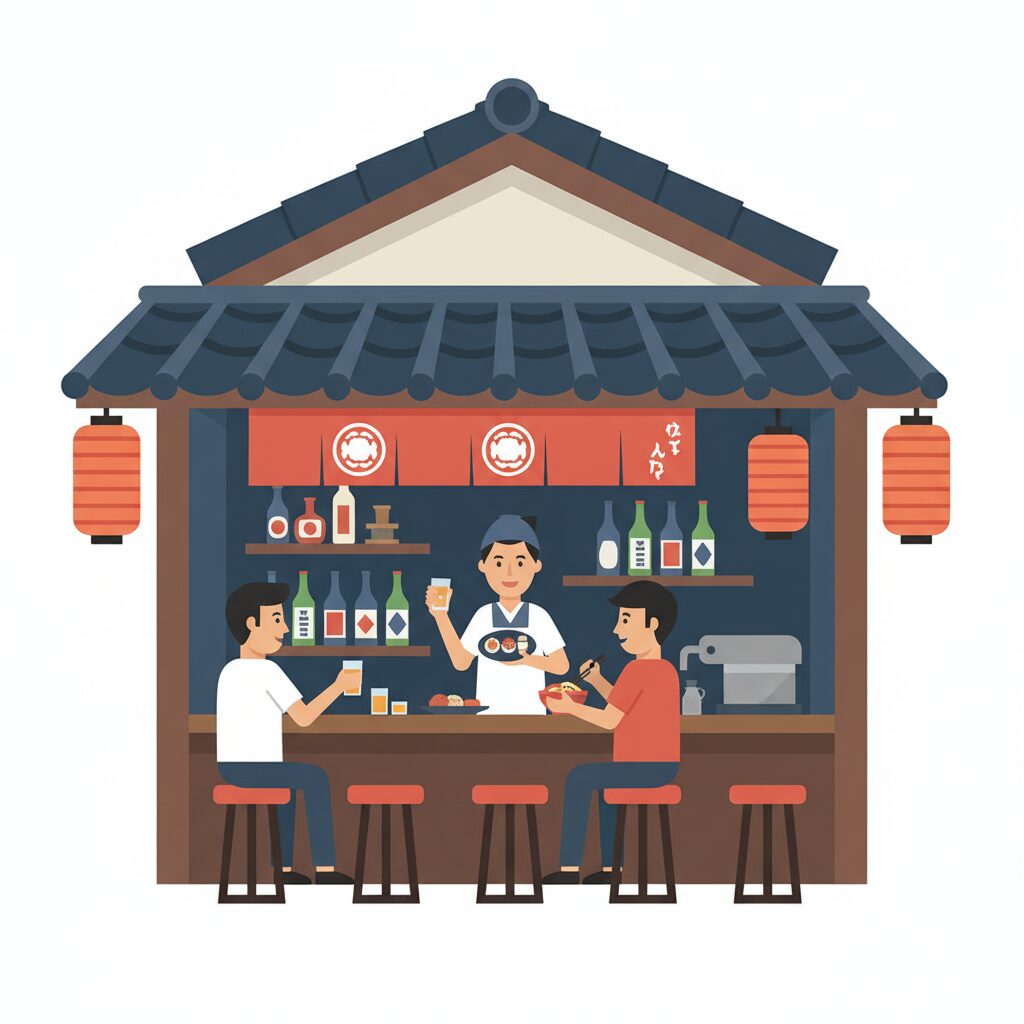
Seek out the counter. This is the single most crucial piece of furniture in your search. Whether it’s a long wooden counter at an izakaya, a stainless-steel ledge at a tachinomi (standing bar), or the Formica top of a Showa-era kissaten (coffee shop), it serves as the communal table where community is created. Sitting at the counter breaks down the barrier between you, the owner, and the other patrons. Everyone faces the same direction, watching the kitchen’s theater and sharing the experience. In neighborhoods like Tenma, with its maze of tiny eateries, or Ura Namba, hidden behind the glittering main street, these places are the heart of the community. The taisho (master) or mama-san (female owner) serves as the gravitational center, with their personality defining the establishment. Finding the right one is like dating. You need to discover a place whose atmosphere speaks to you. Is it loud and lively? Quiet and reflective? Does the food evoke the smell of home? This will be your home away from home, so choose carefully.
The “No First-Timers” Vibe (and How to Break Through It)
Entering a small, local spot for the first time can be one of the most daunting experiences in Japan. You push open a door and are met with sudden silence. A dozen pairs of eyes turn toward you. You can feel the shared question: “Who’s this?” This is the invisible barrier of the jōren-san culture. It’s not unfriendly; it’s protective. These people have spent months or years building trust, and you’re the unknown factor. The key is to project the right energy. Don’t be shy, but don’t be loud either. A confident nod, a clear “konbanwa,” and a simple question like “Is it okay for one person?” will go a long way. The trick is to read the atmosphere before stepping inside. Look for a menu outside. Peek through the window. If the place is packed shoulder-to-shoulder with people laughing loudly and you don’t feel ready for that energy, maybe come back another night. Find a spot with a few empty seats at the counter and an owner who doesn’t seem overwhelmed. Your aim on the first visit is simply to be a low-maintenance, respectful customer.
The Slow Burn: Your First Few Visits are an Audition
Becoming a regular is a marathon, not a sprint. It involves gradually building trust and familiarity through consistent, respectful visits. Each time you come in is a small step, building on the previous one. Essentially, you are auditioning for a role in the social fabric of the place, quietly being evaluated.
Act One: The Silent Observer
Your first two or three visits are about establishing a routine. The objective isn’t to make friends immediately but to become a familiar presence. Sit at the counter, order a drink, and maybe one or two food items. Be decisive. Avoid asking too many questions. Watch the owner at work. Notice how they engage with the regulars. Tune into the flow of conversation. Take your time with your drink, enjoy your food, then pay promptly and leave with a simple, clear “gochisousama deshita” (thank you for the meal). That’s it. You have successfully positioned yourself as a polite, unobtrusive customer who values the food and respects the atmosphere. If possible, try to visit on the same day of the week around the same time. Consistency is your strongest asset. You begin to move from a random stranger to “that person who comes in on Tuesdays.”
Act Two: The Power of Recognition
After three or four visits, a subtle change will occur. You might receive a nod of recognition upon entering or a small “mai do ari” (Osaka dialect for “thanks, as always”) when you pay. This signals that the owner has acknowledged you as a recurring figure. Now is the moment to initiate a small, low-risk conversation. The topic should never be about yourself but about the place, the food, or the drink. Comments like “This simmered daikon is incredible,” or “You have a great selection of sake,” show you’re paying attention and appreciate their craft. This acts as a compliment that invites a response without demanding extended dialogue. Gauge the owner’s reaction. If they’re busy, they may simply thank you; if they have time, they might share something about the dish or the sake. This interaction begins your connection.
Act Three: Crossing the Threshold
The breakthrough often occurs naturally. Another regular, having noticed you several times, might ask a simple question: “Where are you from?” or “Do you live around here?” This is the test—they’ve been quietly watching, and their curiosity has taken hold. Answer honestly and succinctly. Osaka locals value straightforwardness. This is also when the owner might formally introduce you, saying to another regular, “This is Daniel-san. He comes here all the time and loves our atsukan (hot sake).” Suddenly, you have a name and a story. You are no longer just a face but a person. This marks your transition from outsider to insider. The conversation might be simple, but its social significance is profound. You’ve been accepted.
The Language of Belonging: More Than Just Words
Once you’re inside, you need to grasp the local dialect of interaction. This goes beyond simply speaking Japanese; it involves understanding the unspoken communication and community rules that define these intimate spaces. It’s a language of banter, mutual exchange, and a delicate balance between respect and personality.
The Art of the “Tsukkomi”: Banter as a Social Gauge
Osaka’s conversational style is deeply rooted in the manzai comedy tradition featuring boke (the funny fool) and tsukkomi (the sharp straight man). This interplay occurs naturally in everyday life. People will tease you playfully as a sign of affection and inclusion. If you order a large beer and the owner asks, “Working hard or hardly working?” they’re not criticizing you—they’re inviting you to join the exchange. A poor response is to get defensive or laugh nervously. A good response is a tsukkomi of your own: “I need the energy to enjoy your fantastic food!” Being able to trade light-hearted jabs is an important social skill here; it shows you don’t take yourself too seriously and that you grasp the local humor culture. It serves as a barometer of social acceptance. When the regulars begin teasing you, you know you’ve truly arrived.
Gifts, Favors, and Reciprocity: The Unwritten Balance Sheet
Community is founded on a network of small, unspoken debts and credits. When you take a short trip out of town, bring back a box of local snacks (omiyage) for the owner and perhaps some to share with the other regulars. It’s not about the expense; it’s a tangible message that says, “I was away, but I was thinking of this place and these people.” This gesture carries significant meaning. Reciprocity also shows in smaller ways. If a regular struggles to read the English label on a whiskey bottle, offer your help. If someone is short a few coins for their bill, volunteer to cover it. These small acts of generosity are woven into the community’s fabric, showing you’re not just taking but contributing to collective goodwill.
Knowing Your Place, But Standing Your Ground
Every regular spot has an unspoken hierarchy. The owner is the sun, with the oldest regulars as the planets closest to it. As a newcomer, you are like a distant moon. Respect that. Listen more than you speak. Yield to the older patrons. However, this doesn’t mean you should fade into the background. Osaka doesn’t respect bland conformity. People here value character and authenticity. When asked for your opinion, share it. When you have a story, tell it. The goal is to strike a balance between honoring the existing dynamic and establishing your unique space within it. You add your own flavor to the stew, not just dissolve into the broth.
The Payoff: What It Means to Be a “Jōren-san”
So why put in all this effort? Because the reward is truly significant. Being a jōren-san means more than just having a spot to eat and drink. It means having a place where you truly belong. It’s your third space, the steady point between the demands of work and the solitude of home. When you’ve had a rough day, the owner will notice it on your face and quietly slide your favorite drink to you without a word. They’ll listen to your troubles or, sensing you need a break, introduce you to someone new. The other regulars become a kind of family. They’ll offer advice on navigating Japanese bureaucracy, provide tips on apartments, or invite you to weekend barbecues. They become your emergency contacts, your supporters, and your confidants. In a city of millions, you have found a tribe. This is the deep, resilient community spirit beneath Osaka’s lively exterior. It’s not given freely, but earned through patience, observation, and authentic human connection. And once you’re part of it, the sense of belonging is one of the most profound experiences you can have living abroad.
Why This Doesn’t Happen in Tokyo (Usually)
Could you experience this in Tokyo? Possibly, in some traditional neighborhoods. However, the city’s usual social environment is quite different. Tokyo’s social interactions tend to be more structured and private. People connect through work, school, or formal hobby groups. The notion of spontaneously forming a deep bond with strangers at a local bar is less frequent. The culture of enryo, a form of polite restraint and respect for the group, is stronger. Conversations are generally more measured and less personal. In Osaka, there is a shared desire to break down formal barriers and reach the “real” person more quickly through humor and straightforwardness. The professional separation between staff and customer, so strictly observed in Tokyo, is pleasantly flexible in Osaka. Your bartender in Tokyo will always remain your bartender. Your taisho in Osaka might become one of your closest friends. This fundamental difference in social philosophy is what makes Osaka a place where a lonely foreigner can, with some effort, find a home at the counter, one drink and one shared laugh at a time.