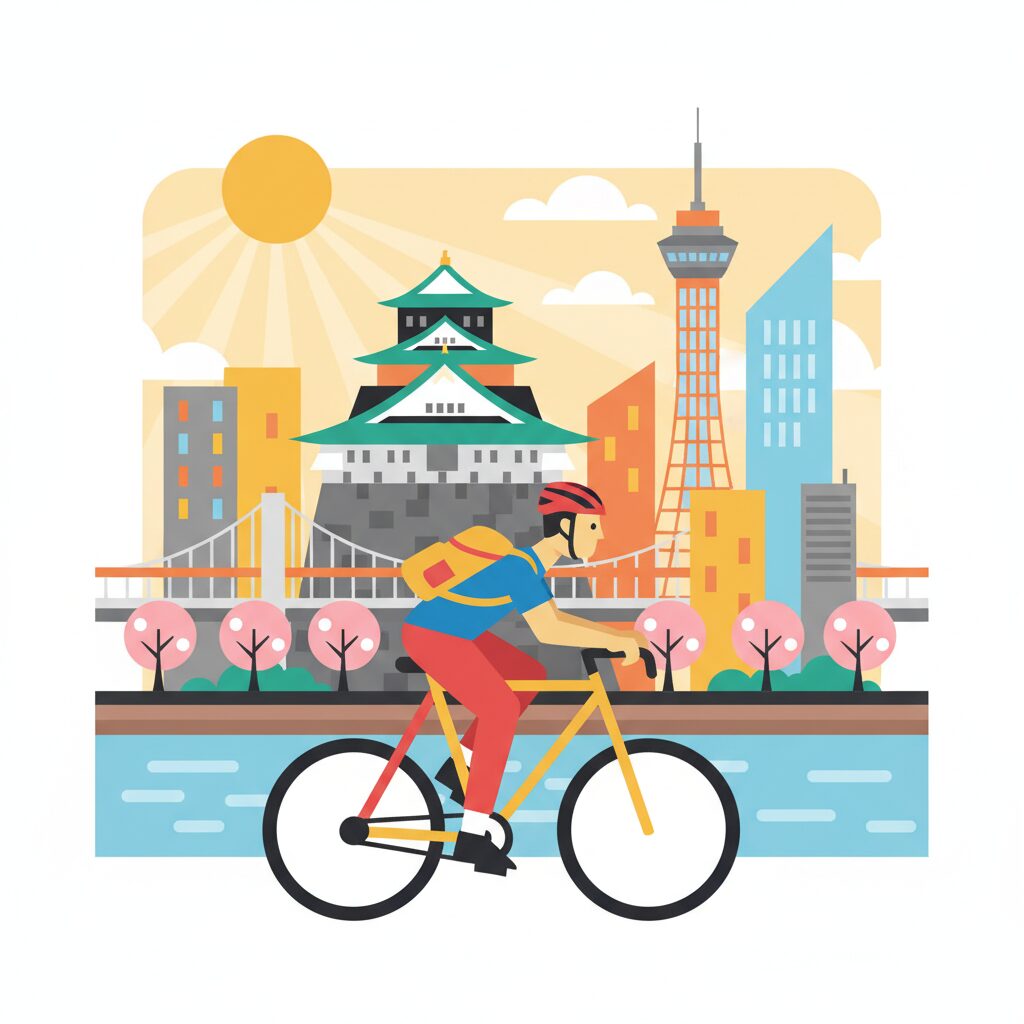
So you did it. You moved to Osaka, a city that runs on two wheels and a healthy dose of audacity. You navigated the paperwork, found an apartment, and, to truly cement your status as a local, you bought a bicycle. A sleek, silver mamachari, maybe, with a sturdy basket and a bell that rings with the sound of freedom. You picture yourself gliding through covered shotengai shopping arcades, a bag of freshly fried takoyaki swinging from your handlebars. You imagine the money you’ll save, the calories you’ll burn, the pure, unadulterated liberty of it all. The bicycle, you think, is your key to unlocking the city, a simple machine for a simple, cost-effective life. And for a week, it is. Then you try to park it at your local train station on a Monday morning.
Suddenly, your simple machine is a complex problem. You’re confronted by a veritable sea of silver, a sprawling, multi-level metal labyrinth packed so tightly you can’t see the pavement. Every bike seems to bear a small, colorful sticker, a secret badge of entry you don’t possess. Stern signs in dense Japanese list rules and fees. An elderly man in a faded blue uniform watches you with an expression that is neither welcoming nor hostile, but simply… knowing. This, you realize with a sinking feeling, is not free. It is not simple. And it is your first real lesson in the unspoken social contracts that govern daily life in Osaka. This isn’t just about finding a spot to leave your bike; it’s about understanding how Osakans manage shared space, community responsibility, and the pragmatic dance of getting by in a city that values efficiency over elegance. Forget the guidebooks for a moment. Your journey into the heart of Osaka begins right here, in the organized chaos of the neighborhood bicycle parking lot, the jitensha okiba, or more commonly, the churinjo.
While decoding Osaka’s intricate bicycle parking system, you might also discover how discount train tickets can further optimize your daily budget.
The Unwritten Constitution of the Churinjo
Your first experience with a station-side churinjo offers a lesson in implicit social dynamics. Tokyo may welcome you with sleek, automated underground parking towers run by large corporations, where your interaction is limited to a machine and a credit card reader. It’s efficient, anonymous, and sterile. In contrast, Osaka delivers something much more organic and human. These lots are often overseen by the city, a local semi-private foundation, or even the neighborhood association itself. They feel less like corporate infrastructure and more like the community’s large, shared garage. Like any shared space, it operates according to a complex set of written and unwritten rules.
The Sticker is Your Passport
That small, colorful sticker you notice on almost every bike is the key. It serves as your proof of payment, your membership card, your passport into this particular parking ecosystem. You can’t simply tap a button on an app to get one. Instead, you must locate the office, often a tiny prefabricated shed tucked into a corner of the lot. Inside, you’ll find an attendant—a typically older man or woman, an oji-san or oba-san—seated at a small desk with a thermos of tea and a mound of paperwork.
The process is ritualistic. You declare your intention: a one-month pass (ik-kagetsu), a three-month pass (san-kagetsu), or, if truly dedicated, an annual contract. You fill out a form with your name, address, and your bicycle’s anti-theft registration number. Payment is made in cash. The transaction feels deliberate and quiet. The attendant will locate your new sticker, carefully peel it from its backing, and may even step outside with you to demonstrate the correct placement on your rear fender. This is more than a financial exchange; it’s an initiation. You become a recognized member of this station’s daily commuter community. That sticker not only grants parking rights but also signifies your participation in the local system, showing you’ve done your part. Arriving without one instantly marks you as an outsider, a tourist, or a newcomer still learning the rules.
The Hierarchy of Spaces: A Silent Negotiation
Once you have your sticker, the next challenge arises: the daily quest for a good spot. Not all parking spaces are equal. The most desirable are on the ground floor, in single-level racks that require no lifting. These spots go first, typically claimed before 7:30 AM by early-bird commuters. Arrive later, and you’re relegated to the second tier.
These double-decker racks are a marvel of Japanese engineering and a daily test of strength and balance. To park, you must place your back wheel into a small groove, then, with effort and hope, lift and slide the entire bike upwards into its elevated metal cradle. The first few times you attempt this, you’ll feel awkward, weak, and certain you’ll drop your bicycle onto a row of others, triggering a domino effect of metallic chaos. But watching the petite elderly woman next to you effortlessly hoist her heavy, child-seat-equipped mamachari with a grace born of countless repetitions, you realize it’s about technique, not brute strength. This daily physical act is a great equalizer. Everyone—from high school students to salarymen in crisp suits—shares this brief, collective struggle. It’s a moment of mundane effort that unites the commuting community. An unspoken understanding exists: the ground floor spots are implicitly reserved for those who need them most—the elderly and parents managing large, tank-like bicycles designed to carry multiple children. No one enforces this; it’s just understood. This small daily act of community consideration, a practical solution to a common challenge, encapsulates the Osakan mindset.
The Economics of Two Wheels: More Than Just Pedal Power
One of the biggest misconceptions for newcomers is the cost of cycling. While the bike itself may be a one-time purchase, incorporating it into your daily routine involves a series of small, recurring expenses that represent your investment in the city’s infrastructure. In Osaka, the attitude is often described as kechi, loosely translated as “stingy.” This is a significant misunderstanding. Osakans aren’t stingy; they are value-conscious and hate waste. Paying a 2,000 yen fine for illegal parking is wasteful and, frankly, foolish. On the other hand, paying 150 yen for three hours of secure parking outside a department store is simply smart—an investment in convenience and peace of mind.
“Free” Parking Isn’t Free
This principle extends beyond the station. You’ll find small, automated parking lots outside supermarkets, drug stores, and shopping arcades. The signs tempt you with: “First 60 Minutes Free.” This isn’t a kindness; it’s a carefully designed system to encourage shopper turnover and prevent commuters from monopolizing valuable spots. When you roll your front wheel into the lock, a timer starts. You do your shopping, and if you return within the hour, the lock releases automatically. It’s a smooth experience.
But if you linger too long, lose track of time over coffee, you’ll come back to find your bike held captive. You must locate the payment machine, enter your spot number, and insert a few hundred yen to retrieve your ride. Overstay by a full day, and the fees become surprisingly high. Ignore this, and you risk the dreaded tow. This system perfectly captures the Osakan mix of convenience and practical no-nonsense. The city provides infrastructure to help you live efficiently, but it expects respect for the system. The rules are clear, consequences immediate, and there’s no room for argument. It’s a fair exchange everyone understands.
The Community Chest: Where Does the Money Go?
So where do all these small fees—the 2,700 yen for your monthly station pass, the 150 yen at the supermarket—actually go? Often, especially with community-run lots, the money doesn’t flow to some faceless corporation in Tokyo. It’s reinvested directly into the local area. That money pays the modest salary of Mr. Sato, the attendant greeting you every morning. It covers maintenance costs, grease for the lift-up racks, and new lightbulbs for covered areas. Sometimes surplus funds are directed by the neighborhood association towards other local projects, like planting flowers in the park or supporting the summer festival.
This creates a fundamentally different relationship with the service. You’re not just purchasing a parking spot; you’re a stakeholder in your community. Your fee is a tangible contribution to neighborhood upkeep and local employment. This fosters a sense of collective ownership and responsibility. It’s our parking lot, and we all chip in to keep it safe and functional. This grassroots, circular economy is a defining feature of Osaka’s urban character, contrasting sharply with the top-down, corporate-driven model often seen in Tokyo’s public spaces. Living in Osaka often means participating—even in these small financial ways—in a network of local, interdependent relationships.
The Human Element: The Guardians of the Silver Sea

What truly distinguishes Osaka’s bicycle parking culture from elsewhere is the human element. The system isn’t entirely automated; it is overseen, managed, and given its unique character by the attendants. These individuals are much more than low-paid security guards. They are community fixtures, serving as informal information centers, amateur mechanics, and guardians of the neighborhood’s daily rhythm.
The Oji-san as the Unofficial Mayor
Spend enough time at the same churinjo, and you’ll get to know your attendant. You’ll observe his routine: how he sweeps the entrance precisely at 7 AM, the brand of canned coffee he enjoys during his mid-morning break, the small portable radio on his desk always tuned to a baseball game. In turn, he will come to know you. He’ll recognize your bike, your face, and your schedule. He’ll greet you with a nod in the morning and a gruff “be careful” (ki o tsukete) in the evening.
This relationship proves invaluable when problems arise. If you have a flat tire, he might direct you to the nearest bicycle repair shop or even retrieve a pump from his shed. If you’ve lost your keys, he’ll patiently help you search. On a day with a typhoon warning, you might return to find he has taken the initiative to move your bike from an exposed area to a more sheltered spot. This isn’t part of his official duties—this is the human touch that no manual can capture. In Tokyo, you might spend years interacting only with machines. In Osaka, you develop a subtle, practical relationship with the person who watches over a part of your daily life. He is a quiet, constant presence, a living element of the city’s infrastructure, and his role encapsulates Osaka’s social fabric: straightforward, practical, and unexpectedly caring, beneath a sometimes gruff exterior.
Navigating the System When Things Go Wrong
Eventually, every cyclist in Osaka faces the harsh reality of having their bike towed. Maybe you misread a sign, parked in a forbidden spot a little too long, or just had bad luck. You return to your spot to find only a chalk mark on the ground and a sticker on a nearby pole directing you to the municipal impound lot. The experience can be daunting for foreigners. It requires a trip to a remote, industrial district, navigating a maze of paperwork, and paying a fine that often seems disproportionately high.
Yet even here, the Osakan spirit shines through. Though the process is bureaucratic, the people managing it tend to be pragmatic. In Tokyo, a missing document or a small discrepancy might stop the whole process. In Osaka, the emphasis is on resolving the issue. If you are polite, apologetic, and can clearly prove ownership of the bike, you’ll often find the staff surprisingly helpful. They care less about strict legal enforcement and more about clearing the day’s workload and getting everyone moving. This flexibility, this readiness to bend the rules for a practical outcome, is a defining trait of the city. The system may be rigid, but the people operating it are often reasonable. This distinction is crucial and offers a lifeline for any foreigner navigating the city’s complex regulations.
The City’s Rhythm: How Bicycles Define Osaka’s Flow
Understanding the bicycle parking system ultimately means grasping the rhythm of Osaka itself. The city’s flat terrain and dense urban environment make bicycles the most efficient way to travel for any trip under a few kilometers. It’s not merely a choice; it’s a necessity. This collective reliance on two wheels shapes the city’s entire flow, creating a unique form of organized chaos.
The Commuter Rush: A Synchronized Chaos
Observe the area around a major train station like Tennoji or Kyobashi at 8:30 AM. It is a display of synchronized movement. Thousands of people gather at the churinjo all at once. There’s a symphony of unlocking chains, the metallic click of kickstands, and the hum of spinning wheels. Then, a great river of cyclists flows into the surrounding streets. It appears chaotic, but it’s actually a well-practiced dance. Riders weave by each other with mere inches to spare, anticipate the flow of pedestrians, and use their bells not as harsh warnings but as polite audio cues—a gentle “excuse me, coming through.” This shared space demands a high level of ambient awareness and mutual trust. You have to trust that the rider ahead will maintain their line, and they trust you to do the same. This unspoken, high-density choreography is what keeps the city functioning.
Beyond the Station: The Neighborhood Network
The bicycle’s impact goes far beyond the morning commute. The entire city is built around it. You see this in the narrow lanes of residential neighborhoods, too small for cars but ideal for bikes. You see it in the dedicated bicycle lanes along larger boulevards. You see it in the informal yet respected lines of bikes parked outside every ramen shop, public bath, and local clinic. Bicycles are the lifeblood of the neighborhood economy. They’re how people pick up groceries from the local market, how parents take their kids to the park, and how the elderly visit friends. This dependence on bicycles keeps neighborhoods vibrant, fostering a culture where local businesses can thrive because they are easily accessible to nearby residents. This dynamic turns Osaka into a collection of lively, self-contained villages, all connected by a network of cyclists.
A Final Thought on Finding Your Place
That unassuming bicycle parking lot, which at first might seem like a barrier, is actually a gateway. It’s an entry point into the authentic, lived experience of Osaka. Learning its rules, both explicit and unspoken, is a rite of passage. It reveals the city’s pragmatic approach to shared resources, its deep-rooted community responsibility, and its preference for human-scale, common-sense solutions. The monthly fee for your parking sticker isn’t just a cost; it’s your subscription to the local community. The daily nod from the oji-san attendant signals your acceptance. And the moment you can confidently navigate the morning rush, hoisting your bike onto the second tier and merging into the river of cyclists without hesitation, is when you stop being just a resident. It’s when you become part of the city’s relentless, practical, and beautifully human rhythm.