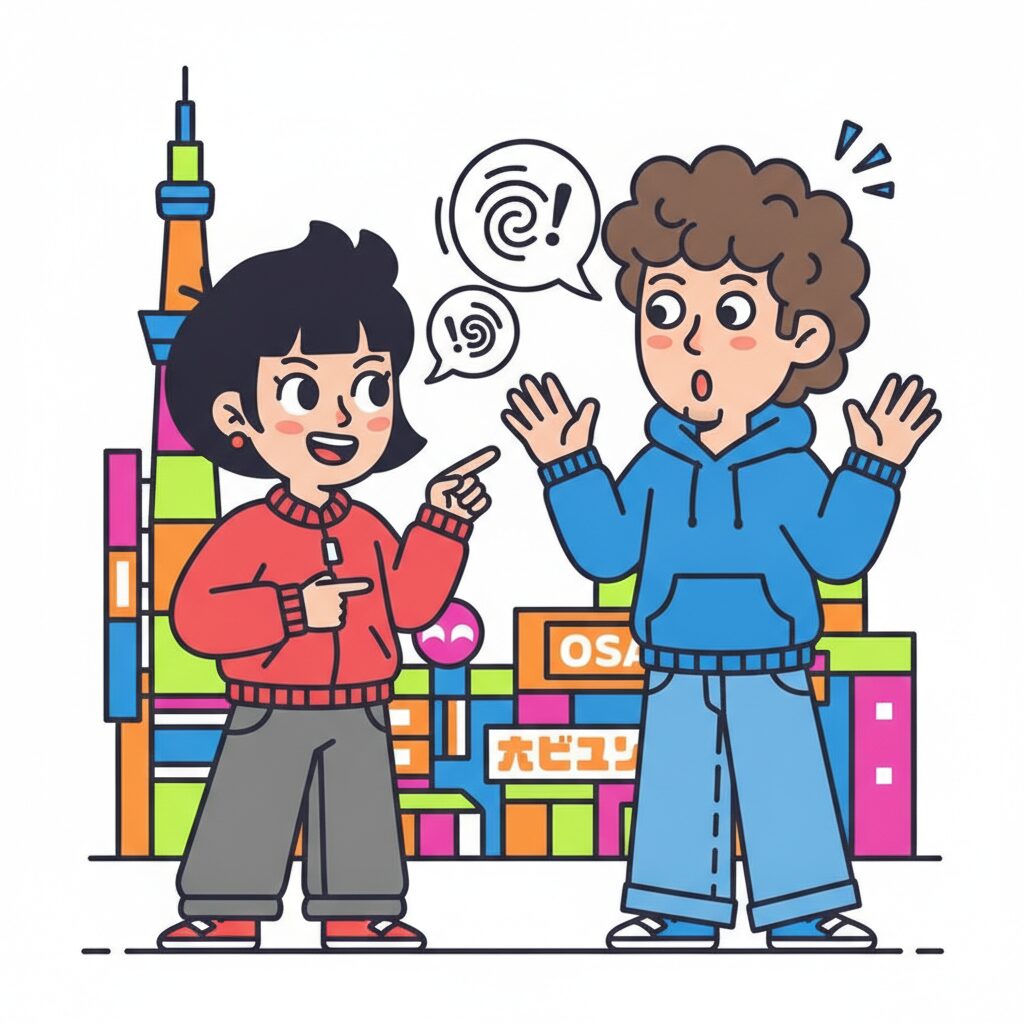
When I first moved to Osaka from Tokyo for an event planning gig, I thought I had Japanese communication figured out. You know the drill: read the air, value harmony, and express opinions through a delicate filter of polite suggestion. My Tokyo self was a master of the subtle nod, the non-committal “I see,” and the art of saying everything by saying almost nothing. Then, on my third day here, I went to buy a ridiculously bright yellow raincoat in a shotengai, one of those lively covered shopping arcades. The old lady running the shop looked at my choice, looked at me, and said with a perfectly straight face, “You gonna try to direct traffic in that thing, or just blind a few pilots?” I stood there, speechless. In Tokyo, a shopkeeper would have said, “The color is very vibrant, it suits you well.” But here? I was being roasted. I stammered something, paid, and left, convinced I had just been expertly insulted. It took me a few more weeks of similar encounters to realize I hadn’t been insulted at all. I had been welcomed. I had been given the opening line in a city-wide comedy routine, and I was just beginning to learn my part. This playful, sometimes abrasive, always quick-witted banter isn’t noise; it’s the music of daily life in Osaka. It’s a form of communication so different from the rest of Japan that it needs its own instruction manual. This is it.
Every new encounter revealed that the playful boke and tsukkomi banter was not merely a humorous quirk but a heartfelt invitation to join Osaka’s uniquely spirited social fabric.
The Unspoken Rules of the Osaka Comedy Club

To understand Osaka, you first need to understand manzai, a traditional style of Japanese stand-up comedy usually performed by a duo. There’s the boke, the funny one who says absurd, silly, or incorrect things, and the tsukkomi, the straight man who corrects the boke with a sharp remark and often a quick, harmless tap on the head or shoulder. In Tokyo, manzai is something you watch on TV, but in Osaka, it’s how you converse with the guy at the corner store. This dynamic forms the underlying “software” running in nearly every conversation. People are constantly and subconsciously seeking chances to play either the boke or the tsukkomi. It’s a verbal game of catch: the boke deliberately throws a silly, easy-to-grasp ball, and the tsukkomi skillfully catches it and sends it back with a satisfying snap. The aim isn’t to win an argument or be mean but to create a rhythm—a shared moment of laughter that instantly bridges the gap between two people. When the lady at the raincoat shop teased me, she was playing the tsukkomi, and my bright yellow raincoat was the accidental boke. The joke was complete the moment she spoke; my confused silence was like dropping the ball. What she awaited was a comeback, a playful retort that showed I was part of the game.
The Boke and Tsukkomi in the Wild
Once you notice it, you can’t unsee it. Watch two friends from Osaka interact: one complains about being tired, and instead of sympathy, the other replies, “From what? Thinking too hard? That’s a new one for you.” This is a classic tsukkomi. The first friend might then clutch their chest dramatically and say, “Your words wound me!”—a typical boke response. The rhythm is quick, sharp, and surprisingly affectionate. It’s a performance where everyone has a role. Someone might purposely wear mismatched socks or say something slightly off-topic just to see who in the group is alert enough to deliver the tsukkomi. It’s a test of engagement. Are you listening? Are you part of this? A good tsukkomi signals intelligence, wit, and above all, attention. It says, “I hear you so well that I can dissect what you just said and hand it back in a funnier form.”
“Nande Ya Nen!”: Deconstructing the Osaka Retort
The Osaka dialect, or Osaka-ben, seems almost designed for the tsukkomi. The expressions are brief, sharp, and carry a playful aggression absent from standard Japanese. The undisputed champion of retorts is “Nande ya nen!”, which literally means “Why?!” or “What the heck?!” However, that translation misses the essence of the phrase. It’s not a sincere question but a dramatic exclamation—a verbal slap expressing disbelief and amusement at the boke‘s foolishness. This is often accompanied by a light tap on the arm or shoulder, a physical cue that says, “You idiot, I love you.” Another common phrase is “Akan ya n!”, meaning “That’s no good!” or “You can’t do that!” It’s typically used when a friend makes a silly error, like trying to push a door that says “pull.” In Tokyo, a friend might quietly say, “Ah, I think it’s a pull door.” In Osaka, you get a loud “Akan ya n! Moji yometen ka?!” (“That’s no good! Can’t you even read?!”). The teasing tone makes it clear this is all in good humor. It points out a flaw so minor and human that laughing together strengthens your bond. These phrases serve as conversational shortcuts to intimacy, skipping the dull small talk and moving straight to the comfortable, teasing phase of a friendship.
More Than Just Words
The physicality plays a crucial role. The light smack, the exaggerated sigh, the hand thrown up in exasperation—all are part of the performance. A Tokyo native might mistake a light smack on the back of the head for the start of a fight. But in Osaka, it’s quite the opposite. It’s a gesture of closeness, breaking the personal space bubble in a way that feels structured and safe. You can’t just go around smacking strangers, but once you’ve entered this banter-sphere, such physical punctuation becomes part of the shared language. It’s a way of saying, “We’re close enough for this.” This gesture reaffirms the connection, making sure the sharp words are understood as playful, not hostile.
Silence is Golden… Except in Osaka
Here lies the greatest source of confusion for outsiders. In Tokyo, and indeed in many cultures around the world, the safest way to respond to a stranger or new acquaintance is with polite neutrality—a gentle smile, a non-committal nod, or a quiet laugh. In Osaka, however, this can be seen as coldness, disinterest, or even arrogance. When someone jokes or teases you, they are extending an invitation to engage. Responding with polite silence is like looking at their outstretched hand and refusing to shake it; it shuts down the conversation. A sharp, witty retort, on the other hand, signals respect. It shows you were paying attention, you understood the joke, and you have the confidence to play along. It’s a demonstration of social skill. The most unsettling reaction you can receive from an Osakan is not a loud tsukkomi; it’s a polite, Tokyo-style smile paired with a quiet “Sou desu ne” (“That is so, isn’t it”). That’s when you know you’ve truly failed to connect. They’ve built a wall. The banter, teasing, and loud comebacks—that’s the sound of those walls coming down.
The Takoyaki Test
Let me illustrate this with a concrete example. You’re at a takoyaki (octopus balls) stand. You take a bite and, because it’s molten hot, you instinctively yelp. Now, consider the responses. In Tokyo, the vendor might say, with genuine concern, “Daijoubu desu ka? Atsui desu kara, ki wo tsukete kudasai.” (“Are you okay? It’s hot, so please be careful.”) It’s polite, helpful, and maintains a clear customer-vendor distance. In Osaka, the vendor is more likely to lean over the counter and yell, “Atarimae ya! Yakitate ya zo!” (“Obviously! It’s fresh off the grill!”) followed by a grin. This isn’t poor customer service; it’s premium, Grade-A Osaka interaction. The vendor treats you not as a generic customer, but as a fellow human who just did something amusingly predictable. The right response is not to be offended, but to laugh and reply with something like, “Honma ya, kuchi no naka kaji natta wa!” (“You’re right, the inside of my mouth is now a blazing fire!”). Do that, and you might just earn an extra piece of takoyaki for free. You passed the test. You’re no longer merely a customer; you’re part of the scene.
How to Play the Game: A Foreigner’s Guide to Osaka Banter
So, you find yourself in Osaka and want to join the game. You don’t need to be a professional comedian; just learn a few basic moves. First and foremost, don’t take the teasing personally—this is rule number one, tattooed on the inside of your eyelids. When someone mocks your clothes, your Japanese accent, or your awkward chopstick skills, they aren’t attacking you—they’re including you. The opposite of playful teasing isn’t politeness; it’s indifference. Being ignored is the true insult. Being teased means you’ve been noticed—you’re interesting enough to joke with. Second, you don’t have to deliver a killer comeback. Your role is simply to show you understand it’s a game. A loud laugh and a shake of the head works perfectly. A simple, well-timed “Nande ya nen!“ is the gold standard. Even with a terrible accent, the effort is met with delight. It shows you’re trying to speak the local language—not just Japanese, but Osaka’s social language. Third, dare to be the boke. Say something a little silly. Ask an obvious question. Wear that ridiculous yellow raincoat. This is like tossing the ball into the air, inviting someone to hit it back. You’re creating a chance for connection. When they inevitably tease you, you’ll know you’ve succeeded.
Beyond the Banter: The Warmth Behind the Wit
This entire communication style may appear chaotic, but it stems from a deeply rooted cultural logic. Osaka has always been a city of merchants. In a competitive market, you need to build rapport quickly, be memorable, and stay sharp. The polite, indirect dance of samurai–class Tokyo diplomacy was inefficient. Osakan merchants developed a way of communicating that was direct, human, and forged instant connections through shared laughter. This spirit endures. The banter serves as a tool for social cohesion, offering an incredibly effective way to break down barriers between strangers. In Tokyo, you might work alongside someone for a year and still use polite, formal language. In Osaka, you can feel like old friends with someone you just met at a bar after five minutes of good-natured teasing. This culture values a different kind of harmony—not one of avoiding friction, but one of creating a fun, energetic rhythm together. It’s about recognizing our shared imperfections and finding humor in them. It’s a noisy, dynamic, and warmly connected way of relating, built on the idea that laughing together matters far more than being polite alone.
Final Thoughts
Living in Osaka feels like holding a backstage pass to a city-wide improv show. The script is optional, and the best lines are those fired back spontaneously. That quick retort from a stranger isn’t a punch; it’s an invitation. That teasing insult from a friend isn’t a jab; it’s a hug. It takes some adjustment, especially if you come from a place where politeness is shown through quiet deference. But once you catch the rhythm, once you realize the aim is always connection, never cruelty, a whole new side of the city reveals itself. You stop being an observer and become a participant. So the next time a shopkeeper gives you a hard time, don’t just stand there in stunned silence like I did. Smile, take a breath, and get ready to play. Welcome to the club.