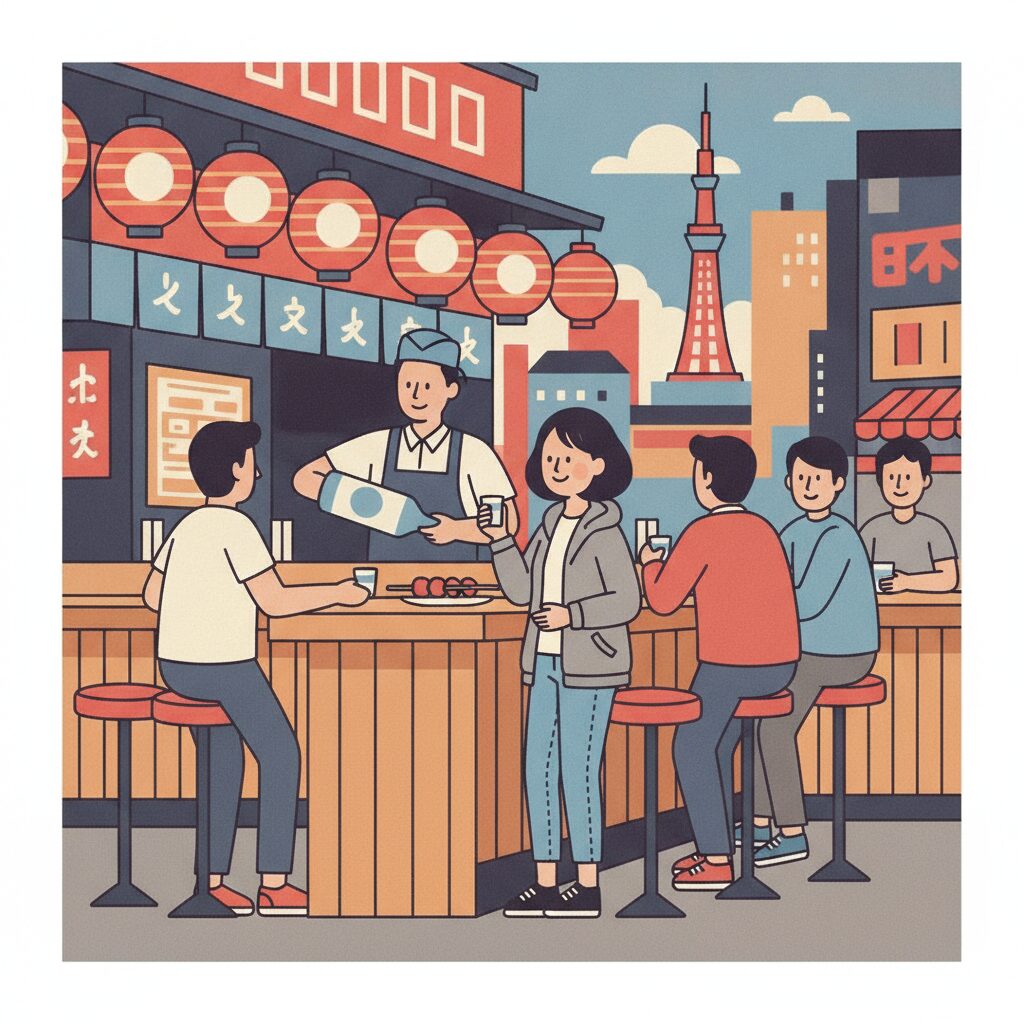
Walk through the backstreets of Kyobashi or Tenma any night of the week, and you’ll feel it. A current of energy pulling you away from the bright, wide avenues into the narrow, lantern-lit shotengai arcades. Here, the air is thick with the smell of grilled skewers and simmering dashi. The dominant sound isn’t the rumble of trains, but the low, happy hum of conversation spilling from doorways so small you might miss them if you blink. These are Osaka’s tachinomi, the standing bars that serve as the city’s unofficial living rooms. You’ll see them packed shoulder-to-shoulder, a vibrant mosaic of humanity. But look closer. You’ll see a salaryman in a crisp suit, tie loosened, staring into his beer. You’ll see a young woman in vintage clothes, a book propped against a soy sauce bottle. You’ll see two old men quietly debating the Hanshin Tigers’ latest game. What you won’t see, almost ever, is a boisterous group of six coworkers celebrating a project launch. This presents a paradox that confuses many newcomers. How can a place so crowded and social be so fundamentally designed for the individual? The truth is, tachinomi aren’t just bars. They are a physical manifestation of Osaka’s soul: pragmatic, efficient, unpretentious, and fiercely individualistic, yet bound by a shared, unspoken social contract. Understanding the tachinomi is understanding the rhythm of daily life in this city. It’s where you learn that in Osaka, “friendly” doesn’t mean forever, and community is something you build one fleeting, ten-minute conversation at a time.
The bustling individualism of Osaka’s tachinomi scene finds a natural extension in the subtle dynamics of community, and exploring the nuances of osekkai culture reveals how everyday exchanges can foster unexpectedly profound connections.
The Unspoken Rules of the Counter
The first time you enter a proper tachinomi, it can feel overwhelming. The space is cramped, the pace is brisk, and the rules are unspoken. Yet, these unwritten codes are what keep the whole system running—a beautiful, chaotic dance of efficiency and fleeting social grace. It’s a world founded on mutual, unspoken understanding, a fundamental aspect of life in Osaka where people expect you to simply get it without any instructions.
A Symphony of Solitude and Fleeting Connections
The true charm of a tachinomi lies in its ability to be two things at once: a refuge for the solo drinker and a stage for spontaneous interaction. There’s no social barrier to entry. You don’t need a reservation, a drinking companion, or a reason. You only need a few coins and a craving for a cold beer and a hot snack. This reflects a deep-seated Osakan practicality. Why wait for friends to be free when you’re thirsty now? This isn’t viewed as lonely or sad; it’s embraced as self-sufficient. You can stand at the counter for an hour, lost in thought, nursing a single glass of shochu, and no one will disturb you. The background sounds—the sizzle of the teppan grill, the gruff orders shouted out, the clatter of plates—become a comforting soundtrack to your solitude.
Yet, you’re never truly alone. The close quarters create a unique social membrane. It’s permeable. A comment about the shocking plot twist in the drama playing on the corner TV can spark a ten-minute discussion with the stranger beside you. A recommendation for `kushikatsu` (deep-fried skewers) might turn into a shared plate with the person to your right. These interactions are quintessential Osaka: direct, unfiltered, and temporary. You might learn your neighbor’s views on the prime minister, his favorite sake, and his daughter’s upcoming wedding, but probably never his name. When he drains his glass and says, “`Ja, osaki ni`” (“Well, I’m heading out”), the connection dissolves as quickly as it formed. There’s no awkward exchange of numbers or pressure for future plans. It was a moment, and that moment has passed. This is often misunderstood by foreigners used to more structured approaches to making friends. The friendliness isn’t a prelude to a lasting relationship; it is the relationship, complete in its brevity.
Kosu-pa as a Way of Life
At the core of the tachinomi experience is the sacred concept of `kosu-pa`, or cost performance. This isn’t just about being cheap; it’s about getting the maximum value for your yen—a principle that shapes nearly every transaction in Osaka. In Tokyo, you might pay for ambiance, brand name, or impeccable formal service. In Osaka, you pay for the product itself. A draft beer for 350 yen. A plate of savory `dote-yaki` (slow-cooked beef sinew) for 250 yen. Three sticks of grilled chicken skin for 400 yen. The prices are fair, the food is delicious, and the service lightning fast. This isn’t a place for fancy garnishes or elaborate plating. It’s about enjoying good, hearty food and drink without fuss.
This philosophy is perfectly reflected in the payment system used by many older tachinomi: `kyasshu on deribarii` (cash on delivery). You place a 1,000 yen coin or bill in a small tray on the counter in front of you. When your beer arrives, staff take 350 yen. When your skewers land on your plate, they take another 400. There’s no running tab, no waiting for a bill, no complicated credit card routine at the end. It’s a system of pure, unadulterated efficiency. It enables a steady flow of customers and keeps prices low by minimizing administrative work. It also puts responsibility on you: you know exactly how much you’re spending in real time. When the tray is empty, it’s time to put more money down or head home. This straightforward, no-nonsense approach to business is Osaka in a nutshell. People here value transparency and hate feeling cheated. The tachinomi, with its clear pricing and efficient system, is the ultimate trusted local institution.
Why Your Group of Five is a Logistical Nightmare
So you’ve discovered the joy of tachinomi and want to share it with your friends. You gather your group of five and try to squeeze into your favorite spot. Suddenly, the warm, welcoming atmosphere disappears. You catch subtle glares from the regulars. The master behind the counter looks stressed. Unknowingly, you’ve committed a cardinal sin of tachinomi culture. These places aren’t merely small; their entire social and physical design is intended to discourage large groups.
The Tyranny of Physical Space
The typical tachinomi is a masterclass in spatial economy. Often, it’s a long, narrow room, sometimes no wider than a hallway, dominated by a single wooden counter. Behind the counter is a ballet of frantic activity, with one or two staff members navigating grills, fryers, and beer taps. The area in front is for customers, and it’s extremely limited. A solo patron occupies about 50 centimeters of counter width. A pair can stand side-by-side or face each other. A group of three forms a small, tight triangle. Anything beyond that, and the geometry falls apart.
A group of five becomes an impenetrable human wall. You block the narrow pathway for other customers trying to reach the back or the restroom. You make it difficult for the staff to serve people at the far end of the counter. You essentially take up a large portion of the bar’s scarce real estate. This isn’t just inconvenient; it’s seen as inconsiderate. In Osaka, there is a strong sense of shared public space. You are expected to be mindful of your footprint, to read the environment, and not to take up more than your fair share. Trying to cram a large group into a tiny tachinomi is like trying to park a bus in a spot meant for a scooter. It reveals a fundamental misunderstanding of how the city operates. The regulars aren’t being unfriendly; they are responding to a breach of unspoken spatial etiquette.
Breaking the Social Rhythm
Beyond the physical disturbance, a large group fundamentally changes the social atmosphere of a tachinomi. The magic of the space lies in its gentle hum of dozens of small, independent conversations. It’s a collective soundscape where you can still enjoy your own quiet moment. A large group, by nature, is loud. Your inside jokes, boisterous laughter, and overlapping stories create a single, dominant sonic bubble that drowns out everything else.
This disrupts the delicate balance between solitude and public life. The solo drinker who came for a quiet beer becomes an unwilling audience to your office gossip. The two old friends trying to chat are forced to shout over your celebration. You’ve effectively brought a private party into a shared, public space, making it less comfortable and accessible for everyone else. This is a classic example of failing to `kuuki wo yomu` (read the air), a vital social skill in Japan, but one enforced with particular bluntness in Osaka. In Tokyo, if you made this mistake, you might be met with polite silence and icy stares. In Osaka, it’s common for the bar master or a regular patron to outright say, “`Antara, urusai wa!`” (“You guys are being too loud!”). This isn’t meant to be harsh. It’s a direct, practical correction aimed at protecting the space’s integrity for the entire community. It’s the tachinomi’s immune system responding.
Reading the Air: Tachinomi Etiquette for the Foreign Resident
Navigating the tachinomi world is a skill you can definitely learn. It involves observation, mindfulness, and a readiness to adjust to a different social rhythm. Mastering these small etiquette points will not only make your experience smoother but also earn you respect from the regulars and deepen your understanding of Osaka’s culture.
The Art of Finding Your Spot
When you enter a busy tachinomi, resist the urge to just squeeze into an open-looking spot at the counter. The proper way is to pause at the entrance, just inside the `noren` curtain. Make eye contact with the `taisho` (master) or a staff member. A simple nod or raising your index finger to indicate “one person” is sufficient. They will scan the counter and, with a subtle nod or a gesture with a towel, direct you to a seat. You might need to wait briefly, but this shows respect for their management of the space. Once at the counter, get ready for the “tachinomi shuffle.” As people pay and leave, gaps open up, and the patrons on either side will subtly shift to fill the space. Often, they will collectively shuffle down to create a larger spot for a new pair of customers. Join this fluid dynamic—squeeze in respectfully, keep your elbows close, and place your bag on the floor or on hooks often found under the counter. The goal is to be as compact and unobtrusive as possible.
Ordering Like a Regular
The pace inside a tachinomi is fast. The staff juggle many orders simultaneously and appreciate efficiency. Before you reach the counter, have your first drink order ready. The universal opener is “`Toriaezu, biiru`” (“Beer for now”). It’s quick, easy, and gets a drink in your hand while you scan the handwritten menus taped to the wall. When ready to order food, be decisive. Make eye contact and state your order clearly and loudly enough to be heard over the noise. If your Japanese is uncertain, pointing works perfectly and is often encouraged. “`Kore, hitotsu`” (“One of these”) always works. Don’t hesitate or ask for complicated substitutions. Avoid engaging the taisho in lengthy conversation when they are busy. The time for chatting comes later, when it quiets down. The initial interaction is about a quick, clean transaction—a sign you understand the place’s rhythm.
Knowing When to Leave
A tachinomi isn’t a European-style cafe where you linger for hours over a single espresso. It’s a high-turnover spot—a quick stop on the way home or the first leg of `hashigo-zake` (bar-hopping). The business model and social contract depend on this flow. Have a couple of drinks, eat two or three small dishes, and move on. About an hour to an hour and a half is typical. If a line forms outside, that’s your cue to finish up. Overstaying, especially when others are waiting, is a major faux pas. When you’re ready to leave, say “`Okanjo, onegaishimasu`” (“The bill, please”) or “`Gochisousama`” (“Thank you for the meal”). Pay quickly, nod to the taisho, and slip out as smoothly as you came in. This respect for the flow of people is what keeps the tachinomi ecosystem healthy and welcoming for everyone.
More Than a Bar: The Tachinomi as a Community Hub
It’s easy to view the tachinomi as merely a transactional spot for cheap food and drink. However, that completely misses the point. These establishments are the lifeblood of their neighborhoods. They serve as the “third place” for countless individuals—an essential space that exists beyond the pressures of work and the responsibilities of home. It’s a low-cost, low-commitment social hub in a world that can often feel isolating.
The `taisho` is more than just a cook; he acts as a community switchboard. He knows who recently received a promotion, whose child is ill, and who is going through a hard time. He facilitates introductions, mediates friendly disputes, and provides a dependable, attentive ear. The regulars form a loosely connected family by circumstance. A construction worker still in his work clothes might share a laugh with a university professor. A young aspiring musician might receive life advice from a retired grandmother. Social hierarchies disappear at the counter. Everyone is equalized by the shared experience of standing, drinking, and eating. There are no VIP sections in a tachinomi.
This is where the true essence of Osaka’s “friendliness” shines through. It’s not the bubbly, performative warmth found in tourist-oriented places. Instead, it’s a gruff, practical, and deeply ingrained sense of shared humanity. It’s the quiet understanding that you’ll make space for a newcomer. It’s the gesture of passing a bottle of soy sauce down the counter without being asked. It’s the collective groan when the local baseball team surrenders a home run. It’s a community built not on grand gestures, but on a thousand small, repeated acts of consideration within a cramped, chaotic, and beautiful space. The tachinomi is a microcosm of Osaka itself: a bit rough around the edges, fiercely practical, with a heart of gold hidden just beneath the surface.