The blue light of the laptop screen paints your face in a sterile, corporate glow. It’s 9 PM in your Nishi-ku apartment, but the Slack notifications ping with the rhythm of a New York morning. Your neck aches, your eyes burn, and the boundary between your living room and your office has dissolved into a single, pixelated blur. This is the new reality for many of us, the digital nomads and remote workers drawn to Osaka for its vibrant culture and affordable living, only to find ourselves tethered to a global clock, working in a bubble of Wi-Fi and caffeine. You came here to experience Japan, but most days you just experience the inside of your apartment and the glowing rectangle that pays your rent. The city hums outside your window, a living, breathing organism of laughter, sizzling takoyaki, and the rumble of the Midosuji line, yet you remain disconnected, a ghost in the machine of your own life. How do you log off when your home is your office? How do you connect with a city when your primary interface is a screen? The answer, my friend, is not in an app or a new productivity hack. It’s just around the corner, behind a sliding door and a simple fabric curtain called a noren. It’s in the steam, the scalding water, and the shared silence of the neighborhood sentō, Osaka’s last bastion of true, analog connection. This isn’t about luxury spas or onsen resorts. This is about the humble public bath, the 520-yen ticket to sanity that has been the social and spiritual anchor of Osaka neighborhoods for generations. It’s where you go to strip away not just your clothes, but the digital armor of modern life, and immerse yourself in a ritual that’s as essential to understanding this city as learning to stand on the right side of the escalator. Forget your phone, forget your deadlines, and forget the person you’re supposed to be online. The sentō asks only that you show up and be present.
Embracing the analog sanctuary of the sentō can lead you to appreciate how Osaka’s playful boke and tsukkomi culture offers a refreshing counterbalance to the digital grind of remote work.
The Tyranny of the Glowing Rectangle: A Remote Worker’s Reality

Let’s be brutally honest about the dream of remote work in a city like Osaka. The fantasy involves working a few hours from a minimalist café, then spending your afternoons exploring ancient temples or wandering through the neon maze of Namba. The reality, however, is often a cramped one-room apartment where your dining table doubles as your desk, your bed serves as your boardroom, and the persistent blinking of the Wi-Fi router is your most constant companion. Your posture gradually curves into a question mark. Your social interactions occur through a webcam, your voice compressed into data packets. Though you may be physically in Osaka, your mind drifts in a placeless, digital realm, a resident of the internet first and your neighborhood second. This digital existence breeds a peculiar kind of loneliness. Surrounded by millions of people, you remain fundamentally isolated. The casual, spontaneous interactions that foster a sense of community are replaced by scheduled Zoom calls and asynchronous messages. The city’s rhythm is something you watch from a window, not something you actively engage in. This is a modern alienation, a sensory deprivation where the rich tapestry of urban life—the smell of rain on asphalt, the chatter of shopkeepers, the distant clang of a train crossing—is filtered out, leaving only the monotonous hum of your laptop fan. In Tokyo, this feeling can intensify due to the city’s immense scale and its more reserved social etiquette. The pressure to be productive, efficient, and conform to a sleek, modern ideal is overwhelming. The city’s energy is an unrelenting forward motion, and it’s easy to feel left behind if you can’t keep pace. You might find comfort in meticulously designed coffee shops or curated retail spaces, but these are often solitary experiences, transactions rather than connections. You are a consumer of the city, not an active participant in its life. The digital fatigue you experience is not just eye strain; it’s a soul-deep weariness, a yearning for something tangible, something real. It’s a craving for an experience that doesn’t require a password, login, or software update. It’s a need to feel grounded in your own body and physical surroundings, a reminder that you are more than just a blinking cursor on a screen.
The Sentō’s Embrace: An Analog Sanctuary in a Digital World
Now, imagine this. You close your laptop and leave your phone resting on the charging cable, like a dormant serpent. You grab a small towel and some soap and step out into the evening air of Osaka. The neighborhood’s scents surround you—grilled eel from the corner shop, damp earth from a nearby potted garden. Turning down a side street, away from the bustling main road, you spot it: a building resembling a small temple, with a modest curtain hanging over the entrance. This is the sentō. The moment you slide open the door, the modern world slips away. Instead of Wi-Fi signals, you’re greeted by a wave of warm, humid air scented with cedar, soap, and minerals. The sound shifts instantly from city traffic to the gentle lap of water, voices echoing in the tiled room, and the clatter of plastic stools. You pay your fee—just a few hundred yen—to an elderly woman or man seated on a raised platform called a bandai, a throne from which they oversee their small realm. There are no touch screens here, only a well-worn wooden counter and a person who might respond with a gruff but welcoming nod. You enter the changing room, the datsuijo, where the true ritual unfolds. You shed your work clothes, your street clothes, the uniform of your daily life. Along with your jeans and t-shirt, you let go of the anxieties of your inbox, the burdens of your to-do list, the posture of your desk-bound existence. You store your belongings in a simple locker, often secured with an old-fashioned key on a rubber wristband—a charmingly low-tech security measure. Standing there, naked except for a small towel, you are reduced to your essential self. There are no status symbols, brands, or job titles. You are simply a body among other bodies, all gathered for the same purpose: to cleanse, to warm, to find stillness. This shared vulnerability forms the core of the sentō experience. It acts as a great equalizer, a place where a company president and a construction worker can soak side-by-side, their worldly differences dissolved in the steam.
Osaka’s Living Rooms: Why the Public Bath Thrives Here
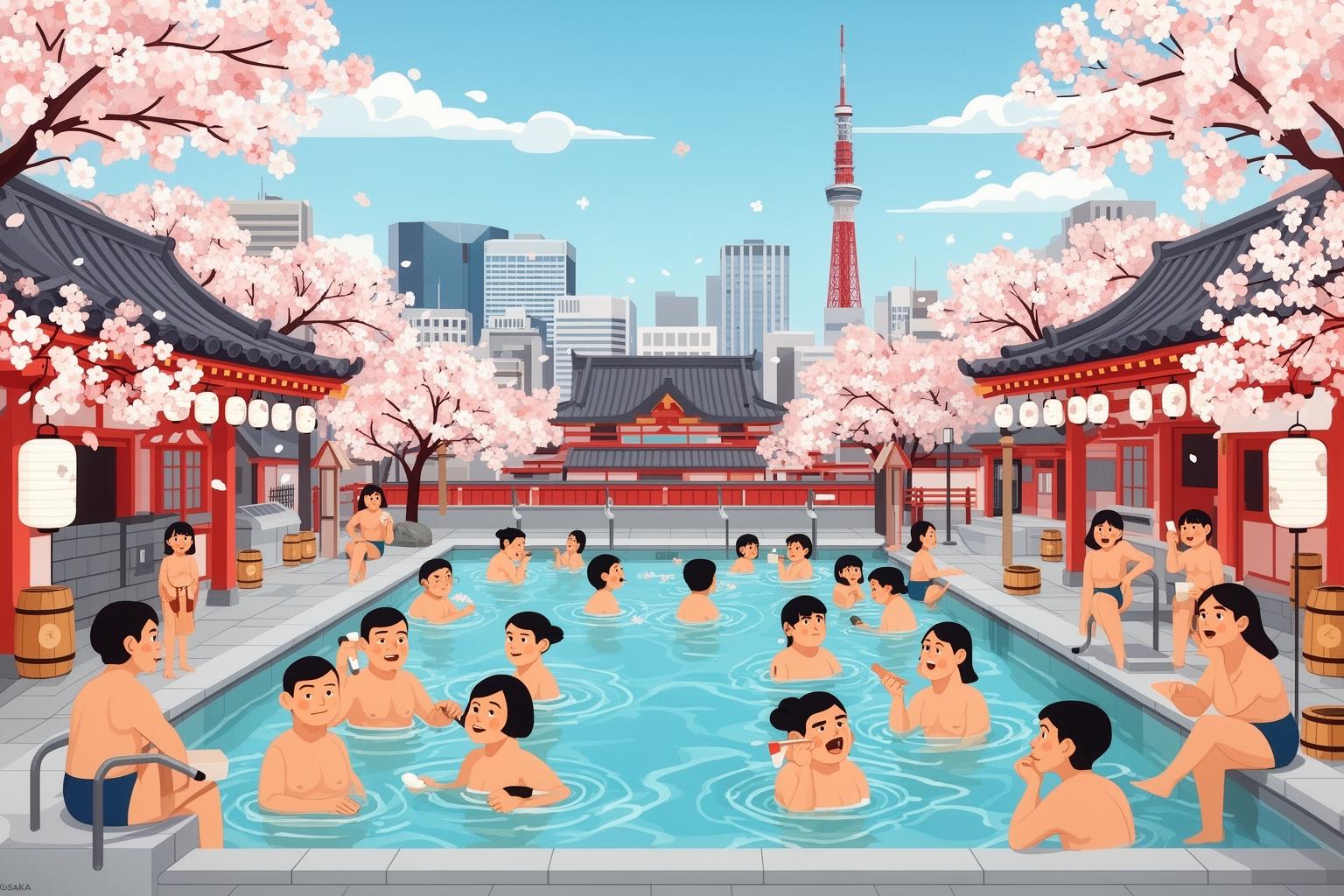
Why does this tradition endure so strongly in Osaka, a city known for its relentless commercial energy and modernization? While sentō are vanishing throughout Japan, Osaka clings to its neighborhood baths with remarkable tenacity. The reason reveals something essential about the city’s character, starkly contrasting Tokyo’s polished facade. It ultimately boils down to pragmatism and a distinct sense of community. In Tokyo, redevelopment is almost a religion. Old buildings are often viewed as inefficient barriers to be cleared away for the newest, most earthquake-resistant skyscraper. There is a constant pursuit of perfection and a seamless urban aesthetic. In Osaka, there is a deep-rooted pragmatism. If it still serves its purpose, why replace it? This isn’t about being old-fashioned; it reflects a merchant city’s respect for utility and value. An old sentō that continues to provide a hot bath and a gathering place for the neighborhood is considered a valuable asset, not an eyesore. Its worn tiles and aging pipes stand as proof of resilience, not decay. This practicality extends to spatial concepts. Osaka apartments are famously small, and for generations, the sentō wasn’t a luxury but an extension of home. It functioned as the neighborhood’s shared bathroom, its public living room. This attitude still holds today. Why steam up your own cramped bathroom when, for a small fee, you can soak in a tub the size of a small car and enjoy various amenities? It’s a sensible, cost-effective choice that directly appeals to the Osakan obsession with kosupa (cost performance).
The Pragmatism of Shared Space
The Osakan approach to community is less formal, more intertwined, and livelier than in Tokyo. The Tokyo ideal often involves harmonious, non-intrusive coexistence—respecting your neighbor by keeping to yourself. In Osaka, community is an active, sometimes chaotic engagement. It arises from the dense, bustling energy of a merchant city where your business and life are intertwined with those of your neighbors. The sentō epitomizes this. It’s a semi-public space where private lives overlap. You hear local gossip, find out who’s getting married or sick, and watch neighborhood kids being scolded by their mothers. It’s an unfiltered flow of local life that you simply can’t access through a screen or in a quiet café. This isn’t forced friendliness; it’s shared existence. The sentō reinforces that you’re part of an ecosystem, not just an individual living in isolation. This physical proximity and casual intimacy serve as a powerful antidote to the isolation brought by remote work. It reminds you that you are rooted in a specific place, a member of a tangible community, even if your work is entirely virtual.
Sewakkai Culture: More Than Just “Friendly”
Foreigners often describe Osaka people as “friendly,” but this term is too simplistic. A more precise word is sewakkai, meaning someone who enjoys looking after others, sometimes to the point of being a bit meddlesome. You’ll experience this firsthand in the sentō. An elderly woman, an obachan, might notice you’re not scrubbing your back properly and, without a word, grab a brush and start scrubbing it for you. Or an old man might see you shivering after the cold plunge and lecture you on the proper way to alternate between hot and cold baths for circulation. In Tokyo, this would be seen as a shocking invasion of personal space. In Osaka, it’s a form of connection—a way of saying, “We’re all in this together.” They are not judging you; they are including you. For a foreigner, this can be a pivotal moment of acceptance. It’s the city’s way of saying, “We see you. You’re one of us now.” This direct, unfiltered interaction lies at the heart of the Osaka experience. It can be startling at first, but once understood, it reveals a warmth far more genuine than polite, distant smiles. It is this sewakkai spirit that prevents the sentō from becoming a silent, anonymous space and instead transforms it into a lively, breathing community hub.
Hadaka no Tsukiai: The Unspoken Code of the Naked Commune
To truly appreciate the sentō, you need to grasp the concept of hadaka no tsukiai, meaning “naked communion” or “naked friendship.” This idea signifies that by removing your clothes, you also shed your social status, titles, and pretensions. In the bath, everyone stands equal. This principle holds great appeal in a country with a complex social hierarchy. It enables a more direct and honest form of interaction that is uncommon in other environments. The sentō serves as a sanctuary where this ideal is practiced every day. Yet, this freedom is accompanied by a strict, unspoken set of rules. Adhering to them is not merely about etiquette; it expresses respect for the shared space and fellow bathers. Mastering this code is the gateway to experiencing the true essence of the sentō, transforming you from a passing guest into a welcomed regular.
The Ritual of Cleansing: Respect in Action
The most important rule of the sentō is this: you must thoroughly wash your body before entering the main baths. The bathing area, or kariba, features rows of low stools, faucets, and handheld showers. You take a stool and a plastic basin, find a place, and scrub yourself clean with soap and shampoo. This is not a quick rinse, but a careful, top-to-bottom cleansing. The hot tubs are for soaking and relaxation, not for washing. Entering the communal water with a soapy or dirty body is a grave offense. It is regarded as deeply disrespectful and selfish, a contamination of the shared space. Observe the regulars—they take their time. The washing itself is a ritual, preparing both body and mind for the forthcoming soak. Performing this ritual properly sends a clear message to others: “I respect this space. I respect you.”
The Towel: A Small Cloth with Big Significance
You’ll notice everyone carries a small, thin towel about the size of a large handkerchief. This is not meant for drying off completely—larger bath towels stay in the changing room for that. This small towel serves two important purposes. First, it’s used for modesty. As you move from the changing room to the washing area or between baths, you use it to cover yourself. While the sentō is a place of shared nudity, a certain decorum is maintained. Second, and most importantly, the towel must never touch the bathwater. When soaking in the tub, you should either place the towel on your head, as many seasoned bathers do, or leave it on the side. Letting it fall into the water is considered unclean. This small cloth acts as a tool and symbol of your understanding of the subtle rules of this environment. Using it correctly demonstrates your respect and awareness.
Navigating the Social Waters: To Speak or Not to Speak
Is it alright to talk to others? This is a common concern for foreigners. The answer, especially in Osaka, tends to be a cautious maybe. The key is to gauge the atmosphere. Unlike the often quiet, meditative mood of a Tokyo sentō, an Osaka bath can be lively. You might hear elderly men debating the Hanshin Tigers’ latest game, mothers exchanging school advice, or friends catching up on news. The steam seems to free people’s tongues. However, forced conversation is unwelcome. The best approach is to begin with a simple nod or a quiet konbanwa (good evening) to those nearby. If someone seems receptive, they will engage. A neutral comment about the water temperature (“Ii oyu desu ne” – “This is nice hot water, isn’t it?”) works well to break the ice. But if people remain silent and absorbed in their thoughts, respect their quiet. The sentō embraces both socializing and solitary reflection. The beauty lies in the choice. Simply being there and respecting the rules makes you part of the community—you don’t have to perform.
A Practical Guide to Your First Sentō Experience: An Extended Walkthrough
Let’s unravel the entire process. The concept of the sentō can seem daunting, a mysterious box of cultural customs. However, in reality, it’s a straightforward, inviting, and deeply satisfying routine. This is a step-by-step adventure, from the moment you decide to visit until you step out, renewed, into the night.
The Preparation: Gathering Your Sentō Setto
While some sentō are well-supplied, the traditional neighborhood bath expects you to bring your own items. This assortment is your sentō setto (sentō set). At minimum, you will need: a small towel for washing and modesty, a large towel for drying, soap or body wash, and shampoo. Many regulars carry these items in a small plastic or waterproof basket. If you forget anything, no worries. Nearly every sentō sells these essentials for a modest fee. You can arrive empty-handed and buy a “starter kit” that usually includes a small towel, a razor, and single-use packets of shampoo and soap. Part of the enjoyment is gradually refining your personal kit—discovering the perfect quick-dry towel or a favorite brand of Japanese soap. It becomes a small, personal ritual before the main experience.
The Approach: Discovering Your Local Treasure
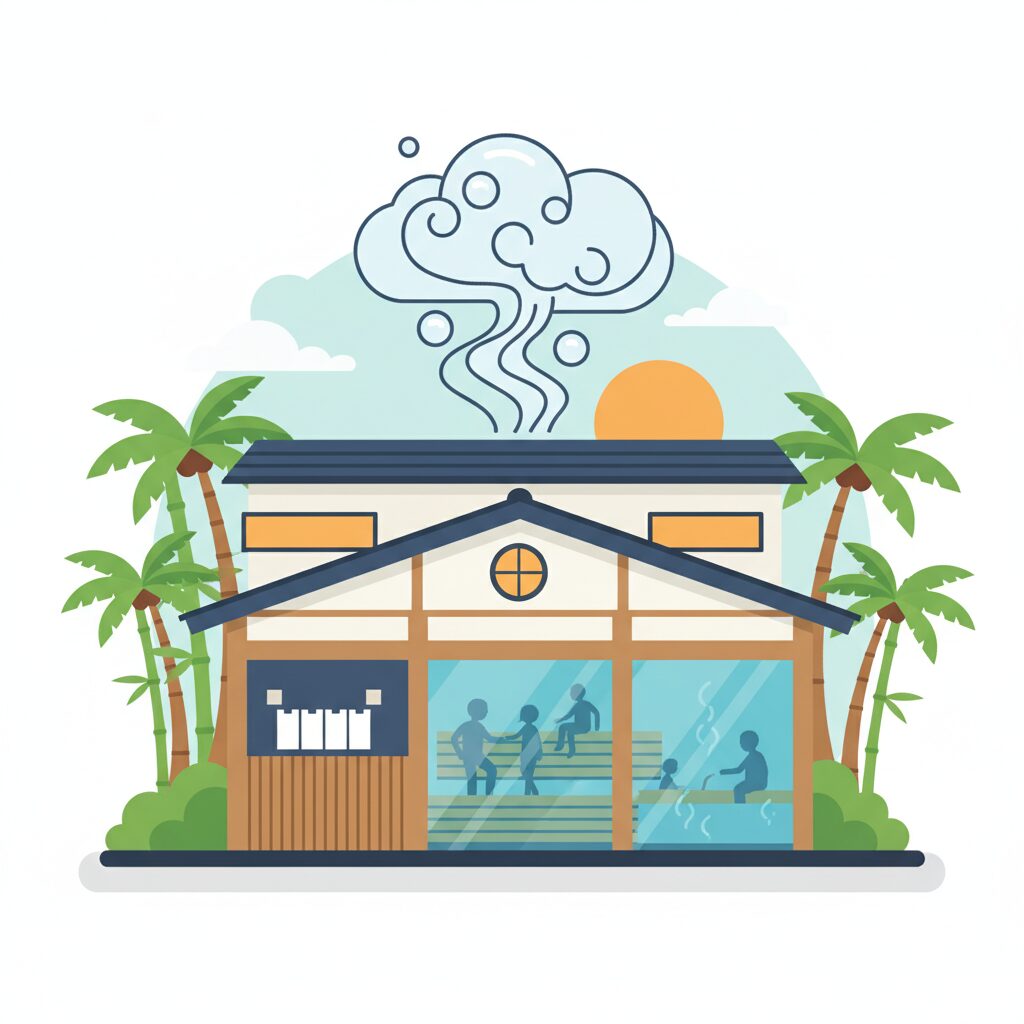
Your journey starts with finding the right sentō. Look for distinctive architecture—often featuring a temple-like roof (karahafu)—and the kanji 湯 (yu) for hot water displayed on a sign or noren curtain. Entrances are generally separated by gender from the outset. Look for the character for man, 男 (otoko), or the color blue, and for woman, 女 (onna), or the color red. After passing through the curtain, you’ll enter a small foyer with rows of shoe lockers. Slide your shoes in and take the wooden key. This is the first of many keys you’ll handle, a tangible symbol of your passage from the outside world.
Crossing the Threshold: The Noren and the Bandai
You slide open the next door and step into the heart of the facility. Here you’ll find the attendant at the bandai or a more modern front desk. Simply pay the entrance fee. If you need soap or want to rent a towel, now’s the time to get them. The attendant will provide what you need, and you’ll proceed to the proper changing room. This brief exchange is typically minimal—a routine repeated countless times. There’s a comforting rhythm to it. You’re just one more person in a long line of people seeking warmth and cleanliness in this very place.
The Datsuijo (Changing Room): Lockers, Baskets, and the Silent Ritual
The changing room is a remarkable space, blending privacy with communal life. You’ll find rows of lockers, some wooden and old, some modern metal. Pick an empty one and undress fully. This may be the toughest moment for first-timers, but you’ll soon realize no one is watching you. Modesty is honored, but nudity isn’t sexualized or judged. It’s simply the natural state for bathing. Store your clothes and large towel in the locker. Bring only your small towel and washing items into the bathing area. You’ll notice locals moving with practiced precision—a choreographed routine of disrobing and storing that’s become second nature. Watch them, and you’ll quickly catch the rhythm.
The Kariba (Washing Area): The Scrubbing Ritual
Entering the bathing area is a sensory immersion. The air is thick with steam, the sound of running water constant, and tiled walls echo every noise. Your first stop is the washing area. Find an empty station. Each station includes a low plastic stool, faucet with hot and cold taps (or a shower head), and a basin. Sit on the stool. Avoid washing standing up to prevent splashing neighbors. Use the basin to scoop water from the faucet and douse yourself. Soap your small towel or a nylon washcloth and scrub every inch of your body. Wash your hair. Rinse thoroughly, making sure no soap remains. Finally, rinse your stool and the area around you before leaving. This small act of tidiness is a vital part of communal etiquette.
The Main Event: Immersing in the Atsuyu (Hot Bath)
Now clean and rinsed, you’re ready for the tubs. Most sentō offer several baths with varying temperatures. The main bath, the atsuyu, is usually quite hot—often between 42-45°C (107-113°F). Enter slowly. The heat can be startling at first. Let your body adjust. The aim is to submerge yourself up to your shoulders and let the warmth penetrate deeply into muscles and bones. This is where the magic unfolds. The tension in your shoulders, neck, and back—the physical imprint of your digital life—starts to dissolve. Your mind, forced into the present by intense physical sensation, finally quiets. The endless cycle of worries and duties breaks. There is only the water, heat, and your own breathing.
Exploring the Baths: Jet Baths, Denki Buro, and Unique Experiences
Beyond the main bath, you’ll often find various other options. There may be a jet bath (jetto buro) with strong streams to massage your back and legs. Some baths are scented with herbs or minerals. Then there’s the uniquely Japanese denki buro, or electric bath. This tub channels low-voltage electric currents between two plates. Sitting between them, you’ll feel a tingling buzz that gently stimulates muscles. It’s a peculiar but surprisingly pleasant sensation, favored by older bathers for its reputed benefits on stiff joints. Trying these different baths is part of the fun—a journey of discovery within the sentō walls.
The Trial by Fire and Ice: Sauna and Mizuburo Traditions
Many sentō also have a sauna. After sweating in the intense dry heat, the next step is the mizuburo, or cold plunge pool. This is not for the faint-hearted. The water is often icy cold. The shock is intense, but the sensation afterward is one of pure exhilaration. The rapid blood vessel contraction is believed to have many health benefits, but the immediate effect is a profound sense of clarity and rejuvenation. Sauna enthusiasts often repeat this cycle—sauna, cold plunge, rest—multiple times. It’s a rigorous discipline that challenges your physical and mental limits, leaving you feeling completely refreshed and alive.
The Afterglow: Drying Off, Moisturizing, and the Sacred Vending Machine
After soaking thoroughly, return to the washing area for a final rinse. Then, before heading back to the changing room, use your small towel to remove excess water. This step is crucial to keep the changing room floor dry and marks you as an experienced sentō-goer. Now, retrieve your large towel and dry off thoroughly. You’ll feel a comforting warmth radiating from your core. Your skin will be soft, your muscles relaxed. This is the post-sentō glow. But the ritual isn’t quite finished. In the changing room or lobby, you’ll find a vending machine stocked with cold drinks. The classic post-bath choice is a small glass bottle of milk—plain, coffee-flavored, or fruit-infused. Drinking this cold, sweet beverage while your body remains warm is a simple yet profound pleasure, verging on the sublime. It’s the perfect end to the ritual, a small reward that completes the experience.
The Sentō in History: A Researcher’s Perspective on Osaka’s Social Fabric
As a researcher fascinated by the narrative of Japanese cities, I view the sentō not just as a place for bathing, but as a living museum of social history. Its story is closely intertwined with the development of urban Japan. The height of sentō culture occurred in the post-war era. As cities like Osaka were reconstructed, housing was built rapidly and often lacked private bathrooms. The sentō became an absolute necessity, forming the foundation of daily life. It was there that the social fabric of the neighborhood was woven, serving as the primary hub of information exchange, where one learned all that was important. With Japan’s economic boom and the advent of private baths, the sentō’s role changed. It was no longer a necessity, but a matter of choice. This distinction is crucial. In many cities, this change prompted a swift decline. However, in Osaka, the transition unfolded differently. Choosing to visit the sentō became a subtle affirmation of a particular way of life—a vote for community over isolation, for shared experience rather than private convenience. It turned into an act of cultural preservation. The architecture of many older sentō, with their intricate karahafu gables and stunning murals of Mount Fuji (even though Osaka is far from the actual mountain), reflects an era when these were more than utilitarian structures; they were proud civic institutions, palaces for ordinary people. To sit in one of these baths is to sit in history, to experience the continuity of generations who have soaked in the same waters beneath the same painted sky.
The Sentō Economy: Why 520 Yen is the Best Investment in Your Sanity
In a city driven by business logic, the sentō stands out as an almost absurdly good value. The cost for a basic adult entry is set by prefectural regulation—as of now, it’s 520 yen in Osaka. Let’s consider that from an Osakan perspective of kosupa. For less than the price of a high-end coffee, you receive one to two hours of entertainment, relaxation, and wellness treatment. You get unlimited hot water, access to high-pressure jets, often a sauna, and a clean, warm space to unwind. Compared to the price of a gym membership, a yoga class, a movie ticket, or a couple of beers at a bar, the sentō offers a far better return on investment for your mental and physical well-being. It is an inclusive and accessible form of self-care. This is not the exclusive domain of pricey spas—this is for everyone. This affordability is key to its role as a community hub. Because it is affordable, it draws people from diverse backgrounds, creating a genuine social cross-section that’s increasingly uncommon in our stratified society. For the budget-conscious remote worker, it’s a godsend. It provides a way to leave the apartment, relieve stress, and engage with local culture without overspending. It’s the ultimate life hack for living well in Osaka, a small price to pay for disconnecting from the world and reconnecting with yourself.
Beyond the Bath: Integrating the Sentō into Your Osaka Life
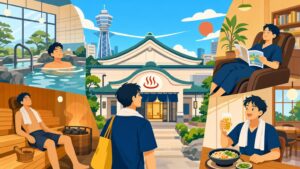
The experience doesn’t end the moment you step outside, toweling your damp hair. The true essence of the sentō lies in how it grounds you in your neighborhood and syncs with the rhythm of your daily routine. You emerge from the steam into the cool night air, your body pleasantly warm, your mind clear and calm. The familiar streets of your neighborhood appear different, more alive. You notice small details usually missed while rushing home to get back online. Perhaps you stop by the local izakaya for a cold beer and a plate of yakitori, joining other patrons fresh from their bath. Maybe you pick up a hot korokke from the butcher shop on the corner. The sentō isn’t an isolated occasion; it serves as a hub within the neighborhood network. Making it a regular part of your schedule—say, every Wednesday and Sunday night—provides comforting structure to the often-unstructured life of a remote worker. It becomes a temporal landmark, a steady point of relaxation and connection during your week. You begin to recognize the other regulars. Nods evolve into greetings, and greetings into conversations. You stop being an anonymous outsider and become “the person who comes on Wednesdays.” You’re no longer just living in Osaka; you’re actively participating in its life. You’ve found the off switch. It was there all along, just around the corner, waiting behind the steam and the sound of running water.