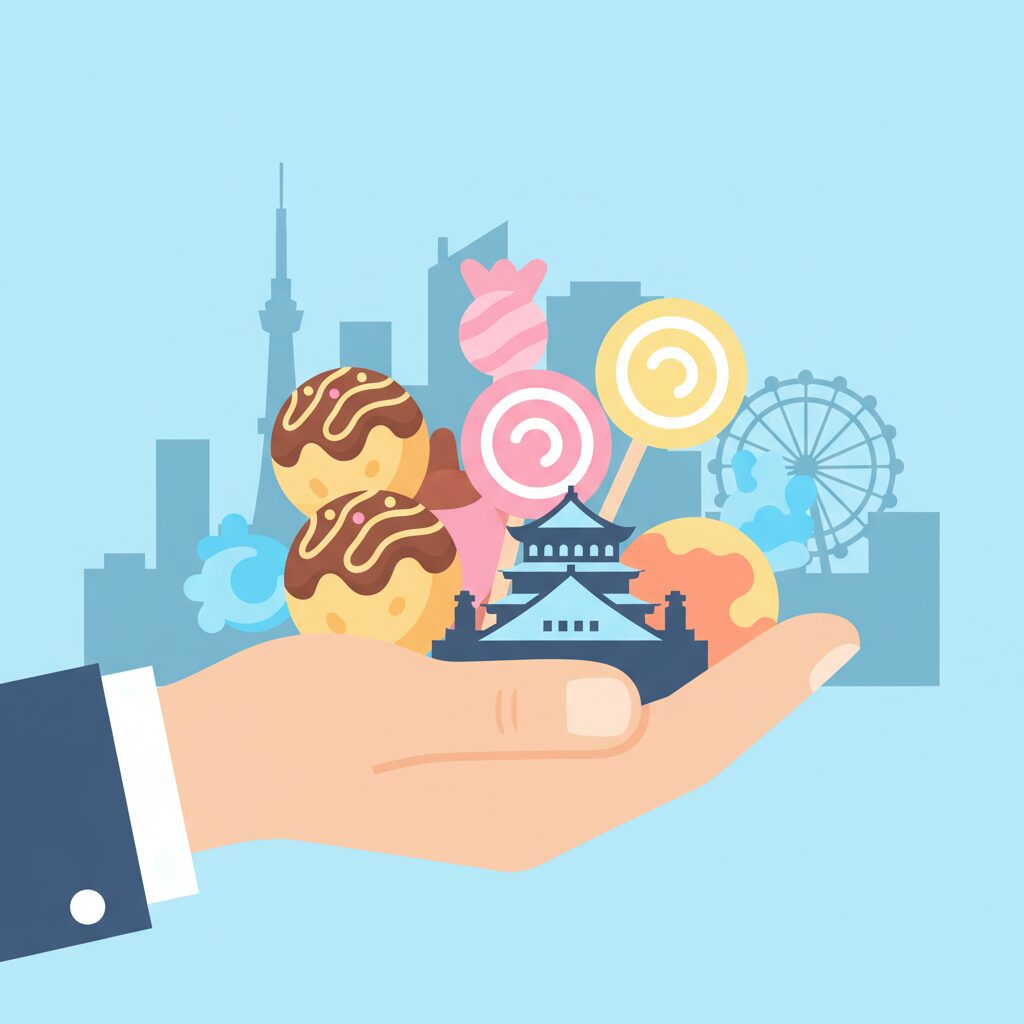
Picture the scene. You’re standing on a crowded platform at Umeda Station, navigating the glorious, chaotic symphony of Osaka life. You’re maybe a little lost, a little overwhelmed, trying to decipher the train map while a thousand people stream past you. Then, a gentle tap on your shoulder. You turn to find an older woman, maybe in her sixties or seventies, with a brightly patterned blouse and a kind, crinkly-eyed smile. Before you can even form a question, her hand is outstretched, and nestled in her palm is a small, hard candy, its wrapper glistening under the fluorescent station lights. Your brain, conditioned by a lifetime of “don’t talk to strangers” warnings, goes into overdrive. Is this a trick? A sales pitch? Some kind of elaborate local prank? You hesitate, a dozen socially awkward responses dying on your lips. In that moment of confusion, you’ve just had your formal initiation into one of Osaka’s most defining and heartwarming cultural rituals: the giving of ame-chan.
This isn’t just about candy. That tiny piece of sugar is a key, a secret handshake that unlocks the very soul of this city. It’s a gesture that feels impossibly strange if you’ve just arrived from the reserved, polished streets of Tokyo, yet it’s as natural and essential to an Osakan as breathing. For the socially cautious foreigner, this can be a baffling experience, a sudden breach of the personal space bubble we hold so dear. But understanding the ame-chan phenomenon is the first, and perhaps most important, step to truly understanding what it feels like to live here. It’s about more than just a sweet treat; it’s a lesson in communication, community, and the beautifully blurred lines of public and private life in Japan’s vibrant second city. Before we unwrap the layers of this fascinating tradition, let’s get our bearings right in the heart of where these sweet encounters are a daily occurrence.
The candy exchange may be as delightful as it is puzzling, but delving into Osaka’s inventive discount culture reveals even more about the city’s everyday approach to community and frugality.
The Unspoken Rules of the Ame-chan Exchange
First things first, let’s outline the cast of characters and the unwritten script of this everyday street performance. The main distributor of ame-chan is a figure as emblematic of Osaka as the Glico Running Man sign: the Osaka obachan. She is a middle-aged or elderly woman, often exuding formidable energy, a practical sense of style that may or may not feature leopard print, and a handbag that seems to defy the laws of physics. This bag serves as her command center, holding everything from tissues and a foldable fan to a small fortune in various hard candies. She acts as the guardian of social warmth, the self-appointed fairy godmother of public transit and grocery lines.
Who receives these candies? Literally anyone. It could be a salaryman in a sharp suit looking drained after a long day. It might be a student cramming for an exam on the train. Or a foreigner utterly puzzled by the ticket machine. But the main target, the recipient who almost always triggers the ame-chan ritual, is a parent with a fussy child. For the Osaka obachan, a crying toddler is not an annoyance to ignore; it’s a problem to be fixed. With the practiced ease of a seasoned diplomat, she will pull a candy from her bag, lean in with a knowing smile, and offer it as a tool of strategic soothing. The gesture says, “I see you. I understand. Let me help.” It’s a moment of solidarity that spans generations and nationalities.
The motivation behind this exchange is often misunderstood by outsiders. It’s not pity. It’s not charity. It’s connection. The ame-chan is a social lubricant, an icebreaker meant to ease the awkward silence between strangers. It’s an opening line, a way to start a conversation without the formal, multi-step introductions Japanese culture often demands. In a city of millions, it’s a small, edible confirmation that you are not alone. The candy is the excuse; the brief, shared moment of humanity is the true point. It’s a way of transforming a cold, impersonal public space into a warm, communal one, even if just for a fleeting thirty seconds on a crowded train.
Why Candy? The Psychology Behind the Sweet Treat
To understand why this small ritual is so distinctly Osakan, you need to recognize how different this city feels compared to its eastern rival, Tokyo. Spend a week in Tokyo, and you’ll become adept at navigating the urban bubble. On the Yamanote Line, an invisible barrier encases every passenger. Eye contact is rare and often accidental. People exist in their own private worlds, shielded by headphones, smartphones, and an unspoken pact to maintain complete anonymity. Offering candy to a stranger there would generally be seen as a social misstep. It would likely be met with suspicion, confusion, and perhaps a polite but firm refusal. The bubble would stay intact.
Osaka, however, operates on a different social wavelength. The bubble here is either permeable or nonexistent. Life is lived openly, and the boundary between public and private interaction is pleasantly blurred. The ame-chan is an ideal tool for this setting. Consider this: it’s a clever piece of social technology. It’s inexpensive, so it carries no sense of obligation or debt. It’s individually wrapped, which makes it hygienic and safe. It’s small and portable, easily taken out from a purse at a moment’s notice. And it’s a universally recognized symbol of a small pleasure. Understanding the gesture of a smiling face offering a sweet requires no complex language skills. It is a low-risk, high-reward gesture of goodwill.
This practice is deeply rooted in Osaka’s history as Japan’s commercial hub. For centuries, it was a city of merchants, shopkeepers, and traders whose success relied not only on the quality of their goods but on their ability to foster relationships. The spirit of shobai (business) in Osaka has always centered on connecting with the customer. You chat, you laugh, you build rapport. You might even add a little something extra, an omake or a free gift, to show appreciation and encourage return visits. Ame-chan culture is the social parallel of that omake. It’s a small, unsolicited gift meant to create a moment of positive feeling and forge a brief, friendly bond. The entire city operates on this philosophy of investing in human connection.
Your Ame-chan Action Plan: A Guide for the Socially Cautious
So, you’re now equipped with the cultural background. But what exactly do you do when a friendly stranger offers you a piece of fruit-flavored hard candy? For those of us not raised with this kind of warm hospitality, having a clear plan can help you handle the moment gracefully and without social anxiety. Consider this your step-by-step guide to a successful ame-chan encounter.
Step 1: The Offer
The interaction begins with non-verbal signals. You’ll notice the obachan purposefully digging through her bag. You’ll hear the faint, distinctive crinkle of cellophane wrappers. Then, she’ll make direct, friendly eye contact. This isn’t a shy, sideways glance; it’s a clear gesture of intent. Her hand will extend, and the offer will be made. Verbally, it might be a simple and polite “Douzo” (Please, go ahead) or a more casual and classic Osaka phrase like “Ame-chan,いる?” (Need a candy?) or “Ame-chan taberu?” (Wanna eat a candy?). The tone is always light, friendly, and expectant. She isn’t asking if you want candy; she is letting you know you are about to receive some.
Step 2: The Acceptance (The Only Real Option)
This is the crucial moment. Your instinct might be to politely decline. In many cultures, accepting gifts from strangers is taboo. In Osaka, it’s the opposite. Refusing the ame-chan is the real social faux pas. It’s not just turning down the candy; it’s seen as rejecting the person’s goodwill and their offer of connection. It’s like someone telling a joke and you refusing to smile. It abruptly ends the interaction in a way that feels surprisingly cold.
So, your move is simple: accept it. Smile warmly. A slight nod or a small bow of the head is a perfect accompaniment. Reach out and take the candy. One hand will do, but using two hands to receive it is a sign of politeness and respect. As you take it, say your line. A clear and smiling “Arigatou gozaimasu” (Thank you very much) is ideal. It’s polite, proper, and universally understood. If you want to score bonus points and bring out a genuinely delighted smile from your benefactor, try the local dialect: “Ookini!” This is how Osakans say thanks, and using it shows you’re in tune with the local culture. It’s a guaranteed win.
Step 3: The Aftermath
Once the candy has been handed over, the transaction is technically done. But often, it’s just the start. Remember, the ame-chan is an icebreaker. It has effectively broken the ice. Now, be ready for a brief conversation. This is the main event. Typical follow-up topics include your country of origin (“Doko kara kitan?” – Where did you come from?), your Japanese language skills (“Nihongo jouzu ya ne!” – Your Japanese is great!, a compliment given regardless of your actual ability), or a simple comment about the weather (“Kyou wa mushiatsui naa” – It’s humid today, isn’t it?).
Don’t worry if your Japanese isn’t fluent. A simple answer, a smile, and a nod go a long way. The goal isn’t a deep, philosophical discussion; it’s simply to share a pleasant minute or two. However, it’s also important to know that you are not required to engage in a long chat. If you’re in a hurry or not feeling talkative, a heartfelt thank you and a smile is a perfectly complete and successful interaction. The main objective—accepting the gesture of kindness—has been fulfilled.
Misunderstandings and Modern Anxieties
Let’s confront the obvious: the “stranger danger” instinct that many of us have deeply ingrained. The first question a foreigner often asks is, “Is this safe to eat?” When it comes to the Osaka ame-chan culture, the answer is a clear yes. These candies aren’t mysterious, unmarked treats from a white van but commercially produced, factory-sealed sweets from well-known brands found in any convenience store. The gesture is purely one of kindness, with no malice intended. Accepting and eating the candy is completely safe.
However, if you have a valid reason not to accept—such as allergies, dietary restrictions, or recent dental work—these are all understandable concerns. In this case, a polite refusal is acceptable but should be expressed thoughtfully. The key is to phrase your refusal as an apology, indicating regret that you cannot accept their kindness. Saying something like, “Gomennasai, arerugii ga aru node…” (I’m so sorry, but because I have allergies…) with an apologetic tone will be well understood. You’re not rejecting the person; you’re explaining a personal constraint. Most likely, they will be sympathetic and withdraw the offer without taking offense.
Another common worry is that this gesture might be the start of a scam. Will this person ask for money? Are they trying to sell something? While such concerns are understandable, within the specific cultural context of the ame-chan exchange, they are unfounded. This tradition exists entirely apart from commerce. It is simply a social gesture with no strings attached—it is exactly what it appears to be: a small act of spontaneous generosity. Living in Osaka means, in part, learning to adjust your cynicism and accept that sometimes, a free candy is just a free candy.
Beyond the Candy: What Ame-chan Really Teaches You About Osaka

The ame-chan is far more than just a candy. It represents a symbol and a daily lesson in the spirit of Osaka. Each time you receive one, you take part in a ritual that upholds the city’s fundamental values. This is a place that cherishes warm, genuine human connections over cool, polished formality. While other cities might prioritize the quiet, seamless operation of society, Osaka embraces its noisy, messy, and delightfully human core.
This tradition perfectly exemplifies the Japanese concept of osekkai. The term can be translated as “nosy” or “meddlesome,” and in some situations, it may carry a negative meaning. However, in Osaka, osekkai often has a warm, affectionate implication. It’s the instinct to get involved, to offer help, to treat a stranger’s issue as your own. Offering candy to a crying child on a train is the essence of osekkai. It’s a loving refusal to mind your own business. It reflects a belief that community requires active participation.
For anyone wanting to build a life in this city, embracing the spirit of the ame-chan is crucial. It means lowering your defenses slightly. It means welcoming unexpected conversations on the subway. It means realizing that in Osaka, public space is more like a shared living room than a sterile passage between private destinations. Resisting this will cause friction, making you feel out of tune with the city’s rhythm. But embracing it, learning to smile, say “Ookini!”, and accept the candy is your gateway to belonging. It’s how you stop being merely an observer of Osaka life and start becoming part of its vibrant, sweet, and endlessly surprising story.