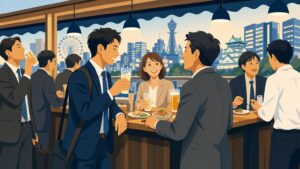
The laptop glows, the apartment walls feel a little too familiar, and the silence is either too loud or punctuated by the wrong kinds of noise. This is the remote worker’s dilemma, a global search for the perfect ‘third place’—that sanctuary between the domestic realm of home and the professional pressure of the office. You could default to the nearest chain cafe, with its sterile efficiency, predictable playlist, and the low hum of transactional anonymity. It’s an option. It works. But you’re in Osaka, and to do that here is to miss the point entirely. It’s like eating a convenience store sandwich for lunch when a tiny, family-run udon shop is beckoning from a side street. You’re missing the soul.
Osaka’s answer to the third place predates the concept by decades. It’s the kissa-ten (喫茶店), the traditional Japanese coffee shop. And let’s be clear, this isn’t about a retro aesthetic or a fleeting trend. The kissa-ten is a living, breathing institution, woven into the city’s very fabric. It’s a cultural pillar as foundational as the merchant spirit and the sharp, playful cadence of the local dialect. For the newly arrived remote worker, navigating this world can feel like unlocking a secret level of the city. These aren’t just places to get caffeinated; they are microcosms of Osaka life, each with its own unwritten rules, rhythms, and resident characters. This guide isn’t a list of the ‘best’ pour-overs or the fluffiest egg sandwiches. It’s a map to understanding the culture they represent, a field guide to finding your own spot, your own ibasho, that elusive place where you truly belong. It’s about learning to see the city not through its grand landmarks, but through the steam rising from a syphon coffee maker in a quiet, wood-paneled room.
Remote workers venturing through Osaka may further enrich their local experience by exploring sento etiquette, which offers valuable insights into the city’s depth of cultural customs.
The Kissa-ten Isn’t a Cafe: Decoding the Social Code
First, an important distinction. In modern Japanese, the word ‘cafe’ (カフェ), written in katakana, evokes images of bright, airy spaces, latte art, avocado toast, and likely a sleek, Scandinavian-inspired interior. These establishments are often part of national or international chains. A kissa-ten (喫茶店), written in kanji, is quite a different entity. The name itself roughly translates to ‘tea-drinking shop,’ reflecting its older origins. Entering one often feels like stepping back in time, into a space shaped by a singular vision, where the rules differ and the currency is more than just yen.
The Master and the Counter: Beyond a Simple Transaction
At the center of almost every authentic kissa-ten is the ‘Master’ (マスター). This figure is neither a manager nor a head barista. The Master is the owner, the curator, the silent orchestrator of the entire experience. Often a man of a certain age, he moves with quiet, practiced efficiency, polishing glasses, carefully preparing coffee by syphon or nel drip, and overseeing the flow of his small domain. The relationship with a Master isn’t the overtly cheerful, scripted friendliness found in chain cafes. It’s a slow-growing rapport founded on quiet consistency.
In Tokyo, service tends to be marked by impeccable politeness and high efficiency. It’s smooth, professional, and largely impersonal. In Osaka, however, the interaction is rooted in a different kind of relationship. The prime spot in any kissa-ten is a seat at the counter. That’s where you watch the Master’s craft and gradually become a familiar face. There might be little conversation beyond your order and a quiet ‘thank you.’ Yet by your third visit, you might receive a subtle nod of recognition. By your tenth, he might remember your usual order. This slow, steady acknowledgment is Osaka’s version of a warm welcome. It signals you’re shifting from a mere customer (okyaku-san) to a regular (jouren-san). You’re no longer just buying coffee; you’re becoming part of the establishment’s life. This is a city founded on relationships, not mere transactions, and the kissa-ten is a training ground.
The Sound of Silence (and Jazz)
The ambiance of a kissa-ten is a carefully crafted aspect. Many are quiet, but it’s a living silence, not an uncomfortable one. It’s the gentle clink of a porcelain cup, the rustle of a newspaper, the low murmur of conversation at a corner table. This is the sound of a shared public space where personal reflection is honored. It stands in sharp contrast to the loud, lively chatter typical of many Western cafes, which often prioritize social performance. Here, the aim is focus, relaxation, or quiet connection.
The soundtrack plays a crucial role. You won’t hear a Top 40 playlist. Instead, the background is almost always classical music or, more often, jazz. Vinyl records are frequently displayed proudly behind the counter, the Master’s personal collection shaping the establishment’s auditory character. This is not just background noise; it’s a curated soundscape designed to aid concentration and foster a particular mood. It sends a clear, unspoken message: this is a place to slow down, to think, to read, to work deeply. It’s a purposeful counterpoint to the hectic rhythm of the city just beyond the door.
Reading the Air: A Remote Worker’s Etiquette Guide
To thrive in an Osaka kissa-ten, you need to master kuuki wo yomu, or ‘reading the air.’ The rules are seldom posted on the walls. Instead, they are absorbed through observation and an appreciation for the unspoken social contract. For the digital nomad, this means adjusting your work habits to fit the environment, rather than expecting the environment to adapt to you.
The Art of the ‘One Order Stay’
Your table rental is covered by the price of your first order. Kissa-ten coffee typically costs more than at chain cafes, generally between 500 and 800 yen. You’re not just paying for the beans and water; you’re paying for the space, the ambiance, and the time. A single cup of coffee grants you a socially accepted window to occupy your seat. How long that lasts is flexible, but a good guideline is one to two hours. If the shop is busy and others are waiting, it’s courteous to finish up. On a quiet afternoon, if you intend to stay for a longer work session, ordering a second item—another coffee, a slice of toast, or a piece of cake—demonstrates respect for the Master’s business.
This practice is rooted in Osaka’s practical, business-oriented mindset. People value a fair exchange. You’re using the Master’s space to conduct your own affairs, and making a second purchase acknowledges this understanding. It’s a small gesture that goes a long way in marking you as a thoughtful customer, not merely a freeloader with a laptop.
Laptops, Outlets, and the Unspoken ‘No’
Here lies the biggest challenge for the modern remote worker: technology. Many classic kissa-ten, especially those from the Showa era, lack Wi-Fi and power outlets. This isn’t an oversight but an intentional feature. These spaces were created for analog activities—reading, writing by hand, and quiet conversation. The absence of digital infrastructure is a conscious decision to preserve that atmosphere.
So, what can you do? First, manage your expectations. Always arrive with a fully charged laptop and a power bank. Use your phone as a personal hotspot if you need internet access. Before opening your laptop, take a moment to observe the room. Are others working on computers? If not, you might be in a kissa-ten that discourages it. The Master likely won’t say anything directly—direct confrontation is avoided—but you may sense a subtle change in the mood. The best strategy is to find spots where a quiet work culture is already established. Look for a diverse group of patrons: some reading, some chatting softly, and one or two quietly typing away. These are your safest bets. Never take a phone call inside; step outside for that. Maintaining the sanctity of the shared quiet space is paramount.
The ‘Morning Set’ and the Rhythm of the Day
To truly grasp the role of the kissa-ten in Osaka life, you need to experience the ‘Morning Service’ (モーニングサービス), often just called ‘Morning.’ Available from opening until around 11 a.m., it’s one of the best deals in Japan. For the price of a single coffee, you receive a set meal usually consisting of a thick slice of fluffy toast (shokupan) with butter and jam, a hard-boiled egg, and sometimes a small yogurt or salad. It’s a ritual. It’s how local shop owners start their day, where elderly neighbors catch up on gossip, and where salarymen fuel up before the office.
For remote workers, the Morning Set provides a perfect anchor for the day. It offers structure, gets you out of the house, and connects you to the local community’s rhythm. It’s also a window into Osaka’s otoku mindset—the appreciation of a good value deal. It’s not about being cheap, but being smart and savvy. The Morning Set perfectly embodies this: a high-quality, comforting, and incredibly cost-effective start to the day. It’s a daily reaffirmation of the city’s practical, no-nonsense spirit.
Finding Your Zone: Kissa-ten Archetypes Across Osaka

Osaka is not a single entity, and neither are its kissa-ten. Each shop’s character often mirrors the neighborhood it occupies. Recognizing these archetypes will help you find the ideal setting for the type of work you need to accomplish.
The Showa Retro Sanctum: Time Travel in Nakazakicho
Wander through the winding alleys of Nakazakicho, a neighborhood that remarkably survived wartime bombings, and you’ll discover kissa-ten that feel like time capsules. Picture dark, polished wood, well-worn velvet chairs in hues of burgundy or forest green, ornate siphon coffee makers bubbling on the counter, and maybe a touch of stained glass. The air is heavy with the echoes of conversations past. These establishments, originating in the Showa period (1926–1989), serve as sanctuaries of nostalgia.
They embody the neighborhood’s strong independent spirit and preference for preservation over redevelopment. Working in one of these kissa-ten encourages deep focus. The absence of modern distractions fosters an analog-style workflow. They are ideal for writing, editing, or any task requiring sustained, uninterrupted concentration. The atmosphere is quiet, contemplative, and highly respectful of personal space. It’s a subtle resistance to the hectic pace of contemporary life buzzing just over in nearby Umeda.
The Merchant’s Lounge: Business and Coffee in Honmachi and Yodoyabashi
Venture into the central business districts of Honmachi or Yodoyabashi, and the atmosphere changes. Here, the kissa-ten serve as informal extensions of the office. Interiors tend to be more spacious, with comfortable booths suited for quiet meetings. You’ll observe men in sharp suits discussing deals over a ‘blend coffee’ and plates of curry rice. The energy is focused and productive, yet still preserves the personal touch of an independent café.
This reflects Osaka’s history as Japan’s merchant capital. Business here has always relied on personal relationships and trust. A handshake in a familiar kissa-ten can be more binding than a formal contract. For the remote worker, these spots offer a productive buzz. The ambient energy exudes purpose and commerce. They are perfect for days when you need to feel professional and tackle a heavy to-do list. You are effectively working alongside the city’s commercial core.
The Student’s Hideout: Scholarly Vibes in Tanimachi and Around the Universities
In quieter, more residential areas like the long stretch of Tanimachi-suji or near the city’s universities, you’ll find kissa-ten catering to a more scholarly clientele. These venues often have a slightly brighter, more academic ambiance. Students cram for exams, professors grade papers, and locals spend hours immersed in novels or the daily newspaper. The Masters of these shops tend to be more tolerant of extended stays, understanding their patrons’ needs.
An unspoken rule here is to maintain a studious atmosphere. Visitors come to focus. These kissa-ten are perfect for extended work sessions, research, or any task that requires spreading out a bit. Prices might be somewhat more reasonable, and the vibe is one of relaxed, shared intellectual pursuit. Think of it as a communal library with better coffee and the comforting, low-level hum of a local institution.
Why Kissa-ten Culture Thrives in Osaka
In an era dominated by globalized chains and hyper-efficiency, the enduring presence of the traditional kissa-ten might appear unusual. Yet in Osaka, it is entirely logical. Their continued existence is a tribute to the city’s fundamental values and a clear expression of its distinctive cultural identity.
A Counterpoint to Tokyo’s Efficiency
While Tokyo is characterized by speed, scale, and an unyielding drive for the new, Osaka is marked by personality, pragmatism, and the preservation of the old. Chain cafes represent a Tokyo-centric approach: scalable, repeatable, and efficient, designed to be uniform everywhere. A kissa-ten, however, is the complete opposite. Its worth lies in its uniqueness. It embodies one individual’s taste and is the result of decades of consistent operation in a single location. Osakans often favor the charm of an independent shop over the sterile perfection of a corporate chain. They choose the slightly rough-around-the-edges but familiar Master over the polished yet anonymous part-time barista. It is a deliberate preference for character instead of convenience.
The Spirit of the ‘Akindo’
Osaka was established by akindo, or merchants, with a profound and lasting respect for small business owners and the spirit of shobai (the art of doing business). A kissa-ten is typically a small, family-run establishment passed down through generations. Being a regular at a kissa-ten means more than just being a customer; it means being a patron who supports a local entrepreneur. This represents a quiet form of community investment. That is why relationships matter. Loyalty is directed not at a brand, but at a person and their life’s work. This merchant spirit cultivates strong loyalty to local shops, creating a robust ecosystem in which these small businesses can continue to prosper.
Your Personal ‘Ibasho’
Ultimately, the lasting charm of the kissa-ten lies in its capacity to offer ibasho (居場所)—a Japanese idea that goes beyond the concept of a ‘third place.’ An ibasho is a space where you truly belong, where you can be yourself, offering physical and emotional comfort. For a foreigner grappling with the complexities of a new culture, discovering your ibasho is a significant breakthrough. It’s when the city shifts from a mere collection of streets and stations into a web of familiar, inviting places. Your kissa-ten becomes your anchor. The Master’s nod turns into a warm greeting. The familiar aroma of coffee and toast offers a sense of stability. Therefore, the search for the perfect spot is far more than just finding good coffee and free Wi-Fi. It is a journey into the soul of Osaka. It’s about paying attention, observing, and locating that one place where the city’s rhythm harmonizes with your own—one perfectly brewed cup at a time.