
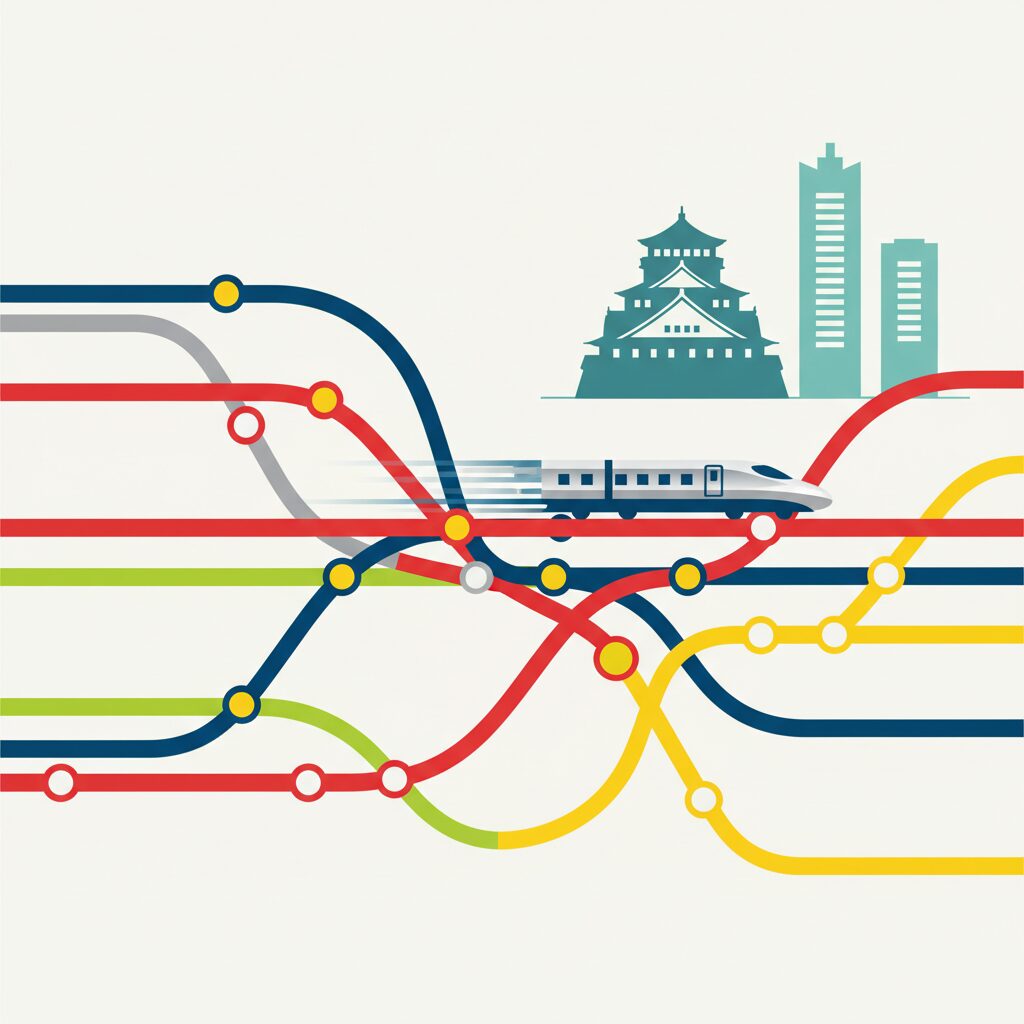
Stand in the heart of Umeda station. Just for a second. Look up. You’ll see signs for JR trains, Hankyu trains, Hanshin trains, and the Midosuji subway line. They all scream for your attention, pointing in directions that feel both logical and impossibly contradictory. Your phone’s map app flickers, trying to make sense of the subterranean city sprawling beneath you. You thought you were going to “Umeda Station,” but you’ve landed in a hornet’s nest of competing companies, a concrete and steel battleground where history, pride, and big money are etched into every platform number and tiled corridor. Back in Tokyo, life feels simpler. You find the nearest JR Yamanote Line entrance, and the city unspools for you in a neat, green circle. Here? Not a chance. This chaotic, overlapping, and fiercely competitive network isn’t just a way to get around. It’s the most honest explanation of Osaka you will ever get. It’s a living blueprint of the city’s merchant spirit, its deep-seated rivalries, and its pragmatic, no-nonsense approach to daily life. To understand these trains is to understand the very rhythm of the Osakan heart. Forget the guidebooks for a moment. The real story of this city runs on steel wheels.
Osaka’s intricate urban pulse finds a parallel in the region’s economic drive, as global hotel investments in Kansai mirror the competitive, forward-looking spirit that defines the city.
The Private Railway Kingdom: Why JR Isn’t King
In Tokyo, Japan Railways, or JR, reigns supreme as the undisputed heavyweight champion. This government-originated giant forms the backbone of the city’s transportation network. However, Osaka follows a different rhythm. The city was shaped not by bureaucrats in Tokyo, but by enterprising entrepreneurs who constructed their own railway lines to link their department stores, housing developments, and entertainment hubs with the city center. This gave rise to a “Private Railway Kingdom,” where a few powerful companies divided Kansai into their personal domains. Although JR is a significant player, it is just one voice within a vibrant, noisy chorus. This competition is what fundamentally distinguishes life in Tokyo from life in Osaka, infusing each commute with choice, rivalry, and a unique character.
A Tale of Two Terminals: Umeda vs. Namba
Osaka’s vitality centers around two massive hubs: Umeda in the north (known as Kita) and Namba in the south (known as Minami). Unlike Tokyo’s multi-centered network of Shinjuku, Shibuya, and Ikebukuro, Osaka revolves around this strong north-south dynamic. Each hub is the exclusive domain of different railway companies, making them feel like entirely separate worlds.
Umeda represents the polished, corporate, and chaotic face of modern Osaka. It is the grand terminal for Hankyu and Hanshin railways, along with the city’s primary JR Osaka Station (note that “Umeda” and “Osaka” stations share the same location, often causing confusion). Here, towering department stores owned by railway companies compete silently for your spending. The atmosphere is fast-paced, professional, and endlessly maze-like, a true labyrinth of underground passages.
Travel south along the main Midosuji subway line, and you emerge into Namba, Osaka’s historic entertainment district, dominated by the Nankai and Kintetsu railways. Namba is louder, grittier, and more eclectic. It serves as the gateway to the neon-lit streets of Dotonbori, the counterculture haven of Amerikamura, and the kitchenware mecca of Doguyasuji. While Umeda feels like a corporate boardroom, Namba gives the impression of a street party. Your preference between the two speaks volumes about your personality, and the train line you take defines your journey.
The Five Families: Meet the Private Lines
To truly experience Osaka, you must know the key players. These aren’t just railway companies; they embody cultural identities. People often develop fierce, lifelong loyalty to their chosen line—a concept that may seem odd to outsiders but is entirely normal here.
Hankyu Railway: The Velvet Rope
If you spot a sleek, polished, maroon-colored train gliding silently into Umeda, that’s a Hankyu. Hankyu epitomizes class. Its founder, Ichizo Kobayashi, pioneered a business model later emulated by other railways: create a railway to undeveloped suburbs, build attractive residential housing there, and establish a lavish department store at the city terminal to encourage residents to come downtown. This is the foundation of the “Hankyu lifestyle.” The train interiors are pristine, often featuring plush olive-green velvet seats and wood-grain paneling. The line connects Umeda to upscale residential neighborhoods like Ashiya and Nishinomiya, while also offering a stylish, comfortable route to Kobe and Kyoto. Riding Hankyu feels less like commuting and more like a refined journey. Residents along the Hankyu line are often seen as somewhat more sophisticated, and they wouldn’t have it any other way.
Hanshin Railway: The People’s Champion
Right beside the Hankyu station is its long-standing rival, Hanshin. If Hankyu is aristocratic, Hanshin is the scrappy, blue-collar champion. Its trains are more utilitarian, its route to Kobe more direct and coastal, passing through older, industrial areas. Hanshin’s identity is deeply intertwined with the Hanshin Tigers, Osaka’s beloved and perpetually underdog baseball team. During the baseball season, the trains turn into a sea of yellow and black jerseys, filled with loud, passionate, and occasionally inebriated fans heading to Koshien Stadium. The mood is boisterous and communal. The rivalry between Hankyu and Hanshin mirrors Osaka itself—a friendly but fierce clash between polished refinement and pragmatic grit. Choosing which train to Kobe to take isn’t just about time or cost; it’s a declaration of identity.
Kintetsu Railway: The Sprawling Empire
Operating from Namba and Tsuruhashi, Kintetsu is the largest private railway in Japan, a sprawling giant that connects Osaka to Nara, the famous cherry blossoms of Yoshino, the sacred shrines of Ise, and even the industrial city of Nagoya. Kintetsu acts as the artery bringing life from Japan’s ancient heart to Osaka. Its Tsuruhashi station is an experience in itself, dropping passengers right into the heart of Osaka’s lively Koreatown, where the air is thick with the smell of grilled yakiniku. Riding Kintetsu feels like a journey through time and culture, linking the bustling city to the tranquil temples and landscapes that define the broader Kansai region.
Nankai Electric Railway: The Southern Gateway
Nankai serves as your chariot to both sky and sea. Its main line extends from the busy Namba terminal down to Kansai International Airport (KIX) and the shores of Wakayama. Its most famous train, the limited express “Rapi:t,” looks like a vehicle straight out of a 1980s sci-fi anime, with its deep blue paint and futuristic round windows. It stands as an iconic symbol of Osaka’s role as an international hub. For many southern Osaka residents, Nankai is a vital link to the city center—a reliable workhorse connecting quiet coastal towns with the vibrant bustle of Minami.
Keihan Electric Railway: The Kyoto Commute
Running alongside the Yodo River, the Keihan line is the main connection between Osaka’s financial district around Yodoyabashi and the cultural treasures of central Kyoto. While JR and Hankyu also serve Kyoto, Keihan covers a distinct corridor popular with commuters and students heading to universities along the route. Keihan is known for its comfortable double-decker cars, providing a more scenic and relaxed ride. It exemplifies the close, symbiotic relationship between Japan’s ancient capital and its lively merchant city.
Navigating the Daily Grind: The Osakan Mindset on Rails
Understanding the hardware is one aspect, but the true education comes from observing the software—the people. How Osakans use their trains reflects their core values: pragmatism, efficiency, and a healthy skepticism about paying even a single yen more than necessary.
The Unspoken Rules of the Rush Hour Rumble
Tokyo rush hour is renowned for its silent, almost stoic crush. People press together in a dense, orderly pack, eyes closed or fixated on their phones, enduring the ride in a state of suspended animation. Osaka’s rush hour exudes a different energy. It’s equally crowded, but far less quiet. There’s a low murmur of conversation, a sense of controlled chaos. People are more straightforward. If they need to get off, they don’t simply wait for a path to open by itself. A firm but polite “sumimasen” (excuse me) is used not as a timid apology but as a clear, functional signal: “I’m coming through.” There’s an unspoken agreement that everyone is in a hurry, and the most efficient way to handle it is with a bit of directness. Pushing remains taboo, but a gentle, determined shuffle is the accepted standard. Osakans are experts in what I call “transit geometry.” They know exactly which car to board to line up perfectly with the escalator at their destination. They know which staircases are less crowded. This isn’t just about convenience; it’s about optimizing life—a game of seconds and steps played twice daily.
“How Much?” The Price is Always Right (or Wrong)
Osaka’s famed pragmatism is most apparent in choosing a train route. When several lines lead to the same place, an Osakan’s decision is a quick calculation of three factors: speed, convenience, and, most importantly, cost. A Tokyoite might default to the most direct JR route, but an Osakan will proudly take a route involving an extra transfer if it saves 60 yen. This isn’t about stinginess; it’s about being smart. Why pay more for the same outcome? This mindset fuels a cottage industry of “kinken shops,” or discount ticket vendors, clustered around major stations. There, you can buy single-journey tickets for a few yen less than the machine price. It seems like a small saving, but for Osakans, it’s a small victory against the system. It’s a tangible reward for understanding how the city really operates. For foreigners, this is an essential lesson: don’t just follow the first route your app suggests. Ask a local. They’ll likely know a cheaper, slightly different way that works just as well.
The Labyrinth and The Loop: Conquering Osaka’s Core
Every city presents its own navigational challenges, but Osaka is known for two legendary ones: the Umeda underground maze and the gritty, soulful JR Loop Line. Mastering these is a rite of passage for any local.
Decoding the Umeda Dungeon
Let’s be honest: your first experience with the Umeda underground will probably leave you confused and close to tears. It’s not just one station; it’s a sprawling, multi-level subterranean city linking six different train stations, three subway lines, and numerous department stores and shopping arcades. The signage is a chaotic blend of colors, and the sheer number of people moving in every direction can be overwhelming. Foreigners and newcomers often try to understand it through a map, attempting to mentally map out the entire system. This is a rookie error. The Osakan way is much more practical. You don’t learn the entire dungeon; you learn your paths. You develop the muscle memory to go from the Hankyu platform to the Yodobashi Camera entrance. You familiarize yourself with the flow of people moving from the Midosuji Line to the JR gates. You internalize a handful of personal routes and disregard the rest. The Umeda dungeon perfectly symbolizes life in Osaka. On the surface, it’s chaotic and indecipherable. But once you carve out your own paths and settle into a rhythm, it becomes one of the most efficient and convenient places on earth.
Riding the Osaka Loop Line: The City’s Beating Heart
Tokyo has the Yamanote Line, a bright green loop connecting the city’s most famous and polished commercial districts. Osaka has the Kanjo-sen, the Loop Line—and the two couldn’t be more different. While the Yamanote Line offers a tour of modern, cosmopolitan Japan, the Loop Line is an unfiltered journey through Osaka’s working-class heart. Riding its bright orange trains takes you through a surprisingly diverse cross-section of the city. You pass the gleaming office towers near Osaka and Kyobashi, as well as the smoky, gritty nightlife of Tenma, filled with standing bars and izakayas. You see the historic grandeur of Osaka Castle Park, and just a few stops later, the bustling chaos of Tsuruhashi’s Koreatown. Further south lies Shin-Imamiya, a neighborhood revealing a tougher, more marginalized aspect of urban life rarely seen by visitors. Recently, JR has tried to refresh the line with new trains and unique departure melodies at each station, but its essential character remains unchanged. Riding the Loop Line in a full circle is to witness the authentic Osaka, stripped of tourist-friendly gloss. It serves as the city’s circulatory system, pumping life into its diverse, noisy, and vibrant neighborhoods.
Living on the Line: How Your Train Defines Your Life
For anyone considering a move to Osaka, here is the most important advice you will ever receive: don’t choose your home solely based on the neighborhood. Instead, choose it based on the train line. In Osaka, your railway line is like your community. It shapes your daily commute, your shopping preferences, and even subtly influences your social standing.
Choosing a Home, Choosing a Tribe
A real estate agent in Osaka won’t just inquire about your budget and the number of rooms you want. They’ll ask, “Which line do you want to be on?” Living along the Hankyu Kobe Line vs. the Nankai Main Line is like living in two completely different worlds. A Hankyu resident probably commutes to a polished office in Umeda, shops at the upscale Hankyu Department Store on weekends, and enjoys a quiet, suburban lifestyle in a neighborhood known for its cleanliness and good schools. Meanwhile, a Nankai resident might work near the airport or in the southern industrial area, shops at the lively Namba Parks complex, and leads a life more connected to the sea and sky. This isn’t a rigid class system but more a matter of self-selection. Each line has its own character, and people naturally gravitate to the one that fits their lifestyle. As a foreigner, it’s easy to overlook this. You might find a great apartment on the map that looks centrally located, only to realize you’re on a line requiring multiple inconvenient transfers to reach your destinations. Before signing a lease, ride the line. Spend some time at the terminal station. See if its community feels like your community.
The Kansai Commute: A Blessing and a Curse
This intricate network of competing railways creates a unique experience for residents. The biggest benefit is the outstanding connectivity throughout the Kansai region. From a single hub like Umeda, you have three different companies—JR, Hankyu, and Hanshin—that can get you to downtown Kobe in under 30 minutes for just a few hundred yen. Two of those companies can also take you to Kyoto just as fast. This turns Kobe, Kyoto, and even Nara from mere day-trip destinations into practical commuting suburbs. The entire area feels less like separate cities and more like one huge, interconnected metropolis. This is a quality-of-life advantage that Tokyo, despite its efficiency, simply can’t match due to higher costs and longer travel times on its regional trains. The downside, however, is the complexity. While a single IC card like ICOCA or Suica works seamlessly across all companies for payment, commuter passes or special tickets are usually tied to one company only. This means transferring between different companies can be cumbersome, often requiring you to exit one set of ticket gates and walk, sometimes a significant distance, to another. It’s the cost of having choice. You gain an array of options, but you need to become a skilled navigator to use them effectively.
The Final Whistle: Reading Between the Lines
The roar of an approaching train at an Osaka station is more than mere noise. It embodies a city shaped by competition, pragmatism, and a strong sense of regional independence. The railway map serves as Osaka’s true constitution, its intersecting lines declaring that there’s more than one way to achieve success, more than one path to the goal. What initially seems like chaos reveals a deep, intricate logic once you grasp the history behind it—a history of merchants, not samurai; entrepreneurs, not emperors. These pioneers built their own empires of steel, department stores, and housing, competing both with the state-sponsored JR and among themselves in a capitalist drama that unfolds daily. So, the next time you find yourself lost in the Umeda dungeon, don’t despair. You’re not merely lost in a station; you are at the very core of the Osakan identity. Mastering the navigation of these competing railways is not just a practical skill for traveling from A to B, but the key to understanding the complex, frustrating, and ultimately brilliant spirit of Japan’s other capital.








