When you first arrive in Osaka, the city hits you with a sensory overload, and most of it is edible. The air smells of sweet sauce and sizzling batter. The streets of Namba and Dotonbori are a gauntlet of food stalls, each one hawking a version of the city’s most famous exports: takoyaki and okonomiyaki. You see the octopus balls glistening under heat lamps, the cabbage-filled pancakes steaming on massive griddles. It’s a spectacular, delicious performance, and for many, this is the beginning and end of Osaka’s food story. But if you stop there, you’re only reading the cover of the book. You’re missing the everyday narrative, the chapters that explain what it’s actually like to live here.
The real question isn’t what Osaka serves to tourists, but what fuels its people on a rainy Tuesday afternoon or a hurried lunch break. The city’s profound, almost religious devotion to “kona-mon”—a catch-all term for flour-based dishes—runs much deeper than its two most famous creations. It’s woven into the fabric of daily life through lesser-known, yet arguably more essential, staples. Two dishes in particular, Negiyaki and Ikayaki, offer a clearer window into the Osaka psyche. They reveal a city that values substance over style, speed over ceremony, and community over pretense. Understanding these dishes is understanding the rhythm of Osaka itself, a rhythm that’s often lost in the noise of the main tourist drags. This isn’t just about food; it’s about decoding the city’s operating system.
Exploring Osaka’s everyday food rituals further reveals a side of the city that comes alive after the main courses, as even late-night delights like shime ramen carry their own unspoken rules.
The Floury Foundation: Why “Kona-mon” is Osaka’s Lifeblood

To truly understand Osaka, you must first appreciate the sanctity of kona-mon. The term literally means “flour things,” a modest name for a culinary category that defines the city. This isn’t the delicate, artisanal flour culture of a Parisian bakery. Rather, it’s flour as sustenance, comfort, and a vehicle for flavor—offered cheaply, quickly, and with intense satisfaction. This passion runs deep. Historically, Osaka has been Japan’s commercial kitchen, a merchant city where time was money and a full stomach was vital for a hard day’s work. After the war, when resources were limited, flour became an affordable and versatile way to feed the masses. This history has ingrained a certain mindset into the city’s DNA: a strong appreciation for practicality and value.
This sharply contrasts with Tokyo’s culinary scene, which often emphasizes refinement, presentation, and established traditions—think perfectly sliced sushi or multi-course kaiseki meals. Osaka’s food culture follows a different principle. The holy trinity here is yasui, umai, hayai—cheap, delicious, and fast. Dishes are judged not by elegance but by their ability to deliver maximum flavor and satisfaction at the lowest price and in the shortest time. This philosophy extends beyond food. It’s evident in how people shop, communicate, and conduct business. Osakans have an innate instinct for a good deal, impatience with inefficiency, and a belief that quality doesn’t require expense or complexity. Kona-mon embodies this worldview. It’s the great equalizer, enjoyed by everyone from students to salarymen, forming the humble foundation of daily life.
Negiyaki: The Sophisticated Sibling You Haven’t Met
While okonomiyaki captures international acclaim, many locals cherish its more refined, understated counterpart: negiyaki. At first glance, it appears similar—a round, savory pancake cooked on a teppan griddle—but its essence is entirely distinct. Okonomiyaki is a hearty, cabbage-rich dish, often topped with pork and coated in a thick, sweet brown sauce and mayonnaise, whereas negiyaki celebrates one dominant ingredient: negi, or green onions.
What Exactly is Negiyaki?
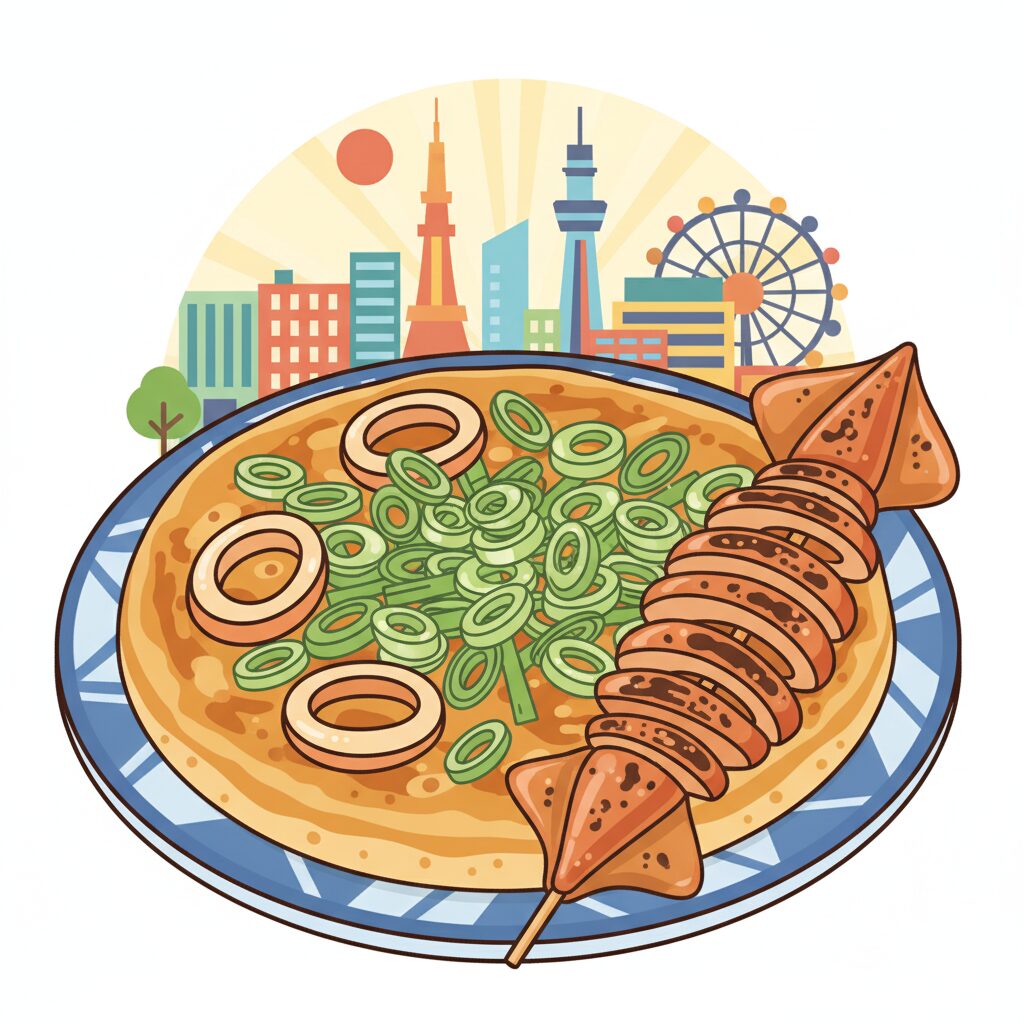
Picture a batter lighter and thinner than its famous relative, combined with an almost overwhelming amount of finely chopped green onions. The abundance of negi transforms the dish completely. When cooked on the hot griddle, the onions wilt and caramelize, releasing a sharp, aromatic sweetness that balances the richness of the batter. Instead of pork, negiyaki often features beef tendon (`suji`), which becomes tender and flavorful after hours of simmering. The final touch truly distinguishes it: rather than heavy sauces, negiyaki is seasoned simply with a splash of soy sauce and a squeeze of fresh lemon juice. The result is savory, zesty, and surprisingly light—a kona-mon perfect for those seeking flavor without the food coma. It feels more mature, nuanced, and quietly confident, without the need to shout.
Where It Fits into Daily Life
Negiyaki isn’t festival fare. You won’t find it under the bright lights of Dotonbori. Its true home lies in small, modest neighborhood joints tucked away on side streets in places like Juso, Fukushima, or Tenma. These spots typically feature a worn wooden counter, a few stools, and a huge teppan at the room’s center. The owner, likely flipping pancakes on the same griddle for decades, knows the regulars by name. It’s the kind of place you visit after a long workday—not for a wild night out, but for a quiet beer and some conversation. The experience is intimate: sitting at the counter, watching your meal being prepared, hearing the rhythmic scrape of metal spatulas and the sizzle of batter. It’s a communal space masquerading as a restaurant. In these moments—sharing casual conversation with the owner, appreciating a simple meal done right—you encounter the true heartbeat of local Osaka life, far removed from curated tourist experiences.
The Negiyaki Mindset: A Nod to Nuance
This humble pancake reveals a side of Osaka’s character frequently overlooked. The city is known for being loud, boisterous, and a bit rough around the edges; yet negiyaki reflects a deep respect for simplicity and quality ingredients. It shows that Osakans don’t always seek the extravagant. There is confidence in allowing one key ingredient—the green onion—to take center stage. This culinary choice embodies a broader cultural value: understanding that genuine quality doesn’t need elaborate adornment. This quiet preference for simple, well-made alternatives expresses local pride. Opting for negiyaki over okonomiyaki feels like a subtle signal, a sign you’re in on the local secret. It acknowledges that while Osaka is famous for its flamboyant cuisine, its residents also treasure a more understated, sophisticated palate.
Ikayaki: The Ultimate Osaka Fast Food
If negiyaki reflects Osaka’s quieter, more contemplative side, then ikayaki captures its hectic, impatient, and brilliantly efficient spirit. This isn’t the grilled whole squid on a stick commonly seen at summer festivals. Osaka’s ikayaki is entirely different: a thin, chewy, savory pancake made from a simple flour-and-water batter mixed with chopped squid, pressed and cooked in seconds between two specialized, high-pressure iron plates. It is the ultimate expression of `hayai`—speed.
Speed, Simplicity, and Squid
The entire process exemplifies urban efficiency. You place your order, and within a minute or less, a steaming hot, folded pancake is handed to you in a small paper wrapper. The flavor delivers a direct hit of umami: the savory batter, the slightly briny squid, and a brush of savory-sweet sauce. There’s no complexity here. It is pure, unadulterated function. Its most iconic location isn’t a street stall but the basement food hall (`depachika`) of the Hanshin Department Store in Umeda. For over 60 years, a small, unassuming counter there has served ikayaki to enormous crowds. The line often extends deep into the food hall, yet it moves with remarkable speed, managed by a team who have transformed the preparation of ikayaki into a flawlessly synchronized industrial ballet. Watching them work is part of the experience—a tribute to Osaka’s talent for streamlining processes to their bare essentials.
A Symbol of Osaka’s Merchant Soul
Ikayaki perfectly suits a city shaped by merchants. It’s incredibly affordable, consistently tasty, and produced at a pace that maximizes volume and profit. It costs less than a cup of coffee, making it accessible to everyone. This isn’t a trendy dish meant for Instagram; it’s a practical solution to a common problem: you’re hungry, pressed for time, and don’t want to spend much. The ikayaki at Hanshin is a cultural institution because it embodies the principle of `cospa`, or cost performance, cherished by Osakans. While Tokyo might boast trendy crepe stands with elaborate fillings, Osaka offers a squid pancake barely altered over fifty years because it has already perfected its form. This is a testament to the local belief that if something works well, there’s no reason to change it. This unpretentious, function-first mentality lies at the heart of Osaka’s business and social ethos.
The Ikayaki Ritual: More Than Just a Snack
Watching how people eat ikayaki reveals as much as the food itself. In the Hanshin basement, there are no tables or chairs. You receive your pancake and find a small spot to stand by a pillar or wall, eating it amid the `depachika` hustle and bustle. The entire process, from queuing to the last bite, takes about five minutes. No ceremony, no fuss. This act encapsulates the Osaka attitude. It’s direct, efficient, and utterly without pretension. Why waste time and space providing seating when the goal is simply to enjoy a delicious snack? This shared ritual forms a unique, unspoken connection. Standing there, eating your ikayaki alongside a high school student, a grandmother, and a salaryman in a suit, you partake in a fundamental Osaka experience. It’s a moment that connects you to the city’s relentless, forward momentum.
Flour, Friends, and the Fabric of the City
Ultimately, what makes kona-mon so essential to Osaka’s identity isn’t just the ingredients or the price. It’s the context in which these dishes are enjoyed. By nature, they are social foods, and the places where they’re served are designed to encourage casual interaction. This is the key element that foreigners often overlook when trying to understand why Osaka is regarded as so “friendly.”
Kona-mon as a Social Glue
The `teppan` griddle is more than just a cooking surface; it functions as a communal table. When you sit at the counter of a negiyaki shop, you’re not merely a customer; you become both an audience member and a participant. You face the chef instead of a wall, sitting shoulder-to-shoulder with strangers. This physical setup naturally breaks down social barriers. Conversations flow easily—a comment about the food, a question for the chef, a shared laugh with the person beside you. Similarly, the stand-and-eat culture at an ikayaki counter creates a brief sense of shared experience. These settings dissolve the formality that often defines social interactions in other parts of Japan. Food becomes the reason for connection. This is the secret behind Osaka’s renowned friendliness. It isn’t just a vague personality trait; it’s a result of a culture built around shared griddles and informal, counter-style dining.
Reading the City Through its Batter
If you really want to understand what drives Osaka, you need to look beyond the giant Glico running man and the mechanical crabs. You need to read the city through its batter. The tourist-oriented takoyaki and okonomiyaki tell one story—a story of bold flavors and lively entertainment. But the everyday staples tell a deeper, more authentic one. Negiyaki reflects the city’s understated appreciation for nuance, its love for neighborhood gathering spots, and its respect for simple quality. It reminds us that beneath the boisterous exterior lies a city with a subtle and confident soul. Ikayaki, meanwhile, is a pure expression of Osaka’s merchant spirit: a relentless pursuit of speed, efficiency, and unbeatable value. It’s the city’s impatient, pragmatic, and ingenious character served up in a folded pancake. Together, they offer a far fuller picture of Osaka’s identity.
Living the Kona-mon Life
For anyone considering a move to Osaka or seeking to understand life here as a resident, delving into the deeper aspects of kona-mon culture is a rite of passage. It marks the difference between being just a tourist and truly becoming a local. It means skipping the long lines at Dotonbori and instead discovering your neighborhood negiyaki spot, where the owner begins to recognize you. It means knowing that the shortest Hanshin ikayaki line appears right after opening or just before closing. It’s about learning the subtle rhythms and unwritten rules that shape everyday life in the city.
Embracing these foods is embracing the city’s philosophy. It’s about realizing that in Osaka, the best things are often the simplest, quickest, and most unpretentious. The city’s essence isn’t only baked into its famous dishes; it’s fried on the griddles of countless small neighborhood shops and pressed between the hot irons of a lively department store basement. This is the real Osaka: a city founded not on grand landmarks, but on a humble, delicious, and deeply practical base of flour and water.