The clock hasn’t struck twelve yet, but you can feel it coming. A subtle tension builds in the air, a city holding its breath. Yodoyabashi, the glass-and-steel heart of Osaka’s corporate world, is a district of straight lines and sharp suits, a place that seems to run on caffeine and quarterly reports. From the outside, it looks like any other financial hub in Japan. Polished, efficient, maybe even a little sterile. But if you want to understand what makes Osaka tick, what truly separates its rhythm from the relentless march of Tokyo, you don’t look at the skyscrapers. You look at the sidewalks, right around 11:59 AM. Because what’s about to happen isn’t just a lunch break. It’s a daily ritual, a strategic maneuver, and a performance of pure, unadulterated Osaka spirit. It’s the midday scramble, and for a foreign professional trying to find their footing, it can feel like chaos. But it’s not chaos. It’s a system, a culture, a language spoken not with words but with quick steps, knowing glances, and an almost religious devotion to getting the best possible meal for the best possible price in the sixty minutes you’re given. This isn’t about just grabbing a bite. This is about mastering the art of the workday meal, and in doing so, mastering a piece of Osaka itself.
Embracing the art of a meticulously planned workday meal not only deepens your connection with Osaka’s culinary rhythm but also opens the door to exploring late-night shime meals that reveal yet another layer of the city’s gastronomic allure.
The 12 O’Clock Bell: A Race Against Time, Not Your Coworkers
It happens in a flash. As the hour shifts, the elevators exhale, descending packed with office workers. Doors slide open, releasing a flood of people onto the streets. This is the first misconception a newcomer faces. It seems like a chaotic, everyone-for-themselves scramble. But it isn’t. It’s a finely tuned, though unspoken, ballet of efficiency. In Tokyo, the lunch hour often feels like a surrender— a quick dash to a convenience store for a plastic-wrapped sandwich eaten quietly at a desk, the keyboard tapping a solitary rhythm. It’s about fueling the corporate machine with minimal interruption. In Yodoyabashi, lunch is the disruption. It’s a sacred pause, with the rush focused on making every second count.
There are unspoken rules to this rhythm. First, you must know your destination before leaving the building. Aimless wandering is a cardinal sin. The experienced professional carries a mental rolodex of restaurants, sorted by cuisine, price, and current wait times. The decision is made at the desk, not on the street. “Today feels like a curry day,” someone will mutter, and that settles it. The plan is set. The mission begins.
Dining alone is not a sign of loneliness; it’s a strategic edge. The solo diner moves quickly. They can slip into the last counter seat at a bustling ramen shop or claim a stool at a crowded standing-only udon spot. They are the special forces of the lunch rush, in and out with silent precision. Groups, however, require a different tactic. The usual polite back-and-forth common elsewhere in Japan— “Oh, I’m fine with anything,” “No, you choose”—gets you nowhere here. It wastes precious time. In an Osaka lunch group, a leader quickly takes charge. “Right, we’re going for the grilled fish special at Yamamoto-san’s. Anyone who disagrees can find their own meal.” It sounds harsh, but it’s kindness. It’s a decisive move that benefits everyone by getting all fed and back at their desks without the agony of indecision.
“Cos-Pa” as a Philosophy: More Than Just a Cheap Meal
To grasp the concept of lunch in Yodoyabashi, you need to understand “kosupa,” a blend of “cost performance.” While this term is widely used across Japan, in Osaka, it goes beyond being just a buzzword; it’s a way of life. It forms the core foundation of the entire midday economy. Foreigners often misinterpret it as merely a quest for cheapness, but this is a fundamental misunderstanding of Osaka’s mindset.
“Kosupa” isn’t about spending the least money possible; it’s about getting the utmost value for the money you spend. A 500-yen bowl of noodles with watery broth and sparse toppings represents poor kosupa. In contrast, a 1,300-yen set meal featuring a perfectly grilled piece of mackerel, a generous bowl of shining white rice, a side of crisp pickles, a small dish of simmered vegetables, and a steaming bowl of miso soup made from authentic dashi stock—that is outstanding kosupa. It’s a bargain, a triumph. You leave not only full but feeling clever, having skillfully navigated the market to emerge victorious.
The contest for the best kosupa unfolds in the underground arcades, or “chika,” that weave an extensive labyrinth beneath the office towers. These are far from ordinary pedestrian tunnels; they are bustling hubs of commerce where dozens of tiny restaurants fiercely compete. Their secret weapon is the “higawari teishoku,” the daily special set meal. The chalkboard outside each eatery serves as a battlefield proclamation. “Today only! Pork cutlet with unlimited rice and soup, 900 yen!” proclaims one. “Crispy fried chicken with homemade tartar sauce, 850 yen!” counters another. Over time, learning which place serves the best tonkatsu on Tuesdays or the freshest sashimi on Fridays becomes a skill sharpened through experience.
A crucial sign of excellent kosupa is the phrase “gohan okawari jiyuu”—free rice refills. This is more than a simple perk; it’s a gesture of trust and generosity. It says, “We know you work hard. We know you’re hungry. Eat until you’re satisfied. We’ve got you covered.” For the Osaka office worker, this signals that the restaurant truly “gets it.” They understand the unspoken agreement: you provide a satisfying, energizing meal at a fair price, and in return, we offer our loyal, repeat business. This relationship is founded on the sacred principle of value.
The Social Fabric of the Counter Seat
While efficiency and value fuel the lunch rush, there’s a deeper, more human aspect at play, often revealed at the humble counter seat. For many, lunch is a solitary moment, a brief break from the social pressures of the office. Yet being alone doesn’t mean feeling isolated. Sitting at a wooden counter, just inches from the chef, you become more than a customer; you temporarily enter the kitchen’s world.
In a typical Tokyo eatery, interaction might be limited to a quiet order and a silent payment, with a clear professional boundary between chef and customer rarely crossed. In Osaka, that boundary is delightfully permeable. The experience is vivid and immediate: you hear the sharp hiss of tempura frying, the rhythmic chop of a knife on a well-worn board, the clatter of bowls being washed. You catch the rich aroma of simmering curry and the smoky char of grilled fish. You are immersed in the process.
Communication is often brief, yet meaningful. A gruff but warm “Maido!” (“Welcome, thanks for your business!”) from the taisho, the owner-chef, as you sit down. A quick nod of acknowledgment. Perhaps a brief remark on the weather as he places your plate before you. This isn’t idle chit-chat to fill silence. It’s a form of acknowledgment, a subtle connection woven into a busy day. It’s a shared understanding that you are both here to do a job—he to cook, you to eat—and mutual respect exists in that simple, sincere exchange. It’s a moment of community amid the controlled chaos, a reminder that the city is made up of people, not just buildings.
Decoding the Yodoyabashi Lunch Map
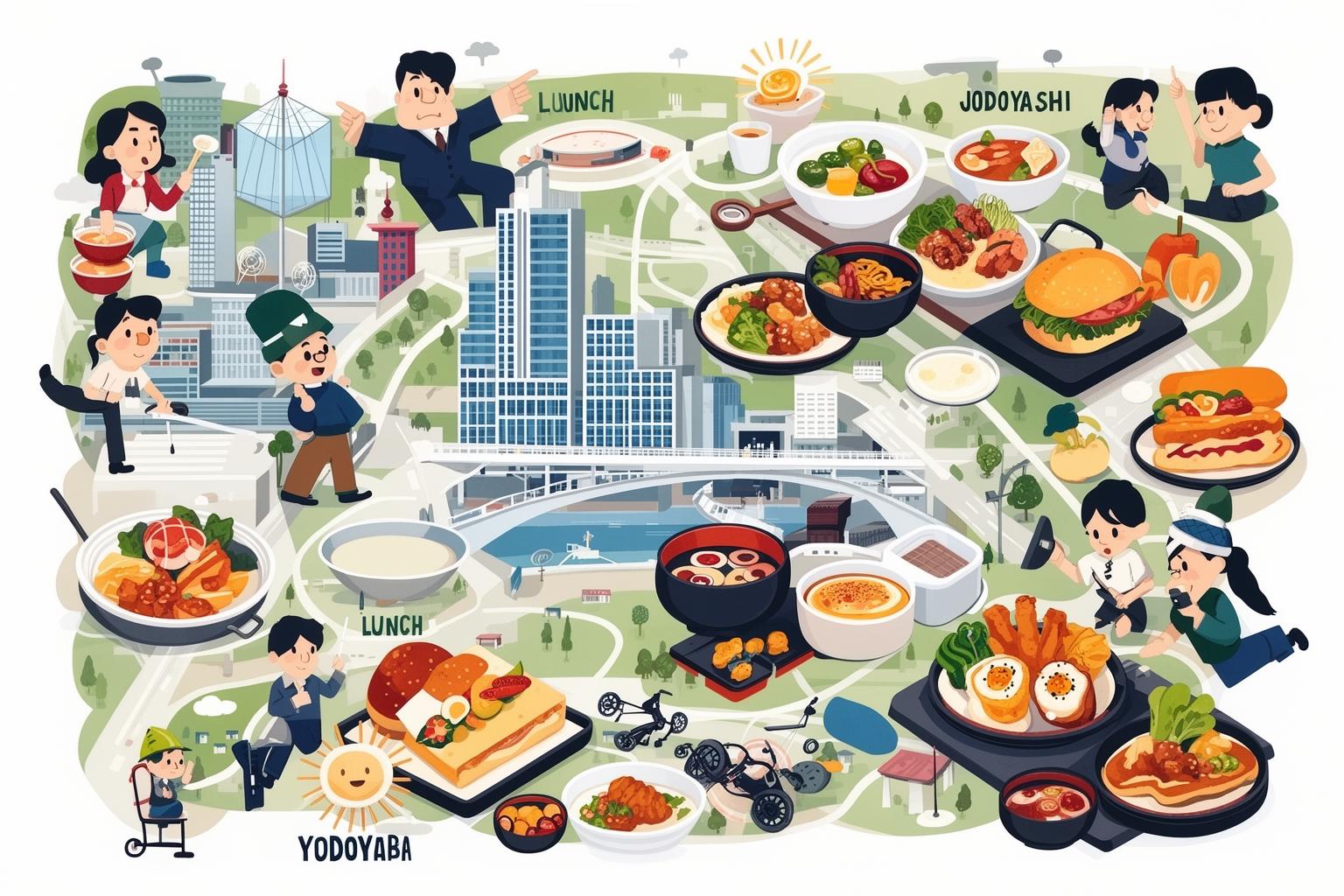
Where you choose to eat in Yodoyabashi reveals something about who you are, or at least your purpose during that particular lunch hour. The district is not a uniform entity; rather, it consists of various micro-zones, each with its distinct character and clientele.
The Main Streets: Corporate Status and Client Lunches
The wide, tree-lined boulevards like Midosuji are the territory of the expense account. Here, restaurants feature sleek modern interiors, subdued atmospheres, and prices that reflect the prime real estate. The food is often excellent, but the meal itself serves a purpose beyond taste. This is where you bring an important client, where deals are quietly negotiated over carefully arranged kaiseki courses. Lunch here is a display of success, reinforcing the corporate hierarchy. It’s less about convenience and more about status.
The “Yokocho” Alleys: The Salaryman’s Sanctuary
Step off the main streets into the narrow “yokocho,” the back alleys winding between buildings, and you enter another world. This is the domain of the everyday office worker, a genuine sanctuary. The air is thick with the aroma of cooking oil and dashi broth. The signs are faded, and the entrances are small and unpretentious. Many of these establishments have been family-run for generations. Here, there is no pretense. You’ll find worn wooden counters, calendars from the local bank hanging on walls, and a television quietly humming in the corner. This is where you get the best value, the most sincere cooking, and the loudest slurping of noodles. Dining here signals that you are in the know, appreciating substance over style, and that you are part of the true fabric of the city’s working life.
The Nakanoshima Pivot: A Breath of Fresh Air
There is a third choice, a strategic escape from the urban hustle. A short stroll across one of the elegant bridges brings you to Nakanoshima, the long, green island dividing the river. Here, a different lunch culture takes shape. It’s the culture of the bento box. Office workers line up at small stalls or the dazzling food halls in department store basements, known as “depachika,” to pick up a pre-made lunch. They then find a bench in the park, overlooking the water, to eat outdoors. This isn’t a sign of being too rushed to dine in a restaurant. It’s a conscious decision—a deliberate effort to carve out a moment of peace and personal space amid the city’s density. It represents a different kind of value—the value of a calm mind and a view of the sky.
Beyond the Food: What Lunch Teaches You About Osaka
If you pay close attention, the Yodoyabashi lunch hour reveals everything you need to understand about the Osakan mindset. It’s a city that values pragmatism over refinement. A restaurant’s success is measured not by its decor, but by the tastiness of its food and the fairness of its prices. Substance will always outweigh style. This embodies the spirit of the “akindo,” the merchant, ingrained in the city’s DNA. Every meal is a transaction, but a good one is built on honesty and mutual benefit. The restaurant owner offers good food; you offer your patronage. It’s a simple yet powerful relationship.
The lunch rush also uncovers a unique form of community born in chaos. During that shared, hectic hour, you become part of a collective effort. Everyone is navigating the same crowds, searching for the same value, and respecting the same unwritten rules of speed and efficiency. There’s a quiet camaraderie in the joint mission of a satisfying lunch.
For any foreign professional trying to grasp this city, my advice is this: leave the spotless, convenient cafe in your office lobby. Step outside into the street at noon. Allow yourself to get a bit lost in the back alleys. Follow the crowds to a place with a line out the door and a hand-written menu you can’t fully understand. Point to the daily special. Sit at the counter, watch the chef work his magic, and enjoy a meal that feels like a triumph. When you master the lunch hour in Yodoyabashi, you haven’t just learned where to eat. You’ve learned how to perceive the soul of Osaka.