You hear the term “third place” thrown around a lot. It’s that spot that isn’t home, isn’t work, but a third anchor in your life where community and comfort reside. The modern world chased this idea with minimalist cafes and subscription-based coworking spaces, all clean lines, fast Wi-Fi, and artisanal coffee. They built an industry on a need that Osaka never forgot it had already solved, decades ago. The answer is the kissaten, the traditional Japanese coffee house, and in this city, it runs deeper than just a cup of dark roast. It’s the original coworking space, the unofficial community center, and the real boardroom where the city’s business gets done. Forget the sleek glass facades and exposed brick walls. The true heart of Osaka’s daily grind beats in dimly lit rooms, behind doors with little brass bells, on worn velvet seats that have absorbed a million conversations and untold amounts of cigarette smoke.
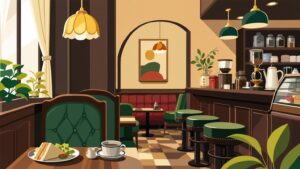
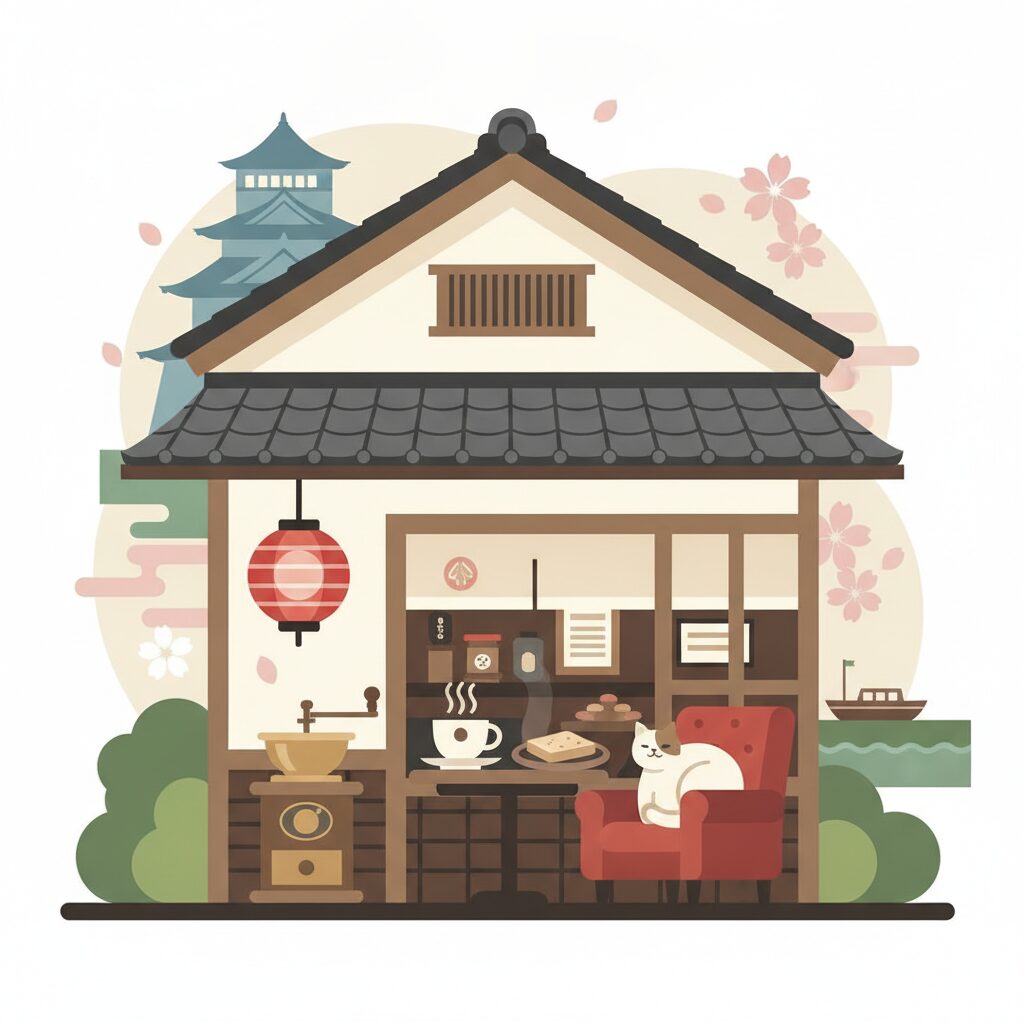
To a newcomer, a kissaten can feel like a time capsule. The decor is unapologetically Showa-era, a throwback to the mid-20th century. Think dark wood paneling, ornate lamps casting a warm, amber glow, maybe a bubbling siphon coffee maker that looks like a chemistry experiment. The air is thick with the scent of roasted beans and, often, tobacco. This isn’t a place that’s trying to be retro; it simply is. It hasn’t changed because its function hasn’t changed. For countless Osakans, this isn’t a novelty. It’s an essential piece of their daily infrastructure, an extension of both their office and their living room. Before you can understand Osaka’s rhythm, you have to understand the role these humble establishments play in the life of the city.
Many workers now make a smooth retreat from the kissaten’s nostalgic ambience to embrace a balanced lifestyle, as exemplified by Osaka’s sento culture for remote work, which redefines the modern work-life switch.
The Unspoken Rental Agreement: Coffee as Your Desk Fee
Step into a typical Tokyo cafe with a laptop, and you may sense a subtle pressure. The tables are small, turnover is rapid, and the unspoken rule is to consume quickly and then make room. It’s a volume-driven business. In an Osaka kissaten, however, the approach is entirely different. When you order a 500-yen cup of coffee, you’re not merely purchasing a drink—you’re renting a space. The transaction focuses less on the product itself and more on the time and space it offers you.
This is most apparent in the tradition of “Morning Service,” or simply “Morning” (モーニング). From opening until around 11 a.m., ordering a single coffee comes with a small meal—typically thick-sliced toast with butter and a hard-boiled egg. This isn’t just a pleasant bonus; it’s the foundation of the kissaten economy. For the price of that coffee, a student gains a quiet spot to study for exams. A salesman finds a base of operations to plan his day’s routes. A freelance writer gets a desk with unlimited caffeine. It’s a deeply practical arrangement and a hallmark of Osaka’s merchant spirit. Why rent an expensive office when a booth at the local kissaten suffices? The owners understand this. They aren’t hurrying you out the door. They recognize their regulars come to settle in, to work, to think. The low murmur of background chatter, the clink of porcelain, the rustle of newspapers—it creates the perfect white noise for concentration, a shared public silence that has become increasingly rare.
This illustrates a fundamental difference in urban philosophy. In Tokyo, space is a scarce resource to be maximized for profit by the minute. In Osaka, space is a community asset to be offered with the expectation that loyalty and repeat business will follow. The value lies not in how many customers you serve in an hour, but in how many people see your shop as an essential part of their daily routine.
The Master and the Regulars: Weaving a Social Safety Net
A chain coffee shop employs a manager and baristas, while a kissaten has a “Master” (マスター). This title holds special significance. This person, often the owner who has stood behind the same counter for decades, is more than just a proprietor. They serve as the anchor of a small, informal community. They are the keeper of stories, the quiet observer, the human hub connecting the various spokes of the neighborhood.
Newcomers might not notice it right away, but after several visits, the pattern becomes clear. The same faces appear at the same times each day. This is the realm of the jōren-san, the regulars. The Master knows their order without asking. They know when a regular’s daughter is getting married or when their business is struggling. The conversation is rarely deep—just small exchanges—but it is the accumulation of these check-ins that creates a strong social bond.
Consider the elderly man who lives alone and comes in for his morning coffee every day. The Master is often the first to notice if he doesn’t show up. In a country with a rapidly aging population, these informal networks act as a vital, often unseen, social safety net. This stands in stark contrast to the anonymity of a global coffee chain, where staff turnover is high and interactions are scripted for efficiency. A kissaten is a place where you are recognized, where your absence doesn’t go unnoticed. This mirrors Osaka’s character—a city of neighborhoods that, despite its vast size, often functions with the intimacy of a much smaller town. People stay connected, watch out for one another, and business is closely linked with personal relationships. The kissaten is the living embodiment of that spirit.
The Real Deal Room: Business in a Cloud of Smoke
While tourists gather around Dotonbori‘s dazzling signs, the true business of Osaka often takes place in the quiet, hazy corners of its kissaten. These cafés serve as the city’s unofficial negotiation rooms. Forget sterile conference rooms and PowerPoint slides. For small business owners, salespeople, and local entrepreneurs, the kissaten is the favored neutral ground for making deals.
Imagine this: two men in slightly rumpled suits, leaning over a small table. One speaks in a low, earnest tone, moving his hands to emphasize points. The other listens closely, sipping iced coffee slowly. Papers lie spread out between them beside a steadily filling ashtray. Here, partnerships are forged, contracts are discussed, and trust is nurtured. Why choose this setting? Because it’s disarming. An office can feel intimidating, a formal display of power. A kissaten is personal. It removes corporate veneer and gets to the heart of Osaka’s merchant spirit (akindo): business revolves around people.
First, you build rapport by talking about family or the Hanshin Tigers, then you get down to the numbers. The slightly worn, lived-in ambiance is not a flaw but a feature. It signals a lack of pretense. It says, “We are here for genuine conversation, not to impress each other with fancy offices.” While a Tokyo salaryman might entertain a client in a luxurious hotel lounge in Marunouchi, his Osaka counterpart is more likely to seal a deal over a plate of Napolitan spaghetti and a hot coffee in a basement kissaten in Umeda. This cultural nuance is often lost on outsiders. Sometimes, the scruffier the setting, the more serious the business.
A Foreigner’s Guide to Kissaten Etiquette
For someone unfamiliar, entering a kissaten can feel like stepping into a private club. The rules aren’t spoken aloud, but they are very much present. Grasping these unwritten guidelines is essential to truly appreciating these distinctive spaces.
Reading the Room
There is no official time limit, but an unofficial one exists. The unspoken agreement is that you may stay as long as you’re not interfering with the Master’s ability to earn a living. If the shop is empty, you can comfortably linger for hours over a single coffee. However, if a lunch rush begins and patrons are waiting for tables, it’s polite to either order something else to refresh your “rent” or to pack up and leave. The owner will rarely ask you to leave. It’s your responsibility to read the atmosphere (kuuki wo yomu) and act considerately. This social awareness is a fundamental aspect of life in Japan, and the kissaten provides a perfect environment to practice it.
The Classic Menu
Don’t expect a V60 pour-over or a matcha latte with oat milk here. The menu is a piece of history. Coffee is typically offered as “Blend” (ブレンド), “Hot” (ホット), or “Ice” (アイスコーヒー, pronounced aisu kōhī), with the latter often served with syrup and cream by default. Other classic offerings include Cream Soda (a bright green melon soda topped with vanilla ice cream) and, particularly in Osaka, Mixed Juice (ミックスジュース), a thick, frothy blend of canned fruits and milk. The food is just as traditional: variations of toast, egg sandwiches (tamago sando), and pasta dishes like Napolitan (a ketchup-based spaghetti). It’s meant to be sustaining, not gourmet. It’s dependable, comforting, and serves its purpose well.
The Smoke Signal
Here’s the crucial point: many traditional kissaten still allow smoking. For some, this is a nostalgic aspect of the atmosphere; for others, it’s an immediate deal-breaker. Recent legislation has required many to become non-smoking or to separate smoking areas, but classic, single-room establishments often remain exempt. If the smell of stale tobacco smoke bothers you, it’s wise to check inside before committing. This is a major source of confusion. A kissaten isn’t simply a Western-style cafe; it developed as a lounge, a salon, a place for adults to unwind, and for much of the 20th century, smoking was part of that. It’s a relic from a bygone era, for better or worse.
The Soul of the City in a Coffee Cup
If you truly want to grasp what makes Osaka tick, spend an afternoon in a kissaten. Don’t simply drink your coffee. Observe. Listen. Notice how the Master interacts with the regulars. See the salarymen using the table as their office, the students as their library, and the elderly couple as their living room. Within this single space, the fundamental aspects of Osaka culture unfold in real time.
You’ll witness the city’s renowned pragmatism in the straightforward, high-value exchange of coffee for time and space. You’ll sense its strong community spirit in the easy rapport between owner and customers. You’ll appreciate its modesty in the worn furniture and simple menu — a place that values function and familiarity over fleeting trends.
While a trendy Tokyo cafe might be designed for the perfect Instagram photo, an Osaka kissaten is designed for life. It doesn’t need advertising because its worth is clear to those who depend on it daily. It’s a stubborn, beautiful, and utterly essential part of the urban landscape. So find one, push open the heavy door, let the little bell announce your arrival, and take a seat. You’re not just drinking coffee; you’re connecting directly to the heart of Osaka.