Most visitors arrive in Osaka and immediately look up. They look at the blinding neon lights of Dotonbori. They look at the towering heights of the modern skyline. They look at the giant mechanical crab swinging its massive arms above the crowded tourist streets. The city presents itself as a chaotic, colorful playground. It feels like a place built entirely for entertainment, food, and loud nights out. But this is only the glossy surface. If you want to understand the true pulse of this city, you need to look away from the neon. You need to look east. You need to leave the polished tourist corridors and step into a world of gray concrete, humming machinery, and the sharp, undeniable scent of cutting oil. Welcome to Higashiosaka.
To live in Osaka, or even to truly understand the people here, you have to understand their foundation. Tokyo may be the brain of corporate Japan, but Osaka has always been its calloused, working hands. This is a city built on commerce, trade, and physical creation. The locals are famous across Japan for being straightforward, pragmatic, and entirely unpretentious. They do not care about fancy titles. They do not care about sleek appearances. They care about what you can actually do. They care about what you can build. This deeply ingrained cultural mindset stems directly from places like Higashiosaka. This sprawling district is the undisputed heavyweight champion of Japanese manufacturing. It is a dense, unapologetic landscape of tiny, family-owned workshops. These workshops are the unsung heroes of the global economy. They are the places where everyday people clock in, roll up their sleeves, and quietly build the precise components that keep the modern world turning. If you are an expatriate living here, or a traveler wanting to grasp the soul of the region, skipping this industrial heartland means missing the very essence of the local identity. This is the realm of the Machi-koba.
What is a “Machi-koba”? Japan’s Backbone of Manufacturing
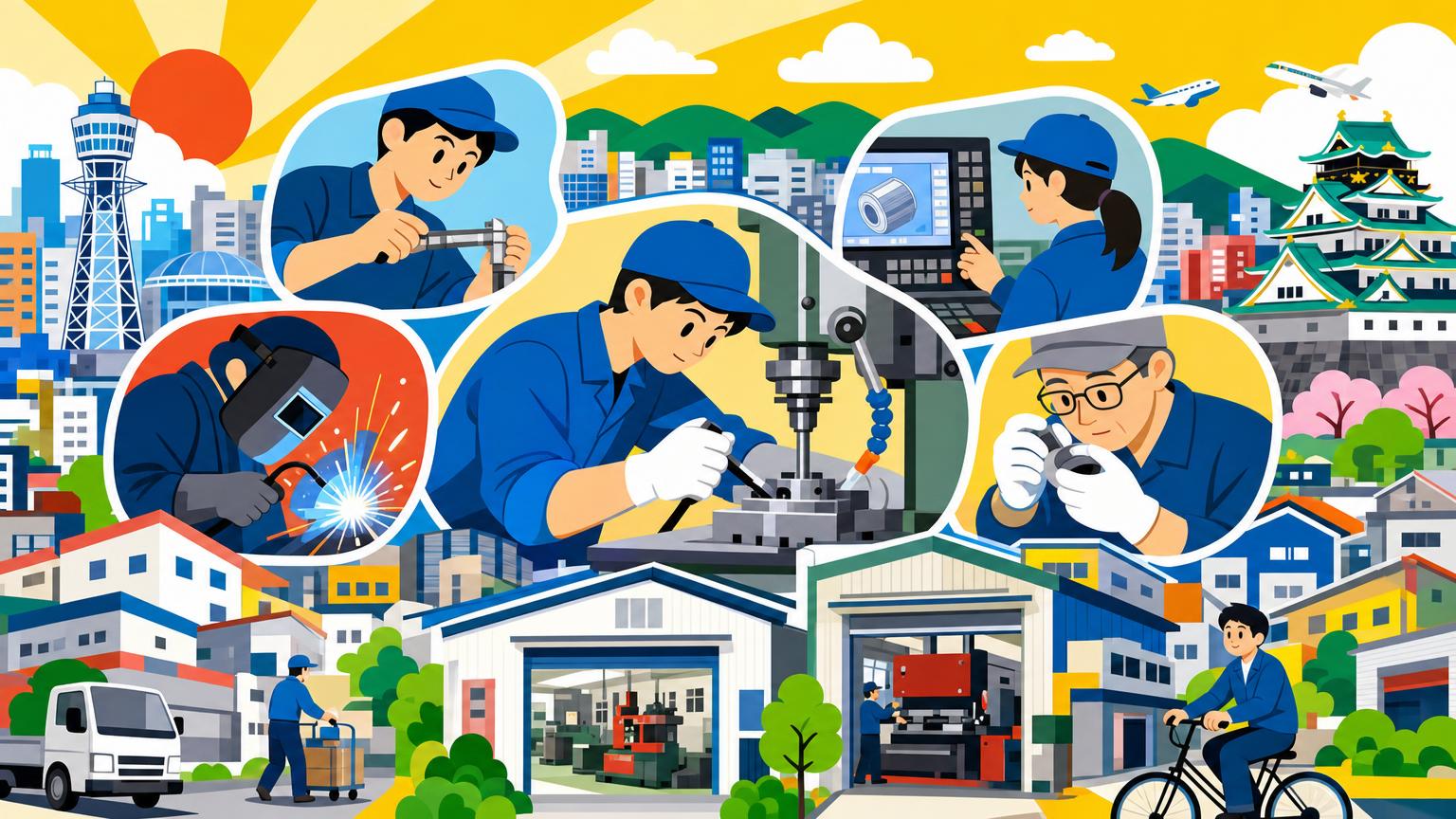
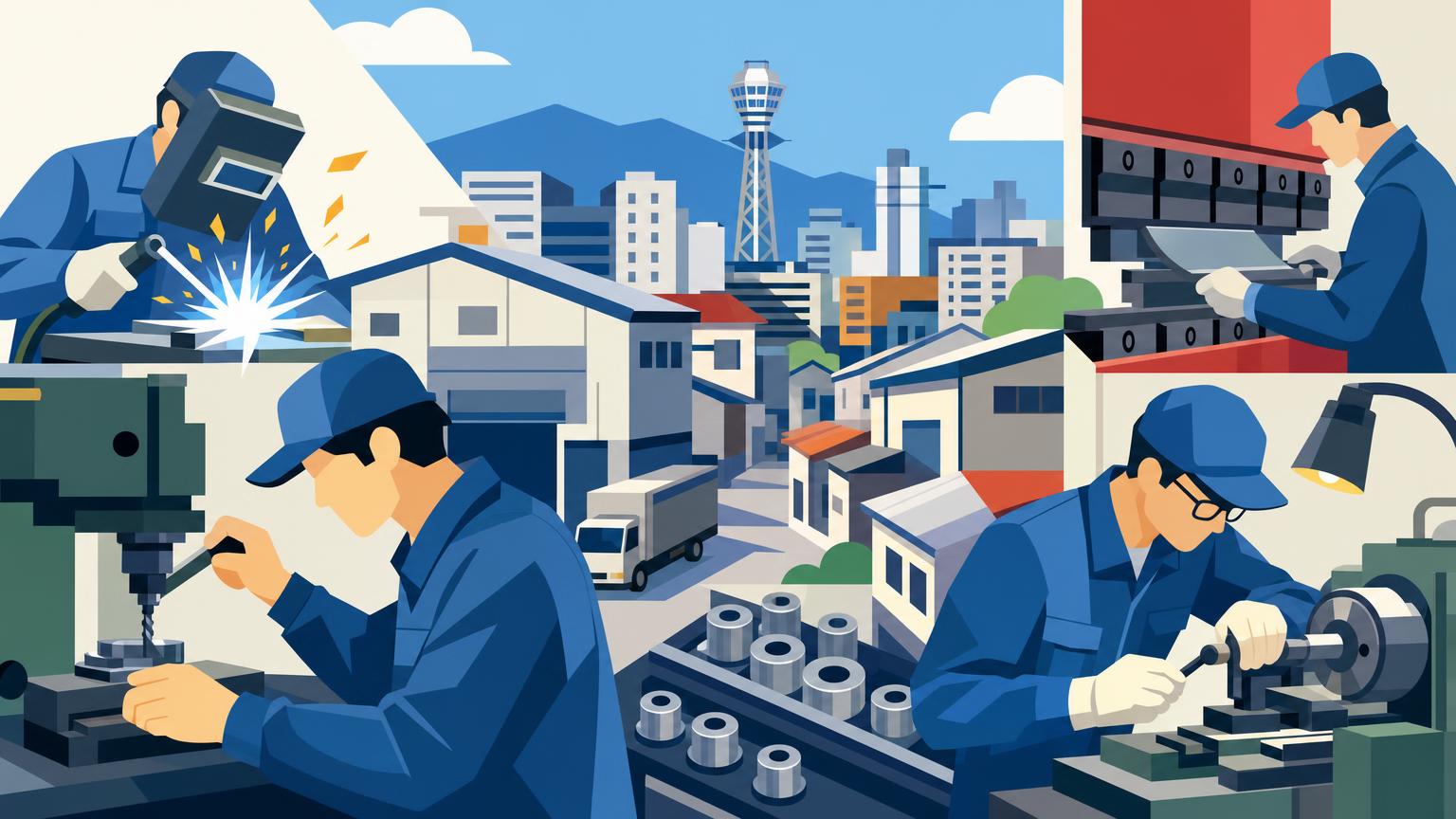
The term Machi-koba literally means town factory. However, this simple translation doesn’t fully convey the cultural significance of the word. When you hear “factory,” you probably imagine a huge, sterile corporate facility—vast parking lots, thousands of anonymous workers in identical uniforms, and endless automated assembly lines. A Machi-koba is quite the opposite. These are hyper-local, intimately operated businesses, often tucked into residential neighborhoods. A typical Machi-koba might have fewer than ten employees and is usually owned and run by a single family, passed down through generations.
Strolling down a quiet street in Higashiosaka, you might spot a family home with a garage attached, its rolling shutter wide open. Inside, amid metal shavings and the deafening sound of a hydraulic press, an older man and his son work with meticulous precision. They aren’t producing entire cars or finished consumer goods but are focused on one incredibly specific step within a vast supply chain. One Machi-koba may specialize exclusively in stamping metal washers, the neighbor might polish those washers to a mirror finish, and the shop across the street might handle heat treatment.
This creates a fascinating, highly interdependent ecosystem where the factories depend on each other to thrive. If one shop gets an order requiring a technique they don’t have, they don’t turn it down; instead, they visit a neighbor, split the work, and collaborate. This strong reliance on community networks perfectly reflects Osaka’s social fabric. Here, relationships trump contracts. Trust is built over decades of hard work and late-night drinks at the local izakaya. Foreigners moving to the region often wonder why business deals here seem informal or why casual chats quickly lead to professional favors. The answer lies in the cooperative, Machi-koba mentality: survival means lifting your neighbors up, and success comes from knowing exactly who in your neighborhood has the right tool for the job.
Why Higashiosaka is the Undisputed Capital of Machi-koba
Industrial zones are scattered throughout Japan, but none possess the legendary reputation of Higashiosaka. With thousands of factories operating within a relatively compact area, it has one of the highest concentrations of manufacturing facilities in the world. Historically, the region benefited from its closeness to Osaka Bay and an extensive river network, enabling efficient transportation of heavy raw materials like steel and iron. However, geography tells only part of the story. The real strength of the area comes from a generational stubbornness. When manufacturing moved overseas to cheaper labor markets in the late twentieth century, many industrial towns collapsed, but Higashiosaka endured by focusing intensely on unmatched quality. Instead of competing on price, they competed on perfection.
World-Class Technology: From Bullet Trains to the Maido-1 Satellite
The immense technical skill hidden within these humble, dusty workshops is astonishing. You might walk past an unremarkable shop with faded signage, completely unaware that the workers inside hold patents relied upon by global tech giants. These factories do not mass-produce inexpensive plastic toys; they create the essential infrastructure of the modern world.
Take the Japanese Shinkansen, the famed bullet train. These trains race across the country at extraordinary speeds with a safety record admired worldwide. The powerful vibrations from such speeds would loosen standard nuts and bolts within hours. The answer didn’t come from a large corporate lab in Tokyo but from a small Machi-koba in Higashiosaka. Local engineers invented a specialized lock-nut design that absolutely resists loosening under extreme vibration. Today, these locally crafted metal components hold together high-speed rail networks, massive suspension bridges, and skyscraper frameworks across the globe.
The defining moment of regional pride came in the early 2000s. Local factory owners noticed the younger generation losing interest in manufacturing, as many young people wanted to move to Tokyo for clean office jobs, viewing Machi-koba life as dirty, dangerous, and outdated. To challenge this perception, local factory bosses united to accomplish the impossible: building an actual space satellite. Using only local parts, funding, and expertise, they designed and launched the Maido-1 satellite. In 2009, this grassroots spacecraft successfully reached orbit. The name “Maido” is the classic, gritty Osaka greeting used by shopkeepers and merchants. It was the ultimate expression of local pride and capability. A group of workers in oily overalls, operating out of tin-roofed sheds, had literally touched the stars. This story is woven into the city’s cultural identity and exemplifies the local mindset: never tell an Osaka worker something is impossible—they will simply build it to prove you wrong.
The “Shokunin” Spirit: Craftsmanship Passed Down Generations
To grasp the human element behind these factories, one must understand the concept of the Shokunin. While it roughly translates to craftsman, the English term does not fully capture its meaning. A Shokunin does not just hold a job; they dedicate their life to mastering a single skill, an almost spiritual commitment to achieving repetitive perfection.
In Tokyo, success is often measured by upward mobility—starting at the bottom of a corporate hierarchy and striving to reach the executive level. In Osaka’s Machi-koba culture, success is measured by depth. The goal isn’t to become a manager but to become the undisputed master of the lathe, to discern the precise temperature of a metal alloy just by its color. Workers rely heavily on intuition and muscle memory, honed over forty years of performing the same tasks daily.
This Shokunin spirit permeates all aspects of life in the city. It explains why the person running a tiny takoyaki stand on the corner treats his cooking with such dedication. He is not simply making a snack; he is practicing his craft. Foreigners living in Japan frequently comment on the exceptional attention to detail in everyday services, and here that devotion is deeply rooted in the blue-collar pride born on factory floors. There is no shame in hard physical work; on the contrary, it is celebrated. An older man entering a local diner wearing heavily stained work clothes commands quiet, profound respect as a builder, recognized as the foundation of the economy.
Can Tourists Visit a Machi-koba in Higashiosaka?
For a long time, the industrial tourism aspect of this region remained completely closed off. These are active, hazardous workplaces—loud, filled with heavy machinery, and densely packed. Factory owners were reluctant to allow outsiders in, fearing safety risks and interruptions to their strict production schedules. However, as the need to attract young talent and showcase their remarkable skills has increased, the doors have gradually begun to open. Today, experiencing the grit and magic of these workshops is entirely possible, offering a uniquely insightful perspective on Japanese life that most tourists completely overlook.
Factory Tours and Hands-on Workshops
Several forward-thinking Machi-koba have started providing dedicated tours for visitors. These are not polished, sanitized museum displays. When you enter, you step onto an active production floor. You will smell the burning metal, feel the concrete vibrate beneath your feet as massive presses stamp out steel parts, and see sparks flying from welding torches just a few feet away.
Many of these specialized tours are arranged through local tourism boards or specialized industrial tourism websites. Though English support is still evolving, the visual impact of the machinery and the undeniable skill of the workers transcend any language barrier. Some workshops have even begun offering hands-on experiences. Under the watchful eye of a master Shokunin, you can try metal spinning—a technique where a flat metal disc is shaped over a rapidly spinning lathe. You can feel the intense physical resistance of the material and personally experience how challenging it is to achieve the smooth, flawless curves that expert workers effortlessly create in seconds. These moments bring a profound realization: the lifetime of discipline needed to master this craft.
Open Factory Events: Experience “Koba e Iko!”
For the ultimate immersion into this culture, plan your visit to coincide with the annual open factory events. The most famous is called Koba e Iko, which translates to Let’s go to the factory. This city-wide celebration honors local industry. For one weekend, dozens of factories usually closed to the public throw their doors wide open.
The atmosphere during this event is electric. It feels like a neighborhood street festival, but instead of food stalls and games, the attractions are heavy machinery and molten metal. Families roam from factory to factory with maps in hand. Children watch in wide-eyed amazement as massive industrial robots perform intricate dances. The factory workers, typically quiet and intensely focused, become enthusiastic teachers. They proudly explain the specific components they make and how each tiny metal gear eventually ends up in a commercial airliner.
This event is an ideal introduction for expats and foreign visitors. It removes the intimidation of entering a working factory. It offers a rare, beautiful chance to engage directly with the people who built modern Japan. Factory owners are immensely proud of their work and genuinely enjoy seeing international visitors interested in their craft. You’ll be greeted with loud, warm welcomes, handed safety goggles, and invited to take a closer look. This is the true spirit of Osaka hospitality, expressed not in fancy hotel lobbies but on concrete floors covered in steel dust.
What to Buy: Unique Souvenirs Crafted in Local Factories
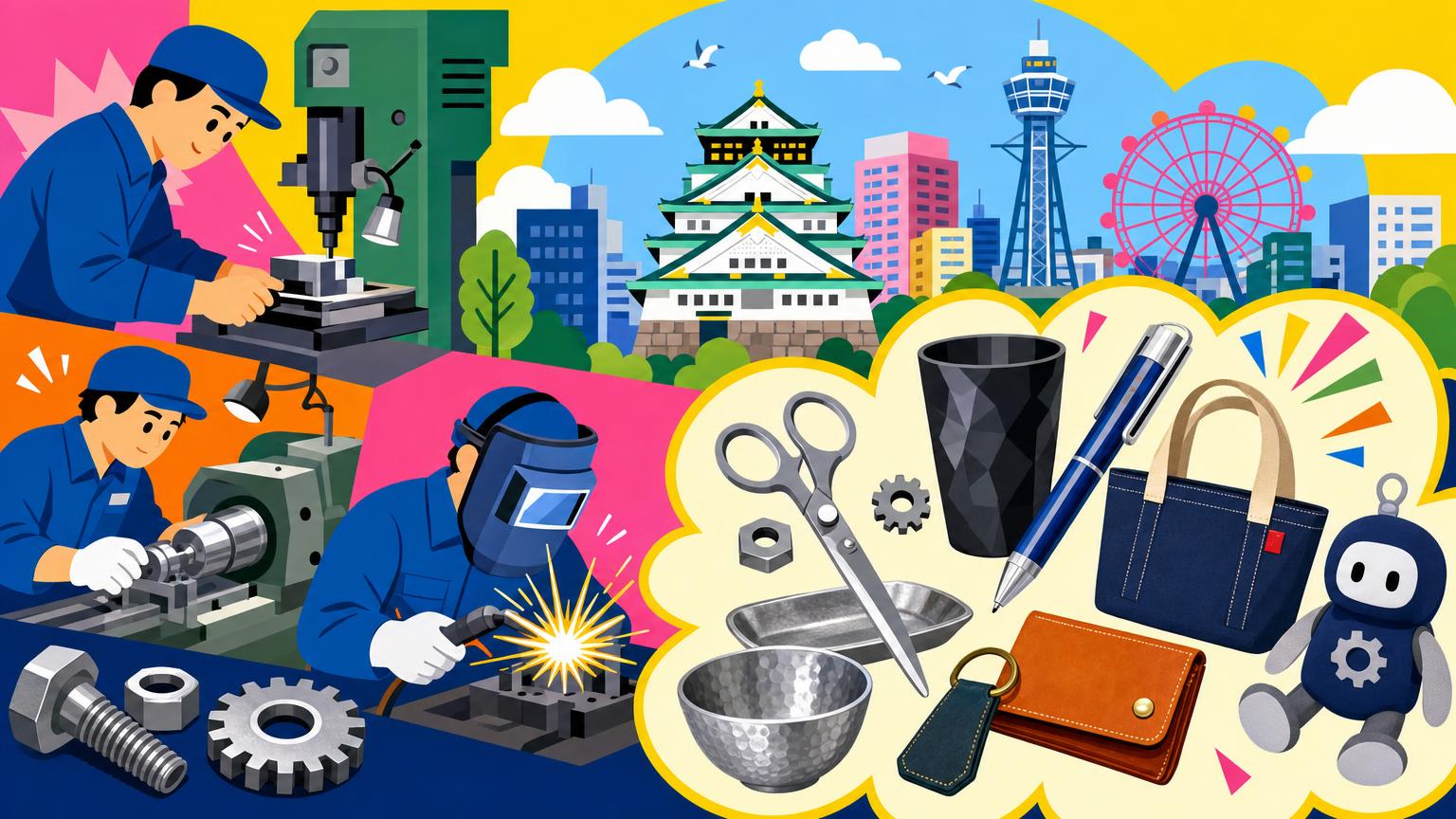
When most people buy souvenirs in Japan, they typically choose mass-produced keychains, boxes of sweet cakes, or inexpensive folding fans. However, if you venture out to the industrial heartland, your shopping options shift significantly. The factories there have realized that their extreme precision can be applied to consumer goods, resulting in some of the highest quality and most unique items available in the country.
You won’t find delicate trinkets here. Instead, you’ll find items made to last a lifetime. Several local shops craft custom-designed metal spinning tops. These tops are machined with such absurd precision that when spun on a glass table, they appear to stand perfectly still. They can spin smoothly for several minutes without a single wobble, serving as beautiful, tactile showcases of flawless engineering.
Other factories have adapted their aerospace and automotive expertise to produce premium outdoor gear. You can discover lightweight, indestructible camping equipment, titanium cooking tools, and incredibly sharp everyday instruments. Heavy-duty scissors designed to cut through thick industrial materials glide through paper effortlessly. You can also find exquisitely machined aluminum pens that feel perfectly balanced in your hand.
Purchasing these items directly from the source is deeply satisfying. You’re not buying a brand name; you’re buying the pure skill of the person right before you. Every time you use that tool or admire the beautifully machined object on your desk at home, you’ll be reminded of the loud, chaotic, perfectly synchronized workshops. It’s a piece of the city’s soul you can actually hold in your hand.
How to Access Higashiosaka from Central Osaka
Although it feels like an entirely different world, the industrial heartland is remarkably easy to reach from the main tourist hubs in the city. The shift from neon lights to factory smoke happens surprisingly quickly. The most straightforward way is via the Kintetsu Railway. From Namba station, located in the center of the entertainment district, you can board the Kintetsu Nara Line.
As the train travels east, pay close attention to the changing scenery outside the window. The landscape transforms rapidly. Tall glass office buildings give way to expansive residential areas, which then merge with large corrugated steel roofs. The stations you pass, such as Fuse and Kawachi-Kosaka, serve as important local transit centers. You’ll notice a shift in the passengers: the tourists with large suitcases fade away, replaced by high school students, weary office workers, and older men wearing sturdy work boots and jackets, carrying heavy canvas bags.
Within fifteen to twenty minutes—depending on your specific stop—you reach the core of the manufacturing district. Stepping out of the station, the atmosphere immediately feels different. It is less crowded yet more industrious. You can hear the steady thumping of metal presses echoing along the narrow streets before the factories come into view. There is no grand entrance, no tourist information center handing out glossy brochures. The factories simply exist, seamlessly woven into the daily rhythm of neighborhood life, situated right beside small grocery stores and quiet local parks.
Conclusion: Discover the Hidden Heart of Osaka’s Industry
Living in or visiting this region requires a willingness to look beyond the surface. The massive castles, bustling shopping arcades, and renowned street food all form wonderful parts of the local experience. However, they do not reveal the full story. The character of this city is loud, humorous, fiercely independent, and incredibly hardworking. You cannot truly appreciate that character until you see where the hard work actually takes place.
Higashiosaka stands as a testament to human perseverance. It is a place where absolute perfection is pursued daily—not for fame, nor for massive corporate bonuses, but simply because doing a job perfectly is the right thing to do. The Machi-koba represent the deep, unshakable backbone of the economy. They demonstrate that massive conglomerates do not have a monopoly on innovation. A handful of dedicated craftsmen in a dusty garage can solve problems that puzzle global engineering firms. They can build the parts that hold high-speed trains together. They can literally build a satellite and launch it into space.
When you walk the streets of this district, when you smell the oil and hear the deafening roar of the presses, you are experiencing the true heartbeat of the city. You are witnessing the grit that fuels the famous local humor. You are observing the honest, physical labor that supports the vibrant nightlife miles away in Dotonbori. The next time you ride a bullet train, fly in a commercial jet, or even just admire the seamless infrastructure of Japan, remember the quiet, relentless workshops operating in the shadow of the big city. Take the short train ride east. Leave the neon behind. Go see the calloused hands quietly building the world.