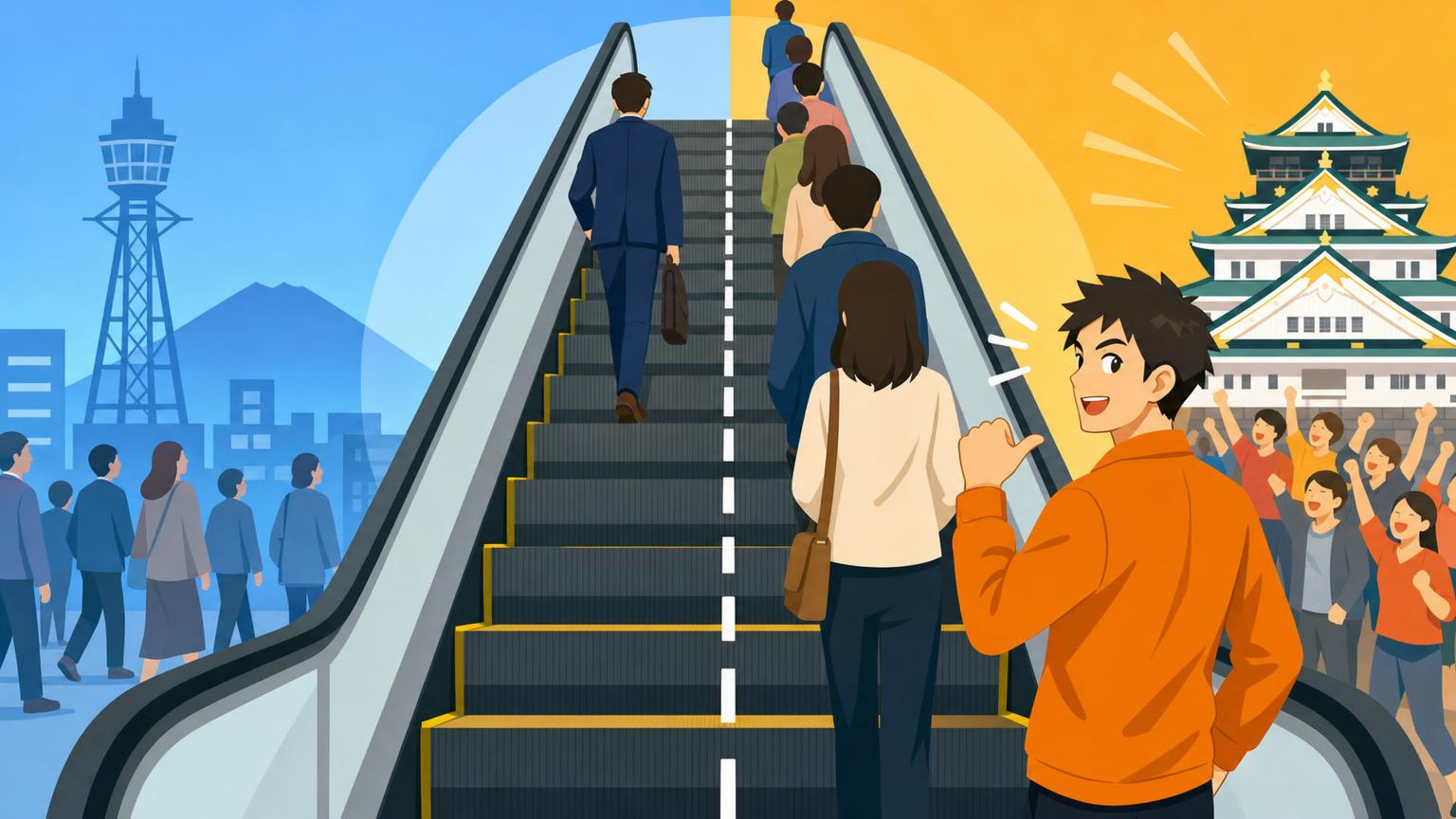
I am Megumi Hara. By trade, I am an event planner based in Tokyo, organizing traditional festivals and large-scale cultural gatherings. Being in my early twenties and managing massive event logistics in the capital, I thought I had seen every possible variation of human traffic. My job revolves entirely around crowd control, human flow, and understanding how massive groups of people move through tight spaces. I spend my days mapping out evacuation routes, entry gates, and vendor lines for massive summer matsuri. I watch how humans behave when they are hot, tired, and in a hurry. When you organize a festival in Tokyo, the crowds are dense but surprisingly docile. They form lines intuitively. They respect the imaginary boundaries set by a single strip of plastic tape. But Osaka is different. Osaka vibrates with a rebellious, kinetic energy. The people here do not just blindly follow the tape; they look for the most efficient route. They are pragmatic to their core.
The very first time I took the Shinkansen down to Kansai and stepped into the sprawling subterranean labyrinth of Osaka Station, every single thing I knew about Japanese crowd dynamics was instantly turned upside down. You see, Japan is famous for its order. Visitors expect a monolithic culture where everyone follows the exact same invisible script from Hokkaido down to Okinawa. But Japan is not a monolith. And nowhere is that more apparent than on a simple escalator ride in the heart of Osaka.
If you are moving to this vibrant, loud, and brilliantly practical city, or if you simply want to understand the true local mindset, you must master the escalators. Escalators are the great cultural dividers of Japan. They reveal history, psychology, and an intense regional pride. So let us address the burning question immediately. In Osaka, you stand on the right. You leave the left side open for those who wish to walk.
If you take nothing else away from this piece, remember that single geographic truth. Stand on the right. Walk on the left. But understanding what to do is only half the battle. Understanding why Osakans do this, and why it matters so deeply to their identity, is how you truly start to live like a local. Let us dive into the mechanics, the history, and the subtle rebellions of Osaka escalator culture.
Which Side to Stand on an Escalator in Osaka?
The Golden Rule: Stand on the Right, Walk on the Left
Upon approaching the steep mechanical escalators at Umeda Station or navigating the busy underground passages of Namba, you will observe a captivating routine. Umeda Station functions less as a transit hub and more like an architectural enigma. It is a vast, multi-layered underground city linking several private railway lines, the city subway, and the Japan Railways network. Millions of people flow through its pathways every day. Here, escalators are more than mere conveniences; they serve as essential lifelines. The movement must stay uninterrupted, or the whole system risks backing up into severe congestion. When you near the steep escalators connecting the Midosuji Line to the Hankyu concourse, you can witness this dance in action.
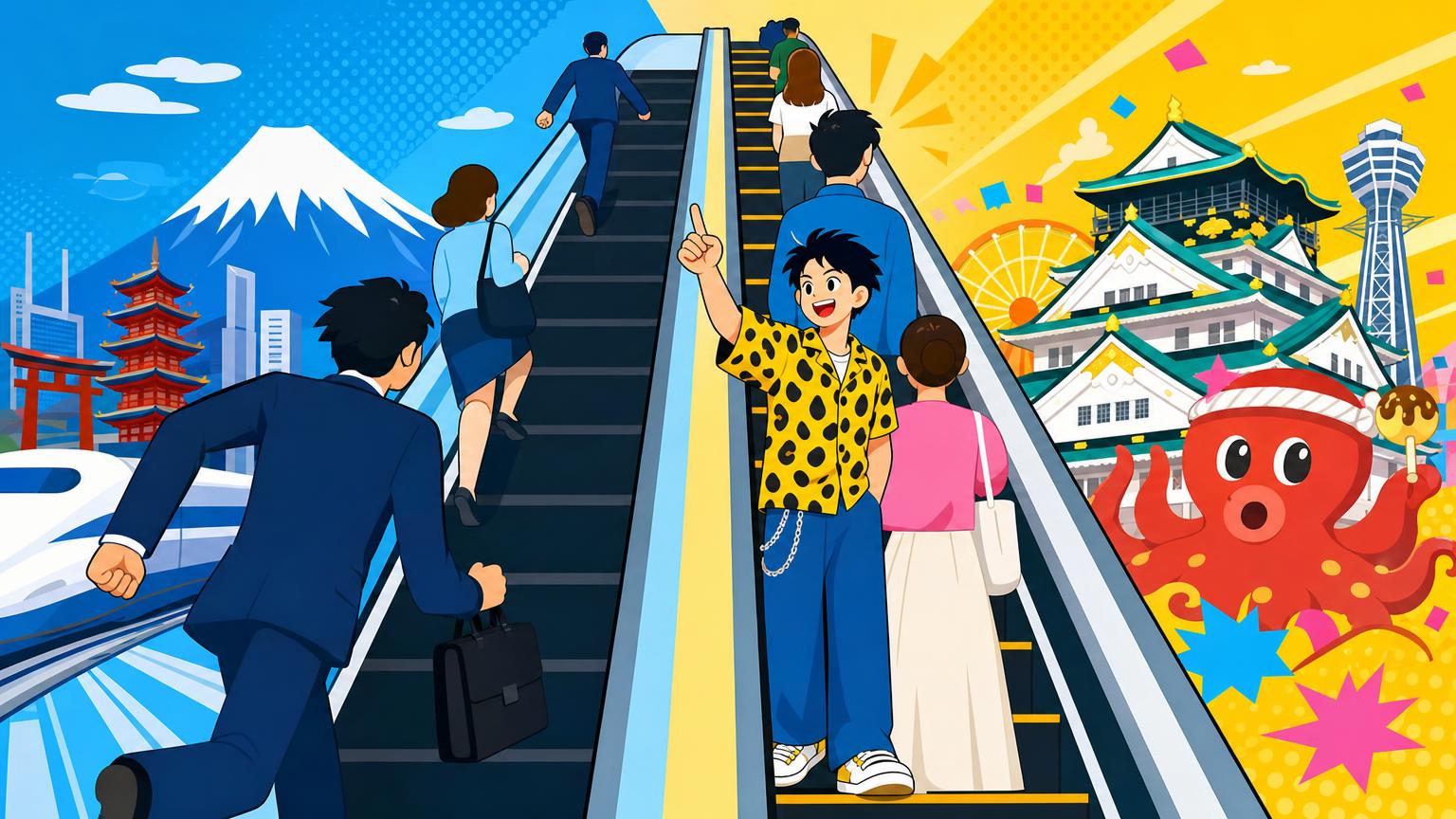
Crowds of commuters, students, and vendors naturally form two clear lanes. The right lane remains completely still. People hold the black rubber handrail with their right hand, check their phones, and ride with quiet efficiency. The left lane functions as a fast-passing route. Salarymen rushing to their next train, teenagers hurrying to meet friends at Dotonbori, and delivery workers carrying packages all move swiftly up the left side.
This is Osaka’s golden rule: stand on the right, walk on the left. If you mistakenly stand on the left side during the morning rush hour, you won’t be met with a polite, silent wait. Instead, you’ll feel an immediate, strong pressure building behind you. The unspoken frustration of a blocked Osakan commuter is a tangible, heavy force. In Tokyo, someone might quietly sigh and wait. In Osaka, you could hear a sharp tongue click, a clear throat, or a direct “excuse me.” Osaka is a city defined by commerce, speed, and practical outcomes. Time is money, and blocking the fast lane disrupts the city’s economic flow. To live comfortably here, you must swiftly adjust your spatial awareness to fit this local rhythm. It becomes second nature after a few weeks, but the initial adaptation takes deliberate effort.
How It Compares to Tokyo (Stand on the Left)
To grasp why this holds such cultural significance, you need to consider the nation’s capital. In Tokyo, the rule is reversed: stand on the left and walk on the right.
As someone who organizes events in Tokyo, I am deeply conditioned by the left-standing norm. It is an instinctive reflex. Stepping onto an escalator in Tokyo feels like engaging a finely tuned clockwork device. You step onto the metal grate and naturally drift to the left, keeping the right side clear for those rushing to work. When a Tokyoite visits Osaka for a weekend, the escalator is the first physical clue they have left their familiar environment. The transition is striking. You exit the bullet train at Shin-Osaka, head toward the subway connection, and suddenly find yourself moving against a tide of people going the other way.
This clear contrast—with Tokyo standing left and Osaka standing right—is one of Japan’s most well-known regional rivalries. It’s about more than logistics; it’s about identity. Tokyo sees itself as the center of order, governance, and bureaucratic norms. Osaka views itself as the fiercely independent commercial powerhouse of the west. The fact that they can’t even agree on which side to stand on an escalator serves as a perfect metaphor for their differing civic personalities. Osaka outright refuses to conform to Tokyo’s standards. They have their own ways, and they embrace that difference as a mark of local pride.
Why Does Osaka Stand on the Right?
The 1970 Osaka World Expo Theory
One might assume that such a deeply ingrained behavioral difference has existed since time immemorial. However, escalators are a relatively recent invention, and the true origins of Osaka’s right-side rule remain a topic of intense debate among locals and historians alike. The most prominent, widely accepted, and historically verifiable explanation dates back to the year 1970.
In 1970, Osaka hosted the Japan World Exposition, a monumental event for the city that attracted over sixty-four million visitors from around the world. Japan was thriving during the post-war economic boom, and Osaka was eager to present itself on the global stage, showcasing its modernization, technological advancements, and international readiness. The iconic Tower of the Sun was constructed, and millions of foreign tourists descended upon the Kansai region.
To prepare for this massive influx of international visitors, the Hankyu Railway, a major luxury transit operator in the Kansai area, issued widespread public announcements instructing passengers to stand on the right side of escalators. Why the right side? Because at that time, it was considered the international standard. Hankyu executives reportedly took cues from the London Underground and other global transit hubs, observing that Western countries typically drove and stood on the right. To accommodate international guests and project a cosmopolitan image, Osaka temporarily adopted this global norm.
After the Expo ended, the pavilions were dismantled, and the foreign tourists returned home, but the habit remained firmly entrenched. Locals had spent months being reminded by station attendants and overhead announcements to stand on the right, making it a deeply ingrained muscle memory in the city. What began as a hospitable gesture of omotenashi toward the outside world evolved into a permanent part of Osaka’s urban culture, illustrating how Osaka is willing to adapt and change—but strictly on its own practical terms.
The Samurai vs. Merchant Culture Theory
While the Expo theory is deeply practical and logical, there is also a far older, more romantic historical theory that locals enjoy sharing over drinks at a local izakaya. This story dates back centuries, long before escalators existed, and explores the fundamental roots of Tokyo and Osaka’s distinct social classes during the Edo period.
During the Edo period, Tokyo—then Edo—was the undisputed center of samurai political power. The samurai class ruled the city, and they were required to carry their katana, long curved swords, on their left hip. This placement allowed them to draw their blades quickly and smoothly with their dominant right hand in case of an ambush. Because the long swords protruded significantly to the left, two samurai passing on the right side of a narrow, crowded path risked their scabbards clashing. This accidental collision, known as saya-ate, was a serious insult that could instantly provoke a deadly duel in the street. To avoid unnecessary bloodshed and preserve social order, samurai naturally walked on the left side of the road. Edo became a left-walking city out of martial necessity, and that ancient spatial tradition is said to have carried through the centuries to modern escalators.
Osaka, by contrast, was never a samurai city. It was proudly known as Tenka no Daidokoro, the nation’s kitchen. It was a bustling hub of commerce, trade, and merchants. Merchants did not carry swords; they carried heavy coin purses, ledgers, and goods. In bustling marketplaces like Dotonbori, protecting one’s money was paramount. As most people were right-handed, merchants kept their valuables close to their right side and walked on the right side of the street to shield their possessions from the chaotic flow of the crowd. They moved quickly, bargained fiercely, and had no patience for samurai ceremony.
Whether this historical division truly influenced modern escalator traffic remains hotly debated by professional historians. Pedestrian customs shifted frequently over the centuries. Yet the myth endures and is widely told because it encapsulates the psychological truths of the two cities: Tokyo as a city of bureaucrats, strict order, and samurai tradition; Osaka as a city of pragmatists, street-smart merchants, and independent thinkers. Standing on the right is seen as a physical, everyday expression of Osaka’s merchant spirit.
Escalator Etiquette in Kyoto and the Rest of Kansai
The Kyoto Confusion: Why Left is Often the Norm
If Osaka insists on standing on the right, you might naturally assume that the entire Kansai region follows this consistent pattern. However, that assumption will quickly lead to an awkward physical encounter in the neighboring city of Kyoto.
Kyoto lies just next to Osaka, with rapid trains connecting the two city centers in under thirty minutes. Their populations mix daily for work, university, and leisure. Yet upon arriving at Kyoto Station or moving through the downtown Karasuma subway area, you will observe a strange and frustrating phenomenon: Osaka’s strict right-side rule completely disappears. In Kyoto, people typically stand on the left.
This causes significant confusion for foreign residents and tourists trying to grasp Kansai etiquette. Why does Kyoto break Osaka’s rule despite sharing so much regional transit infrastructure?
The answer stems from Kyoto’s distinctive cultural identity and its current economic reality. Kyoto was Japan’s imperial capital for a thousand years. It carries deep-rooted conservatism and a historical loyalty to national customs, rather than embracing the regional distinctiveness found in Osaka. While Osaka prides itself on being loud and different from Tokyo, Kyoto tends to quietly align with broader, more traditional national practices. Additionally, Kyoto is arguably Japan’s top tourist destination. Millions of domestic travelers from Tokyo, Nagoya, and Kyushu flood into Kyoto year-round, bringing their left-standing habits along.
Since Kyoto is overwhelmed daily by outsiders, the local escalator culture has effectively yielded to the national majority. Kyoto Station exemplifies this perfectly. A Shinkansen arrives from Tokyo, spilling hundreds of left-standing businessmen onto the platforms, while a local rapid train from Osaka discharges right-standing commuters. These groups converge at the central escalators in a slow-motion clash of cultural habits. Enforcing a strict right-side rule in Kyoto would be a futile and exhausting fight against an unending wave of left-standing tourists. Consequently, the ancient capital quietly defaults to the Tokyo standard to maintain harmony.
When in Doubt, Follow the Crowd
This regional inconsistency creates a fluid and often stressful experience across the greater Kansai area. Cities like Kobe and Nara lie in the middle of this cultural tug-of-war, resulting in localized spatial confusion. Sometimes you’ll see perfectly orderly lines on the right, sometimes on the left, and more often you’ll witness a chaotic zig-zag of puzzled commuters unsure which rule applies at that moment.
As an event planner, I find this borderline behavior absolutely fascinating. The moment you cross a certain invisible city boundary, the entire crowd dynamic flips. For foreign residents navigating daily life in Kansai, this unpredictability can be highly stressful. Nobody wants to be the oblivious person holding up a line of tired office workers at the end of a long day.
The best survival strategy amid this regional confusion is completely pragmatic. Don’t overthink geography or try to memorize complex regional maps of escalator customs. Instead, rely on real-time observation. Watch the person directly ahead of you, noting their hips and shoulders. Stand on whichever side they are standing.
If you’re the very first person stepping onto an empty escalator, the pressure rests on you to set the standard. If you’re in central Osaka, confidently stand on the right. In Kyoto, stand on the left. If you’re elsewhere and uncertain, simply position yourself in the middle, forcing those behind you to choose a side. They’ll naturally filter around you, allowing you to slip into the lane they establish. This is an essential micro-survival skill for smooth, stress-free integration into the local community.
The New Trend: The “No Walking” Rule in Japan
Safety Over Speed: Standing on Both Sides
Just as you finally master the intricate mental gymnastics of Osaka’s right-side rule and Kyoto’s left-side exception, the ground rules shift entirely beneath your feet. Over the past decade, a major behavioral revolution has been unfolding in Japanese transit stations, one that threatens to eliminate these regional rivalries altogether.
The idea of leaving one side open for walkers is fundamentally dangerous. Escalators are complex, heavy machinery—not simple stationary staircases. They are designed solely for stationary transport. Walking or running up the moving steps leads to trips, severe falls, and significant mechanical wear and tear. More importantly, the unspoken rule of keeping one side clear creates an intensely hostile environment for marginalized and vulnerable commuters.
Consider the elderly passenger who relies on a cane in their right hand, or a stroke survivor with partial paralysis on their left side. They physically need to grip a specific handrail to ride safely. If an elderly person in Tokyo requires the right handrail for stability, they are forced to stand in the fast lane, enduring angry glares, heavy sighs, and physical brushing from hurried salarymen rushing past. This is an unfair, stressful, and exclusionary cultural habit in Japan’s rapidly aging society.
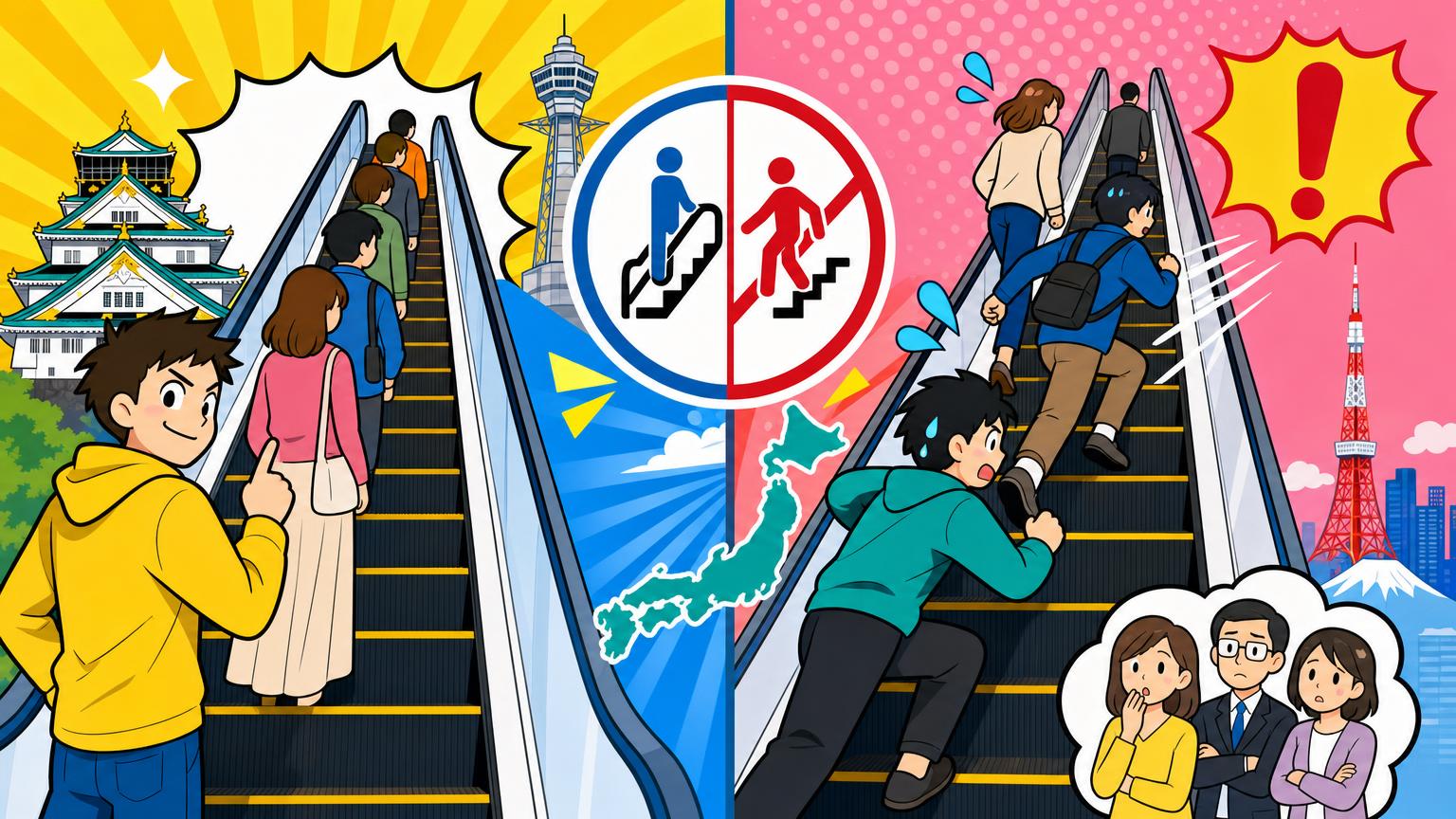
To address this, a nationwide movement is gaining serious momentum. The new directive is simple, absolute, and disregards the Osaka versus Tokyo debate: do not walk on the escalator. Stand still. Stand on both sides. Hold the handrail firmly.
From an event planning and crowd management perspective, this strategy makes perfect mathematical sense. Studies and simulations have consistently shown that two stationary columns of people clear a crowded transit platform much faster than one stationary column paired with one walking column. Walking causes uneven spacing, awkward bottlenecks at entrances, and overall delays. Standing closely packed in two lines maximizes the escalator’s carrying capacity.
Recent Campaigns by Japanese Railways
Changing a deeply rooted cultural habit is exceptionally difficult in Japan. Peer pressure is a powerful, invisible force, and the fear of blocking someone or causing inconvenience often outweighs the desire to follow official safety guidelines. To drive this essential behavioral shift, major railway companies have launched highly aggressive public relations campaigns.
JR West, which operates major rail networks in Osaka and the Kansai region, has taken the lead in this safety movement. They systematically cover stations with bright, unmistakable posters featuring cute mascots standing side-by-side on the escalator. They paint large, highly visible footprints on the floor approaching escalators, clearly marking where two distinct lines should form. During peak travel seasons, station attendants stand at escalator entrances with megaphones, physically blocking the passing lane and politely instructing passengers to stand still on both sides.
Local governments are also stepping in to enforce the issue. In 2021, Saitama Prefecture, just north of Tokyo, became the first place in Japan to legally require standing still on escalators. This ordinance was groundbreaking and sparked intense national debate. Nagoya quickly followed with similar regulations. While Osaka has not yet enacted a strict legal mandate, social pressure from transit authorities is intense.
As a foreign resident, you find yourself in a fascinating, sometimes awkward transitional period. You are witnessing a major cultural tug-of-war in real time. The old unspoken rule demands leaving one side open for efficiency. The new official rule demands blocking the lane and standing still for safety. You will often see a brave local deliberately standing in the passing lane, gripping the handrail tightly, stubbornly refusing to move despite frustrated commuters sighing heavily behind them. They are doing the right thing according to the new safety campaigns, but they absorb significant social friction in doing so.
The Unspoken Rules of Navigating Japanese Escalators as a Local
Living in Osaka is a rich, dynamic, and wonderfully intricate experience. It’s a city that greatly rewards keen observation, quick adaptability, and a good sense of humor. The entire escalator situation perfectly captures what it truly means to live here. It is highly practical, fiercely independent, historically layered, and currently undergoing a massive, highly visible transformation.
When you first arrive in Osaka, you’ll undoubtedly focus on the binary rule. You’ll proudly tell your friends and family back home that Osaka stands on the right while Tokyo stands on the left. You’ll feel a genuine sense of achievement the very first time you instinctively move to the correct side at Umeda Station without even thinking. You’ll feel like you’ve finally found your place in the Kansai rhythm.
But as you spend more time here and deepen your understanding of the culture beyond the surface, you’ll begin to notice the subtle nuances. You’ll sense the quiet anxiety of commuters navigating Kyoto Station. You’ll recognize—and perhaps even admire—the brave souls trying to enforce modern safety campaigns by standing still on both sides of a crowded subway escalator. You’ll realize that beneath the well-known, stereotypical Japanese conformity lies a deeply complex web of regional pride, historical momentum, and ongoing, quiet social negotiation.
The ultimate unspoken rule of navigating escalators—and by extension, daily life in Japan as a foreign resident—is to stay keenly aware of your immediate surroundings. Don’t blindly follow a static guidebook you read a decade ago. Read the room. Feel the rhythm of the crowd. Understand that these cities are living, breathing organisms whose rules bend, flex, and evolve with their inhabitants.
Embrace the right side when the crowd demands it. Stand proudly on both sides when safety requires it and you’re brave enough to handle the awkwardness. And above all, appreciate the magnificent, organized chaos that makes Osaka one of the most compelling, frustrating, and brilliant cities on earth.