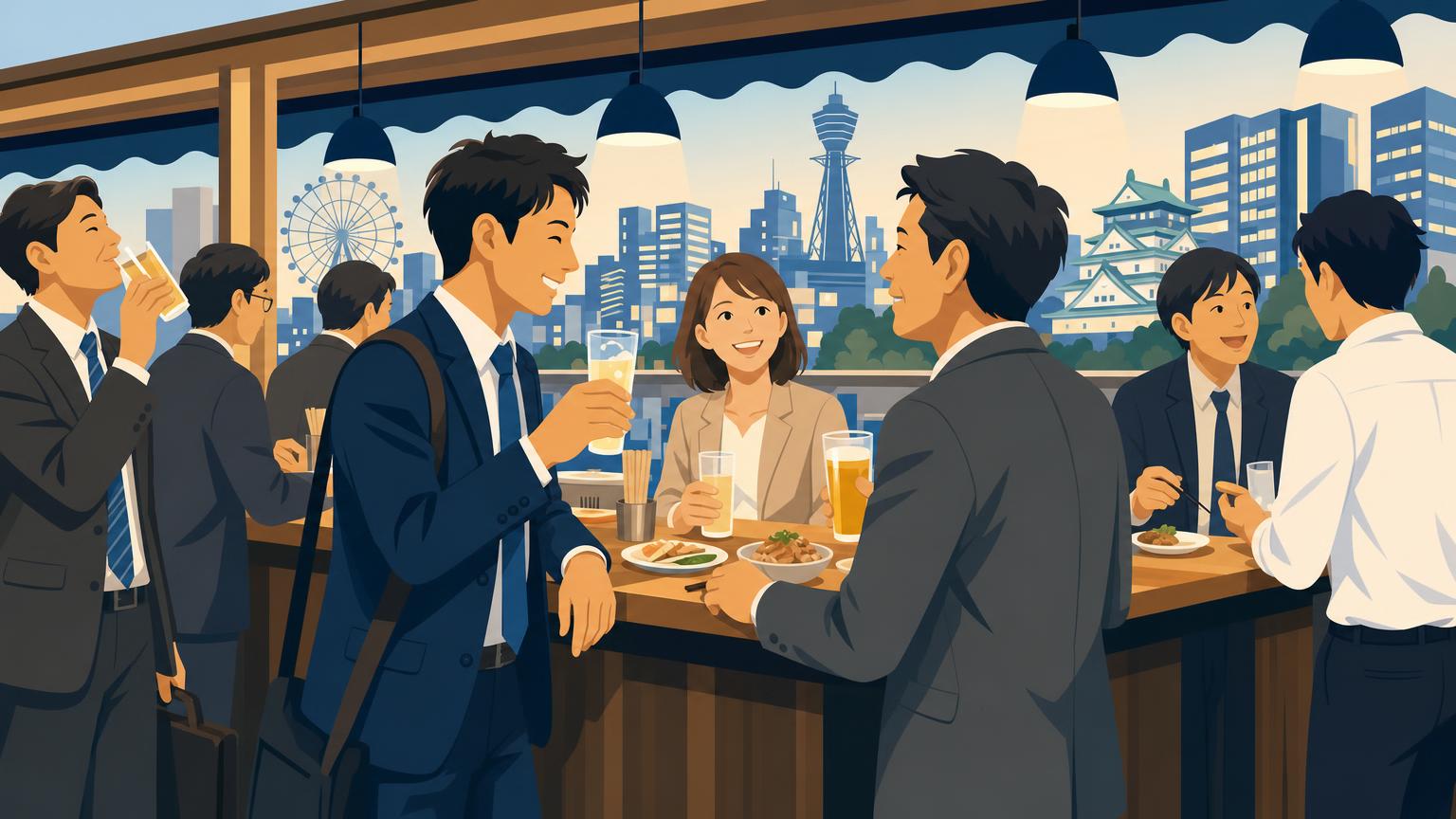
If you are living in Osaka, you may eventually notice a familiar scene on a weekday evening. Office workers leave the station, loosen their collars, check their phones, and disappear into a narrow doorway beneath a handwritten sign. Twenty or thirty minutes later, they emerge with calmer faces, warmer voices, and perhaps a small packet of grilled food in one hand.
The place they entered may have been a tachinomi bar, a standing drinking establishment where people stop for a beer, a highball, a small plate of food, and a few minutes of conversation. To someone from outside Japan, it can look like a night out. To many Osaka workers, it is closer to a daily reset button.
That difference matters. Tachinomi is not simply a cheap way to drink. It reveals how Osaka people manage work, friendship, money, time, humour, and personal space. It also helps explain why daily life in Osaka can feel less formal and less carefully staged than life in Tokyo, even though both cities are busy, crowded, and highly organised.
This is not a guide to the best bars. It is an explanation of what happens inside them and why the habit makes sense. If you are considering living in Osaka, or trying to understand what Osaka people are really like, the weekday standing bar is a useful place to begin.
The map below is only a broad orientation to the central Osaka areas where office districts, railway stations, shopping streets, and drinking neighbourhoods meet. The important point is not the pin itself. It is the relationship between work, transport, and the small local places people use on their way home.
What Tachinomi Means in Everyday Osaka Life
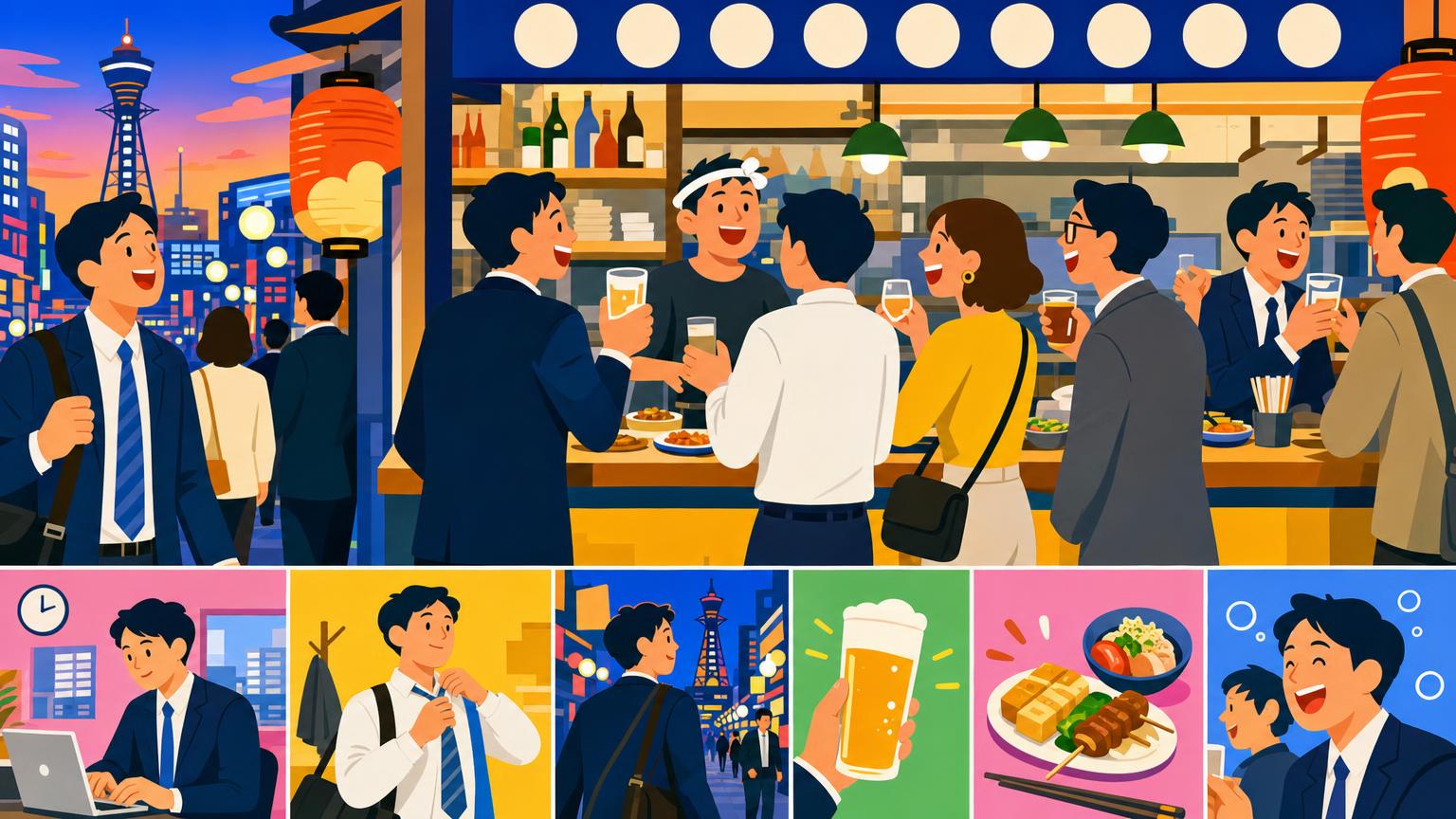
The word tachinomi combines tachi, meaning standing, and nomi, meaning drinking. Its literal meaning is simple: drinking while standing. In practice, however, the category is broader. Some places have a narrow counter with no seats. Others offer a few stools, standing tables, or small ledges where customers can rest a bag. Some are closer to traditional izakayas, while others feel like liquor shops with a counter attached.
The physical arrangement creates a particular rhythm. You do not settle in as though you are renting a table for the evening. You order, eat, talk, observe the room, and decide whether to stay or move on. A visit may last fifteen minutes, or it may last an hour. Either way, the space encourages movement and limits ceremony.
That is the first important point for foreigners: tachinomi is not necessarily a special event. It can simply be a small part of an ordinary weekday.
A worker may stop before going home because the apartment is quiet, because the train journey feels long, because a colleague wants to discuss something outside the office, or simply because one beer beside the station feels more natural than drinking alone in the kitchen. The bar provides a halfway space between work and home.
Japanese society often discusses the division between uchi and soto: the inside world of home and close relationships, and the outside world of colleagues, institutions, and strangers. The tachinomi bar sits somewhere between these categories. It is public but not impersonal. It is social but not necessarily intimate. You can be recognised without being expected to reveal your private life.
A regular might know the owner’s preferred nickname without knowing where the owner lives. Two customers might discuss baseball, the weather, or a difficult manager without ever exchanging their full names. The conversation can be warm without becoming demanding.
This is one reason standing bars suit working people. They offer contact without commitment.
Tachinomi Is Not the Same as a Company Drinking Party
Foreign residents sometimes see a group of Japanese workers drinking together and assume they are attending a formal nomikai, or drinking party. A nomikai usually involves a planned group, a restaurant reservation, a fixed start time, and sometimes a set-course meal. It can be enjoyable, but it may also involve workplace expectations. People sit together, follow a schedule, and sometimes move to a second venue as a group.
A tachinomi visit is generally looser. One colleague may arrive early, while another may join for just one drink. Someone may leave without making an announcement. A person who does not want alcohol can order tea, soda, or a non-alcoholic beer and still take part.
The difference is not only practical. It reflects a different understanding of social obligation. The formal drinking party says, “We are doing this together.” The standing bar says, “We happen to be here together for a while.”
That small distinction gives people greater control over their evening.
Why Standing Makes a Difference
Standing changes behaviour. When people sit at a table, they tend to order more food, talk for longer, and treat the visit as a complete meal. When they stand, their bodies remain slightly ready to move. The atmosphere feels active rather than settled.
This can be especially useful after work. The body may have been fixed in a chair, a train seat, or a shop counter all day. Standing for a short drink can feel less like beginning another formal activity and more like letting go of the working day.
It also makes small spaces practical. In older neighbourhoods such as Tenma, Kyobashi, and parts of Ura-Namba, a bar may occupy only a narrow frontage. Removing chairs allows more people to enter without turning the place into a large restaurant. The result is compact, noisy, and efficient.
Efficiency, however, does not mean coldness. In Osaka, a small space often creates the conditions for easy conversation. You can hear what the person beside you is saying and see the food being prepared. You may comment on an unfamiliar dish or ask what someone is drinking.
The setting does not force friendship. It simply makes small exchanges possible.
Why Osaka Workers Use Tachinomi After Work
The after-work wind-down is often misunderstood by foreigners because it seems to be mainly about alcohol. Alcohol is part of the picture, but it is not always the central purpose. The more important function is transition.
Work in Japan can be psychologically difficult to leave behind. Even after the official working day has ended, the mind may remain focused on messages, unfinished tasks, customer complaints, internal hierarchy, and the responsibilities of the following morning. A brief stop at a bar creates a clear boundary between the office and home.
In Osaka, that boundary often has a conversational quality. A worker may complain about a train delay, joke about a supervisor, discuss a football match, or ask the owner whether the simmered beef is ready. The topics are ordinary, but their value lies in making the day feel complete.
The Bar as a Decompression Chamber
Imagine a hypothetical weekday.
A woman working near Yodoyabashi finishes at 6:20 p.m. She has no particular social plans. She walks towards the station, notices a small tachinomi bar, and steps inside. She orders a draft beer and a plate of pickled vegetables. She exchanges a few words with the person behind the counter. A colleague sends her a message asking whether she is still nearby, and then joins her for half an hour.
Nothing dramatic happens. They do not make an important decision, nor do they necessarily become closer friends. However, the workday has changed shape. It is no longer something that ends at a desk and continues in the mind during the train ride home. It has been discussed, laughed about, and placed somewhere outside the self.
This is why the habit can feel meaningful even when the visit is brief.
The Importance of Not Staying Too Long
In many Osaka standing bars, a short visit is not an inconvenience. It is part of both the business model and the social design. Customers understand that the space is shared. Someone who has finished eating may leave so another person can come in.
That does not mean everyone is constantly watching the clock. It means the bar does not promise unlimited private occupation. You can enjoy the place without claiming it entirely.
For workers, this makes the habit easier to fit into a normal routine. A drink does not have to become a whole evening. You can stop on Monday, skip Tuesday, stay longer on Friday, and still feel that you are using the bar appropriately.
The habit remains flexible because the setting does not require a large emotional or financial investment.
A Small Reward That Does Not Require Planning
Life in Osaka can be busy in a very ordinary way. Commuting, shopping, cooking, childcare, language study, paperwork, and household tasks all compete for attention. A big night out requires planning, while a standing bar often does not.
You can arrive alone, spend modestly, eat one dish instead of ordering a full meal, and leave before the last train becomes a concern. The decision is small enough to make after a tiring day.
This is one reason tachinomi can be more relevant to daily life than fashionable restaurants or large entertainment districts. It does not ask you to perform leisure. It simply provides a place to pause.
Osaka Versus Tokyo: A Different Style of Unwinding
People often compare Osaka and Tokyo as though the two cities have completely opposite personalities. That is an oversimplification. Both cities include formal workplaces, quiet residents, lively neighbourhoods, family districts, and international communities. Neither can be reduced to a single mood.
Still, the experience of having an after-work drink can feel different.
Tokyo often creates a stronger sense of scale and separation. It has enormous office districts, long commutes, specialised neighbourhoods, and many social settings in which people carefully choose which version of themselves to present. Someone may work in Marunouchi, live in Saitama, meet friends in Shibuya, and maintain separate social circles that rarely overlap.
Osaka is also a large city, but many everyday activities can feel closer together. Work, shopping, drinking, and local conversation may all take place within a few streets of a station. The shift from a business district to an ordinary neighbourhood can be quick. A street lined with office buildings may lead to a row of tiny bars, an old market, a family-run restaurant, or a residential lane.
The difference is not that Osaka lacks ambition or professionalism. Rather, public life often feels less ceremonious at street level.
Directness Without Complete Openness
Osaka speech is often characterised as direct, humorous, or informal. Foreigners can misunderstand this. Someone who jokes with you may not be offering deep friendship. A shopkeeper who teases your pronunciation may simply be creating a relaxed atmosphere. A stranger who comments on the weather may be making conversation rather than inviting a lengthy personal exchange.
This directness is often a way of reducing stiffness. It is not necessarily a declaration of closeness.
In a tachinomi bar, this can be particularly noticeable. Someone may ask where you come from, whether you like the food, or why you moved to Osaka. The question may be followed by a joke. If you give a brief answer, the conversation may end naturally. If you show interest, it may continue.
This creates a lower-pressure style of interaction than many foreigners expect from Japanese public life. However, the underlying respect for boundaries remains. Being friendly does not mean having permission to dominate the conversation, photograph people, or assume that the entire room wants to practise English.
Tokyo Politeness and Osaka Casualness
Some foreigners describe Tokyo as more polite and Osaka as friendlier. That comparison is not especially useful unless you clarify what you mean.
Tokyo often rewards restraint. People may avoid imposing their mood on others. The atmosphere can feel calm, controlled, and discreet. Osaka often allows more audible reactions, more jokes, and more visible negotiation with the social situation. A customer may complain about the price theatrically, while the owner responds with an equally theatrical remark.
The exchange can sound argumentative while still remaining good-natured.
This is one of the first distinctions residents need to learn. Volume and emotional expression do not always signal anger. In some Osaka settings, a lively disagreement is a form of participation. At the same time, a genuinely angry customer may become very quiet. You need to read the relationship, not just the words.
A tachinomi bar is a useful classroom for this distinction because conversations are close, fast-paced, and often mixed with humour.
What Osaka People Are Like in a Tachinomi Bar
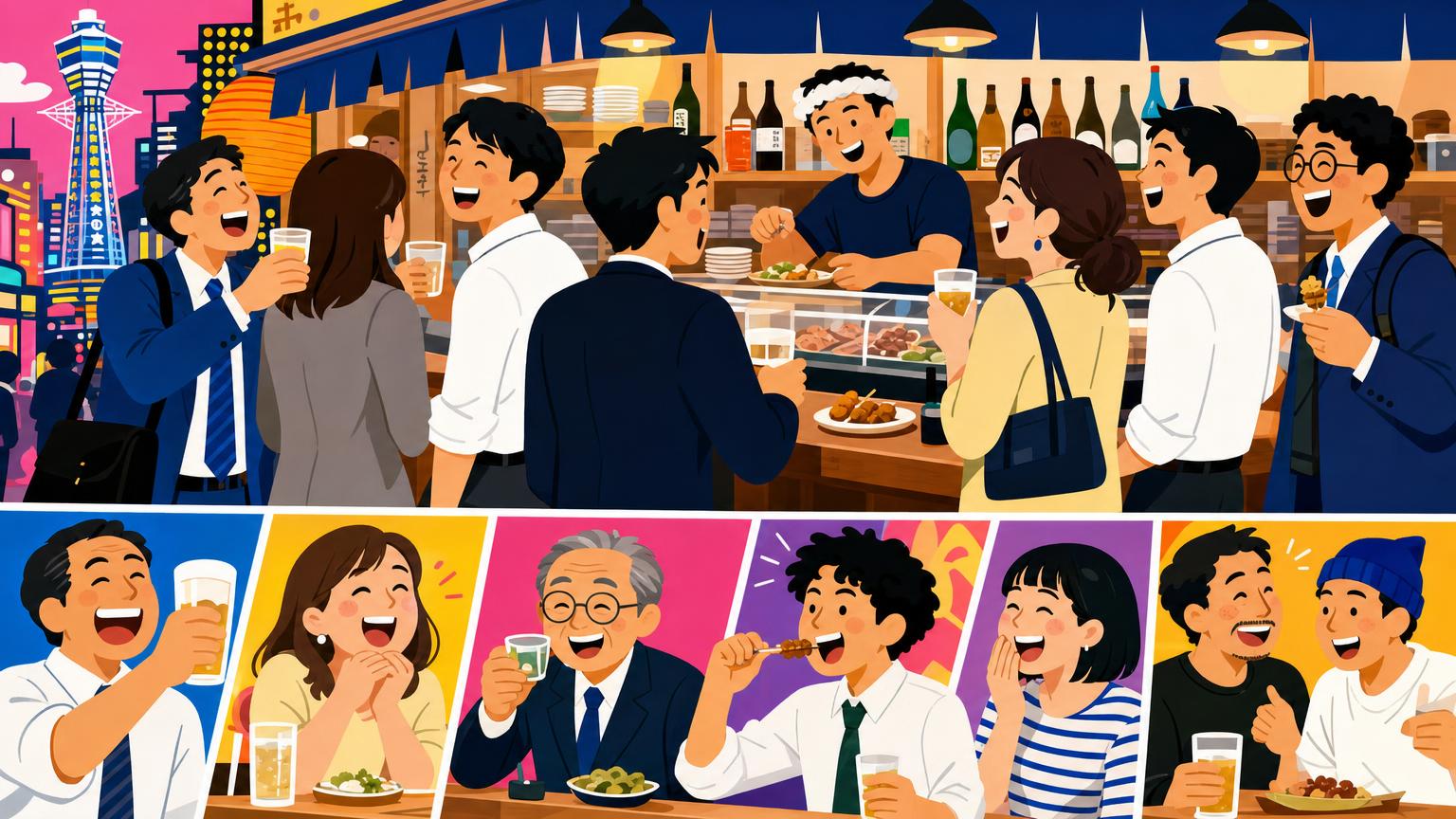
There is no single Osaka personality. The city is home to long-established families, commuters from neighbouring prefectures, university students, international residents, highly paid professionals, small business owners, artists, retirees, and people whose daily lives never intersect.
What you observe in a standing bar is not a universal character but a collection of social habits.
Practical Sociability
Osaka sociability is often practical. People talk while doing something: eating, pouring a drink, preparing food, checking a train time, or making space at the counter. Conversation does not always require a formal introduction.
This makes the atmosphere feel accessible. You do not necessarily need to be entertaining. You can contribute by reacting to the food, answering a simple question, or taking notice of what is happening around you.
The bar may have regulars who clearly know one another, but the social circle is not necessarily closed. A newcomer can join in if they understand the basic rhythm.
Humour as a Social Test
Humour can serve as a test of flexibility. If someone makes a small joke about your Japanese, your order, or your confusion over the menu, they may be checking whether the interaction can become more relaxed.
You do not have to laugh at everything. A smile, a light reply, or a simple sumimasen may be enough. If you feel uncomfortable, you can answer plainly and change the subject.
Foreign residents sometimes make the mistake of trying to become instantly witty in Japanese. This can create more pressure than necessary. In Osaka, a calm willingness to participate is often more valuable than delivering a perfect joke.
Generosity With Limits
A regular may recommend a dish, explain a local expression, or pour a small taste of something unfamiliar. This can feel generous, and often it is. However, it does not eliminate the need for boundaries.
Accepting one suggestion does not mean you have to drink more than you want. Joining a conversation does not mean you must exchange contact details. Being welcomed into a room does not mean you can behave as though it were a private party.
The mature way to understand Osaka friendliness is not as unlimited openness, but as a willingness to make everyday contact easier.
The Daily Geography of the After-Work Drink
The location of a tachinomi bar reveals something about how Osaka functions. These places often appear near stations, beneath railway lines, beside older shopping arcades, and on the edges of office districts. Their position reflects workers’ movements more than the needs of sightseeing.
Tenma and the Short Walk After the Office
Tenma is one of the clearest examples of a neighbourhood where work, shopping, food, and drinking overlap. The area is known for its narrow streets and high concentration of small izakaya, with the Tenma district spreading around the station and nearby commercial lanes.
For residents, its importance is not simply that it has many bars. Rather, the area feels like a lived-in part of the city instead of a sealed entertainment zone. People may finish work, buy vegetables, meet a friend, collect a parcel, and stop for a drink within the same general walking area.
The after-work rhythm in Tenma can be noisy and compressed. Counters sit close to the pavement, and menus are often handwritten. Someone may eat grilled fish beside another person having a quick beer before catching a train. The atmosphere changes throughout the evening, but it does not need to become a special occasion.
Kyobashi and the Rough Edges of Routine
Kyobashi has a strong after-work identity because it brings together offices, railway lines, shopping streets, and older drinking areas. It can feel more direct and less polished than the office districts around Umeda or Nakanoshima.
This is not a criticism. Many workers prefer a place where they do not have to dress their evening in sophistication. A cheap dish, a loud conversation, and a quick drink can feel more honest after a day of corporate language.
Kyobashi also shows that Osaka’s drinking culture is not limited to young, trend-conscious customers. Different generations may share the same street while using the area in different ways. One person wants a small bowl of stew before going home. Another wants to meet colleagues. Someone else may have been visiting the same counter for decades.
Ura-Namba and the Flexible Social Evening
Ura-Namba, the backstreet area behind the main streets of Namba, has become well known for its compact restaurants, bars, and standing-style establishments. Official travel information describes the back lanes around Namba as being filled with small izakaya, while recent coverage of tachinomi culture highlights the area’s hidden standing-bar atmosphere.
For residents, Ura-Namba can serve as a meeting point rather than simply a nightlife destination. Someone may meet one friend for a drink, notice another acquaintance nearby, and change the course of the evening without making a formal plan.
That flexibility is characteristic of the standing-bar habit. The evening is not necessarily organised from beginning to end; it develops through proximity.
Shinsekai and the History of Affordable Eating
In areas around Shinsekai and Janjan Yokocho, standing drinking establishments sit alongside food stalls, kushikatsu restaurants, and long-established casual businesses. Local information about the alley describes a mixture of izakaya and standing drinking taverns, reflecting the area’s working-class and post-war commercial history.
The lesson is not that every visitor should explore the area. More importantly, affordable drinking has a social history. A standing bar is connected to questions of work, income, housing, migration, and the need for inexpensive public space.
When foreigners treat such places as colourful scenery, they overlook the people who use them because they are convenient, familiar, and within their budget.
How a Typical Weekday Visit Works
The routine varies from person to person, but its structure is often recognisable.
The First Stop
A worker may arrive alone between the end of the workday and the beginning of the evening commute. The first drink is often ordered quickly. Beer, a lemon sour, shochu with soda, or tea are common practical choices, but there is no need to copy the person next to you.
The customer may order a small dish at the same time. In many standing bars, food is intended to be eaten in portions: simmered dishes, grilled meat, sashimi, pickles, tofu, fried items, or seasonal vegetables. The food gives the hands and mouth something to do while the mind shifts out of work mode.
The Colleague Who Joins Later
A colleague may enter after sending a message or spotting someone through the window. The two people do not necessarily stand together because there may be no seats. They stand side by side, exchange a few updates, and perhaps discuss whether to continue elsewhere.
This is where the tachinomi format differs from a private meal. The social unit remains loose. Other customers may overhear the conversation, and the pair may briefly respond to something happening at the counter.
The Regulars and the Owner
Regulars often influence the emotional temperature of the bar. They know how ordering works, where to stand, which foods sell out early, and when the owner is too busy for conversation. Their familiarity can make the place more efficient for everyone.
The owner may remember a customer’s usual drink without making a show of it. This is not necessarily a sentimental relationship; it is a form of practical recognition. The customer does not have to explain everything from the beginning, and the owner can serve the room more smoothly.
For a foreign resident, being recognised may take time. It is better to become familiar through repeated, ordinary behaviour than to demand immediate inclusion.
The Final Drink and the Decision to Leave
At some point, the worker checks the time. Perhaps the next morning is busy. Perhaps the bar has become crowded. Perhaps the person simply feels ready to return home.
Leaving is usually straightforward. You settle the bill, say arigatou gozaimasu or gochisousama deshita, and move aside so the next customer can order. You do not need to make a speech about how much you enjoyed the evening.
That modest ending is part of the culture. Pleasure does not have to be turned into a performance.
What Foreigners Often Misunderstand
Living in Osaka means learning that outward behaviour and intended meaning do not always align. Tachinomi bars provide several useful examples.
Misunderstanding One: Everyone Is There to Make Friends
A standing bar creates opportunities for conversation, but many people come there to be left alone. Someone looking at their phone, eating quickly, or facing the counter may not want to interact. Someone who smiles at you may simply be polite rather than open to a long conversation.
Do not interpret a relaxed atmosphere as an expectation that you speak to everyone. The most respectful foreign customer is often the one who can recognise when participation is welcome and when quietness is preferred.
Misunderstanding Two: A Cheap Bar Has No Rules
The prices may be modest, but the rules still matter. You are expected to order something, avoid blocking the entrance, keep track of your belongings, and make room when the bar becomes crowded. If the establishment uses a ticket system or payment tray, follow it instead of assuming that every place operates like a pub in your home country.
Cheap does not mean careless. It means the social contract is efficient.
Misunderstanding Three: Osaka Directness Means Permission to Be Equally Direct
A customer may speak bluntly to the owner because they have known each other for years. That does not mean a new customer should immediately copy the same tone. The appropriate level of informality depends on the relationship.
Begin with polite Japanese. Pay attention to the atmosphere. Become more casual only if the relationship naturally allows it.
Misunderstanding Four: A Bar Is a Cultural Show
The people inside are not performers placed there to explain Osaka. They are eating and drinking after work. They may be willing to answer a simple question, but they are not responsible for providing every foreign resident with an authentic experience.
Avoid photographing customers without permission. Do not record conversations. Do not treat an older customer’s accent or appearance as an attraction. If you are curious, observe quietly and ask the staff when they are not busy.
Misunderstanding Five: Drinking Is Required
You can take part without drinking alcohol. Order oolong tea, ginger ale, soda water, or a non-alcoholic beer if one is available. You can explain, alcohol wa nomimasen, meaning I do not drink alcohol, or osake wa dame desu, meaning alcohol is not suitable for me.
Some people may be surprised, but a normal bar should be able to accommodate someone who does not drink. The purpose of winding down after work is not to prove your endurance.
The Unspoken Rules That Make the Space Work
A tachinomi bar relies on people reading the room. The rules are rarely displayed as a large notice at the entrance, but they are clear to regular customers.
Keep Your Order Moving
When the staff asks what you would like, answer if you can. If you need time to read the menu, say chotto matte kudasai, meaning please wait a moment. Do not let a lengthy translation exercise block the entire counter during the busiest period.
It is perfectly fine to point at a dish, use a translation app, or ask osusume wa nan desu ka, meaning what do you recommend. The key is to keep the exchange practical.
Share the Available Space
Bags should not take up the space where another person could stand. If the bar is crowded, keep your elbows and belongings close. Do not spread out simply because you arrived before everyone else.
Standing spaces can be narrow. A small movement may make it possible for another customer to enter. This kind of consideration is rarely announced, but it is central to the experience.
Do Not Turn the Volume Into a Performance
Osaka bars can be lively. However, lively does not mean that one group should overpower the entire room. If you are speaking English with friends, remember that English can carry strongly in a small Japanese room. You do not need to whisper, but you should notice if your group has become the only sound anyone can hear.
Avoid Occupying the Best Position for Too Long
If you are standing in the most convenient place near the entrance or counter, remain aware of the flow of customers. The position may be needed by someone ordering, collecting food, or leaving.
This is especially important in tiny places, where one person can create a bottleneck without realising it.
Respect the Closing Rhythm
When staff begin cleaning, turning off the lights, or preparing the final orders, understand that the evening is coming to an end. Do not negotiate for an extended private party unless the staff clearly invites it.
A good customer leaves before the atmosphere becomes uncomfortable.
How Language Works in a Tachinomi Bar
You do not need fluent Japanese to enter a standing bar, but you do need a strategy. The best approach is not to memorise a long speech. Instead, learn a few short phrases and combine them with pointing, gestures, and patience.
Useful Phrases
- Nama biiru o hitotsu kudasai — One draft beer, please.
- Lemon sour o hitotsu — One lemon sour.
- Mizu o kudasai — Water, please.
- Kore wa nan desu ka — What is this?
- Osusume wa nan desu ka — What do you recommend?
- Kore o kudasai — This one, please.
- Mou ippai kudasai — One more drink, please.
- Okaikei o onegaishimasu — The bill, please.
- Arigatou gozaimasu — Thank you.
- Gochisousama deshita — Thank you for the meal.
Your pronunciation does not need to be perfect. A clear attempt is usually more helpful than remaining silent and then panicking.
Handwritten Menus and Translation Apps
Many small bars use handwritten menus, seasonal notices, or short names that translation software may not recognise. A camera translation app can be useful, but it should be treated as a tool rather than an authority. Dish names may be abbreviated, written vertically, or linked to local ingredients.
If the translation produces something strange, point and ask kore wa nan desu ka. The staff may respond in simple Japanese, gesture, or show you a portion. You can also ask whether something is spicy, raw, sweet, or contains meat.
For dietary restrictions, prepare a short written explanation in Japanese before entering. Do not assume that a vague translation such as I do not eat bad things will be understood. Be specific about meat, fish, shellfish, eggs, dairy, alcohol, or allergies.
The Value of Watching First
Before ordering, take ten seconds to observe. Notice whether customers pay immediately or later. Look at where people place used plates. See whether staff bring water automatically. Check for a ticket machine or a tray for coins.
Watching is not passive. It is how you learn the local operating system.
How Payment Usually Fits the Routine
Payment practices vary, so never assume that every standing bar follows the same system. Some places take payment after each order, a practice often called cash-on or cash on delivery. You place money on a small tray, and the staff take the correct amount as each drink or dish arrives.
Other bars keep a running bill and ask you to pay when you leave. Some use tickets purchased from a machine. Some accept cards or electronic payments, while others remain primarily cash-oriented.
Cash-On Payment
Cash-on payment is useful because it keeps the transaction visible. You order a beer, place the money on the tray, and receive change if needed. When you order another dish, you repeat the process.
Foreigners sometimes mistake the tray for a tip dish or wait for a final bill. If the staff places a small tray in front of you, ask genkin desu ka, meaning “is it cash?” or koko ni okimasu ka, meaning “should I put it here?”
Do not place money directly on a wet counter if a tray is provided. Keep small notes and coins ready whenever possible. The system is designed for speed, especially during the after-work rush.
Post-Pay and the Final Bill
If payment is made when you leave, say okaikei o onegaishimasu or simply sumimasen, okaikei, and wait for the staff to calculate the total. If you are with other people, decide whether you will pay together or separately before the final moment.
Splitting the bill can be more complicated in a crowded small bar than in a modern café. You can ask betsu-betsu ni dekimasu ka, meaning “can we pay separately?” The staff may agree, or they may request one payment.
Why Payment Style Matters Culturally
The payment system reflects the overall character of the place. Cash-on payment encourages short visits and quick turnover. Post-pay creates a more relaxed, meal-like feeling. Ticket systems separate ordering from serving and can reduce language difficulties.
None is more authentic than the others. They are simply practical solutions for different kinds of businesses.
What a Tachinomi Habit Says About Osaka Society
The daily standing bar reveals several broader aspects of life in Osaka.
People Value Ease Over Ceremony
Osaka does not reject politeness, but it often favours practical comfort over unnecessary ceremony. A person can be respectful without making every interaction formal. A meal can be satisfying without being expensive. A conversation can be meaningful without becoming serious.
This is why a worker may choose a narrow, slightly noisy counter instead of a polished restaurant. The roughness is part of the relief.
Public Life Has a Commercial and Social Mixture
In many Osaka neighbourhoods, commerce and community overlap. A shop is a business, but the owner may know who lives nearby. A bar is a place to earn money, but it may also become a familiar point of connection for regulars. A shopping street is a route to daily necessities, but it can also offer conversation and a sense of local identity.
This does not mean every neighbourhood is close-knit or that every shopkeeper seeks personal involvement. It means economic life remains visibly connected to human relationships.
People Often Prefer Small, Repeated Pleasures
A daily beer, a bowl of stew, a conversation beside the station, or a familiar owner’s greeting may not seem impressive. Its value comes from repetition.
For someone considering whether Osaka is a good place to live, this is worth keeping in mind. The city’s appeal may not lie in constant excitement. It may instead come from the ease of building small routines that make an ordinary week feel less anonymous.
Humour Helps People Carry Difficulty
Osaka humour can be loud, but its deeper function is often defensive. Jokes make difficult subjects easier to approach. They allow people to complain without seeming defeated. They create distance from status and self-importance.
At a standing bar, a worker may laugh about a long day rather than describe the stress directly. This does not mean the stress is insignificant. It means humour is one way of keeping it from controlling the evening.
Foreign residents do not need to imitate this style. They should understand that a joke can be a form of resilience rather than a refusal to take life seriously.
How Foreign Residents Can Join Without Pretending to Be Local
You do not need to become a caricature of Osaka. There is no need to force a loud laugh, use an exaggerated dialect, or declare that you love everything about the city. The best way to join the routine is to behave attentively.
Begin With a Small Visit
Choose a quiet weekday instead of the busiest Friday night. Enter when it seems that the staff have time to notice you. Order one drink and a small dish, then observe what the other customers do.
If you feel uncomfortable, leave after twenty minutes. The goal is not to prove your courage, but to learn the rhythm.
Build Recognition Gradually
Return to the same place if you enjoyed it. Use the same simple greeting, remember the staff’s recommendations, pay promptly, and say thank you. With time, the room may begin to feel familiar.
This is how many local relationships develop: not through a dramatic introduction, but through repeated, low-pressure contact.
Ask Before Taking Photographs
The food may look appealing, and the sign may be beautifully old, but other customers are not part of the decoration. Ask the staff before taking pictures inside. Avoid photographing people in the background unless they have given their permission.
If you want to write about the place online, do not disclose personal details about regulars or turn a private conversation into content without permission.
Accept That Some Places Are Not Designed for You
A bar may be difficult for a foreign resident because the menu is only in Japanese, the counter is very small, or the regulars are not interested in conversation. That does not necessarily mean the staff are unfriendly.
Some places are simply specialised spaces with their own routines. You can leave politely and try again another day or visit a different neighbourhood. Living in Osaka means learning not only how to enter spaces, but also how to recognise when a space is not suitable for you.
Is Osaka a Good Place to Live If You Do Not Drink?
Yes. Tachinomi culture can help you understand Osaka, but it is not a requirement for belonging here. You can find the same social patterns in coffee shops, noodle restaurants, shopping arcades, community festivals, sports bars, family restaurants, and neighbourhood cafés.
The deeper issue is not alcohol itself, but the city’s preference for informal, accessible places where people can share public space without making a significant commitment.
Even as a non-drinker, you can learn to greet local shopkeepers, exchange brief conversations, and become familiar with a neighbourhood. You can join friends at a standing bar and order tea, or meet people through language exchanges, volunteer groups, workplaces, schools, sports clubs, and local events.
Do not let one visible custom define your entire idea of Osaka.
The Limits of the After-Work Wind-Down
It would be dishonest to portray tachinomi as entirely positive. Drinking habits can lead to health problems, financial strain, family conflict, and workplace expectations. Some people feel obligated to join colleagues after work to maintain relationships. Others use alcohol to avoid going home or confronting loneliness.
The bar’s casual atmosphere can conceal unequal pressures. A young employee may not feel free to leave while a senior colleague is still there. A worker may spend more than intended when one bar turns into two. Someone with a difficult commute may not arrive home until late.
Foreign residents should not romanticise every aspect of the tradition. An after-work drink can provide a healthy boundary, but it can also become another obligation.
Choosing Your Own Boundary
You can say kyou wa kaerimasu, meaning “I am going home today.” You can say ashita hayai desu, meaning “I have an early start tomorrow.” You can decline another drink by saying daijoubu desu, meaning “I am fine,” or kekkou desu, meaning “no thank you.”
A brief explanation is usually enough. You do not need to defend your entire lifestyle.
The same principle applies to spending. Decide how much you are comfortable paying before you enter. Check whether the bar uses cash-on-payment. If you are meeting colleagues, do not assume that everyone has the same budget.
A sustainable routine should make your life easier, not quietly consume it.
What the Walk Home Tells You About Osaka
The most revealing part of the ritual may take place after leaving the bar.
A worker steps back onto the street, where the station is still busy. Bicycles pass by. A supermarket remains open, while a small restaurant prepares its final orders. The city has not come to a stop, but the pressure of the office has eased.
In Tokyo, the scale of the commute can make the journey home feel like a second working day. In Osaka, depending on where you live and work, the transition may be shorter and more varied. A person can move from the bar to the platform, from the platform to a shopping street, and from there to a residential lane without any dramatic shift in atmosphere.
This proximity creates a particular kind of urban life. Work is not separate from neighbourhood life. Commercial streets remain part of the social landscape. The city’s informal spaces are not hidden away from daily routines; they are woven into them.
That is why an ordinary tachinomi visit can tell you more about Osaka than a major nightlife district. It shows how people use the city when nobody is trying to impress anyone.
The Real Meaning of the After-Work Wind-Down
Tachinomi is sometimes translated as a standing-bar culture, but that translation overlooks its role in the daily routine. For many Osaka workers, it is a way of shifting emotional gears.
The person who enters is still carrying the office with them. The person who leaves is not suddenly free of responsibility, but the burden has been rearranged. Someone has listened. Someone has laughed. A small plate has been eaten. A bill has been paid. The evening has begun.
This is not necessarily deep social bonding. It is not always authentic in a romantic sense. It can be noisy, repetitive, commercial, and ordinary. That is exactly why it matters.
Daily life is made up of repeated transitions. Osaka’s tachinomi bars give workers a place to make one of those transitions visible and shared.
If you are trying to understand what Osaka people are like, begin with this nuance: they may value warmth, but they also value ease; they may speak directly, but they still recognise boundaries; they may enjoy company, but they do not always want a formal social commitment. Their friendliness often appears not as grand hospitality, but as a small, practical adjustment that makes room for another person.
Someone moves their bag so you can stand. Someone points out the better dish. Someone makes a joke about the rain. Someone tells the owner to serve you first because you are still learning the system.
Then, a few minutes later, everyone returns to their own evening.
That balance between connection and independence is one of the clearest lessons of living in Osaka. A tachinomi bar does not ask you to become part of a permanent community. It gives you a brief, ordinary place in the city’s rhythm—and for many workers, that is enough.