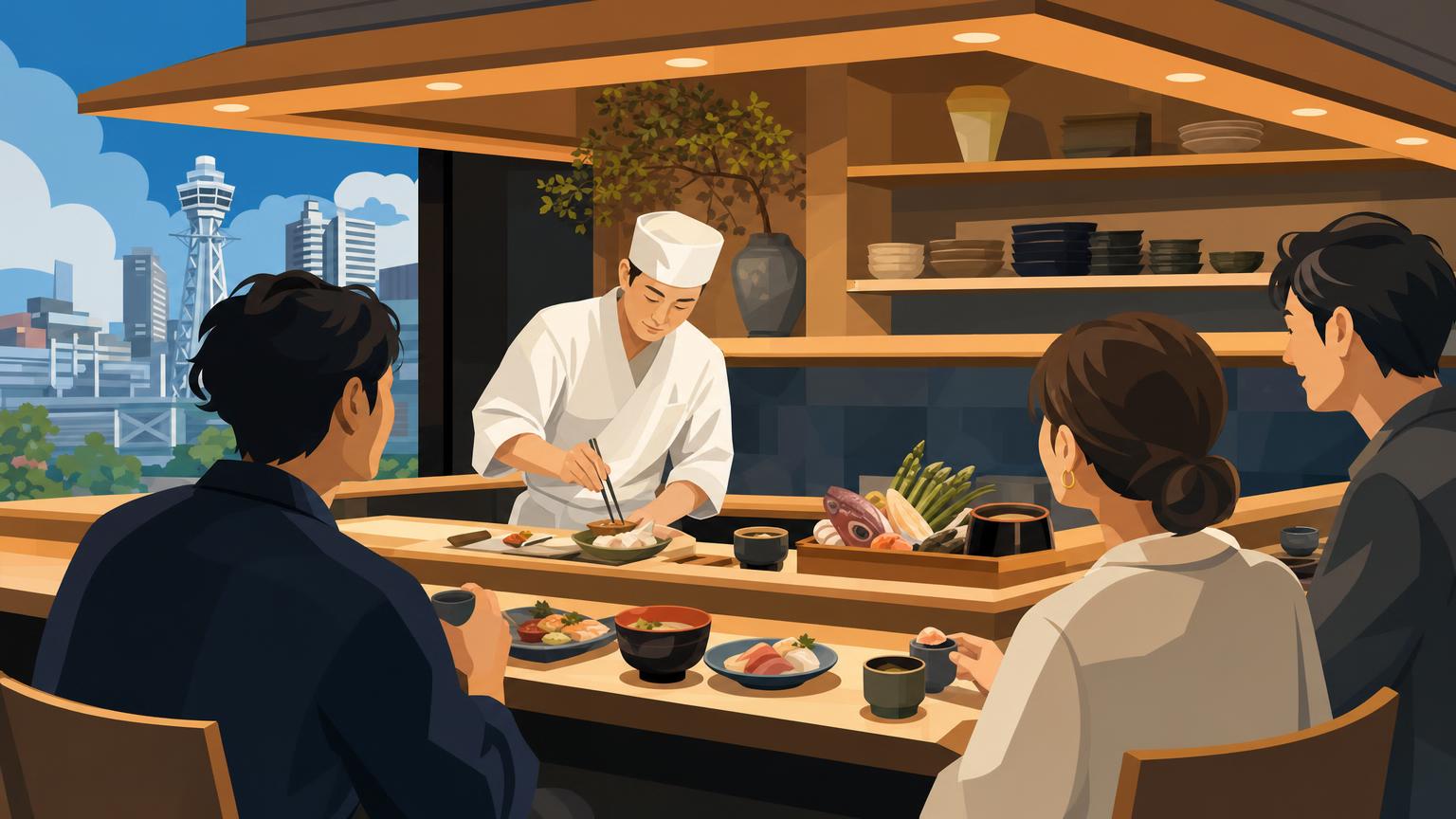
If you are living in Osaka, you may eventually receive an invitation that sounds simple but is not: “Let’s go for kappo.”
The phrase can be confusing. Is it the same as kaiseki? Is it just an expensive Japanese restaurant? Is it a kind of sushi? Why does the chef sit so close? Why are there no clear menu prices outside? Why does the person behind the counter ask what you want instead of simply serving a fixed meal?
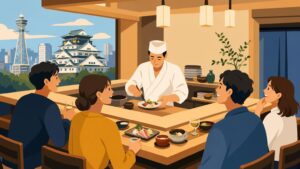
These questions matter because kappo is not only a style of cooking. It expresses a particular way Osaka works. The kitchen is visible. The chef is available. Ingredients are discussed directly. The customer is expected to respond. A meal is not treated as a silent performance delivered from a hidden room; it develops through a small exchange between people.
That directness helps explain why Osaka can feel different from Tokyo. Tokyo often presents refinement through distance, rules, reservation systems, and carefully protected atmospheres. Osaka also has elite restaurants and strict standards, but its food culture more often allows contact, adjustment, humor, and negotiation. The expensive meal may still begin with a practical question: “What looks good today?”
For foreigners who live in Osaka, kappo is useful cultural training. It shows how people here speak when they are being polite but not distant, how expertise is displayed without always being announced, and how the line between formal and casual can shift within the same conversation.
What Is Kappo Dining? The Heart of Osaka’s Culinary Culture
The Meaning and Origin of “Kappo”
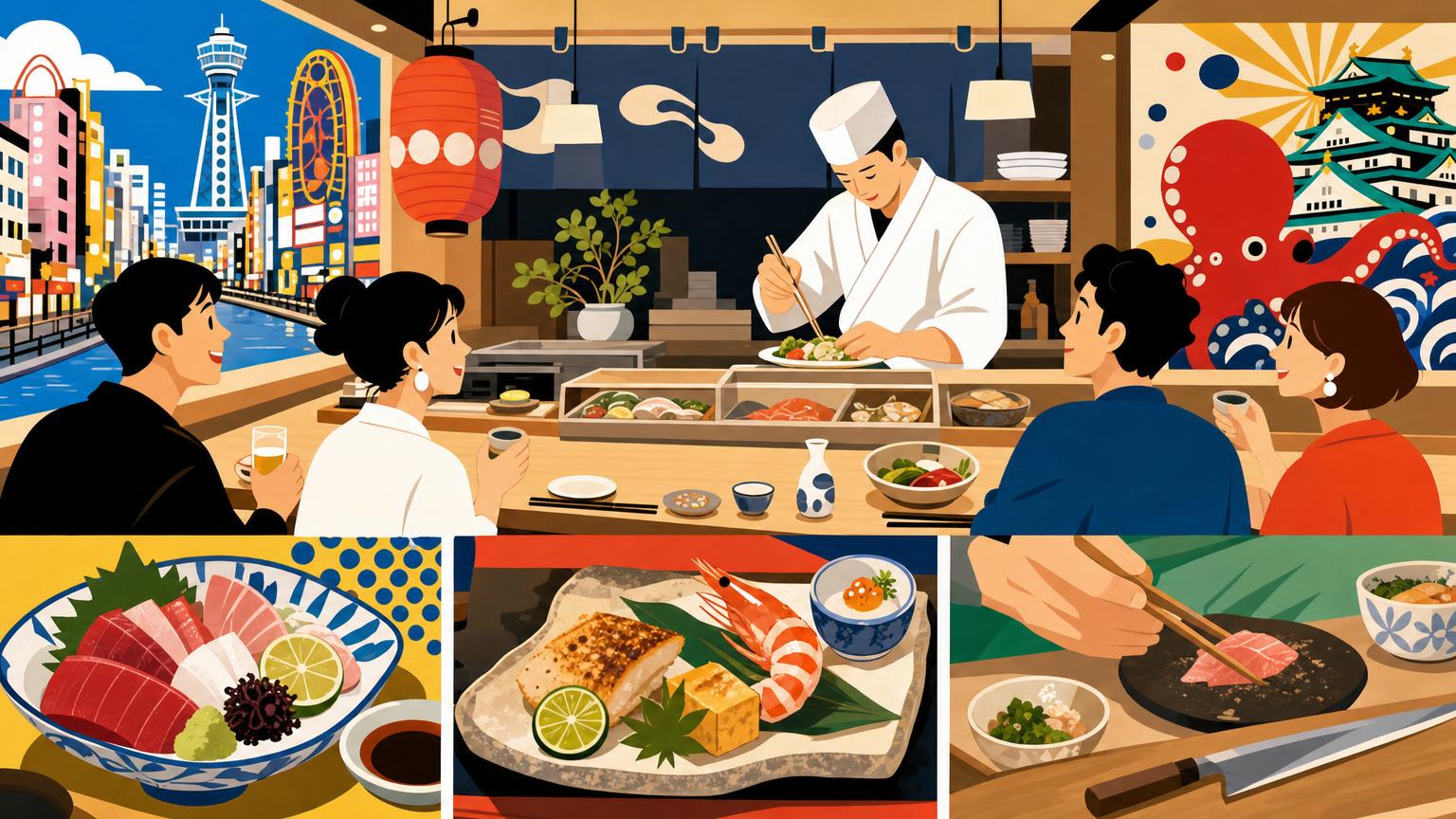
The word kappo is written with characters that mean “to cut” and “to cook.” This description is practical rather than poetic. It refers to the two central actions performed in front of the diner: the chef cuts the ingredients and then cooks them, often in response to the condition of the food and the customer’s wishes.
Kappo is widely associated with Osaka, where the style developed as a more open and approachable form of high-level Japanese cooking. Osaka’s official tourism information describes kappo as a cuisine that became established as a style during the Taisho period, after older restaurant customs began to seem less suitable for people who wanted good food in a more relaxed and enjoyable setting.
That history is important. Osaka has long been shaped by merchants, traders, wholesalers, theatre workers, craftspeople, and customers who wanted value as well as quality. The city’s reputation as “the nation’s kitchen” is not only about abundant food. It also reflects a habit of evaluating food directly: Is it fresh? Is it worth the price? Does the preparation respect the ingredient? Can the chef explain the choice?
A kappo counter makes these questions visible. The fish is not an abstract symbol of Japanese luxury; it is placed on the cutting board. The vegetable is handled right in front of you. The sound of simmering broth, the movement of a knife, and the timing of each dish all become part of the meal. Michelin describes kappo as a less formal style that emphasizes closeness between the diner and the chef who cuts and cooks the food.
The physical arrangement matters. In a traditional Japanese restaurant, the kitchen may be hidden, with servers bringing finished dishes from behind the scenes. In kappo, the counter creates a shared working space. The chef’s hands are visible, but so is the customer’s reaction. You are not expected to interfere with every step, but you are close enough to ask a sensible question.
Why Osaka Became the Natural Home of Counter Cooking
Osaka’s directness is sometimes mistaken for informality. That is not quite right. Kappo can be extremely precise, expensive, and demanding. The difference is that this precision is often made accessible through conversation.
An Osaka chef may explain why a fish is being grilled rather than simmered, or ask whether you prefer stronger seasoning. A customer may say that they enjoyed the sashimi but would prefer the next course to be served warm. This does not mean the chef has lost authority. Rather, the chef demonstrates authority by adjusting intelligently.
That exchange reflects a broader Osaka preference for useful communication. People may use humor, but humor does not mean that standards are low. A shopkeeper can tease you while still expecting you to follow the rules. A colleague can speak casually and remain serious about work. A chef can make a joke while handling ingredients with remarkable discipline.
Foreign residents sometimes expect politeness in Japan to mean emotional distance. In Osaka, politeness may instead take the form of active engagement. Someone asks what you like. Someone warns you that a restaurant is too expensive for a casual weekday. Someone tells you that a shop is good but not worth waiting an hour for. This kind of advice can sound blunt when translated into English, yet it often functions as a form of care.
Kappo dining makes this social style easy to see. The best interaction is not a long speech from the chef. It is a rhythm: a question, a short answer, a decision, a dish, and perhaps a comment about the season. The meal moves forward because both sides participate.
Kappo vs. Kaiseki vs. Omakase: Understanding the Differences
Foreign diners often use these terms as though they were interchangeable. They are related, but they refer to different ideas.
Kappo: Cooking in Conversation with the Diner
Kappo generally emphasizes the relationship between the counter, the chef, and the ingredients. The chef cuts and cooks in front of you. The menu may be course-based, à la carte, or a combination of both. Depending on the restaurant, you may also be able to discuss what is available that day.
The key point is proximity. You can watch the work. You may be able to speak with the chef. The meal can adapt to the situation.
This does not mean that every kappo restaurant allows unlimited customization. High-end restaurants often prepare a set course in advance and must carefully manage expensive ingredients. The chef may offer several choices, but the restaurant still controls the overall structure. “Direct” does not mean “anything is possible.”
Kaiseki: A Formal Sequence and a Carefully Designed Experience
Kaiseki generally places greater emphasis on a formal sequence of courses, seasonal symbolism, presentation, tableware, and the overall structure of the meal. Service may take place in a private room, although not every kaiseki restaurant uses private rooms, and some kappo restaurants also serve formal courses.
Kaiseki often asks the diner to experience the meal as a composition. The order of the dishes, the shape of the bowl, the arrangement of the ingredients, and the relationship between the season and the room all form part of the experience.
Kappo can include many of the same techniques and ingredients. The distinction is not a simple quality scale, with kaiseki at the top and kappo below it. Rather, they are different ways of directing attention. Kaiseki focuses attention on the sequence and design of the meal, while kappo places more emphasis on the live act of preparation and the exchange at the counter.
Omakase: Leaving the Choice to the Chef
Omakase means entrusting the choice to the chef. It describes a decision-making arrangement rather than a specific cuisine. You can have an omakase meal at a sushi restaurant, a kappo restaurant, or another type of Japanese restaurant.
Outside Japan, omakase is strongly associated with sushi. In Osaka, however, an omakase course may include seasonal fish, vegetables, grilled items, soup, rice, and other preparations. A kappo restaurant may call its menu an omakase course because the chef selects the ingredients and sequence according to what is available that day.
This is where misunderstandings often arise. Kappo concerns the style of cooking and the relationship at the counter. Omakase concerns who makes the menu decisions. Kaiseki is associated with a structured, formal sequence and an aesthetic tradition. A single restaurant can combine all three ideas.
A Practical Comparison for Daily Life in Osaka
If you are deciding what kind of meal you want, think about the atmosphere rather than relying on the labels alone.
- Choose kappo when you want to watch the cooking, ask questions, and enjoy a closer relationship with the chef.
- Choose kaiseki when you want a formal seasonal meal with a carefully planned sequence and presentation.
- Choose omakase when you are comfortable letting the chef decide what you eat, whether the restaurant is kappo, sushi, or another style.
The restaurant’s actual menu is more important than the word in its name. Ask whether the meal is a fixed course, whether à la carte ordering is available, whether allergies can be accommodated, whether drinks are charged separately, and whether the counter is the main seating area.
What to Expect from a Kappo Menu and Experience
The Counter Is a Social Space, Not a Stage
When foreigners see a chef working behind a counter, they may assume that the proper behavior is to remain completely silent. That is not usually necessary. You should avoid interrupting during delicate work, but in many restaurants, a brief question or reaction is welcome.
The counter is not a theatrical performance where you are expected to applaud. It is more like a shared workbench. The chef is working, and you are close enough to appreciate the choices being made. A simple “What is this fish?” or “Is this local?” can provide a natural opening.
At the same time, the chef is not automatically your personal entertainer. Some chefs are talkative, while others quietly concentrate on their work. Do not force a conversation simply because an online description promised an interactive experience. Read the room and let the chef’s style determine the pace.
The Menu Changes with the Season
Seasonality in kappo is more than a decorative concept. Fish, vegetables, mushrooms, shellfish, and regional specialties change throughout the year. A chef may build the meal around what arrived that morning rather than following a permanent menu.
This is one reason the same restaurant can feel different on two visits. The price may remain similar, but the ingredients and preparations will change. In Osaka, the chef might feature produce from Osaka Prefecture or the broader Kansai region, while also using seafood and vegetables shipped from elsewhere in Japan.
At Akutsu in Kitashinchi, for example, the restaurant describes its cuisine as centered on seasonal seafood and vegetables from across Japan, Kobe beef, and a counter setting where guests can watch the chef work. Its published courses range from ¥25,300 to ¥33,000, including tax and service charges.
That pricing is not representative of every kappo meal, but it illustrates why it is important to ask about the total cost before booking. A restaurant may list the course price while adding service charges, drinks, extra ingredients, or special seasonal supplements.
Conversation Often Begins with the Ingredient
In Osaka, conversations about food tend to be specific. Rather than discussing abstract culinary philosophy, people may talk about the condition of the fish, how the broth was prepared, or whether the seasoning is stronger than usual.
You do not need advanced Japanese to take part. A few useful phrases can make the exchange more comfortable:
- “What do you recommend today?”
- “What is this called?”
- “Is it seasonal?”
- “How should I eat this?”
- “Could I have a little less wasabi?”
- “I cannot eat shellfish.”
- “I do not drink alcohol.”
If you are living in Osaka, pay attention to the difference between asking for advice and demanding customization. “What is good today?” invites the chef to share their professional judgment. “Can you change every dish?” creates additional work and may not suit the restaurant’s structure.
The Meal May Feel Less Predictable Than Western Fine Dining
A fixed Western tasting menu often tells you exactly what will be served. Kappo may provide a course outline while leaving more details undecided. You may know that there will be an appetizer, sashimi, a grilled dish, soup, and rice without knowing the exact ingredients.
That uncertainty is part of the experience. You are trusting the restaurant to interpret the season. However, trust should not replace basic information. If you have allergies, religious restrictions, pregnancy-related concerns, or strong dislikes, communicate them clearly when booking instead of waiting until the meal begins.
Restaurants may be able to accommodate certain preferences, but they may not be able to replace a central ingredient at the last minute. Japanese fine dining often relies on advance purchasing and preparation. A polite request made several days before the reservation is far more useful than an apology offered after the first course.
Kappo and the Osaka Mindset: Directness Without Constant Familiarity
“Friendly” Is Too Simple a Description
People often describe Osaka as friendly. That description is not wrong, but it is too vague to be especially helpful to a foreign resident.
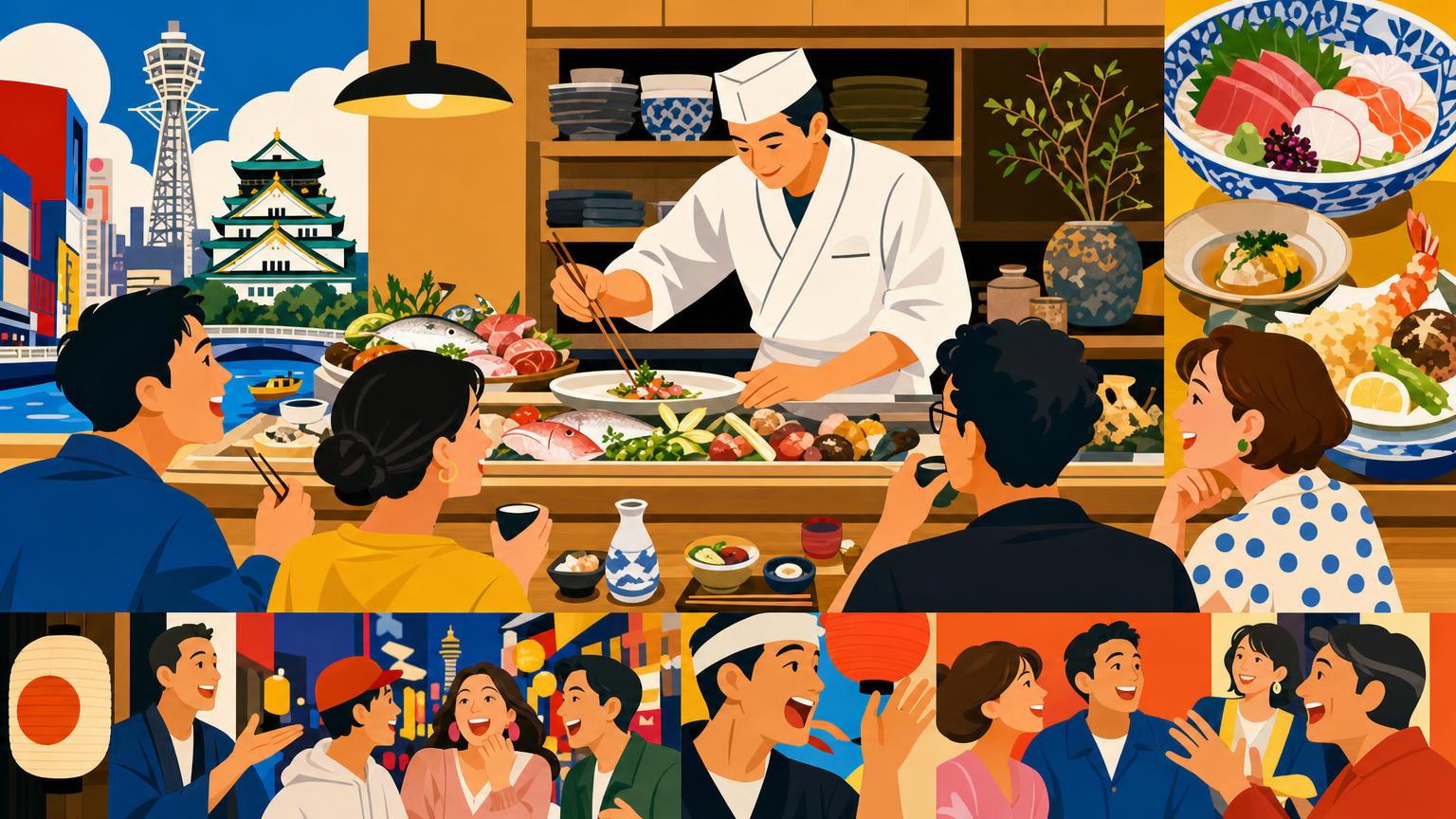
In everyday Osaka, friendliness often means a lower level of social distance during brief interactions. A cashier may comment on the weather. A neighbor may ask whether you have found a good supermarket. A restaurant owner may offer an opinion without waiting for a formal invitation. A stranger may use humor sooner than you expect.
This does not mean that everyone is seeking a close personal relationship. People in Osaka can be warm in the moment while remaining private in the long term. That distinction is important. A lively conversation at a counter does not necessarily lead to an invitation into someone’s home.
Kappo reflects this balance. The chef may speak directly, explain a dish, and joke with customers while still maintaining firm boundaries regarding reservations, timing, payment, and ingredients. Warmth and rules can exist side by side.
Osaka Compared with Tokyo
The contrast between Osaka and Tokyo should not be exaggerated. Both cities have quiet people, formal restaurants, relaxed neighborhoods, and every personality type in between. Still, everyday communication can feel different.
Tokyo often rewards careful attention to status, distance, and procedure. A restaurant may rely on a highly controlled atmosphere, a formal reservation channel, and minimal conversation. Customers are expected to understand the system without needing much explanation.
Osaka can feel more negotiable. People may explain the system aloud. They may tell you directly that a restaurant is full, a request is difficult, or a dish is not worth ordering that day. This may sound less polished to someone accustomed to indirect language, but it can also be easier to navigate once you understand the intention.
Kappo is a useful example because the chef’s expertise is not hidden behind ceremony. The chef remains the authority, but the customer is physically and verbally closer. Osaka’s version of luxury often includes access to the person doing the work.
Direct Does Not Mean Rude
A chef who says, “That is too much food for one person,” may be trying to prevent waste. A restaurant employee who says, “Please arrive on time; we start together,” may be protecting the preparation schedule. A local friend who says, “You paid too much,” may be offering a sincere opinion rather than criticizing your taste.
Foreign residents sometimes interpret this style as impolite because English-language service culture often separates recommendations from judgment. Osaka communication can combine the two. Advice may come in a blunt package, but its content can still be practical and generous.
The best response is not to become equally blunt right away. Listen for tone, context, and the action being requested. If someone is helping you avoid a mistake, a simple “Thank you, that helps” is usually enough.
Best Kappo Dining Experiences in Osaka
This section is not intended as a sightseeing list. The neighborhoods below illustrate how kappo fits into everyday Osaka life: business dinners, celebrations, after-work meals, local regulars, and residents seeking a serious meal without leaving the city.
High-End and Michelin-Recognized Kappo in Kitashinchi
Kitashinchi, next to the Umeda and Osaka Station area, is one of Osaka’s best-known districts for professional dinners and high-end evening restaurants. Its streets are dense and vertical, and they can be easy to misread if you only follow the main roads. Many restaurants are located inside buildings, above street level, or behind small entrances.
This setting helps explain why local knowledge and introductions are important. A restaurant can be prestigious without having an impressive street frontage. The actual sign may be a small nameplate, a building directory, or a reservation message explaining which elevator to take.
Naniwakappo NOBORU is described by the Michelin Guide as a kappo-style restaurant where food is prepared in front of the diner, guided by the principle of “flavour first.” The name itself links the restaurant to Naniwa, an old name associated with Osaka.
Akutsu provides a more contemporary high-end counter experience in Dojima, within the Kitashinchi dining area. The restaurant has fourteen seats, serves set courses, and describes its concept through seasonal seafood, vegetables, Kobe beef, pottery, and sake. Its published information also outlines the practical details: two dinner seatings, a counter-focused room, no smoking, and advance-style course pricing.
Oryori Yamada in Nishitenma is another example of a restaurant combining counter seating with a private-room option. Its English information lists a monthly changing omakase course at ¥26,400, before a ten percent service charge, and recommends smart casual attire.
For a foreign resident, these restaurants offer an important lesson: high-end Osaka dining is not always designed with tourists in mind. The restaurant may provide an English page, but the atmosphere still assumes that guests will arrive on time, understand course dining, and respect the chef’s working environment.
Kitashinchi also includes more approachable forms of kappo. Kuzushi Kappou En, for example, lists course dining in the area, with reservations available through its own channels and reservation services. Its published information indicates a lower-priced entry point than the most expensive counters, while still requiring guests to pay attention to booking rules and service charges.
The term kuzushi kappo suggests a less rigid or deliberately deconstructed approach, but it should not be assumed to mean casual in the Western sense. It may refer to a creative style, a more relaxed atmosphere, or fewer formal conventions—not necessarily lower prices or walk-in availability.
Approachable and Authentic Options in Minami
Minami generally refers to Osaka’s southern central area, including Shinsaibashi, Namba, and nearby neighborhoods. Compared with Kitashinchi’s business-dinner atmosphere, Minami often feels more varied: office workers, residents, nightlife staff, shoppers, theater audiences, students, and visitors all share the same streets.
Kappo in Minami can therefore feel less like a private professional ritual and more like part of the city’s everyday evening economy. Restaurants may be compact, situated in multi-tenant buildings, and surrounded by bars, izakaya, and late-night businesses.
Kappo Yebisuan describes itself as a kappo restaurant located in Minami. Its significance lies not only in its location. Minami demonstrates that serious Japanese cooking exists not only in quiet, secluded neighborhoods. It can function within a noisy, bright, crowded part of the city while still maintaining a focused counter experience.
For residents, Minami may be the more practical place to start if you want to understand kappo without treating it as a once-in-a-lifetime ceremony. Look for restaurants that publish a clear course price, explain their reservation process, and indicate whether counter seating is available. A modest counter with a straightforward chef may teach you more about Osaka’s food culture than an expensive room where you feel uncomfortable asking questions.
How to Choose a Restaurant Without Chasing Prestige
Do not choose a restaurant solely by Michelin recognition, social media photographs, or the word “omakase.” Ask practical questions:
- Is the menu available in English, or can the restaurant communicate clearly with you?
- Is the price per person listed before or after tax and service charge?
- Are drinks included?
- Is the meal served at a fixed time for all counter guests?
- Can the restaurant accommodate allergies or dietary restrictions?
- Is there a cancellation fee?
- Does the restaurant mainly offer counter seating, private rooms, or tables?
- Can you order à la carte, or is the course compulsory?
For someone living in Osaka, the best restaurant may be the one whose rhythm fits your life. A restaurant fifteen minutes from your home, with a clear reservation policy and a chef you can communicate with, may become more meaningful than a famous restaurant you visit once while feeling pressured.
Practical Tips: Reservations, Prices, and Etiquette
How to Make a Reservation as a Foreign Resident
Many kappo restaurants are small. A counter may have fewer than twenty seats, and some restaurants arrange dinner in fixed seatings. For this reason, reservations are essential, especially on Friday and Saturday evenings, during seasonal periods, and around holidays.
Begin by checking the restaurant’s official website or a reputable reservation service. If the restaurant does not provide an English booking form, ask your hotel concierge, serviced apartment staff, Japanese-speaking colleague, or a local friend for assistance. A concierge can be helpful even for travelers who are not staying at a luxury hotel. They can confirm whether the restaurant accepts foreign guests, whether reservations must be made by phone, and whether a deposit or cancellation policy applies.
When contacting the restaurant, include the information that may affect the booking:
- Your preferred date and arrival time
- Number of guests
- Names of all guests, if requested
- Allergies and dietary restrictions
- Whether anyone does not drink alcohol
- Language needs
- A phone number or reliable contact method
- Your understanding of the cancellation policy
Avoid sending only, “Can I reserve for tonight?” without providing further information. Small restaurants may be arranging ingredients and staffing around each booking. A complete message is more considerate and more likely to receive a helpful response.
If you are already living in Osaka, ask a trusted local person to explain how the restaurant prefers to communicate. Some chefs accept messages through social media, while others prefer a phone call. Certain reservation platforms may show availability that differs from the restaurant’s own schedule. The safest approach is the one confirmed directly by the restaurant or by a reputable booking partner.
Realistic Budget Expectations
A reasonable general range for kappo in Osaka is approximately ¥10,000 to ¥30,000 or more per person, depending on the restaurant, course, ingredients, and drinks. Less expensive lunch courses and casual versions may be available, while premium counters can exceed ¥30,000 before additional drinks or special ingredients.
The price is often based on more than the amount of food. You are paying for ingredient sourcing, preparation, small-scale service, specialized labor, tableware, rent in central neighborhoods, and the chef’s ability to adapt the meal to the season.
At the lower end, you may find a more relaxed course or a lunch menu. Around ¥15,000 to ¥20,000, you may experience serious cooking in a less formal setting, although restaurant styles vary considerably. Around ¥25,000 to ¥35,000, you are more likely to encounter premium ingredients, highly specialized preparation, a smaller counter, or a carefully curated course. These are practical estimates rather than guarantees.
Always confirm whether the listed price includes tax and a service charge. For example, Akutsu publishes prices that include both, while Oryori Yamada lists a course price and states that a ten percent service charge is added.
Drinks can quickly increase the final bill. Sake pairings, premium bottles, wine, and seasonal beverages may cost as much as a casual meal elsewhere. If you have a fixed budget, mention it politely before ordering. Saying, “I would like to stay around this amount for drinks,” is more helpful than disputing the bill after the meal.
Dress Code and Counter Dining Etiquette
Most kappo restaurants do not require a suit, but clean, smart-casual clothing is a safe choice. Avoid strong perfume, clothing that sheds fibers, and very noisy accessories. At a narrow counter, bulky bags and large coats can obstruct the chef’s workspace and disturb neighboring guests.
Arrive on time. If the restaurant uses fixed seatings, arriving late may delay the entire course or mean that an important preparation has already been completed. If you become lost inside a building, call rather than spending ten minutes searching silently.
Use the small towel provided for your hands, not as a general napkin for wiping your face or the table. Do not reach across the counter. If you would like to photograph a dish or the chef’s work, ask first. Some restaurants permit photos of food but not of staff or other customers.
Do not touch knives, plates, serving tools, or ingredients unless the chef invites you to do so. The counter may appear open and informal, but it remains a professional workspace.
Use chopsticks carefully. Do not spear food, wave them while speaking, or leave them standing upright in a bowl of rice. If you are uncertain, observe what others do or ask quietly. Japanese diners generally understand that foreign guests may not know every rule; paying attention matters more than achieving perfection.
Avoid pouring drinks for yourself or others without first noticing the restaurant’s usual style. At some counters, guests pour for one another. At others, staff handle the service. If you are unsure, wait or ask.
How to Speak with the Chef
A little conversation is usually sufficient. You can ask where an ingredient comes from, how a dish was prepared, or what the chef recommends with a particular sake. Try not to turn the meal into an interview unless the chef clearly enjoys a longer conversation.
Do not compare every dish with food from your home country. Saying that a flavor is new to you is more helpful than declaring it better or worse than something familiar. Osaka chefs are often proud of their technique, but they do not need a lecture from a customer about what “authentic” Japanese food should be.
If you dislike something, explain it calmly. “I am not used to raw shellfish” provides useful information to the chef. “This is strange” does not. If you have an allergy, clearly use the word allergy and repeat it when necessary. A preference and a medical restriction are not the same thing.
Payment and Tipping
Confirm the accepted payment methods before arriving if the restaurant is small or traditional. Credit cards are common in central Osaka, but cash may still be useful, particularly at smaller restaurants or for additional purchases.
Japan generally does not follow the same tipping culture as the United States. Do not leave money on the table unless the restaurant specifically tells you to do so. A sincere verbal thank-you is appropriate. If a service charge is listed, it is part of the bill, not an invitation to calculate an additional tip.
What Foreigners Often Misunderstand About Kappo
It Is Not Simply “Japanese Fine Dining”
Kappo is not a universal term for expensive Japanese food. Some kappo restaurants are formal and luxurious, while others are relaxed, regional, or creative. What they share is an open relationship between preparation and dining—not a single price point or dress code.
The Chef Is Not Always There to Perform for You
Watching the chef work is central, but the chef may not narrate every movement. Silence can signal concentration rather than hostility. In Osaka, directness also means knowing when not to interfere.
Casual Conversation Does Not Cancel Formal Rules
A chef may joke with you while still enforcing a cancellation fee. A restaurant may feel warm while still requiring a fixed course. A local may call you by a nickname and still expect you to arrive precisely on time.
This combination is common in Osaka: personal warmth exists within practical boundaries. Understanding that balance will help you in restaurants, workplaces, apartment buildings, and neighborhood relationships.
“Omakase” Does Not Mean Unlimited Freedom
Entrusting the chef with the menu does not mean you can arrive without mentioning allergies or ask for a different cuisine halfway through the course. Omakase means the chef chooses within the restaurant’s concept. Your responsibility is to communicate important restrictions before the meal.
Osaka’s Directness Is Not a Tourist Show
Visitors sometimes look for “the friendly Osaka experience” and expect every local interaction to become theatrical. Real Osaka life is less dramatic. People are busy, and they may be helpful, sarcastic, impatient, generous, or quiet depending on the moment.
Kappo reflects that reality better than a slogan does. A chef can be warm without smiling constantly. A customer can ask questions without becoming a special guest. A meal can be excellent without being staged as a cultural performance.
Living in Osaka Through the Kappo Counter
The strongest lesson of kappo is not simply that Osaka has good food. Many cities do. The deeper lesson is that Osaka often values the space between expertise and accessibility.
The chef knows more than the customer, but the customer is not entirely cut off from the source of that knowledge. Ingredients are discussed rather than treated as mysterious symbols. The meal changes with the day. The relationship is courteous, but it is not rigid.
This helps explain everyday life in Osaka. People may tell you what they really think before you have developed a long relationship. A colleague may point out your mistake directly. A neighbor may tell you which supermarket is overpriced. A restaurant owner may recommend that you order less. These interactions can feel abrupt if you expect every form of care to be softened, but they can also make daily life easier.
Osaka is not always more relaxed than Tokyo. It has crowded trains, demanding workplaces, expensive housing, complicated bureaucracy, and the same pressures found in other major Japanese cities. The difference often lies in how people manage contact. Osaka can provide more room for a practical exchange before formality takes over.
That is why kappo is valuable for anyone trying to understand what living in Osaka is really like. Sit at the counter and watch the relationship unfold. The chef does not conceal the work. The customer does not disappear into a private room. Both sides remain aware of each other.
You may leave remembering the fish, the broth, or the final rice dish. But the deeper impression is usually social: someone asked what you wanted, someone explained what was good, and everyone adjusted to the reality of that particular evening.
That is Osaka’s direct food culture in its clearest form. Not loudness for its own sake. Not friendliness as a slogan. It is the belief that good things become better when people stay close enough to speak honestly, pay attention, and respond to what is actually in front of them.