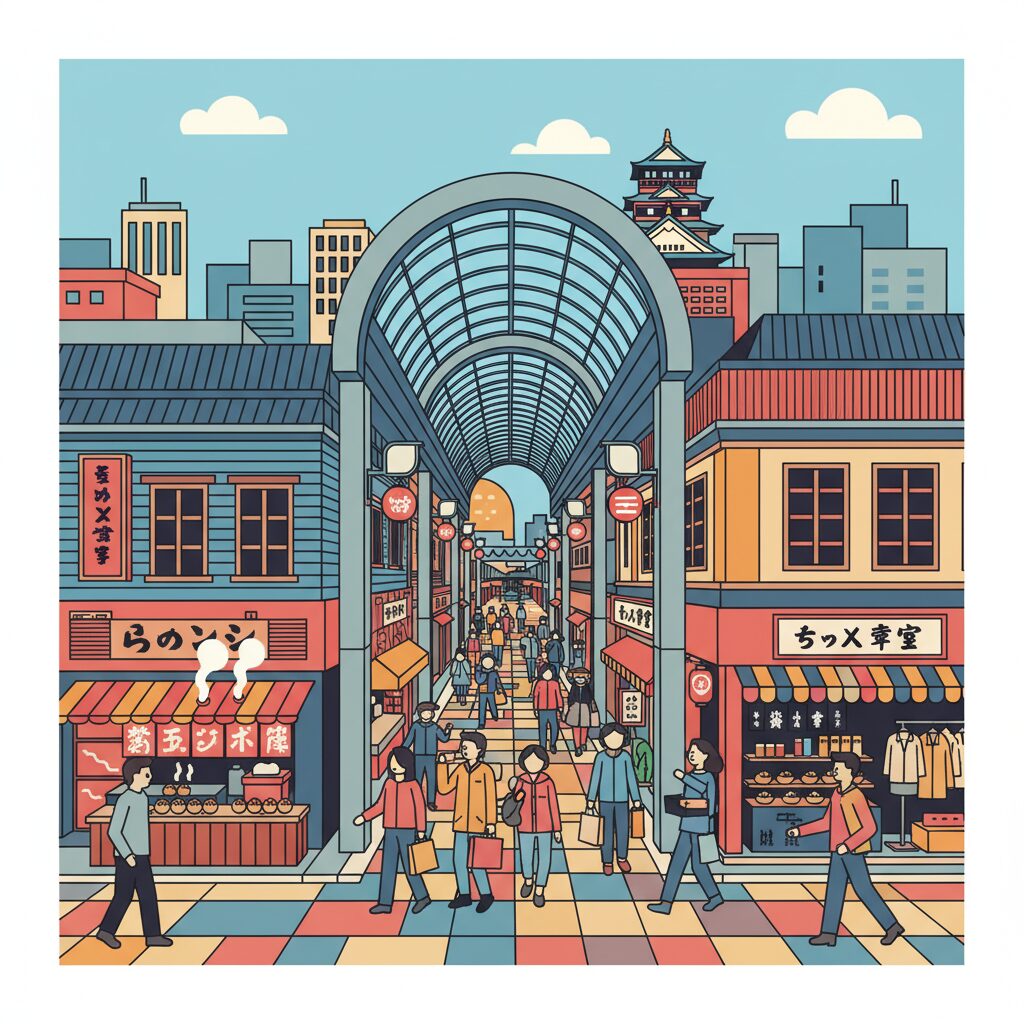
The first time you step out of a sleek, silent Tokyo supermarket and into the boisterous, chaotic embrace of an Osaka shotengai, the culture shock is palpable. In Tokyo, shopping is a mission of silent efficiency. You navigate pristine aisles under the flat, even glow of fluorescent lights, your interactions limited to a polite nod and the beep of a barcode scanner. It’s a transaction, clean and anonymous. Then there’s Osaka. Here, the shopping arcade—the shotengai—isn’t a sterile container for commerce. It’s a living, breathing organism. It’s a cacophony of vendors hawking their wares in a melodic, guttural dialect, the sizzle of oil hitting a griddle, the sweet scent of grilled eel mingling with the earthy smell of fresh daikon radishes, and the constant, rolling laughter of neighbors catching up in the middle of the narrow lane. For a newcomer, especially one accustomed to the reserved nature of the capital, it can feel overwhelming, almost intrusive. You’re not just a customer here; you’re an audience member, a participant, a potential new friend or the butt of a good-natured joke. This isn’t just about buying groceries. It’s about participating in the lifeblood of the neighborhood. This is where the city’s famous warmth isn’t just a cliché; it’s a daily practice, forged in a thousand tiny, seemingly insignificant interactions. It’s in these covered streets, under fluttering banners and aging awnings, that you discover the true heart of Osaka, a place where the line between commerce and community completely dissolves.
This daily practice of community is a cornerstone of Osaka life, much like the unique rhythm found along the Nose Line.
The Shotengai as a Living Room: More Than Just a Marketplace
To truly understand Osaka, you must first realize that a shotengai is more than just a cluster of shops. It serves as the neighborhood’s communal living room, its central nervous system, and its shared dining table all at once. In contrast to the modern, impersonal malls scattered across Japan, the shotengai is a remnant of a more connected era—one that Osaka has steadfastly preserved. It functions by a different set of rules, where human relationships are the primary currency, and the daily pace is shaped not by corporate efficiency but by the natural rhythms of community life. Walking through one offers a sensory immersion, a full-body experience no sterile supermarket can match. It’s where the city sheds its concrete-and-steel facade to reveal its warm, fleshy, and wonderfully chaotic heart.
A Symphony of Senses and Sounds
Step into a shotengai like Tenjinbashisuji, Japan’s longest, and the first sensation you encounter is sound. It’s a rich, layered symphony. At the foundation lies the constant hum of conversation—multiple chats unfolding simultaneously, punctuated by bursts of hearty laughter. Above that rise the distinctive calls of merchants, each trade with its unique vocal signature. From the fishmonger, you’ll catch a deep, rhythmic chant: “Saa, yasukattayo! Kyō no sakana wa pichi pichi ya de!” (“Alright, it’s a bargain! Today’s fish is super fresh!”). His voice is a familiar beacon, signaling quality and trust forged over decades. Further along, the croquette vendor calls out with a higher, livelier pitch: “Age-tate, atsui yo! Hitotsu dō desu ka?” (“Freshly fried and hot! How about one?”), enticing you with the irresistible aroma of fried potatoes and meat. These are not pre-recorded announcements piped in through speakers; they are live, improvised performances—invites to engage. The soundscape is completed by the rhythmic clatter of a butcher’s knife striking a wooden block, the sizzle of okonomiyaki batter on a hot teppan grill, and the gentle, almost musical squeak of a tofu seller’s cart moving down the lane. The visual scene is just as vivid. Handwritten signs, scrawled in bold black ink on cardboard, advertise the day’s specials with more personality than any printed poster. Colorful plastic food models, known as shokuhin sampuru, display the dishes of small eateries with a nostalgic, retro charm. Baskets of shiny seasonal fruit are arranged not just for practicality but with an artist’s attention to color and form. This entire sensory mosaic creates an atmosphere full of vibrant, lived-in humanity. It’s messy, loud, and a bit overwhelming, but undeniably alive. It reflects a core Osakan value: life is meant to be experienced with all your senses, together, out in the open.
The Unspoken Contract: Your Face is Your Loyalty Card
Within the world of the shotengai, your most valuable asset isn’t a point card or coupon; it’s your face. Becoming a regular, a jōren-san, means entering an unspoken social contract with the vendors. This isn’t about collecting points for discounts; it’s about fostering mutual recognition and trust. In Tokyo, you might shop at the same supermarket for years without the cashier ever learning your name. In an Osaka shotengai, after three visits to the same vegetable stand, the obaachan (grandmother) running it will not only recognize you but likely have started keeping a mental profile on you. She’ll remember your preference for slightly firm tomatoes, that you tried making nitsuke (simmered fish) last week, and that you complained about the humidity. This recognition forms the foundation of shotengai commerce. It transforms anonymous transactions into personal exchanges. The vendors aren’t just selling goods; they act as custodians of the neighborhood’s well-being. They become part of your daily routine—a familiar, friendly face providing stability and belonging. This system thrives on consistency. The shopkeepers are present day in, day out, often occupying the very spots their parents or grandparents once held. By showing up regularly, you do more than buy produce; you weave yourself into the social fabric of the community. You signal your commitment, and the community, in return, welcomes you.
The “Omake” Culture
The clearest expression of this relationship is the culture of omake—the small gift or extra something vendors add to your purchase free of charge. To the untrained eye, it might seem like a random kindness or a simple sales tactic. But omake is a complex, nuanced language of appreciation. It’s rarely offered on the first visit. It’s an earned reward, a sign that you have moved from customer to valued jōren-san. Often modest, the omake’s true value is symbolic. When the fruit seller, after weighing your apples, slips in an extra mikan orange and says, “Kore, omatē!” (“Here, an extra for you!”), he’s not just handing you fruit; he’s saying, “I see you. I remember you. I appreciate your business.” This act strengthens the bond between you. The type of omake can be distinctly thoughtful too. The butcher, knowing you bought ground pork for gyoza, might toss in extra wrappers. The fishmonger, after selling you a beautiful sea bream fillet, might give you the head and bones with a “Kore de dashi tottara umai de” (“This will make a delicious broth”). It demonstrates a care and attention that extend far beyond a simple sale. It shows they’re thinking about your entire meal, your whole experience. This culture contrasts sharply with other parts of Japan, especially Tokyo, where precision is strict. In a Tokyo department store, purchases are weighed to the exact gram, and prices are fixed. A clerk casually adding something extra would be almost unthinkable, disrupting inventory and violating rules. In Osaka, human relationships take precedence over rigid systems. The omake is a small act of rebellion against sterile, impersonal commerce—a declaration that here, people matter more than profit margins.
“How’s Your Mom?” — Beyond the Transaction
Once omake begins, conversations deepen. Interactions in an Osaka shotengai quickly go beyond the simple script of ordering and paying. Shopkeepers become part of your life’s story, and you become part of theirs. They serve as unofficial keepers of the neighborhood’s oral history and its daily news bulletin. The tofu maker won’t merely sell you silken tofu; he’ll ask, “Okāsan no koshi, yō natta ka?” (“Did your mother’s back get better?”), recalling a chat from two weeks ago. The woman at the tsukemono (pickle) stand will notice your new haircut and ask if you have a date. The butcher will inquire about your son’s university entrance exams. These aren’t nosy intrusions; they’re threads of connection being woven. They perform a vital community role in a country facing an aging population and more people living alone. For elderly residents, a daily trip to the shotengai might be their most meaningful social encounter of the day. Shopkeepers act as a check-in service, a friendly face to talk with, and an early alert system. If Mrs. Tanaka, who always buys one mackerel every Tuesday, doesn’t show up, someone will notice—someone might even go knock on her door. This level of intimacy may feel jarring for foreigners or Japanese from other regions, blurring boundaries between public and private, professional and personal. Yet, it captures the very essence of the shotengai. It’s a place where you are seen, known, and cared for—not just as a wallet but as a person, a neighbor, a part of the community. The purchase itself is almost secondary to the ritual of connection that surrounds it.
The Language of Connection: Deconstructing Osaka-ben in the Market
The driving force behind this deeply interactive culture is its distinctive language: Osaka-ben. The Osaka dialect is far more than a regional accent; it serves as a social toolkit, expertly designed to break down barriers, foster intimacy, and enable the playful, direct communication that characterizes the city. To outsiders, it may sound rough, aggressive, or even rude compared to the polite, standardized Japanese spoken in Tokyo. However, to truly understand Osaka, one must realize that the directness of Osaka-ben conveys warmth, and its humor acts as a social adhesive. In the shotengai, the dialect is prominently displayed—a living, evolving language that turns every transaction into a potential performance.
More Than an Accent: The Role of the Osaka Dialect
Standard Japanese, or hyōjungo, is a language marked by subtlety and indirectness, emphasizing harmony and avoiding imposition. In contrast, Osaka-ben is immediate and emotionally expressive. Consider the common word for “very.” In Tokyo, the refined and somewhat formal “totemo” is typical. In Osaka, words like “meccha” or “motsui” are used, which feel more visceral and emphatic. When a vendor exclaims that the tomatoes are “meccha umai de!” (“super delicious!”), the phrase itself pulses with genuine enthusiasm that “totemo oishii desu” lacks. Intonation plays a key role as well. While standard Japanese maintains a relatively flat pitch, Osaka-ben is famously melodic, with a rising and falling cadence resembling singing. Sentence-ending particles differ, too; instead of the neutral “desu/masu,” one hears “ya nen” or “dayo,” creating a casual, inclusive atmosphere. A vendor won’t say, “Kore wa sanbyaku en desu” (“This is 300 yen”). Instead, they say, “Kore, sanbyaku en ya de,” which feels less like a formal statement and more like sharing a piece of information between friends. Even the expression for “thank you” is unique. While “arigatou gozaimasu” is understood, the authentic local term is “ōkini.” It’s softer, warmer, and more familiar, encapsulating the merchant city’s spirit of mutual appreciation. Using these expressions, even as a foreigner, signals an effort to connect locally, an effort usually met with delight and encouragement.
The Art of the “Tsukkomi”: Playful Banter as Social Glue
Perhaps the most vital and often misunderstood feature of Osaka communication is the culture of tsukkomi. Borrowed from manzai, a traditional Osaka-style Japanese stand-up comedy, this concept involves a duo where one person is the boke (the silly, air-headed one) who says something ridiculous, and the other is the tsukkomi (the sharp straight man) who corrects them, often with a light slap or quick verbal jab. This comedic pattern is not confined to the stage; it’s the default mode of friendly conversation in Osaka. The shotengai serves as a grand stage for daily manzai. Exchanges between shopkeepers and customers consist of a continual series of boke and tsukkomi. For example, a customer might jokingly say, playing the boke, “Wow, I could probably ride this fish home.” The fishmonger, responding as the tsukkomi, might swiftly reply, “Aho ka! Hayaku kawan to kusaru de!” (“Are you an idiot? If you don’t buy it soon, it’ll go bad!”). To outsiders, calling a customer “idiot” (aho) may sound harsh, but in Osaka, “aho” is often an affectionate term, a playful way to share the joke. The tsukkomi is not meant as an insult; it’s a sign of a close and comfortable connection. It conveys, “I’m paying attention and engaged enough to play along.” Not participating or taking the tsukkomi literally is socially awkward. The proper response is laughter and continuation of the banter. This culture of teasing keeps interactions lively, enjoyable, and engaging, preventing relationships from becoming stiff, formal exchanges between “provider” and “consumer.” It reinforces the sense that everyone is on equal footing—neighbors sharing a laugh while shopping. For foreigners, learning to recognize and join in this banter is a crucial step to feeling truly at home in Osaka.
“Nambo ni shite kurerun?”: The Negotiation Dance
This playful spirit also extends to pricing. While most of Japan follows fixed prices, the Osaka shotengai preserves a subtle haggling tradition. It’s not the aggressive bartering seen elsewhere but a gentle, ritualized dance—a further form of communication and relationship-building. Common phrases include, “Chotto makete kureru?” (“Can you give me a little discount?”) or more playfully, “Nambo ni shite kurerun?” (“How much will you make it for me?”). This is not a demand but an invitation to a game, appropriate only at small, independent stalls with established rapport. Attempting this at chain stores or supermarkets would cause confusion. Context matters. Upon hearing the request, the vendor typically pretends to be reluctant, perhaps sighing dramatically or scratching their head, saying something like, “Shō ga nai nā… anata wa tokubetsu ya de” (“Can’t be helped… you’re a special case”). Then they knock off a small, symbolic amount—50 or 100 yen—or more often offer omake, adding an extra potato or bunch of spring onions instead of a discount. The goal is not significant savings but the interaction itself, a way to reaffirm connection. By engaging in this ritual, you show an understanding of local culture, and the shopkeeper acknowledges you as a savvy, respected regular. This negotiation becomes a brief performance enriching the experience and leaving both parties satisfied. It transforms payment from a mere financial transaction into the rewarding conclusion of a successful social exchange.
Why Here? The Social and Economic Roots of Shotengai Culture
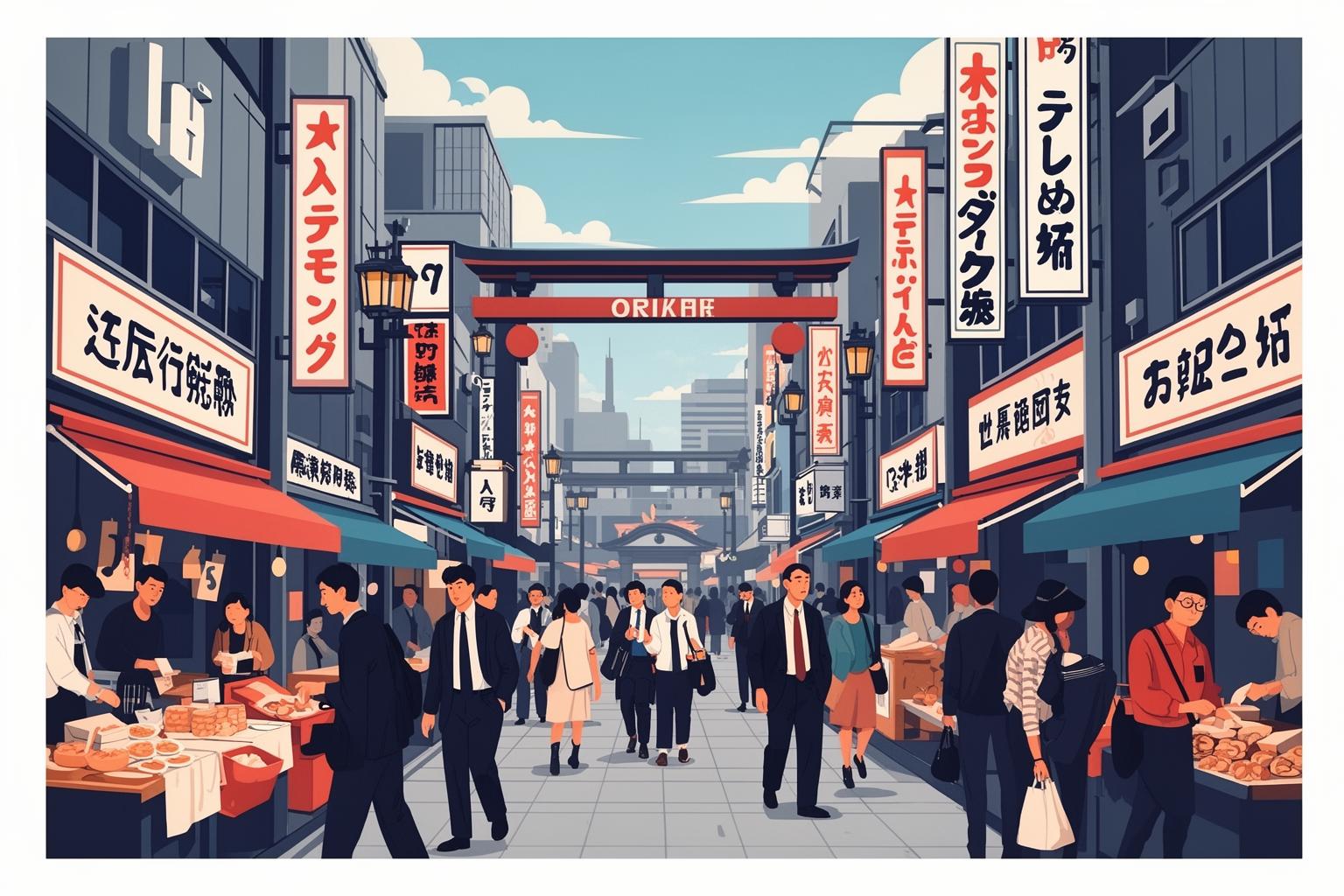
The unique culture of Osaka’s shotengai did not simply emerge out of nowhere. It is the vibrant legacy of the city’s long and distinguished history as Japan’s premier merchant center. Unlike Tokyo (formerly Edo), which was shaped around the rigid, hierarchical world of the samurai and shogun, Osaka was a city created by and for the merchant class. Its identity was forged in the marketplace, where success relied not on birthright or rank but on shrewdness, adaptability, and, most importantly, the ability to build and sustain strong personal relationships. This commercial spirit runs deep through the city’s veins and is most clearly expressed today in the lively lanes of the shotengai. This historical context also helps clarify the sharp cultural differences between Osaka and Tokyo, a rivalry that continues to shape much of contemporary Japan.
The Merchant City DNA: A History of Face-to-Face Commerce
During the Edo Period, Osaka was known as “tenka no daidokoro,” or “the nation’s kitchen.” It served as the central distribution hub for rice, sake, and countless other goods from across Japan. The city’s Dojima Rice Exchange was the world’s first futures market, a place where fortunes were won and lost with a handshake. In this setting, reputation and trusted networks were everything. Deals were often finalized not through lengthy formal contracts but with verbal agreements based on mutual trust. This fostered a culture of pragmatism, straightforward communication, and a focus on cultivating long-term, mutually beneficial relationships. Merchants needed to be good-humored, persuasive, and adept at quickly establishing rapport with diverse people. They couldn’t afford the stiff formality of the samurai class. This history explains why Osakans today still value directness, humor, and a certain degree of playful haggling. The shotengai is a direct heir to this legacy. The small, family-run shops lining the arcades operate on the same principles as the great merchant houses of old: your name and face are your brand. The trust you build with customers is your most valuable asset. This stands in contrast to Tokyo, where culture was shaped by the samurai government’s bureaucracy. In Edo, social interactions were governed by strict etiquette and deference to authority, creating a more reserved, formal, and less openly expressive social environment—a trait still evident in the city’s buttoned-up atmosphere today.
A Counterpoint to Tokyo’s Anonymity
The shotengai culture also acts as a powerful counterbalance to the anonymity of modern urban life, a phenomenon most strongly felt in Tokyo. Tokyo is a megacity operating on a model of supreme efficiency and the preservation of personal space. It is a place where people can live for years in the same apartment building without ever learning their neighbors’ names. Public spaces, such as trains, are often marked by a profound, almost sacred silence. This system enables millions to coexist densely with minimal friction, but it can also foster feelings of isolation and community disconnect. Osaka, through its shotengai, offers an alternative model. The arcade is a space that actively resists anonymity. It compels interaction. It demands engagement. You cannot stroll through the Karahori Shotengai or Kuromon Market without being greeted, without making eye contact, without being drawn into the unfolding human drama around you. Shopkeepers are not merely vendors; they are community builders. They serve as social hubs, connectors, and friendly gossipers who keep the neighborhood network vibrant and alive. In a shotengai, you are never just a faceless consumer in the crowd. You are, for example, Tanaka-san’s daughter, the guy from the third floor who loves mackerel, or the foreign woman learning to cook Japanese cuisine. This constant, low-level social interaction is precisely what builds community and prevents the kind of deep urban loneliness that can afflict other large cities.
The Safety Net of Familiar Faces
This web of relationships provides more than a sense of belonging; it creates a powerful, effective informal safety net. This benefit has become especially meaningful to me as a woman living in a large city. Japan’s formal safety is well-known—crime rates are low, and streets are generally safe—but the shotengai offers a different, more personal kind of security. It’s the security of being known, of having countless pairs of eyes watching out for you. The shopkeepers act as unofficial guardians of the neighborhood. They know the street’s rhythms. They know which children walk home from school at what times, and they notice when a strange car lingers too long. They keep an eye on elderly residents, providing crucial check-ins that can be life-saving. I recall an incident in my local shotengai: an elderly man, a well-known regular, stumbled and fell. Before he fully hit the ground, it felt as though the entire arcade sprang into action. The butcher dashed out with a chair, the pharmacist brought a first-aid kit, and the woman from the fruit stand called his daughter, whose number she had memorized. The ambulance was called, of course, but the immediate, compassionate response came from the community itself. This level of collective responsibility is rare in more anonymous urban settings. It’s a powerful feeling to know that, should something happen to you, you would not be just a stranger in trouble—you would be a neighbor, and your community would support you. This is the hidden strength of the shotengai: it transforms a collection of individuals into a close-knit, caring community, one daily greeting at a time.
Navigating the Shotengai: A Practical Guide for Newcomers
For a foreigner settling into life in Osaka, the shotengai can feel like an exclusive club governed by a set of unwritten rules. The rapid-fire banter, long-established relationships, and distinctive dialect may seem intimidating. However, the community is genuinely welcoming to those who sincerely try to take part. Gaining entry into this world is less about perfecting the language and more about adopting the right attitude: be open, be consistent, and don’t hesitate to engage. Becoming a jōren-san is a rewarding journey that will transform your experience of living in Osaka from that of an outsider to a true member of the neighborhood. Here’s a practical guide to help you get started.
Breaking the Ice: How to Become a “Jōren-san”
The journey to becoming a regular is a gradual process based on consistency and simple gestures. Avoid trying to become a regular at ten different shops all at once. Start small. Choose one or two shops you’ll visit regularly—perhaps the local tofu maker, a fruit stand, or a bakery. Make it a point to go to that specific shop for that particular item whenever you need it. The first step is to let them see your face repeatedly. During the first week, a simple nod along with a clear, friendly “Konnichiwa” upon entering and “Arigatou gozaimasu” or “Ōkini” on leaving is sufficient. By the second week, you can move on to mentioning the weather. “Atsui desu ne” (“It’s hot, isn’t it?”) is a classic for good reason. This opens the door to brief, light conversation. The next, and most important, step is to show interest beyond the product. Ask a simple question. Point to an unfamiliar vegetable and inquire, “Kore wa nan desu ka?” (“What is this?”). Or better yet, “O-susume wa dore desu ka?” (“Which do you recommend?”). This shows respect for the vendor’s knowledge and is almost always met with an enthusiastic explanation, possibly even a cooking tip. Once you’ve built this basic rapport, don’t shy away from playful banter if it arises. If a shopkeeper teases you for buying the same thing again, simply smile and laugh. You might respond with a simple comeback like “Suki ya nen!” (“I like it!”). They’re not mocking you; they’re testing to see if you’re ready to be embraced in their casual, friendly culture. The more you show up and engage in these small ways, the faster you will move from a nameless face to a welcomed fixture of the shotengai scene.
What Foreigners Often Misunderstand
Navigating the social customs of the shotengai can lead to some misunderstandings for foreigners. The first is confusing community-mindedness with nosiness. When the bakery owner asks where you’re headed or who you’re meeting, they aren’t trying to pry into your private life. In Osaka’s community-centered culture, this is similar to a Westerner asking, “How are you?” It’s a conversational opener, a way of expressing personal interest. A simple, general answer suffices. Another common source of confusion is the teasing and tsukkomi. As mentioned, being called an “aho” or being playfully scolded for indecision might be surprising. It’s important to remember this is usually a sign of affection. It indicates the shopkeeper feels comfortable enough to drop the formal customer-service manner. The best response is to take it in the humorous spirit intended. Getting offended will only create awkward distance. Lastly, the art of negotiation can be tricky. The key is to understand it’s not about bargained savings; it’s about the interaction. Never be aggressive. Frame it as a playful request, not a demand. And be ready for the answer to be “no” or for a “discount” to take the form of omake. The goal is to build relationships, not to win a price battle. Understanding the intent behind these practices is essential to appreciating the warmth and richness of shotengai culture.
The Reward: More Than Just Groceries
So why bother with all this effort when you could simply visit a brightly lit, air-conditioned supermarket and finish in ten minutes? The reward for investing time and energy in the shotengai is immeasurable. It’s the difference between merely living in a city and truly belonging to it. When you become a jōren-san, you gain more than just a place to buy fresh food. You gain a community. You gain a network of people who know your name and look out for you. You receive the vendor’s expertise; the fishmonger will save you the best cuts because he knows you’re coming, and the vegetable seller will tell you which melons are perfectly ripe. You’ll get the little extras—the omake—that brighten your day. But beyond that, you gain daily genuine human connection. You share stories, laugh together, and feel the deep, grounding satisfaction of belonging to a place. The feeling of strolling down your local arcade, being greeted by name at three different shops, and returning home with not just a bag of groceries but also a funny anecdote from the butcher and a new recipe from the tofu maker—that is the true reward. It’s a rich, textured, and deeply human way of life that no online delivery service or impersonal supermarket can ever replicate.
The Enduring Heartbeat of Osaka

In an era of relentless modernization, where efficiency and convenience often come at the expense of human connection, the Osaka shotengai remains a vibrant, noisy, and wonderfully stubborn symbol of a different way of life. It is much more than a quaintly retro shopping spot. It is the forge where Osaka’s unique spirit is continuously shaped and reshaped each day. The city’s culture—its warmth, directness, humor, and strong sense of community—is not an abstract idea; it is a lived experience, honed through the daily interactions between shopkeepers and customers.
The seemingly small moments—the playful teasing, the thoughtful omake, the personal inquiries about your family—are the vital threads that create the strong, enduring social fabric of the neighborhood. They turn ordinary errands into chances for connection, building a world where commerce is not a cold transaction but a warm, human exchange. For any foreigner wanting to understand what makes Osaka truly tick, my advice is clear: skip the glossy department stores and sterile convenience outlets, and immerse yourself in the chaotic, beautiful world of your local shotengai. Learn the faces, learn the names, and let them learn yours. It is in these covered alleys, amid the clamor and laughter, that you will stop being a passing visitor and start to feel, genuinely and deeply, at home. Here lies the enduring, life-affirming heartbeat of Osaka.