So you’ve landed in Osaka. You’ve mastered the train map, you can order takoyaki without pointing, and you’ve even started to feel the city’s rhythm, that constant, thrumming beat of commerce and comedy. But you’re looking for the next level, the real-deal, behind-the-curtain Osaka. You’ve heard about sento, the public bathhouses, and the first question that pops into your head, the one everyone asks, is probably about tattoos. “Can I get in with my ink?” In Osaka, the answer is often a refreshingly pragmatic, “Sure, why not?” But I’m here to tell you that the tattoo question is a red herring. It’s the first door, but it’s not the main one. Getting into an Osaka sento is easy. Belonging, truly fitting in, is an art form. The real challenge isn’t about what’s on your skin; it’s about understanding the complex, unspoken, and deeply local social ballet that happens in the steam. This isn’t a spa. It’s not a quiet retreat for solitary reflection. An Osaka sento is the city’s living room, its confessional, its debate hall, and its soul, all stripped down and soaked in 42-degree Celsius water. To understand the sento is to understand the very fabric of this city’s hyper-local, fiercely communal, and beautifully unpretentious way of life. It’s where the unspoken rules of Osaka society are not just practiced, but enforced with a gentle nudge or a gruff word from a neighborhood elder. Forget what you think you know about Japanese bathing etiquette from tourist guides. We’re going deeper. We’re going local.
To truly understand this communal spirit, you can also explore how daily interactions in Osaka’s shotengai build similar community bonds.
The Sento as a Social Microcosm of Osaka
Before even grabbing a towel, let’s clarify one thing. A sento in Osaka operates on a different wavelength than one in, say, Tokyo. In Tokyo, a sento often feels like an extension of the city’s anonymous efficiency. You enter, wash up, and leave. It’s quiet, respectful, and interactions are minimal, polite, and transactional. People keep their personal space, even when naked. It’s a place for personal ritual, a clean and orderly routine. You might hear the gentle splash of water or an occasional sigh, but rarely a full conversation.
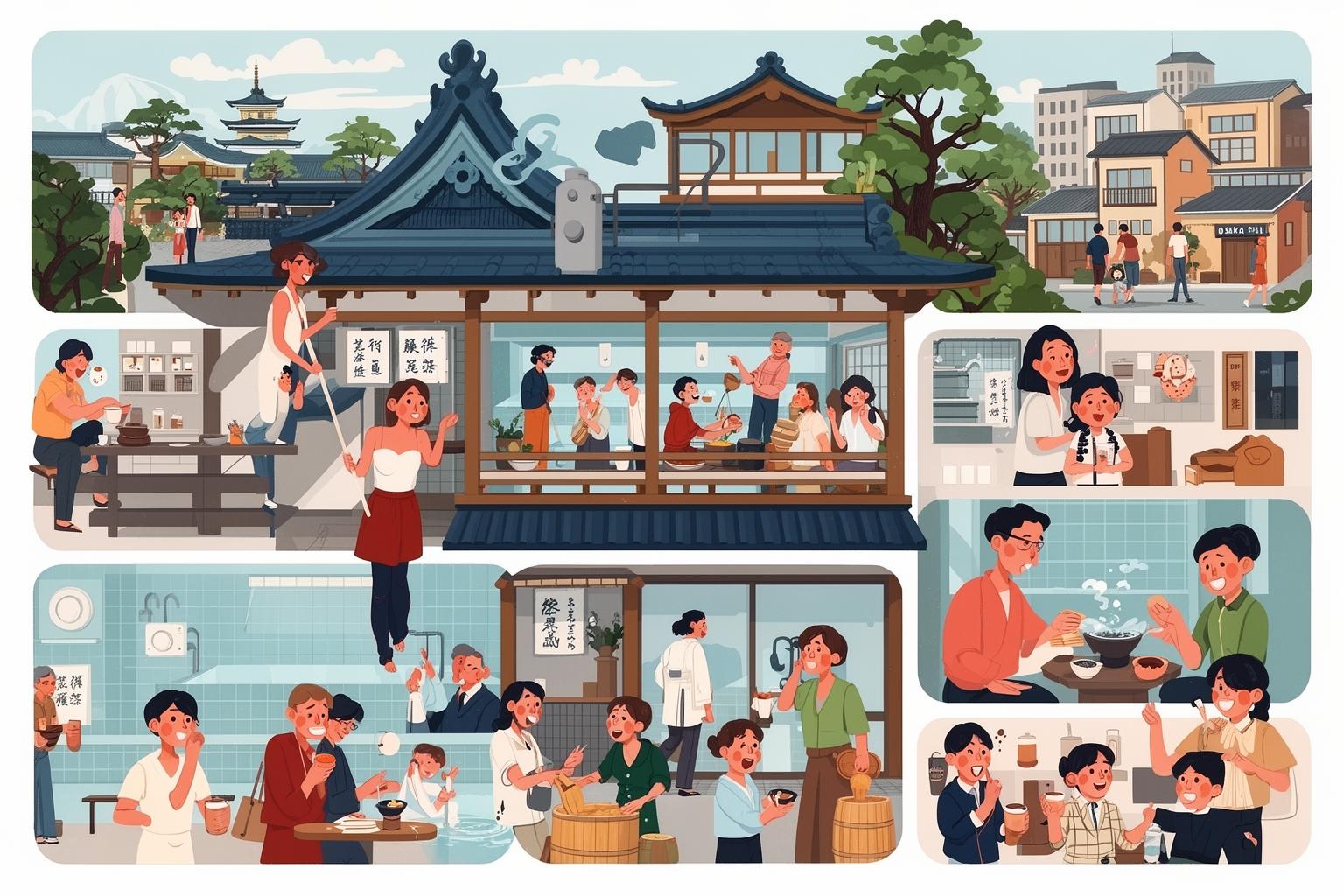
In Osaka, that idea dissolves into the steam. An Osaka sento is essentially a shakouba—a social hub. It’s an acoustic space made for chatter. The high ceilings and tiled walls don’t just echo water splashes; they amplify the hearty laughter, heated debates about the Hanshin Tigers’ latest loss, the price of daikon at the market, and neighborhood gossip that spreads faster than the Shinkansen. It’s the raw, unfiltered voice of the city. This isn’t about a lack of manners; it’s a different understanding of the space’s purpose. Here, harmony comes not from silence, but through active, engaged, and sometimes loud participation in the community. Sharing hot water is an invitation to share a bit of your day. Staying silent and distant in an Osaka sento can sometimes be seen not as polite, but as standoffish or even suspicious. You’re expected to be part of the background social noise, contributing to the collective energy of the room. The value of an Osaka sento isn’t just the hot water; it’s the human connection, the feeling of belonging to the neighborhood’s circulatory system. It’s built on pragmatism. For a few hundred yen, you get clean, warm, and caught up on everything you need to know. That’s classic Osaka kosupa—cost performance—applied to social well-being.
Reading the Room: The Unspoken Laws of the Wash Station
The moment you step through the noren curtains and enter the steamy washroom, the real challenge begins. This isn’t a free-for-all. It’s a carefully organized space governed by a set of invisible yet strictly enforced rules. The washing area, lined with rows of low stools and faucets, serves as the sento’s antechamber, and your conduct here sets the tone for your entire visit. This is where you prove that you belong.
The Art of Claiming ‘My Spot’
You’ll notice it right away. Some wash stations appear… well-lived in. A neatly arranged collection of shampoo, conditioner, and body soap bottles rests on the shelf, perhaps alongside a specific brand of shaving cream and a well-used scrubbing towel. This isn’t abandoned property. It’s claimed territory. This is a regular’s spot, their designated space, and you’d have better odds sitting at the head of a yakuza dinner table than trying to take over this piece of real estate. These are the nushi, the masters or guardians of the bath, who have frequented this exact sento, at this particular time, for decades. They’ve earned their place through unwavering consistency.
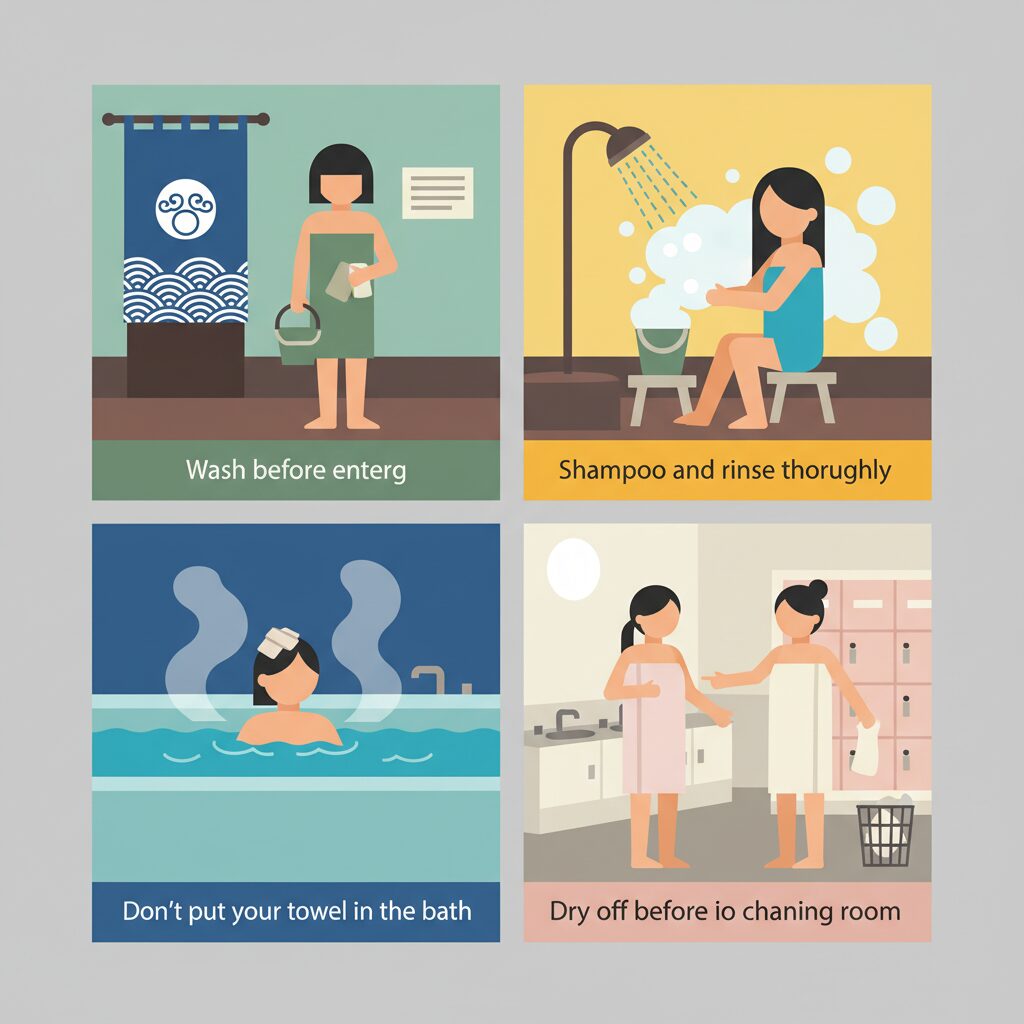
As a newcomer, your role is to be like water: flow around the rocks. Look for empty stations—those with nothing but the standard-issue green soap bar. Or better yet, observe where the regulars go. They move with a purpose that you, the visitor, lack. When you find a vacant spot, pause for a moment before settling down and take in your surroundings. Who are your immediate neighbors? Are they engaged in deep conversation? Are they scrubbing quietly? Match their energy. Once you’ve chosen your stool, rinse it and the bucket with hot water before use. This is fundamental. But the more advanced move involves how you manage your toiletries. Don’t spread them out. Keep them compact. You are a guest here, and your physical and social footprint should be minimal. When you finish, the most important step is cleaning up. Rinse everything—your stool, your bucket, the floor around you. Wash away every last sud. Leave your station spotless, as if you were never there. This act of erasing your presence is the highest form of respect. It signals to the community, “I understand that this space is shared, and I’ve done my part to preserve it for the next person.” It’s a small, silent gesture that speaks volumes.
The Splash Zone: Maintaining Public Harmony
Among all the missteps you can make at the wash station, none is worse than splashing. This may sound trivial, but in the close quarters of a sento, it’s a clear violation of personal space and a glaring display of social ineptitude. Think of each wash station as a semi-sovereign territory. Your water, your soap, your suds must stay within your borders. When you turn on the faucet or use the handheld shower, you must be keenly aware of who is to your left, right, and behind you.
This isn’t just about courtesy; it’s a core Osaka principle embodied in the concept of meiwaku (bothering others), interpreted in the most practical, tangible way possible. In Tokyo, meiwaku might mean playing loud music on the train. In an Osaka sento, meiwaku is getting soap in Yamamoto-san’s eye while he shaves. The response will be immediate and unmistakable. You won’t receive a subtle, passive-aggressive glare. Instead, you’ll hear a gruff, “Oi, anchan, mizu tobashitoru de!” (“Hey, kid, you’re splashing water!”). This is not hostility. It’s an essential, efficient correction to maintain order. The person addressing you isn’t trying to be rude; they’re acting as a community enforcer, upholding rules for everyone’s benefit. The proper response is not defensiveness but a quick, sincere “Ah, suimasen!” (“Oh, I’m sorry!”) followed by an immediate adjustment of your technique. Keep the shower head low. Aim it at your body, not into open air. When rinsing your bucket, do so gently. Mastering the splash-free wash is a sign that you’re mindful, aware, and respectful of the shared space. It’s a crucial step from outsider to competent, welcomed guest.
The Symphony of Buckets and Stools
Listen closely. The sento has its own distinctive soundscape. Beyond conversations and flowing water, you’ll hear the steady, rhythmic clatter of plastic against tile—the sound of buckets (oke) and stools (isu) being moved, placed, and rinsed. This is the sento’s percussion section. And like any orchestra, there’s a proper and improper way to play your part. Never kick your stool into place. Don’t drop your bucket from a height. Set them down gently. These items are communal property, and how you treat them reflects your attitude toward the community itself. When filling your bucket, don’t monopolize the main faucet. Fill up, then step aside. Efficiency and thoughtfulness are key. The bucket is your main tool—to rinse your body before entering the main bath, to hold your towel and soap, and to complete the final cleanup of your station. The stool is your temporary throne—small and low by design—to keep splashing contained and to place you in a stance of humility. You are literally brought down to the same level as everyone else. The CEO and the construction worker sit on the same plastic stool. This is the great equalizer. Your careful handling of these simple objects—a gentle placement, a thorough rinse—is a silent message that you understand and honor the egalitarian spirit of the sento.
Entering the Water: More Than Just a Hot Bath
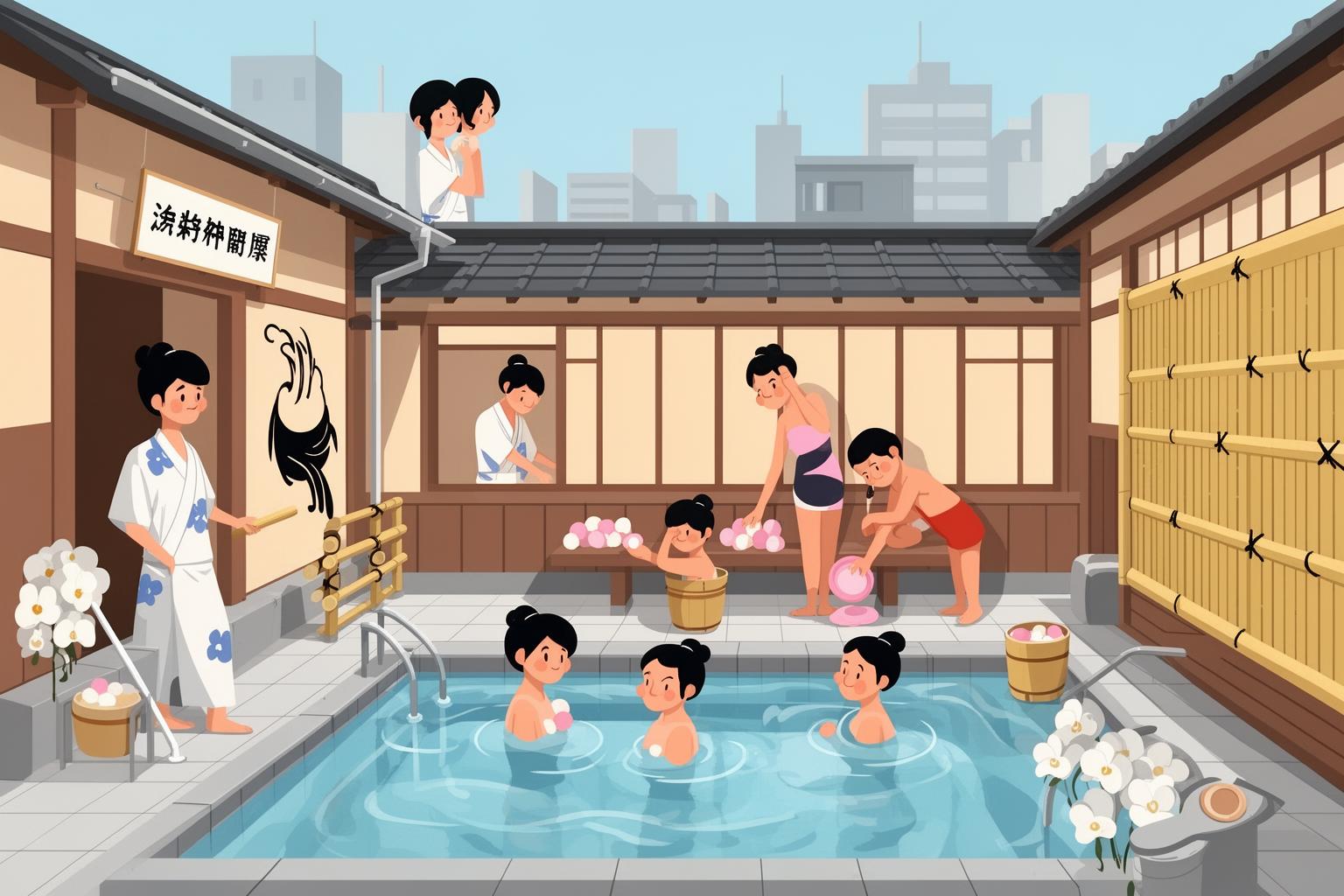
Now that you’re clean, you’re ready for the main event: the baths themselves. But stepping into that steaming pool isn’t like diving into a swimming pool. It’s a carefully choreographed entrance, a ritual that signals your readiness to join the collective. This is where the subtlest rules of sento etiquette come into play, and where your awareness will be most closely observed.
The ‘Kakeyu’ Ritual: A Public Declaration of Purity
You’ve already washed your body thoroughly at your station. So why, just before stepping into the bath, must you take a bucket of bath water and pour it over yourself again? This is kakeyu, perhaps the most misunderstood yet vital ritual of the sento. It’s not for your benefit alone; it’s for everyone else. The kakeyu serves two main purposes. First, a practical one: it helps your body adjust to the extreme heat of the water, preventing a sudden shock. But more importantly, it serves a social function. It’s a public act of respect. By rinsing yourself with the very water you are about to enter, right at the tub’s edge, you make a visible, final declaration to those already bathing: “I am clean. I am mindful. I am ready to join you without contaminating our shared space.” You show that you understand the water is a precious communal resource. The number of scoops is a matter of personal style; some veterans perform an extended, almost ceremonial series of douses, covering every part of their body. As a newcomer, a few solid pours over your lower body and torso suffice. The key is visibility. Do it right at the bath’s edge, so there’s no doubt. Skipping the kakeyu and simply stepping in is the equivalent of wearing muddy shoes into someone’s home. It’s a fundamental breach of etiquette that will earn disapproving glances or even direct corrections.
The Towel Conundrum: A Tiny Piece of Cloth, A Mountain of Meaning
In your hand, you’ll have a small, thin towel, roughly the size of a large washcloth. This tiny piece of fabric is subject to more unwritten rules than almost anything else in Japan. It’s your modesty towel, sweat-wiper, and headrest—but one thing it must never be is a teabag. Under no circumstances should this towel touch the bathwater. Letting it dip into the tub is a major faux pas. The reasoning is simple: the towel, used for scrubbing your body, is considered dirty. Allowing it to soak in the communal water is both unsanitary and deeply disrespectful to fellow bathers.
So, what should you do with it? You have two socially acceptable options. The most common and iconic is folding it neatly and placing it on top of your head. This might feel odd at first, but look around; men and women of all ages wear it this way. It keeps the towel clean and out of the way—and as a bonus, a cold, wet towel on your head can feel wonderful in the sweltering heat of the bath. The second option is to place it on the side of the tub, on a rock, or any other dry surface away from the water. Just don’t forget it when you leave. The big, fluffy towel for drying off should stay in your locker; bringing it into the bathing area is a rookie mistake. The small towel is your only companion in the water, and managing it correctly silently signals that you know the rules. It’s a small detail, but in the world of the sento, details mean everything.
The Silent Language of the Sauna and Mizuburo
Many sento feature a sauna and an adjacent cold plunge pool, the mizuburo. If the main bathing area is the social living room, this section is the serious training ground. The atmosphere here is different. Jovial chatter fades away. This space is for endurance, ritual, and intense, non-verbal communication. When entering the sauna, take one of the small mats provided, if available, to sit on. This creates a barrier between your sweat and the wooden bench—a matter of hygiene. Sit quietly; this isn’t a place for long conversations. People focus on their breathing and enduring the heat. A silent nod to those already inside is appropriate. When the heat becomes too much, exit and head to the mizuburo. But do not go directly into the cold water. This is a critical mistake. You must first rinse off your sweat—a practice called kakezu. Usually, there will be a faucet or a bucket of cold water next to the plunge pool for this purpose. Rinse thoroughly; this shows respect for the shared water as you wash away your sweat before entering. After rinsing, enter the mizuburo slowly. There’s a silent bond among sauna enthusiasts, a shared reverence for the ritual. Splashing or cannonballing into the cold pool breaks this unspoken pact. After your plunge, avoid dripping water back into the sauna; towel off a bit before re-entering. This cycle—sauna, rinse, cold plunge, rest—is both a deeply personal and communal ritual. Navigating it correctly shows a high level of sento literacy and an understanding that different areas within the same facility each have their own distinct social codes and atmospheres.
The Human Element: Conversation, Confrontation, and Community
Now that you’ve mastered the physical etiquette, it’s time to navigate the most intricate aspect of the Osaka sento experience: the people. This is where the city’s character truly comes alive, in all its curious, direct, and communal splendor.
‘Are You New Here?’: The Osaka Welcome Mat
Don’t be surprised if, while soaking in the main tub, a complete stranger turns to you and strikes up a conversation. It might start with a simple remark about the weather or a comment on the water’s heat. Often, though, it will be more straightforward: “Anchan, anata hajimete?” (“Hey kid, you new here?”). This isn’t an interrogation. It’s an opening—a sign of curiosity and, in its own way, a welcome. In many other parts of Japan, initiating a conversation with a stranger in such a vulnerable setting would be a major social breach. In Osaka, it’s normal. It’s how the community functions. They want to know who you are, where you come from, and what brings you to their neighborhood. Answer honestly and with a smile. Your imperfect Japanese will be met with patience and encouragement. This is your opportunity to practice, learn local slang, and hear stories you won’t find in any book. This is the famous Osaka friendliness, but it’s not the shallow, service-industry kind from a hotel concierge. It’s pragmatic, curiosity-driven friendliness. You are a new element in their daily routine, and they want to get to know you. Embrace it. Ask questions in return. Before long, you might be receiving recommendations for the best local okonomiyaki or a firm lecture on why the Yomiuri Giants are the worst baseball team in history. This is how you stop being a visitor and start becoming part of the scenery.
The Gentle Admonishment: Understanding the ‘Obachan’s’ Advice
At some point, you will break a rule. You might forget to rinse your stool, let your towel slip into the water, or accidentally splash someone. When that happens, it’s highly likely your correction will come from a small, wrinkled, and surprisingly loud old lady, or obachan. She’ll emerge from the steam like a spirit of the bath, point a finger at you, and tell you exactly what you did wrong. Your initial reaction may be embarrassment or defensiveness. You might feel scolded by a stranger. But this is the wrong interpretation. The obachan is not a Japanese “Karen.” She is the self-appointed guardian of the sento’s customs, performing an essential community service. By correcting you, she isn’t aiming to shame you; she’s trying to teach you. She’s welcoming you into the fold. Her directness is a form of care. It shows she sees you not as a tourist to ignore, but as a potential community member who needs to learn the ropes. The proper response is a humble and immediate apology: “Ah, gomen-nasai! Arigatou gozaimasu!” (“Oh, I’m so sorry! Thank you!”). Thanking her is crucial. It shows you understand she’s helping, not attacking you. She’ll likely respond with a satisfied huff, and the matter will be settled. You’ve learned a lesson, shown respect, and passed an important social test. Earning the sento obachan’s nod of approval is like receiving a passport to the neighborhood.
‘Hadaka no Tsukiai’ – Osaka Style
There’s a well-known Japanese phrase, hadaka no tsukiai, which translates to “naked fellowship” or “naked communion.” It refers to the idea that when everyone is stripped of clothing, status, and pretenses, more honest and open communication can occur. While this concept exists across Japan, it has a distinctly Osaka flavor. In other regions, it might take the form of a quiet, contemplative, almost spiritual sense of shared vulnerability. In Osaka, it’s much more literal and far less poetic. It means that when you’re both naked in a hot tub, there’s no need to stand on ceremony. It’s the ultimate icebreaker. The conversation is raw, direct, and unfiltered. You’ll hear people complaining about their bosses, their spouses, their aches and pains. You’ll hear awful jokes told with great enthusiasm. You’ll witness debates on politics as heated as the water itself. It’s democracy at its purest. The sento is the great equalizer. Your job, nationality, or wealth—none of that matters here. All that matters is you’re sharing the same water, steam, and moment. Listening to these conversations is like tapping directly into the city’s soul. It’s where you’ll truly understand what Osakans care about, what makes them laugh, and what makes them angry—far better than any newspaper or TV show could ever convey.
Beyond the Bath: The Dressing Room and the Front Desk
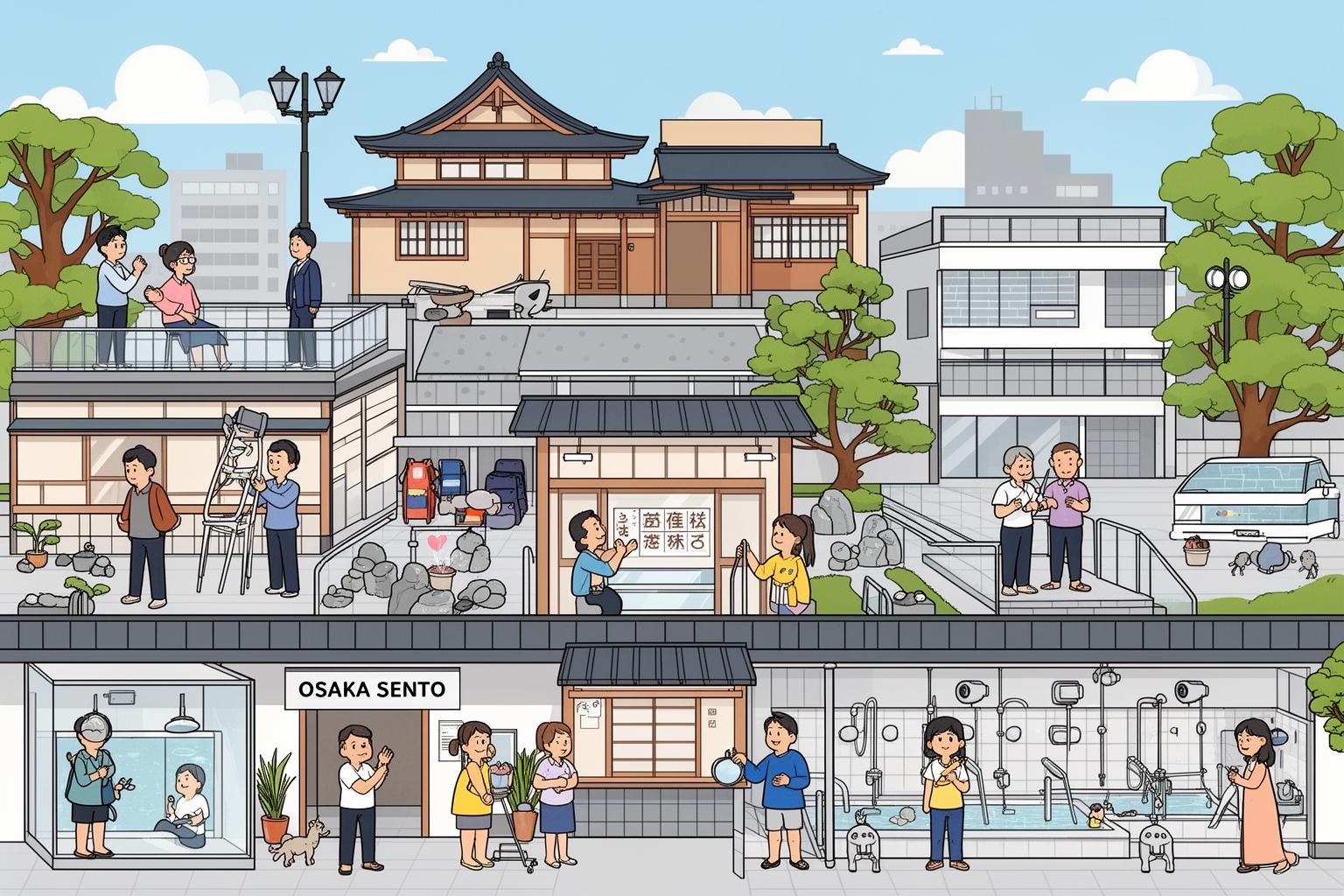
The experience doesn’t end once you leave the water. The datsuijo, or changing room, and the lobby area serve as the final acts of the sento ritual, each with their own set of customs and social moments.
The Post-Bath Ritual: Milk, Beer, and Lingering
After drying off completely (before entering the changing room—dripping is considered a faux pas), the post-bath ritual begins. You’ll find a row of vintage vending machines or coolers stocked with small glass bottles. The classic choice is coffee milk or fruit milk. There’s something uniquely satisfying about drinking an ice-cold, sweet milk beverage after a hot bath. This tradition spans generations, with both elderly men and young children enjoying the same simple pleasure. The proper way is to place one hand on your hip and down the entire bottle in a single go. For many, a cold beer is the preferred alternative. Grabbing a can of Asahi or Kirin and sitting on one of the vinyl benches in the lobby is a common way to unwind. This cool-down period offers another opportunity for socializing. Conversations started in the bath might continue here. People linger, read newspapers, watch sumo matches on the old CRT television, and chat with the owner. Leaving immediately after getting dressed is seen as somewhat odd, almost antisocial. The sento experience includes this time for relaxation and winding down—it’s part of the value you’ve paid for.
The ‘Bandai-san’: The Heartbeat of the Sento
Perhaps the most important person in the entire place is the one seated at the high reception desk, the bandai. Often the owner, this person is the heart and soul of the sento. They act as gatekeeper, cashier, lost-and-found keeper, neighborhood watch, and local historian all in one. Having witnessed generations of families come and go, they know everyone’s name and story. Developing a rapport with the bandai-san is the final step in becoming a true regular. It begins with a cheerful greeting upon arrival (“Konnichiwa!” or “Otsukare-sama desu!“) and a sincere thank you upon leaving (“Arigatou gozaimashita! Ii oyu deshita!” – “Thank you! It was a great bath!”). As you become more familiar, you can start making small talk—asking about business or commenting on the weather. They are a treasure trove of local knowledge and the steady center around which the community revolves. Their approval is the ultimate sign that you’ve mastered the complex social world of the sento. When the bandai-san greets you by name as you enter, you know you’ve truly arrived. You’re no longer just a customer; you’re part of the family.
Why Sento Explains Osaka Better Than Any Guidebook
Ultimately, a visit to an Osaka sento is about much more than simply getting clean. It serves as a living lesson in the city’s core values. It’s a place that captures the spirit of the people in ways that neither a castle nor a famous restaurant ever could.
Pragmatism over Aesthetics
Many Osaka sento aren’t pristine temples of design. They are old, slightly worn around the edges, and highly functional. The tiles might be cracked, the paint peeling, but the water is always hot, the floors always clean, and the price always affordable. This is Osaka in a nutshell. It’s a city that prioritizes substance over style, function over form. A sleek, minimalist, designer sento may be trendy in Tokyo, but in Osaka, the local bathhouse is a reliable workhorse. It performs its role without fuss or pretense. This straightforward pragmatism defines the Osakan mindset. Why pay extra for frills when you can enjoy a perfectly good, scalding hot bath and a sense of community for less than the cost of a cup of coffee?
A Community Woven from Water and Steam
Above all, the sento reveals that despite its urban sprawl, Osaka is a city of villages. Each neighborhood has its own rhythm, characters, and gathering spots, with the sento often being the most important. It is a vital piece of social infrastructure, especially for the elderly, for whom it may be their main social contact of the day. It’s where relationships are built and sustained, information exchanged, and the lonely find companionship. In an increasingly digital and isolated world, the Osaka sento stands as a stubborn, beautiful bastion of face-to-face, skin-to-skin human connection. So next time you stroll down a quiet residential street in Osaka and spot that iconic tall chimney and small curtained entrance, don’t just pass by. Take a breath, grab a small towel, and step inside. Be quiet, observant, and humble. If you can learn the dance, if you can understand the language spoken in steam and splashes, you won’t just enjoy a great bath—you’ll discover the warm, beating heart of this remarkable city.