Coming from Tokyo, you get used to a certain rhythm. It’s a city of polished surfaces, seamless transactions, and a kind of elegant, respectful distance. Streets are designed for movement, for getting from point A to point B. Shops are designed for efficient, predictable service. You tap your card, you receive your perfectly packaged item, you exchange a polite, scripted set of thank yous, and you merge back into the human river. It works. It’s clean, it’s fast, and it’s profoundly impersonal. Then, you move to Osaka, and you walk into your first real, neighborhood shotengai. And that Tokyo rhythm shatters into a million noisy, vibrant, beautifully chaotic pieces. It’s not a river; it’s a whirlpool. A warm, welcoming, and utterly confusing whirlpool.
My first time in the Komagawa Shotengai in the southern part of the city, I wasn’t trying to buy anything specific. I was just exploring. But within ten minutes, the owner of a fruit stand had insisted I try a slice of melon, a woman at a fish stall was explaining—using a lot of gestures and booming laughter—the absolute best way to grill mackerel, and a group of elderly ladies sitting on a bench in front of a closed storefront had pulled me into a twenty-minute conversation about their grandchildren and my questionable Japanese accent. I left with a bag of groceries I hadn’t planned on buying and a feeling I couldn’t quite place. It wasn’t the efficiency of Tokyo. It was something else entirely. It was connection.
This is the fundamental misunderstanding many people, Japanese and foreigners alike, have about Osaka. They hear it’s “friendly” and assume it’s a superficial personality trait. But it’s not. It’s a structural part of the city’s social fabric, and the shotengai—the covered shopping arcades that snake through nearly every neighborhood—are the looms where that fabric is woven every single day. They are not just commercial corridors. They are the city’s shared living rooms, its open-air community centers, its beating, human heart. To understand the shotengai is to understand the unspoken social contract of Osaka, a contract that values human relationships over sterile efficiency, and community over anonymity. For anyone trying to build a life here, figuring out the rhythm of the shotengai is the key to unlocking the entire city.
This vibrant, community-focused rhythm is also palpable in other unique districts, such as the raw and authentic Nishinari Ward.
The Transaction Versus The Conversation

To truly understand the spirit of an Osaka shotengai, you must first recognize its exact opposite: the commercial streets of Tokyo. Whether it’s the high-fashion boulevards of Omotesando or a quiet neighborhood shopping lane in Setagaya, the Tokyo experience revolves around the flawless execution of the transaction. The interaction is a polished, well-practiced performance designed to be as smooth and effortless as possible.
Tokyo’s Refined Professionalism
Imagine entering a meticulously curated boutique in Daikanyama, Tokyo. The lighting is gentle, the music ambient, and the air carries a subtle scent of cedar and fine linen. A staff member, impeccably dressed, approaches only after giving you a respectful moment to settle in. They bow lightly. “Irasshaimase,” they greet you, their tone calm and measured. “Welcome.” Should you need assistance, they offer it with comprehensive knowledge of their products, speaking in formal, honorific Japanese—keigo—which establishes a clear, professional boundary. You are the o-kyaku-sama, the honored guest, while they are the service providers. The roles are distinct and appreciated.
When you decide to buy something, the process becomes a precise ritual. The item is treated with care, wrapped in layers of tissue paper, and placed into a crisp bag with neatly aligned handles. Your payment is received with both hands. Your change is returned on a small tray, never handed to you directly. The final exchange involves a series of bows and polite thank-yous. “Arigatou gozaimashita. Mata o-koshi kudasaimase.” “Thank you very much. Please come again.” It is impeccable, respectful, and entirely impersonal. You could have been anyone—the performance remains the same. The aim is satisfaction through perfect service, not personal connection. You leave feeling served, but not necessarily noticed.
Osaka’s Personable Commerce
Now, let’s travel to a butcher shop in Tenjinbashisuji Shotengai, Japan’s longest shopping arcade. The air is thick with the aroma of fried croquettes and filled with the lively chatter of multiple conversations. The owner, a man in his sixties wearing a blood-stained apron and speaking loudly, spots you examining cuts of pork. “Anata, nani suru no?” he calls out over the counter. “You, what are you making?” It’s direct and informal—there’s no o-kyaku-sama here. You’re simply “you.”
You might mention considering making tonkatsu. He responds with playful skepticism. “Ah, tonkatsu! This cut won’t do; it’ll be too tough! You need this one here, the rosu. See that fat? That’s where the flavor is!” He’s not trying to upsell but advising you like a gruff uncle who secretly wants you to succeed. While weighing your meat, he’s already chatting with the customer next to you, teasing them about their beef choice. “More yakiniku? You’ll get fat!” Laughter erupts. He wraps your pork in plain waxed paper, tosses it into a thin plastic bag, and tells you the price. As you pay, he might notice your bag from the neighboring vegetable stall. “Ah, you got cabbage from Tanaka-san? Good. His stuff’s the best. Tell him I said he’s a cheapskate!”
This is not a transaction; it’s a conversation with a purchase intertwined. The service is not polished but personal. The shopkeeper isn’t playing a role; he’s being himself. He remembers you, knows what you cooked last week, offers unsolicited but usually excellent advice, and connects you to the network of other shopkeepers and customers nearby. You leave not only with pork but with a story, a laugh, and a sense of belonging.
The Delicate Art of Commercial Banter
This contrast stems from language and intention. In Tokyo, commercial language aims to maintain respectful distance. In Osaka, it seeks to bridge that gap. The playful teasing, direct questions, and informal speech all serve as social bonding. It’s a way of saying, “We’re all in this together. We’re neighbors.” Outsiders, and even people from other parts of Japan, might initially mistake this for rudeness. Tokyo residents might be startled by a shopkeeper’s personal questions or jokes at their expense. But in Osaka, this banter—often resembling the classic comedy duo dynamics of boke (the silly fool) and tsukkomi (the sharp reply)—is a sign of affection. If the butcher teases you, it means he likes you. It means you’re part of the community. It’s a verbal handshake, a rapport-building gesture far deeper than the polished politeness of the capital. It’s a system rooted in personality, not just product. And in an era of growing automation and anonymity, it feels refreshingly and wonderfully human.
A Space for Living, Not Just for Buying
The physical design and social role of shopping areas in Tokyo and Osaka reflect their fundamental philosophies. Tokyo’s commercial districts serve as destinations you visit with specific intentions: to purchase a particular brand, dine at a renowned restaurant, or view a specific exhibit. They function as points on a map. In contrast, an Osaka shotengai is not a point; it’s a line—a connective thread running through a neighborhood where the ordinary, essential, and joyful activities of daily life play out in public.
The Shotengai as the Neighborhood’s Living Room
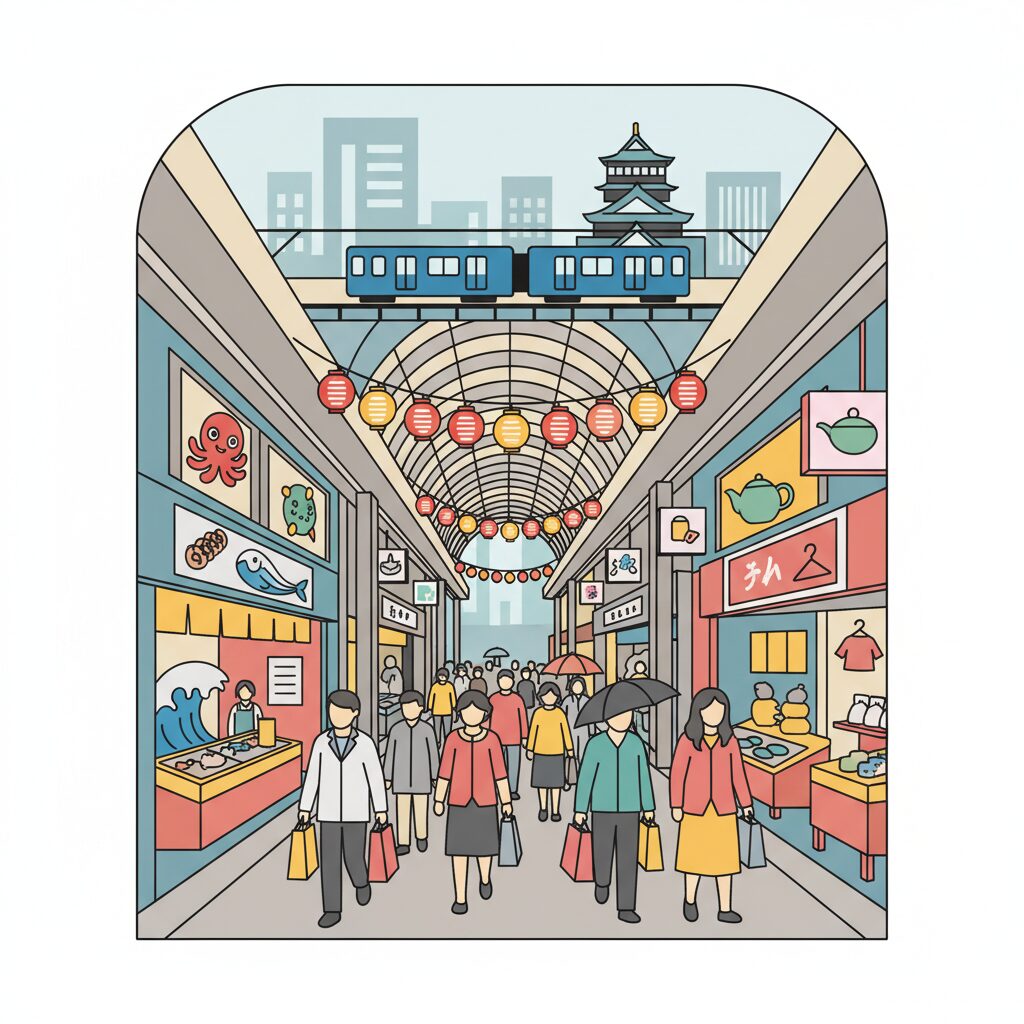
Stroll through a shotengai on a typical weekday afternoon. Yes, people are shopping, purchasing daikon radishes, fresh tofu, and socks. But look more closely—what else is happening? A group of grandmothers occupy a bench intended for tired shoppers, yet they carry no bags. They’ve been sitting for hours, sipping tea from thermoses, chatting, and watching passersby. A cluster of elementary school children, backpacks bouncing, crowd around the croquette stand, spending their pocket money on an after-school treat. The local pharmacy owner stands outside sweeping the pavement while exchanging gossip with the kimono shop proprietor across the way. A community bulletin board displays notices for a neighborhood flea market, a lost cat flyer, and a child’s crayon drawing of the shotengai mascot. This is not a mall food court; it’s a covered public square. It is a safe, multi-generational space where the lines between public and private life blur. People don’t merely pass through; they linger. They exist. Commerce here feels almost incidental—the primary purpose of the space is to nurture community.
The Rhythm of Daily Rituals
This purpose influences the daily routines of residents. In Tokyo, life often revolves around a weekly trip to a large supermarket. You drive or take the train, fill a cart with pre-packaged goods for the week, and return to the relative solitude of your apartment. It’s efficient. Meanwhile, in many older Osaka neighborhoods, daily life remains centered on the daily walk to the shotengai. It’s a ritual. You visit in the morning to buy vegetables for that evening’s meal when they’re freshest. You may stop by the fishmonger to check on the best catch before planning your menu. You drop by the bakery to greet the owner and pick up a loaf of bread. This isn’t inefficient; it’s a different kind of efficiency—social efficiency. Each small errand doubles as a chance for social interaction, an opportunity to connect, to be seen and to check in with your community. It counters isolation and keeps people active and engaged. This daily, rhythmic movement is what sustains the social fabric, transforming mundane grocery shopping into continuous community upkeep.
More Than a Customer: The Path to Becoming a Jōren
Within this ecosystem, the ultimate aim is to graduate from a mere customer, an o-kyaku-san, to a jōren, a regular patron. This status is earned over time through consistent visits and genuine interaction. Becoming a jōren is more than just earning loyalty points; it’s a social promotion. It carries both tangible and intangible rewards that embody the essence of Osaka’s community-centered commerce. The tangible is the well-known omake, meaning “a little extra.” The fruit vendor tosses a few extra mikan into your bag. The butcher adds scraps of fat for soup. The tempura vendor slips in an extra piece of fried lotus root. This is no discount—it’s a gift. A gesture that says, “I see you, I appreciate you, you belong here.” It’s a physical symbol of the relationship you’ve cultivated.
The intangible benefits are even more profound. As a jōren, the shopkeeper becomes a trusted advisor. They’ll hold the best fish for you because they know you’re coming. They’ll advise which apples are the sweetest that week. They’ll inquire about your family and notice if you haven’t been around lately, showing genuine concern. They become a vital node in your social support network. In a society where people can feel isolated even in sprawling cities, the jōren system of the shotengai offers a powerful, grassroots safety net—a system of mutual recognition and care that takes the form of everyday purchases.
The Unspoken Rules of the Arcade

Every social space has its own unwritten codes of behavior, and the shotengai is no different. For newcomers, especially those used to the more reserved and orderly public spaces of Tokyo, the sensory atmosphere and social customs of an Osaka arcade can be overwhelming. Grasping these unspoken rules is essential for navigating and eventually appreciating the distinct energy of these areas. It involves adjusting your expectations of sound, space, and interaction.
Permission to Be Loud
One of the first things that stands out is the noise. It’s a raucous soundscape, but a joyful one. In Tokyo, public spaces are generally governed by an unspoken expectation of quiet respect. On trains, conversations are hushed. In stores, the sounds are often limited to soft background music and polite service murmurs. The Osaka shotengai follows the opposite approach. Here, noise signifies life. It’s called nigiwai, a term that doesn’t translate well to “bustle” or “liveliness” but encompasses much more. It represents the positive energy created by a crowd of people engaging with one another. Vendors’ calls—the famed damiya-goe, or “hoarse voice” from shouting all day—are an essential element of the soundscape. “Yassui de! Yassui de!” (“It’s cheap! So cheap!”) they shout. The conversations of shoppers, laughter, the sizzle of food frying, and the slightly metallic sound of the shotengai’s theme song playing on repeat combine into a symphony of human activity. Trying to stay quiet here isn’t just unnecessary, it feels strange. Embracing the noise is the first step to feeling comfortable. It’s audible evidence that the community is vibrant and thriving.
Personal Space is a Negotiation
Japan is renowned for its respect for personal space. People line up neatly and avoid physical contact on the street. This is largely true in Osaka too, but the shotengai is a notable exception. These arcades are often narrow, cluttered, and lively. People stop suddenly to check out something. Shop displays extend into the walkway. Bicycles somehow thread their way through the crowd. You will be bumped. Your personal space will be encroached upon. The key is to understand the local response. In Tokyo, an accidental bump is often met with a series of sincere apologies. In an Osaka shotengai, it’s more likely greeted with a quick “Ah, gomen” (“Oops, sorry”) and a smile, or sometimes no acknowledgment at all. It’s not rude; it’s a normal part of navigating a shared, bustling space. The expectation isn’t that everyone keeps perfect distance, but that everyone remains adaptable and good-natured about the inevitable jostling. It’s a physical reflection of the social philosophy: we’re all packed in here together, so let’s just make it work.
Loyalty is a Two-Way Street
The economic model of the shotengai is built on a foundation of mutual loyalty that seems almost old-fashioned in the era of Amazon Prime. Residents support their local shops, even if they could buy the same items a few yen cheaper at a large supermarket, because they are supporting their neighbors. They are investing in the wellbeing of their own community. This isn’t mere sentimentality; it’s practical. They know that Mrs. Sato at the tofu shop uses better soybeans and that Mr. Yamamoto at the fish stall knows exactly how to handle a live eel. They trust the quality and expertise that comes from years of specialization. But this loyalty isn’t one-sided. The shops, in turn, are fiercely loyal to their customers. They provide the omake, the advice, and friendly conversation. They might even extend informal credit to a trusted jōren who forgot their wallet. During festivals, they come together to offer food, games, and entertainment for the neighborhood. They aren’t just businesses; they are community stakeholders. This reciprocal relationship—go-hiiki ni, or mutual patronage—is a powerful force that has helped many shotengai survive and even flourish amid competition from anonymous corporate chains.
What This Means for Your Life in Osaka
Understanding the social dynamics of the shotengai is more than just a fascinating cultural insight; it serves as a practical roadmap for building a fulfilling life in Osaka as a foreigner. Whereas Tokyo can sometimes feel like a city of countless private, closed doors, Osaka’s shotengai provide a public, approachable gateway into the heart of the community. It’s a ready-made social fabric waiting for you to engage with it.
Finding Your Place in the Community
For non-Japanese residents, loneliness and social isolation can pose significant challenges. Building a genuine social network from scratch can be overwhelming. In Osaka, the shotengai acts as the ultimate shortcut. The approach is straightforward: choose a few shops in your local arcade—a vegetable stall, a coffee shop, a butcher—and visit them regularly. Try to say a bit more than just “Kore o kudasai” (“This, please”). Ask a simple question like, “Kyou no osusume wa nan desu ka?” (“What’s your recommendation today?”). Compliment their products. Share what you cooked with the ingredients you bought last time. Initially, it might feel awkward, but consistency is crucial. Soon, they will begin to recognize you, greeting you with a nod, then a “Maido!” (“Thanks always!”), and eventually engaging in full conversations. Through these small, repeated interactions, you shift from being an anonymous foreigner to a familiar face, a personality, a neighbor. You become a part of the local fabric. This is how you build a support network. When the elderly man at the tea shop starts asking where you’ve been because he hasn’t seen you in a week, you know you’ve truly connected.
Redefining Convenience
In modern times, and especially in Tokyo, convenience is often defined by speed, 24/7 access, and seamless digital transactions. Osaka’s shotengai, however, embody an older, more human-centered sense of convenience. It is the convenience of trust—knowing that the fishmonger will never sell you anything less than perfectly fresh. It is the convenience of expertise—having someone to ask, “How do I cook this unusual root vegetable?” It is the convenience of relationship—the tofu maker who sets aside a block of the best tofu for you because he knows you’ll drop by after work. This kind of convenience isn’t about saving five minutes on a purchase; it’s about enriching everyday life through dependable, human connections. It replaces the cold efficiency of a vending machine with the warm, if sometimes unpredictable, reliability of a neighbor.
A Real-World Language Lab
For anyone trying to improve their Japanese, the shotengai is the best classroom in the city, and it offers free tuition. Unlike a formal classroom or a reserved Tokyo café, the language here is authentic, unfiltered, and forgiving. You’ll hear thick Osaka-ben, the local dialect, which is both a challenge and a reward. The interactions are repetitive, which greatly aids learning. You’ll buy the same few items weekly, using the same basic phrases, gradually gaining confidence. Most importantly, people are patient and often delighted that a foreigner is making an effort to engage with them and their culture this way. They will speak slowly, use expressive gestures, and laugh with you over your mistakes. You’ll learn practical, everyday vocabulary you won’t find in textbooks. You’ll learn how to joke, compliment, and engage in the natural give-and-take of genuine conversation. In the shotengai, your language mistakes aren’t embarrassing—they mark the beginning of a connection.