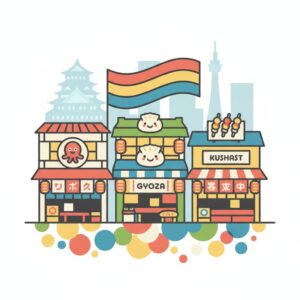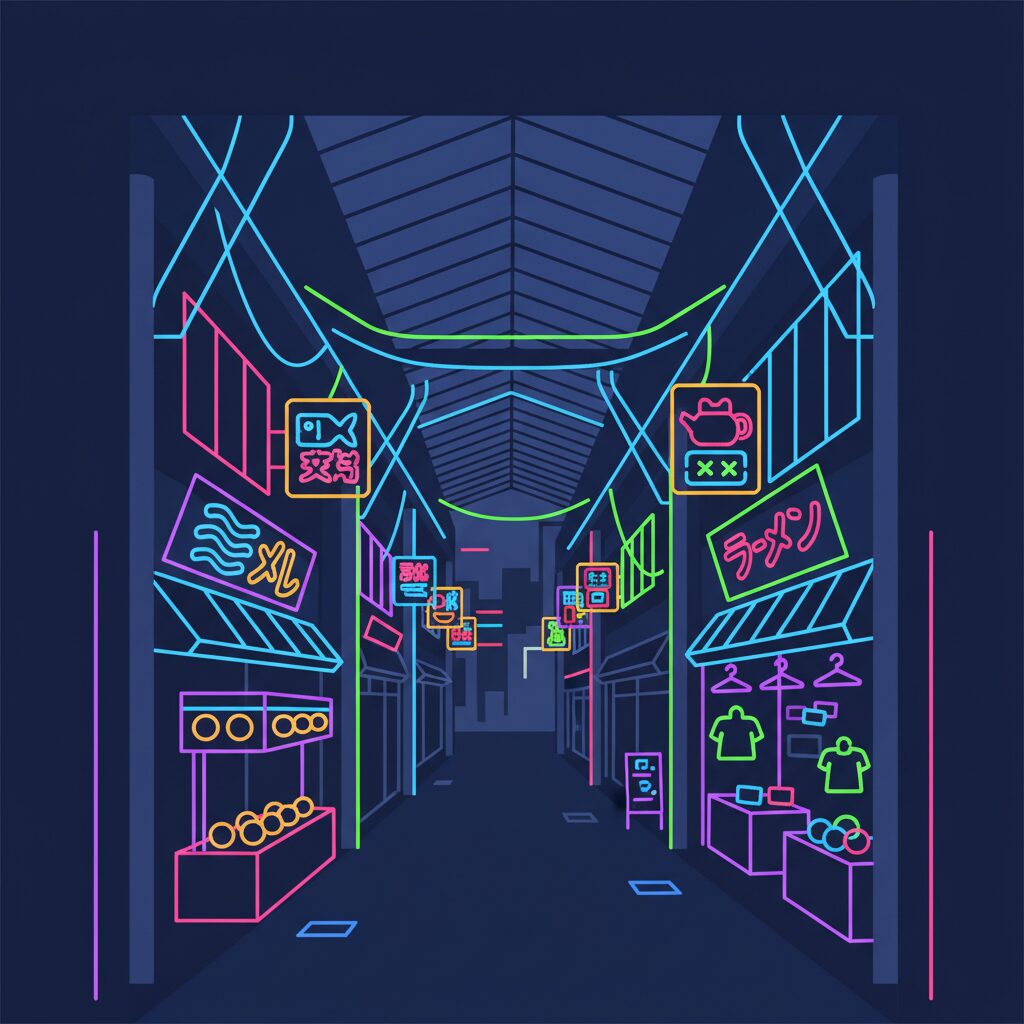
Step into an Osaka shotengai, and your first impression is a sensory flood. It’s a river of life flowing under a plastic or glass roof, a chaotic, beautiful mess of bicycles, banners, and boisterous chatter. You might see it as just a charming, old-fashioned shopping street, a photogenic backdrop for your life in Japan. But that’s like looking at the ocean and only seeing the surface. A shotengai isn’t a place you simply visit to buy things. It’s a social ecosystem, a neighborhood’s living room, and the stage for the daily performance of what it means to be Osakan. Forget what you think you know about polite, reserved Japan. Here, under these weathered arcades, an entirely different set of rules applies. To thrive in Osaka, to truly understand its rhythm and its soul, you must learn to navigate this vibrant, messy, and deeply human world. It’s the difference between being a tourist in your own life and becoming a true resident.
Dive deeper into Osaka’s culinary side by exploring a local supermarket guide that uncovers the vibrant, everyday rituals of dining like a resident.
The Living Room vs. The Mall
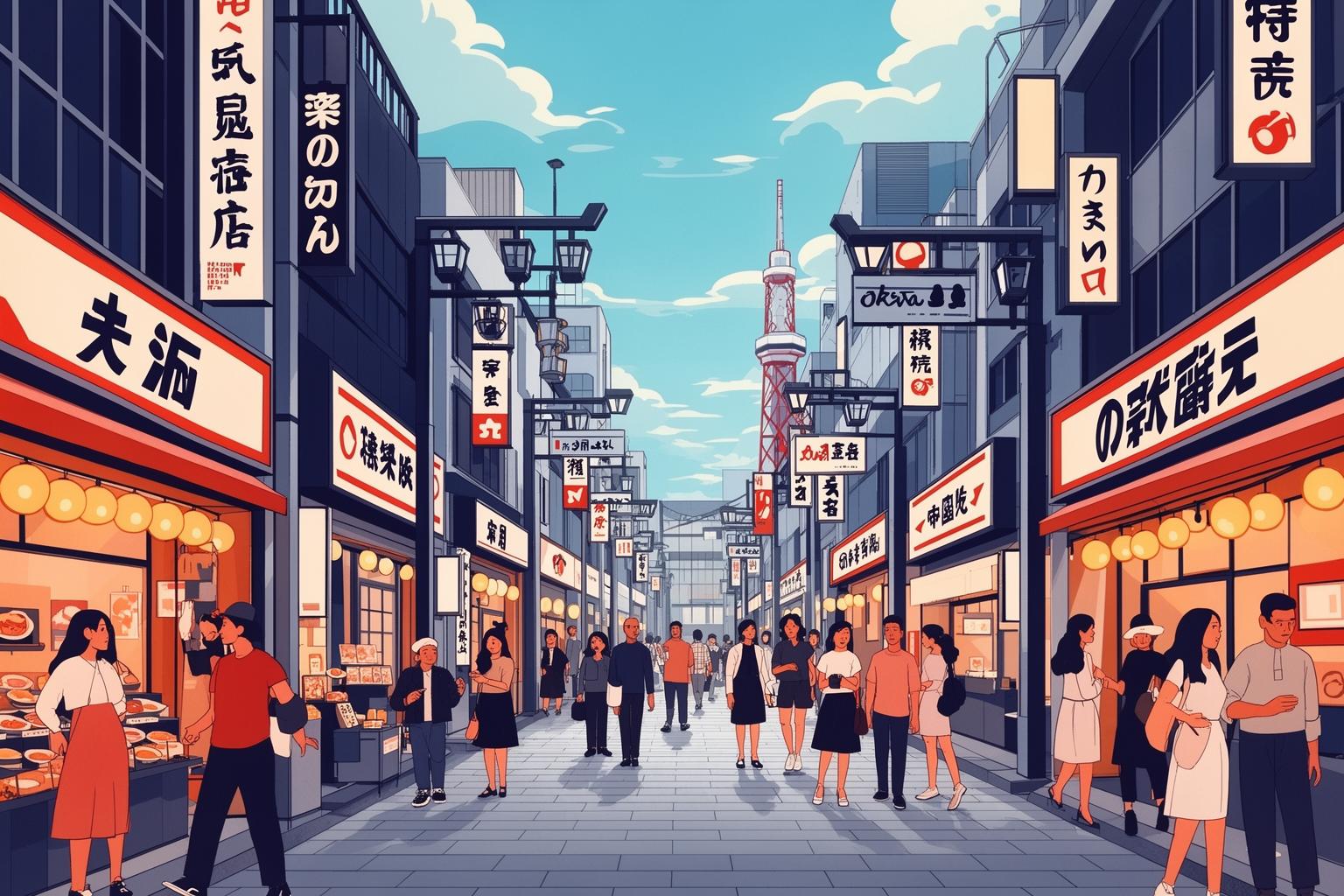
In Tokyo, you shop. In an Osaka shotengai, you take part. This is the key distinction that took me years to truly understand. A modern shopping mall, or even one of Tokyo’s sleek, curated shopping streets, is designed for seamless, frictionless commerce. It’s a quiet, climate-controlled environment where you choose your items, pay, and leave. The background is a generic BGM loop. The interactions are scripted: “Irasshaimase,” “Arigatou gozaimashita.” It’s tidy, efficient, and completely impersonal.
An Osaka shotengai is the exact opposite. It’s a place of friction, in the most positive sense. It’s chaotic, noisy, and deeply personal. The soundtrack isn’t a playlist; it’s the percussive chop of a butcher’s cleaver, the sharp sizzle of takoyaki batter hitting a hot iron plate, the creaky wheel of an elderly woman’s shopping cart, and above all, the constant buzz of human voices. Shopkeepers aren’t silently waiting for your business; they are shouting, “Yasui de! Oishii de!” (It’s cheap! It’s delicious!), engaging in loud, theatrical banter with each other across the street, and greeting familiar faces with a hearty “Maido!”
The Currency of Conversation
Here, the transaction is secondary. The primary exchange is social. You can’t just point at a block of tofu, grunt, and hand over your money. Doing so would be jarringly rude, breaking the unspoken social contract. The proper procedure involves a series of acknowledgements. You must first engage with the person. A comment on the weather is the classic opener: “Kyou wa ee tenki ya naa!” (Great weather today, huh!). Then, you might ask about their family or mention something you bought last week. Only after this social lubricant has been applied can you move on to business.
Buying vegetables becomes a consultation. You don’t just grab a daikon radish; you ask the bright-eyed obachan at the stall, “Kyou no daikon, dou?” (How’s the daikon today?). She’ll pick one up, slap it affectionately, and give you an honest evaluation. “This one’s perfect for oden, but if you’re making a salad, you want this other one.” She’s not just a vendor; she’s your culinary advisor. This is what foreigners get wrong when they hear “Osaka people are friendly.” It’s not a generic, smiling friendliness. It’s an assertive, participatory friendliness that demands engagement. It’s a practical friendliness rooted in a merchant culture where relationships, not individual transactions, form the foundation of business.
Speaking the Local Language
You can manage in a shotengai with standard Japanese, but to truly connect, you need to understand the local dialect of commerce and community. It’s less about grammar and more about catching the subtext of a few key phrases.
More Than a Greeting: The Power of “Maido!”
You’ll hear “Maido!” (毎度) ringing throughout the arcade. On the surface, it means something like “Thanks for your continued patronage.” But it’s much deeper than that. When a shopkeeper says it to you, it’s a verbal sign of recognition. It means, “I see you. You’re one of us. You belong in this community.” The first time the stern-faced fishmonger, who had previously only grunted at me, switched from a formal “Arigatou gozaimasu” to a familiar “Maido, onee-chan!” (Thanks, sis!), I felt like I had passed a secret test. I had moved from being just a customer to becoming a recognized part of the neighborhood fabric. It’s a small word with enormous social significance.
The Dance of the Bargain and the Gift
The stereotype is that Osakans are obsessed with haggling. This is a clumsy oversimplification. You don’t haggle over a 100-yen croquette. That would be ridiculous. The “bargain” is more of a playful, relationship-building dance. It’s about showing value and recognizing the person on the other side of the counter. It often appears not as a price reduction but as an omake—a little something extra.
You might be buying a bag of mikan oranges, and the vendor will weigh them, take your money, and then, as if sharing a secret, toss two more into your bag with a wink and a “Kore, service shとku wa!” (Here, this is a little extra service!). This isn’t about the monetary worth of two oranges. It’s a symbolic gesture that reinforces the bond. It says, “I appreciate you, and I want you to come back.” Trying to aggressively bargain prices down like you’re in a souk is the wrong approach. The right way is to build rapport, be a regular, and let the omake come to you. It’s a reward for loyalty.
The Unwritten Rules of the Arcade
Navigating a shotengai involves more than just communication; it requires physical movement and an understanding of the remarkably porous boundaries between public and private spaces.
The Shotengai Shuffle
Attempting to walk through an Osaka arcade with the quick, purposeful stride of a Tokyo commuter will only lead to failure. The flow isn’t linear; it moves like a winding, unpredictable current. Elderly shoppers progress at a glacial pace, pausing suddenly to chat with a friend they haven’t seen for twenty minutes. Mothers with strollers maneuver the narrow pathways like tank commanders. And then there are the bicycles. Oh, the bicycles. They emerge from nowhere, weaving silently through the densest crowds with astonishing precision. Everyone instinctively knows the unspoken dance of yielding and anticipating. The key is to relax, slow down, and move with the collective rhythm. The shotengai isn’t just a thoroughfare; it’s a destination in itself. Racing through it means missing the entire point.
Life on Display
In Tokyo, business fronts are usually pristine and professional, keeping the shopkeepers’ personal lives out of sight. In an Osaka shotengai, however, the boundary between shop and home practically vanishes. It’s entirely normal to see the butcher’s son doing math homework on a crate behind the counter. The tatami-mat seller’s cat might be napping on a pile of samples. Through open doorways, glimpses of family kitchens and living rooms are common, with laundry hanging just out of view. This isn’t considered unprofessional; it’s simply life. The shop is an extension of the home, and you, the customer, become part of that daily life as a guest. This natural blending is why relationships form so effortlessly here. The fishmonger isn’t just a faceless vendor; he’s Tanaka-san, whose daughter just started piano lessons. This blurring of public and private lies at the heart of the shotengai’s community role. It’s a level of intimacy that can feel surprising at first but ultimately creates its profound warmth.
Osaka vs. Tokyo: Function Over Form
The contrast between the two cities is strikingly evident in their shopping streets. Many of Tokyo’s renowned old-style streets, such as Yanaka Ginza or Sugamo Jizo-dori, feel impeccably preserved, almost like a movie set. They are charming, clean, and carefully curated to enhance a visitor’s experience. They embody nostalgia in performance.
Osaka’s shotengai, on the other hand, mostly do not perform anything. They are gritty, practical, and joyfully indifferent to aesthetics. You’ll see mismatched plastic banners, faded signs handwritten in marker, and harsh fluorescent lighting. The focus isn’t on crafting a quaint vibe; it’s on supplying the community with fresh food and daily essentials at an affordable price. This is the essence of Osaka pragmatism in action. Why spend money on an elaborate sign when you can simply write it yourself and save 10 yen on cabbage? This emphasis on “function over form” might be mistaken for neglect or dirtiness, but it truly reflects the city’s core values: practicality, value, and a total lack of pretense. An Osaka shotengai is a living tool, not a tourist photo op. And that is its genuine charm.
Common Foreigner Misunderstandings
Living in and around these arcades, I’ve observed many fellow foreigners making similar initial mistakes, misinterpreting local culture through their own expectations of Japan.
The Volume is Not Aggression
The sheer noise level of an Osaka shotengai can be overwhelming. The loud calls of vendors, the direct and sometimes personal questions from shopkeepers (“You’re tall! Where are you from? You married?”), and the overall cacophony can feel aggressive or intrusive. However, in the Osaka style of social interaction, volume signifies engagement. A loud, direct approach is a sign of openness and an invitation to connect. Silence, on the other hand, is seen as cold and distant. They are not interrogating you; they are attempting to bridge the gap and draw you into their world. Embracing this with a smile and a simple response, rather than withdrawing, is the key to becoming part of the community.
The Myth of the Silent Observer
In many parts of Japan, the polite behavior for foreigners is to be quiet, respectful, and unobtrusive. This approach will not work in an Osaka shotengai. Here, you are not a passive audience watching a cultural performance. You are expected to be on stage. Trying to be a silent ghost who moves through, takes photos, and avoids interaction will mark you as a tourist, an outsider. The community is founded on a call-and-response rhythm. When a vendor calls out, you are expected to respond, even if only with a nod, a smile, or a simple “Konnichiwa.” Your participation, no matter how awkward, is what counts. To belong to the shotengai community, you have to show up.
The Gospel of Good Value
Osaka’s culture is famously shaped by the concept of kuidaore (eating oneself into ruin) and the relentless quest for things that are yasukute umai (cheap and delicious). Foreigners often associate “cheap” with “low quality,” which is a fundamental misunderstanding of Osaka merchants’ pride. In the shotengai, offering good products at low prices is a mark of honor. A vendor’s reputation, handed down through generations, depends on their ability to provide value. They see the same customers every day, and selling bad fish or rotten tomatoes is not only poor business but a personal failure, quickly becoming neighborhood gossip by nightfall. You can trust that the 100-yen korokke from the butcher shop is made with care because that butcher’s name and face are at stake.
My Saturday Shotengai Ritual
To truly illustrate, let me take you through my typical Saturday. It starts not at a trendy cafe, but in a smoky, timeworn kissaten tucked away in a side alley of the main arcade. The master, a man who seems to have been pouring coffee since the Showa era, gives me a silent nod as I settle into my usual spot at the counter. He already knows my order: a thick slice of toast with a pat of butter, a hard-boiled egg, and a cup of bitter, dark-roast coffee. This is the “morning service.” I sit and listen to the regulars, a group of elderly men, debating the Hanshin Tigers’ chances this season. This is my news feed.
Next comes the grocery run. It’s a slow, meandering journey. I start at the fruit stand, where I spend five minutes chatting with the owner about the weather before she persuades me that the seasonal loquats are unmissable. Then, it’s on to the tofu shop, where the tofu is kept in a large basin of water and scooped out to order. I buy a block of firm momen tofu and some freshly made atsuage (fried tofu). After that, I visit the fishmonger, who shouts, “The sardines are great today, perfect for grilling!” I buy three. Finally, I stop at my favorite butcher for some minced pork, and I can’t resist a freshly fried, piping-hot beef croquette to eat as I walk. Each stop is a conversation, a human connection.
The afternoon might include picking up some flowers or dropping off a pair of shoes at the tiny cobbler’s shop. In the evening, the character of the shotengai changes. The lights of the izakaya and standing bars flicker on. The air fills with the smell of grilled chicken skin and cigarette smoke. The daytime sounds of commerce are replaced by laughter and clinking glasses. The neighborhood’s living room has turned into its dining room.
This is the rhythm of life here. It’s a life lived in public, among neighbors. It’s a life built on hundreds of small, repeated interactions that weave you into the social fabric. To understand Osaka, you don’t need a guidebook. You need to find your local shotengai. You need to learn the names of the vendors. You need to brave a conversation, buy your dinner one ingredient at a time, and become part of the beautiful, chaotic, deeply human performance. This is where the city’s heart beats, loud and clear.