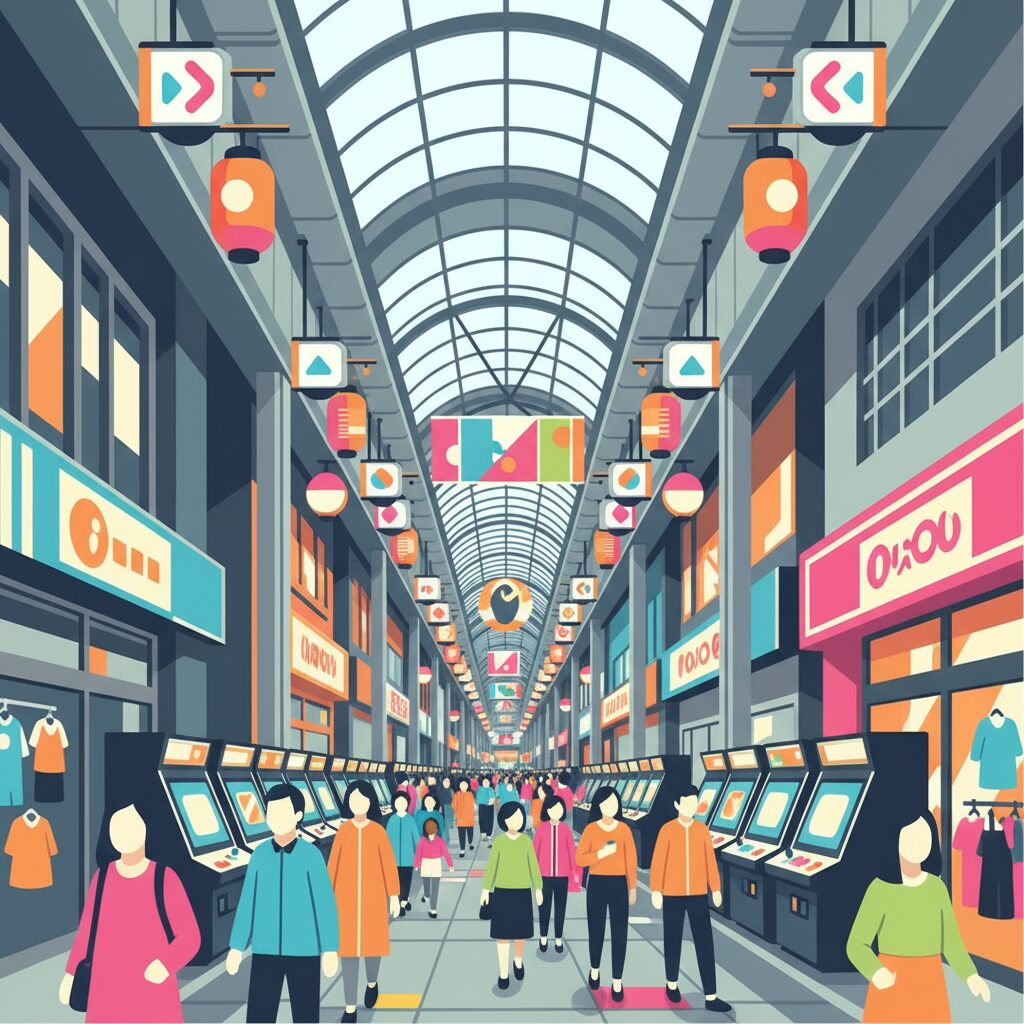
Forget the glossy image of Japan you see on postcards. Forget the silent temples, the minimalist aesthetics, the polite, reserved bows. To understand Osaka, you need to walk into the belly of the beast: the shōtengai, the covered shopping arcade. It’s a chaotic, vibrant, and relentlessly human tunnel of commerce that serves as the central nervous system for most of Osaka’s neighborhoods. This isn’t a mall. A mall is a planned, sterile environment designed for consumption. A shōtengai is an ecosystem, an organism that grew organically from the city’s merchant soul. It’s where grandmothers in house aprons haggle over the price of mackerel, where the air is thick with the smell of fried croquettes and cheap perfume, and where the soundtrack is a constant, overlapping chorus of store jingles, vendors’ calls, and the rumble of bicycles skillfully weaving through crowds.
For many foreigners, the shōtengai is a fascinating cultural spectacle, a highlight on a tourist itinerary. But what’s it actually like to live there? To have that glorious, messy, noisy spectacle as the literal extension of your front door? Living near a shōtengai isn’t just a choice of location; it’s a choice of lifestyle. It means plugging yourself directly into the raw, unfiltered current of Osaka life, with all its brilliant advantages and its exhausting drawbacks. It’s a decision that will fundamentally shape your daily experience in this city, pulling you deep into its unique cultural rhythms in a way that living in a quiet residential tower never could. Before you sign that lease for the cheap apartment right above the takoyaki stand, let’s talk about what you’re really signing up for.
To truly grasp how these arcades function as the city’s social heart, it’s essential to understand why Osaka’s shotengai are considered its living room.
The Upsides: Living Plugged into the Community’s Mainframe
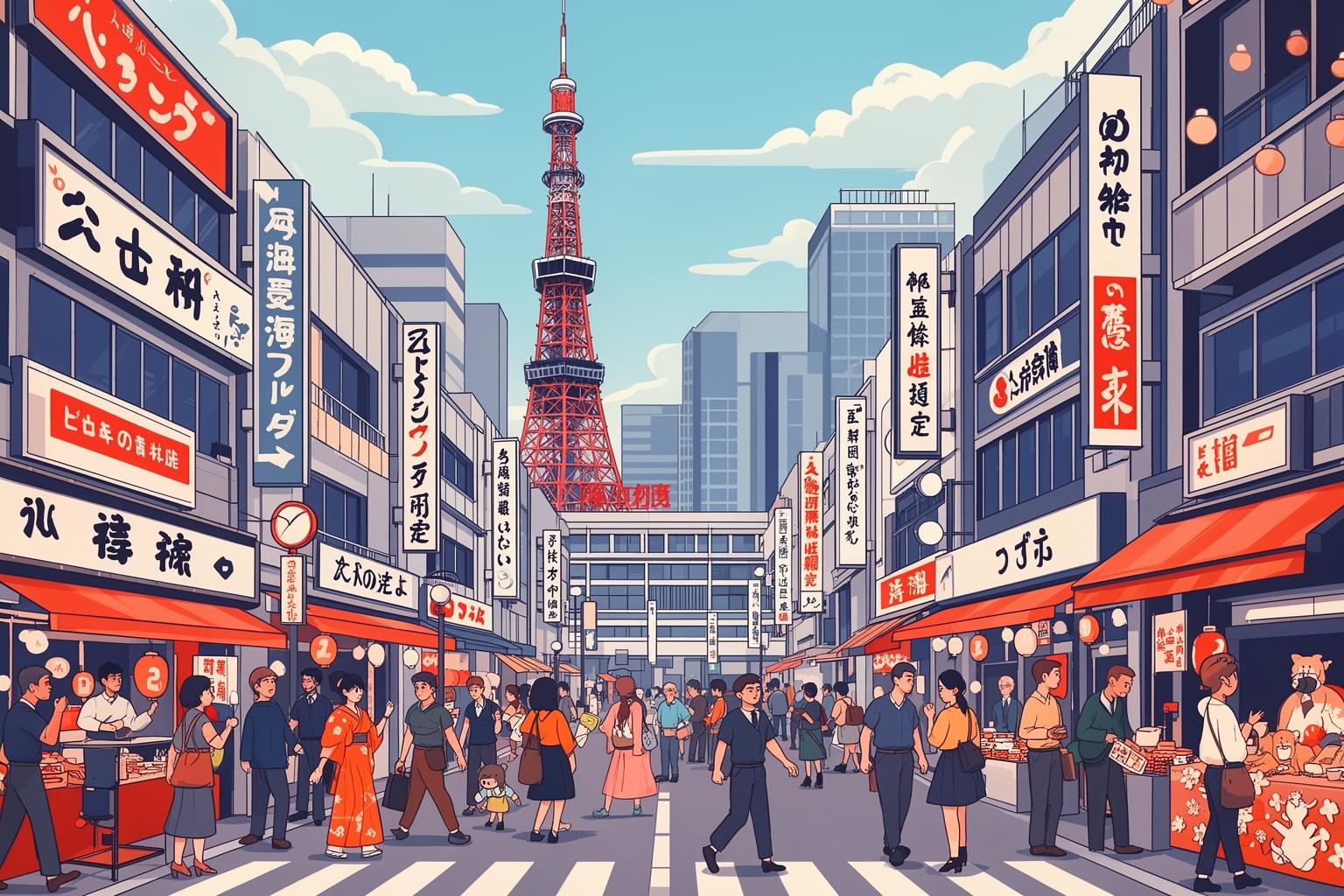
Choosing to live on the edge of a shōtengai is like choosing to reside at the city’s core, sensing every beat of its rhythm. The advantages are immediate, tangible, and deeply ingrained in the practical, people-focused culture of Osaka.
Convenience Redefined: The “Pajama-Friendly” Zone
This benefit is obvious, yet its significance is often underestimated. It’s not merely about having a supermarket nearby. It’s about a level of detailed convenience that makes life remarkably smooth. Need a single nail to hang a picture? There’s a small, cluttered hardware shop run by an elderly man who will sell you just one. Feel like making tempura spontaneously? The fishmonger offers fresh shrimp, the vegetable stall has perfect lotus root, and a specialty store two doors away sells the ideal flour—all within a one-minute walk. This ultra-locality encourages a spontaneous lifestyle. Meal planning shifts from a weekly, strategic supermarket trip to a daily walk to see what catches your eye. It’s a return to a traditional, village-like living amid a bustling metropolis of millions.
In Tokyo, convenience is often measured by proximity to train stations and their chain stores and polished supermarkets. Efficient, but impersonal. Osaka’s shōtengai convenience is different—organic, specialized, and human-scaled. You don’t just buy groceries; you buy from the fruit vendor, the tofu lady, and the butcher. This direct access to everything needed for daily life creates what I call the “pajama-friendly” zone. Though slightly exaggerated, the essence is true: the boundary between your private domestic space and the public commercial world becomes remarkably thin. You feel less like a resident of a vast, anonymous city and more like part of a lively, self-contained town.
The Human Touch: Where They Know Your Name (and Your Usual Order)
This is the heart of the Osaka difference. The shōtengai thrives on relationships. After a few weeks nearby, you stop being a faceless customer. You become “the foreign girl from the third floor” or “the guy who always gets the dark roast coffee.” The butcher might set aside a prime cut of pork for you. The baker may give you a free pastry at the end of the day because he knows what you like. The elderly woman at the oden stand will ask if you’re feeling better since you mentioned your cold last week. This isn’t scripted customer service; it’s genuine, sometimes blunt, community connection. It’s a social safety net woven through countless daily interactions. They’re looking out for you.
Foreigners often misread this. Coming from cultures valuing individualism and privacy, this familiarity can feel intrusive. It’s not. In Osaka’s mindset, knowing your neighbors and their habits is a form of collective responsibility. It contrasts sharply with the polite, yet distant, atmosphere often felt in Tokyo, where interactions are transactional and anonymity is standard. Here, your life becomes part of the local story. It might be intimidating, but it’s also deeply grounding. It counters the loneliness that expats often face. In the shōtengai, you are never truly alone, for better or worse.
A Masterclass in “Nebaru”: The Art of the Osaka Bargain
Stroll through a shōtengai late in the afternoon and you’ll hear it: vendors lowering prices, friendly exchanges between shoppers and sellers. This is Osaka commerce’s theater, guided by nebaru—meaning to persist, haggle, and stick with it for a good deal. Outsiders often mistake this for cheapness, but it’s not. It’s a communication ritual, a game both sides enjoy. Asking for omake (a little something extra) when buying oranges isn’t rude; it opens conversation. It shows you’re engaged.
The shōtengai is the training ground for this skill. You learn by watching local experts—the sharp-eyed grandmothers who can coax an extra fishcake from vendors with a well-timed compliment. This is unimaginable in Tokyo’s fixed-price department stores or chain supermarkets, where the price is final. Here, price is a starting point for relationship-building. It reflects Osaka’s merchant history, where value goes beyond the sticker price to include human connection, clever negotiation, and mutual satisfaction. For a foreigner, mastering this playful bargaining is essential to being seen not as a tourist, but as someone who truly gets Osaka.
The Downsides: When the Volume Never Goes Down
For every benefit of being at the heart of the action, there is an equal drawback. The very energy that makes the shōtengai lively and thrilling can become overwhelming and intrusive when there’s no way to escape it. Living there means accepting a certain degree of chaos as your normal.
The Sensory Overload: Noise, Smells, and Crowds
The shōtengai is a constant bombardment on the senses. The noise starts early, with the clang of metal shutters rising and the rumble of delivery carts over the stone pavement. By mid-morning, background music kicks in—a relentless loop of annoyingly cheerful store jingles, interrupted by the rhythmic calls of vendors selling their goods. Peace is nonexistent. There is no quiet moment for reflection. Your apartment windows might as well be open to a stock exchange floor. Then there are the smells. A delightful scent of grilled eel and sweet soy sauce might drift up one moment, only to be replaced by the less appealing odor of the fishmonger hosing down his stall or the stale oil from a deep fryer. These smells penetrate your apartment, your curtains, your life.
And the crowds. Navigating the arcade on a Saturday afternoon is a contact sport. You’ll dodge wandering shopping bags, slow-moving seniors, and reckless cyclists who seem to defy physics. This constant, low-level stress of weaving through dense crowds can be exhausting. If you recharge in silence and solitude, living near a shōtengai can feel like trying to sleep in the middle of a carnival. What’s exciting as a brief visit can wear down your sanity when it’s your 24/7 reality.
The Price of “Atmosphere”: The Quirks of Older Buildings
Prime real estate in a shōtengai is, by nature, old real estate. The buildings that house these shops and the apartments above have often stood for decades. While this gives a certain historic charm, it brings practical issues. “Character” often means poor insulation, single-pane windows, and questionable wiring. You can hear your neighbor’s TV, their arguments, every cough and sneeze. They, in turn, will hear yours. Modern conveniences are rare. Forget about auto-lock security, soundproofing, or spacious balconies. Your apartment might carry a persistent odor from the yakitori restaurant below, a testament to an outdated ventilation system. Rent tends to be lower for a reason. You are exchanging modern comfort and structural soundness for location and atmosphere. For some, this is a romantic, bohemian compromise. For others, it’s a constant struggle against drafts, noise, and the nagging feeling that the building is held together mostly by nostalgia and determination.
The Goldfish Bowl Effect: Zero Anonymity
The flip side of the warm, friendly community is a total lack of privacy. The same shopkeepers who greet you cheerfully in the morning are also the ones who see you stumbling home late at night. They notice who visits you. They see when a package arrives. Your daily routine is an open book to dozens of casual onlookers. A friendly question like, “Oh, you were out late last night, everything okay?” from the fruit stand lady usually comes from genuine concern. But for someone used to the anonymity of a big city, it can feel like surveillance. This is village mentality on steroids. Your business is, in some ways, everyone’s business. If you want to disappear into the crowd and live without comment or scrutiny from neighbors, the shōtengai isn’t for you. You are not just a resident; you are a character in the arcade’s daily drama, and your comings and goings are part of the public record.
The Shōtengai as a Cultural Barometer
Ultimately, the shōtengai is much more than merely a place to live or shop. It is a living, breathing institution that unveils the soul of Osaka. Its vitality, character, and very existence reveal everything essential about the city’s priorities and identity.
A Living Museum or a Dying Breed?
Not all shōtengai are prospering. Many are experiencing a gradual decline, with aging shop owners, closed storefronts, and intense competition from large, gleaming Aeon Malls in the suburbs. The condition of a neighborhood’s shōtengai directly reflects the community’s economic health and social cohesion. A lively arcade, filled with independent shops and bustling locals, indicates a strong, stable community that values local commerce over corporate convenience. Conversely, a fading one, dominated by chain drugstores rather than family-run businesses, tells a story of demographic shifts and changing economic currents. Living there means witnessing this urban evolution firsthand. You become part of a living museum of Japanese post-war urban life—a model that is both resilient and fragile.
The Anti-Tokyo Statement
At its core, the shōtengai is a deeply anti-Tokyo phenomenon. Tokyo prizes polish, order, and brand-name prestige. Its commercial centers tend to be sleek, vertical, and meticulously curated. In contrast, the Osaka shōtengai is horizontal, chaotic, uncurated, and fiercely independent. It symbolizes a different kind of capitalism—one grounded in personal relationships, practicality (jitchoku), and keen business sense (akirindo), rather than marketing budgets and corporate synergy. It is a daily, tangible rejection of the idea that newer is always better. It loudly affirms that human-scale, slightly messy, deeply personal interactions are not mere nostalgic relics but a valid and vital way to organize society. It is the city’s pragmatic heart, valuing substance over style, a good deal over a fancy bag, and genuine conversation over polite silence.
So, Should You Live Near a Shōtengai?
There is no simple answer. It is a profoundly personal decision that depends on what you want from your life in Osaka. It ultimately comes down to a straightforward trade-off: are you willing to sacrifice peace and privacy for convenience and community?
If you are an extrovert, someone who thrives on energy and human connection, this could be the best choice you ever make. You will be fully immersed in the local culture, learn practical Japanese at a rapid pace, enjoy delicious meals at low cost, and build a network of friendly acquaintances that make this vast city feel like a small town. Your life will be enriched with daily interactions and the vibrant, authentic pulse of Osaka.
On the other hand, if you are an introvert, someone who needs quiet to recharge, values personal space, and prefers a clear boundary between home and the outside world, it could be an unending struggle. The constant noise, lack of anonymity, and dense crowds might leave you feeling perpetually drained and overstimulated. You may find yourself yearning for the sterile, calm predictability of a modern apartment building far from the bustling crowds.
Living near a shōtengai is the ultimate immersion into Osaka. It’s not for everyone, but there’s no quicker way to discover what truly drives this city. It compels you to connect with the local rhythm, understand the unspoken social cues, and appreciate the messy, noisy, warm-hearted humanity that defines Osaka. It’s a choice to not just live in the city, but to let the city live within you.