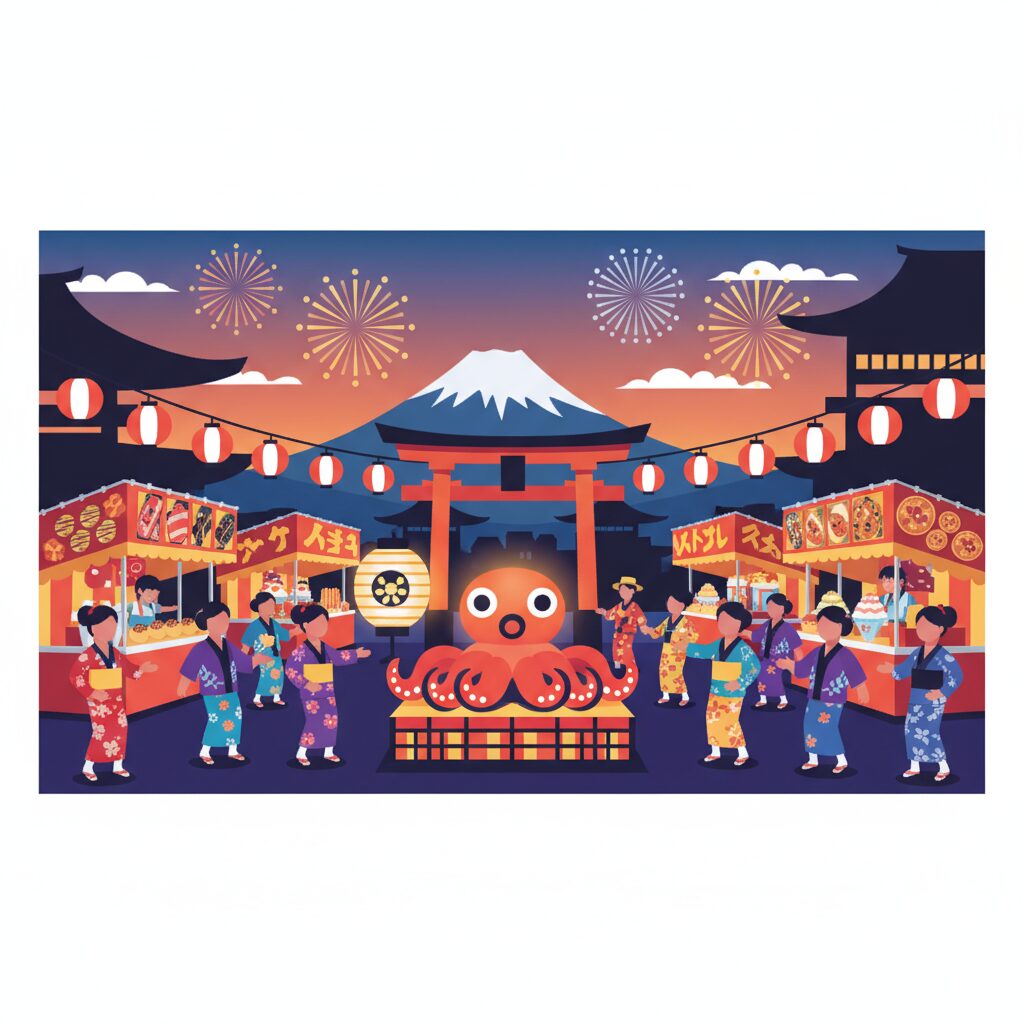
It starts with a sound. You’re walking home from the station, maybe in the thick, soupy heat of a July evening, and you hear it. It’s not the usual city symphony of train announcements, bicycle bells, and the sizzle of takoyaki stands. This is something else entirely. It’s a rhythmic, guttural chanting, a deep and percussive drumbeat that seems to vibrate right through the pavement into the soles of your shoes. You turn a corner, and your quiet residential street has been completely transformed. It’s a river of bodies, all surging in one direction, a tide of sweat, energy, and sound. Towering over them is a massive, ornate wooden structure, a portable shrine or a gigantic float, lurching and swaying as if it has a life of its own, carried on the shoulders of dozens of people in matching festival wear. Your first thought might be, “What is this? A parade?” Your second might be, “How do I get around this?” But the real question, the one that unlocks a fundamental truth about living here, is “What part of Osaka am I really looking at?” Because you’re not just witnessing a festival, a matsuri. You’re seeing the invisible social architecture of your neighborhood made visible, loud, and incredibly real. In Tokyo, life can often feel vertical and anonymous, lived in high-rises and conducted through train lines. In Osaka, life is horizontal. It’s lived on the street, in the shotengai shopping arcade, and it’s anchored by the local shrine. This festival isn’t a performance for tourists; it’s a status report, a spiritual audit, and a raucous family reunion all rolled into one. It’s the neighborhood reaffirming its own existence, and understanding that is the first step to feeling like you truly belong here.
To further explore how the vibrant community spirit transcends the festival into daily life, consider discovering the role of Osaka’s mama-san in local snack bars as a window into the neighborhood’s enduring traditions.
The Heartbeat of the Streets: Understanding the Mikoshi and Danjiri
That enormous object being carried or pulled along the street is more than just a decoration. It serves as the centerpiece of the entire ritual, and what you witness reveals much about the unique character of your neighborhood. Typically, you’ll encounter one of two main types: the mikoshi or the danjiri.
The Sacred Palanquin: The Mikoshi
A mikoshi is essentially a portable shrine. During the festival, it is believed that the local deity, the kami, inhabits this ornate vessel as it is paraded through the neighborhood. Its purpose is to bless the residents, homes, and businesses within its parish. Notice how it moves. The procession is far from smooth. Carriers frequently shake it violently, jostling it up and down and side to side. A common misconception among foreigners is that this appears disrespectful or chaotic. In fact, the opposite is true. The shaking is thought to amplify the power of the kami, spreading its blessings more vigorously throughout the community. It is a physical, demanding act of faith. The chants, such as “Wasshoi! Wasshoi!” or other local variations, are more than just entertainment. They are a collective means to focus energy and synchronize the movements of the many people bearing the immense weight. This is a pure expression of group effort, where the individual merges into the whole. This concept is central to Japanese society, yet in Osaka, it is performed with a distinct kind of lively, uninhibited pride. There is less quiet reverence and more joyous, energetic exertion.
The Earthly Powerhouse: The Danjiri
If your local festival includes a danjiri, you’re in for a very different kind of spectacle, one deeply connected to the merchant spirit of Osaka. A danjiri is a huge, intricately carved wooden float, often weighing several tons. Unlike the mikoshi, which is carried, the danjiri is pulled by long ropes, with key figures riding on top to steer its movement. The most famous and intense danjiri festivals take place in the southern parts of Osaka prefecture, such as Kishiwada, though many neighborhoods hold their own. The highlight is a maneuver known as the yarimawashi, where the massive float swiftly takes a corner at high speed. It is an extremely dangerous feat requiring absolute precision and courage. Here you witness the competitive Osaka spirit in its purest form. It is a display of skill, power, and controlled chaos. This is not solely about honoring a deity; it is about demonstrating the strength, unity, and daredevil spirit of a particular neighborhood association or trade guild. It serves as a performance of local identity, boldly declaring, “This is who we are. This is our territory. And we are the best.” The energy here is less spiritual and more adrenaline-fueled, reflecting a city built on bold ventures and calculated risks.
You’re Invited to Watch, Not Necessarily to Join
Here’s a crucial piece of cultural insight that many foreigners struggle to grasp. You see the energy, you feel the camaraderie, and you think, “This looks incredible! Can I help carry the mikoshi?” The straightforward, practical answer is almost always no. This isn’t an activity you can just join spontaneously. Participation is a deeply rooted social privilege, not a casual volunteer opportunity. The people carrying the shrine or pulling the float have likely belonged to that festival group, or ren, for years, if not their entire lives. It’s often a family tradition, with roles passed down from father to son or mother to daughter. Alternatively, it’s linked to your status within the community. Are you a business owner who has supported the neighborhood association for decades? Are you married into a family with deep local ties? These are the paths to participation. It’s a closed system based on trust, heritage, and long-term dedication. Trying to insert yourself is like trying to step into a stranger’s family photo. It’s not that the people are unfriendly; it’s that you’re witnessing something that fundamentally reinforces existing bonds.
The Currency of Community: Gofushin
So, how do you get involved? You do so as a supporter. You might notice your Japanese neighbors setting out small tables with drinks and snacks for the festival participants. You’ll definitely see paper lanterns hung everywhere with names written on them, or wooden boards displaying the names of local businesses and families. This is the financial and social foundation of the matsuri: donations, known as gofushin or gokifu. A few weeks before the festival, a representative from the local shrine or neighborhood association may even visit your door with a small envelope, asking for a contribution. This can feel awkward for a foreigner. Is it mandatory? How much should I give? It’s not mandatory, but it is a primary way of showing that you are part of the community. Contributing a few thousand yen gets your name on the list and sends a clear message: “I live here, I respect your traditions, and I support our neighborhood.” This gesture is far more meaningful than trying to grab a rope on the danjiri. It’s a quiet, respectful acknowledgment that Osaka people, who are keenly aware of social and commercial relationships, will recognize and appreciate. It’s you paying your dues—not merely financially, but socially.
More Than Street Food: The Real Purpose of the Party
It’s easy to get caught up in the surface-level excitement. The air is rich with the aroma of grilled squid (ikayaki), the sweet scent of caramelized sugar from candy apples (ringo ame), and the savory fragrance of octopus balls (takoyaki). The streets are dotted with yatai—food stalls—and games like goldfish scooping (kingyo-sukui). This is an essential part of the experience, and you should definitely indulge. But don’t confuse the festivities with the true purpose. The yatai are like celebratory wrapping paper, while the true gift is the spiritual and social renewal of the community. At its heart, a matsuri is a Shinto ritual. It’s about honoring the local kami. This deity isn’t an abstract, distant god; it is the guardian of that specific geographic area. The festival might be held to pray for a bountiful harvest (even in a concrete city), for the success of local businesses, for the health of children, or simply to thank the kami for another year of protection. Osaka is a mosaic of fiercely independent neighborhoods, each with its own history, specialty, and patron deity. The matsuri serves as the annual event that redraws and reinforces these invisible boundaries. People from neighboring areas might come to enjoy the food stalls, but their loyalty lies with their own shrine and their own mikoshi. This strong local pride is a hallmark of Osaka. While a Tokyoite might identify with a large ward like Shinjuku or Shibuya, an Osakan’s sense of identity is often much more specific: “I’m from Tenma,” “I’m from Kyobashi,” “I’m from Namba.” The matsuri is the ultimate expression of that hyper-local identity.
How to Be a Good Spectator: The Dos and Don’ts
Navigating a matsuri means respecting its energy without obstructing it. It’s a dance of enthusiastic observation. Here’s how to do it properly and gain the quiet approval of the locals.
What You Should Do
- Buy Food and Drink: This is the simplest and best way to join in. The stalls are usually operated by local community members, so your purchase directly supports the event. Grab a beer, get some yakisoba, and find a spot to watch the festivities unfold. Eating and drinking are part of the celebratory spirit.
- Give Way to the Procession: This is the most crucial rule. The mikoshi or danjiri has absolute right of way. It’s heavy, often unpredictable in movement, and the carriers are focused and exhausted. When the chanting grows louder, step back against a wall or slip into a storefront. Don’t be the person trying to take a selfie who causes a multi-ton float to swerve.
- Show Your Appreciation: A smile, a nod, or a simple “Otsukaresama desu” (a phrase honoring someone’s hard work) to participants during breaks goes a long way. If you admire their effort, a “Kakkoii!” (Cool!) will be met with a grin. People in Osaka thrive on positive energy and sincere reactions.
- Mind the Kids: Festivals are a big deal for local children. You’ll spot them in their own miniature happi coats, pulling smaller floats or running around excitedly. Be mindful of them and let them enjoy their special day.
What You Should Avoid
- Touching the Sacred Objects: Never touch the mikoshi or danjiri unless explicitly invited by a senior festival member. These are not just floats; they are sacred items or treasured community symbols. It’s a serious breach of etiquette.
- Complaining About the Noise or Disruption: For a few days, the festival is the main event. It will be loud, it will go late, and it may block streets. Complaining is like grumbling about the summer heat—it’s pointless and marks you as someone who doesn’t understand. Embrace the temporary chaos as part of the city’s lifeblood.
- Treating it Like a Performance: Remember, this isn’t Disney. These are your neighbors, local shopkeepers, and elders from nearby. They are engaged in a serious, meaningful, and physically demanding tradition. Observe with respect, not as a detached tourist viewing a show. The difference is subtle but essential.
The Morning After: Resetting the Rhythm
One of the most striking aspects of a matsuri is how swiftly it disappears. One night, your street is a lively, joyful festival site, scattered with skewers and paper cups. You go to bed with the sound of drums still ringing in your ears. You wake up the next morning, and it’s… gone. The street is immaculate. The stalls are gone. The lanterns are taken down. The only sign it ever took place might be a few weary-looking people slowly sweeping the pavement. This rapid, efficient cleanup is quintessentially Osaka. The celebration was explosive and all-encompassing, but now it’s finished, and it’s time to get back to work. This isn’t cold indifference, but a deeply rooted pragmatism that characterizes the city. Osakans know how to party, but they also know how to work. The festival fulfills its purpose: it rejuvenates the community’s spiritual and social energy. It reinforces bonds of family, commerce, and place. It reminds everyone who they are and where they belong. And once that’s achieved, the switch is flipped. The sacred time ends, and the ordinary, everyday rhythm of life and work resumes. The matsuri isn’t an escape from reality in Osaka. It’s the intense, focused ritual that makes everyday life possible. It’s the annual winding of the city’s clock, ensuring the gears of community, commerce, and culture keep turning for another year.