The first time you hear it, you might flinch. Standing on a train platform in Tennoji, a middle-aged woman in a leopard-print blouse clicks her tongue, gestures vaguely at the packed train, and sighs to her friend, a sound loud enough for half the platform to hear: “Uwa, kokonattoru-wa.” It lands somewhere between a complaint and a declaration. It sounds… annoyed. Maybe angry. As a newcomer, your instinct, honed by life elsewhere, is to create distance. You assume a conflict is brewing, an argument about to erupt. But then, the friend laughs, a full-throated cackle, and replies, “Honma ya na. Akan wa, kore.” (Totally. This is hopeless.) They both shake their heads, a shared smile playing on their lips, and push their way onto the train together, still chatting. In that moment, nothing was solved, but something was forged. A connection.
Welcome to Osaka, where the language of complaint is often the language of love, connection, and shared identity. Moving here from the quiet landscapes of Canada, I was trained to interpret language literally. A complaint was a sign of displeasure, a problem needing a solution. But in Osaka, I quickly learned that the grumbles and groans you hear on the street, in the shops, and between friends are part of a complex social rhythm. It’s a city that wears its heart on its sleeve, and sometimes, that heart has a few things to say about the humidity, the length of the line for takoyaki, or the state of a messy room. To truly understand life here, you have to decode its most potent expressions, and few are more revealing than the versatile, exasperated, and deeply affectionate phrase, “Kokonattoru-wa.” This isn’t just about learning a dialect; it’s about learning the city’s heartbeat. It’s about understanding that in Osaka, acknowledging a shared, minor struggle isn’t negative—it’s the first step to a smile.
In Osaka, everyday interactions extend into the early hours, where the unique morning service breakfast culture in neighborhood kissaten turns routine coffee moments into opportunities for sincere community connection.
The Sound of Osaka: More Than Just an Accent

Before we plunge into the details, let’s clarify one thing. The dialect here, Osaka-ben, is much more than simply replacing arigatou with ookini. It’s an entire linguistic ecosystem. You’ll grasp the basics quickly: meccha meaning “very,” honma for “really,” akan meaning “no good,” and the ever-present sentence-ending yanen. These serve as signposts, simple vocabulary that gives you a sense of progress. Yet, the true essence of Osaka-ben lies not in the words themselves, but in the intonation, rhythm, and the raw, unfiltered emotional energy that fuels the speech.
In Tokyo, communication often resembles a carefully crafted work of art. Standard Japanese, or Hyojungo, values subtlety, indirectness, and the preservation of harmony (wa). Thoughts and feelings are cloaked in layers of polite language. If a complaint is expressed at all, it’s so heavily softened it barely registers. The goal is to avoid burdening the listener and maintain a smooth, undisturbed surface. This reflects the principle of tatemae, the public facade one shows to the world. It is polite, efficient, and to outsiders, sometimes frustratingly opaque.
Osaka tosses that approach aside. Communication here is less like fine art and more like jazz—improvisational, emotional, and unapologetically direct. People speak their minds openly, often loudly and with dramatic flair. This isn’t rudeness; it’s a unique social etiquette based on transparency and the belief that honesty is a form of kindness. A shared gripe about the weather isn’t a downer; it’s a conversation starter, an immediate connection between two people enduring the same sticky, humid summer day. It’s a philosophy that says, “Let’s not pretend. Let’s be real with each other.” And the soundtrack of this philosophy is often a weary, knowing, and deeply bonding sigh of “Kokonattoru-wa.”
Unpacking ‘Kokonattoru-wa’: The Anatomy of a Friendly Gripe
To truly understand this phrase is to unlock a key to the city’s social fabric. It’s a linguistic Swiss Army knife, with its meaning shifting significantly depending on who says it, where it’s said, and the subtle tilt of their head as they speak.
What Does It Mean Literally?
On paper, “Kokonattoru-wa” is a colloquial contraction of “Kono you ni natte iru wa,” roughly translating to “It has become like this” or “Look at what this has become.” It’s an observational statement. The -wa at the end is traditionally a feminine sentence particle, but in Osaka-ben, everyone uses it to add emphasis and emotion—a kind of audible sigh. The phrase highlights a situation or condition that has strayed from the ideal, usually in a way that’s somewhat chaotic, messy, or overwhelming. It’s a verbal gesture pointing at reality and saying, “Will you just look at this?”
Context is Everything
Its literal meaning is actually the least fascinating aspect. The real magic lies in its use. This phrase paints a vivid picture, and you have to be there to appreciate it.
Picture an Osaka mother walking into her teenage son’s bedroom. Clothes scatter the floor, manga books stack high, and empty chip bags peek out from under the bed. Her eyes widen. She places her hands on her hips, takes in the mess, and utters the classic line: “Uwaa, kokonattoru-wa.” Is she angry? Not really. Disappointed? A bit. Mostly, she’s expressing theatrical exasperation. It’s not an attack; it’s an opening statement. It means, “This situation is objectively ridiculous, and we both know it.” It’s a prompt, inviting the son to grin sheepishly and start tidying up, but also carrying a trace of resignation—a mother’s enduring affection. It’s a complaint wrapped in the everyday reality of family life.
Now imagine two friends waiting in line for a famous ramen shop in Namba. The queue winds around the block. They arrive at the back, craning their necks to see the distant entrance. One turns to the other, a wry smile playing on his lips, and says, “Ge, meccha naranderu. Kokonattoru-wa.” (Whoa, it’s super crowded. Look at this mess.) He’s not actually suggesting they quit the line or angry about the wait. He’s performing a social ritual. The complaint attests to the restaurant’s popularity. It says, “This is crazy, but we’re in this together, right? This better be worth it.” The friend’s right response is enthusiastic agreement: “Honma ya. Demo, zettai oishii de, koko.” (Absolutely. But it’s definitely going to be delicious.) This shared complaint solidifies their choice and turns a tedious wait into a shared adventure.
Or consider the most common usage of all: the weather. A sudden downpour soaks you on your way to meet a friend. You burst into the café, drenched, hair plastered to your forehead, and laugh, “Gomen! Kokonattoru-wa!” (Sorry! Look at the state I’m in!). You’re not angry at the rain; you’re turning a personal mishap into shared humor. You present your disheveled state as a funny story, and your friend responds with sympathy and laughter, not irritation. The phrase transforms an unpleasant moment into an anecdote, a point of connection.
The Tone That Changes Everything
How it’s said is crucial. “Kokonattoru-wa” is almost never delivered with the sharp bitterness of genuine anger. It’s carried on a sigh, softened by a head shake, or punctuated with a small, self-mocking laugh. It’s a performance of frustration, not pure emotion. This subtlety is what many outsiders miss. They hear the complaint but miss the underlying harmony of connection. The tone says, “Isn’t this something?” inviting cooperation, not conflict; seeking a chorus, not opposition. Once you learn to hear that tone, you start to think like a local.
Why Complaining is a Form of Connection in Osaka

This culture of friendly complaining may seem unusual if you come from a place where positivity is prioritized and grievances are kept private. However, in Osaka, it serves as an essential tool for forming and sustaining social connections. It acts as a shortcut to closeness, breaking down barriers by acknowledging the small, shared absurdities of life.
Building Rapport Through Shared Experience
At its heart, expressing a minor, mutual frustration is an act of empathy. When you turn to the person next to you at a bus stop in the sweltering August heat and say, “Atssui naa…” (It’s hot, huh…), you’re not merely stating the obvious. You’re signaling, “I see you. You feel this too. For this brief moment, we’re united against the sun.” The other person’s nod of agreement, their own sighed “Honma ni…” (Truly…), completes the connection. A small, temporary community has formed.
This is quite different from the Kanto region. In Tokyo, there is a stronger focus on gaman, or stoic endurance. Complaining can be seen as a sign of weakness or as imposing negativity on others. People are expected to carry their burdens quietly. In Osaka, the opposite holds true. Sharing a burden, no matter how minor, is viewed as a way to lighten it for everyone. It promotes a sense of solidarity. It’s a continuous, low-key reminder that no one is alone. Whether it’s the Hanshin Tigers losing a baseball game or the train running two minutes late, the collective, audible groan serves as a form of group therapy.
Humor as a Social Lubricant
This instinct is closely linked to Osaka’s reputation as Japan’s comedy capital. The city is the birthplace of Manzai, a form of stand-up comedy based on the rapid-fire exchange between a boke (the funny, absent-minded one) and a tsukkomi (the sharp-witted straight man). Everyday conversation in Osaka often mirrors this pattern.
When a situation is absurd—a ridiculously long line, an ugly necktie, a badly parked bicycle—that situation becomes the boke. The person who points it out with “Kokonattoru-wa” takes on the tsukkomi role. They act as the voice of reason, highlighting the absurdity for everyone to see. By doing so, they set up a joke. They invite others within earshot to join the performance. You can agree (acting as another tsukkomi), or respond with a joke (playing the boke yourself). For example, in the ramen line, a witty reply might be, “Kore, ashita ni naru nchau?” (Do you think we’ll get in by tomorrow?). The initial complaint isn’t the end of the exchange; it’s the opening line of a shared comedy act. It’s interactive, engaging, and a way to make life a bit more amusing.
What Foreigners Often Get Wrong
Without this cultural background, it’s very easy to misread the signals. The bluntness, the loudness, and the seemingly harsh language can come across as startling for those used to more reserved ways of communicating. The journey to understanding Osaka is lined with these early misconceptions.
Confusing Friendliness with Rudeness
The most frequent mistake is overhearing a loud, complaint-heavy exchange between two Osakans and thinking they’re about to argue. As a photographer, I often watch people in public places, and at first, the loud energy of the Shotengai (shopping arcades) seemed aggressive. Shopkeepers would shout, customers would haggle noisily, and friends greeted each other with what sounded like a list of complaints. “Anta, mata sonna fuku kite!” (You’re wearing that again!). It sounded harsh, even cruel.
But I quickly understood it was quite the opposite. This straightforward, unfiltered way of speaking shows closeness. You only tease those you care about. You only speak with such candid honesty to people you consider family, by blood or choice. The absence of formalities and polite layers is the highest praise. It means, “I feel comfortable enough with you to be completely myself.” The loud talk and exaggerated complaints don’t push people away; instead, they draw them nearer.
The Pitfall of Trying to “Fix” Things
For many Westerners, a complaint signals a need for action. If a friend says, “This line is so long,” our knee-jerk reaction is to solve the problem. “Want to go somewhere else?” “Maybe we should check wait times online.” In Osaka, this is almost always the wrong approach. It misses the entire purpose of the exchange.
When your friend says, “Kokonattoru-wa,” about the line, they aren’t seeking a solution. They want you to share a moment of common experience. They want your validation, to participate in the performance. The right—and only—response is to agree and build on it. “Honma ya na. Shindoi wa.” (Absolutely. This is tiring.) Offering a fix is like telling a comedian to stop mid-joke because you already know the punchline. It kills the vibe and halts the connection ritual. The aim isn’t to remove the minor inconvenience; it’s to use that inconvenience as a way to strengthen bonds.
Living with ‘Kokonattoru-wa’: Daily Life in the Complaining City
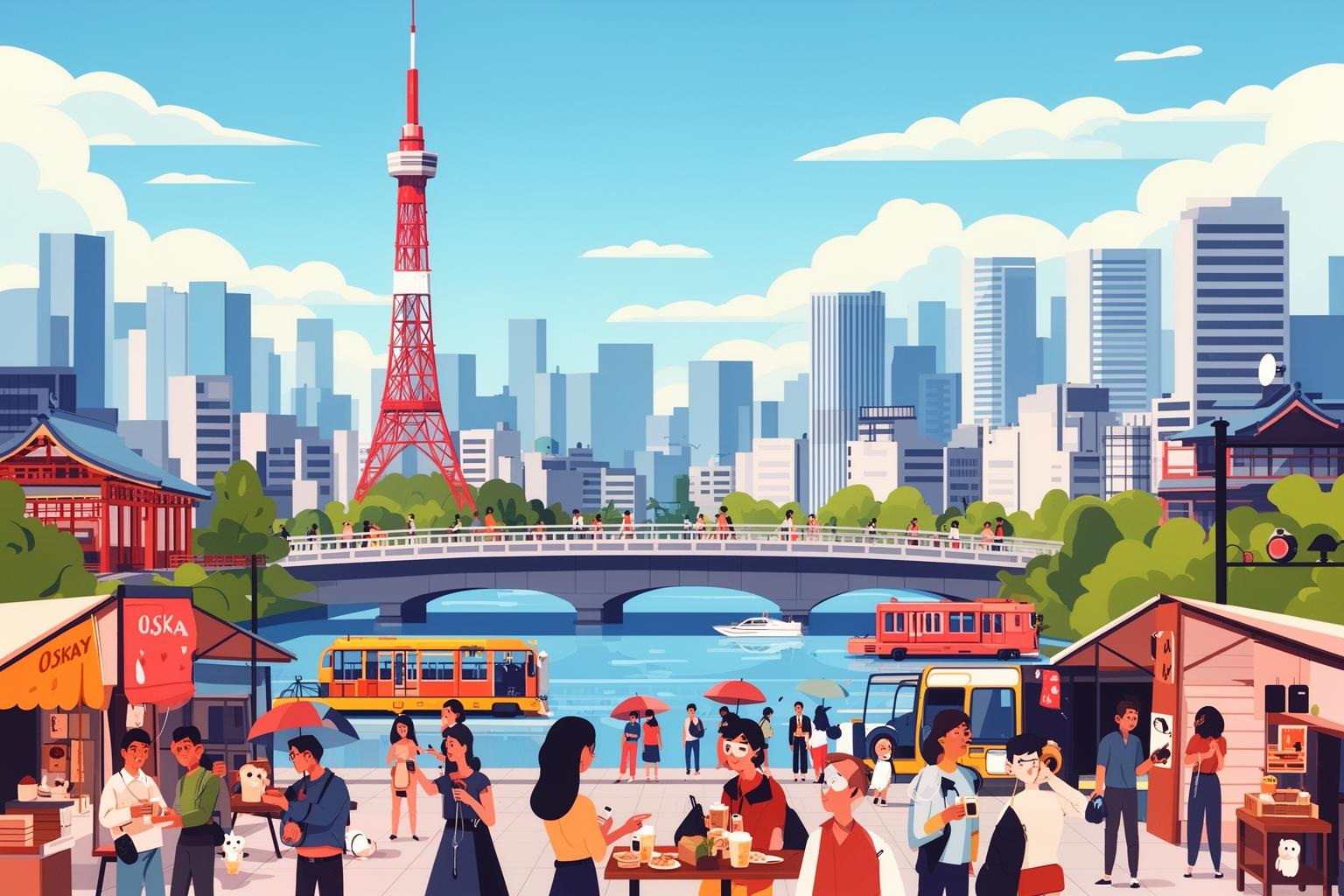
Once you learn to recognize the pattern, you start noticing it everywhere. It’s the ambient hum of the city, the social glue that ties daily life together through countless small, seemingly insignificant moments.
At the Supermarket
Stand near the vegetable aisle at any neighborhood supermarket, and you’ll see it. An obachan (an older woman) picks up a daikon radish, checks the price tag, and lets out a dramatic sigh for the entire aisle to hear. “Maa, takai wa, kore.” (Oh my, this is expensive.) She’s not just talking to herself. She’s broadcasting, hoping that the person beside her, also eyeing the vegetables, will catch her glance and nod in agreement. And they almost always do. A brief exchange might follow about how prices used to be, a fleeting bond formed over the shared outrage of an overpriced radish.
On the Train Platform
It happens during the morning commute. A train is announced as running three minutes late. A wave of soft groans and sighs passes through the crowd. You’ll hear a salaryman mutter “Maji ka yo…” (You’ve got to be kidding me…) quietly. Someone else might shake their head and say, “Kokonattoru-wa.” There’s no genuine anger. It’s a collective recognition of a shared fate. For those three minutes, everyone on the platform belongs to the same tribe: the slightly inconvenienced commuters. It’s a subtle yet constant reaffirmation of community.
Between Friends and Family
This is where the phrase finds its highest form, transforming from a complaint into an expression of deep care. When a friend sees you looking worn out after a grueling week at work, they might look you over, concern evident on their face, and say, “Omae, kao tsukareteru de. Kokonattoru-wa.” (Hey, your face looks tired. Look at you.) They’re not criticizing your appearance. They’re saying, “I see your struggle. I see how hard you’ve been working, and I’m worried about you. You need to rest.” It’s a hug delivered through blunt observation. It’s the Osaka way of showing affection—direct, unsentimental, and deeply empathetic. The complaint isn’t about you; it’s about the situation that has worn you down.
The Takeaway: Listening Beyond the Words
Living in Osaka demands a recalibration of your social awareness. It’s a city that encourages you to pay attention not just to what is said, but how it is expressed. It means recognizing that a rough exterior may conceal a kind heart, and a series of complaints can actually be an expression of affection. The straightforwardness of Osaka-ben is not a lack of manners; instead, it is a distinct, more grounded form of politeness that values honesty over pretense and shared reality over polished appearances.
For me, the shift from being puzzled by “Kokonattoru-wa” to appreciating its warmth marked the true moment of settling into this city. It was when I stopped hearing complaints and began hearing an invitation—the invitation to laugh at life’s little absurdities, to find camaraderie in small struggles, and to connect on a level that is openly, wonderfully human. It serves as a reminder that sometimes the most loving thing you can do is to look at a mess, shake your head together, and smile.