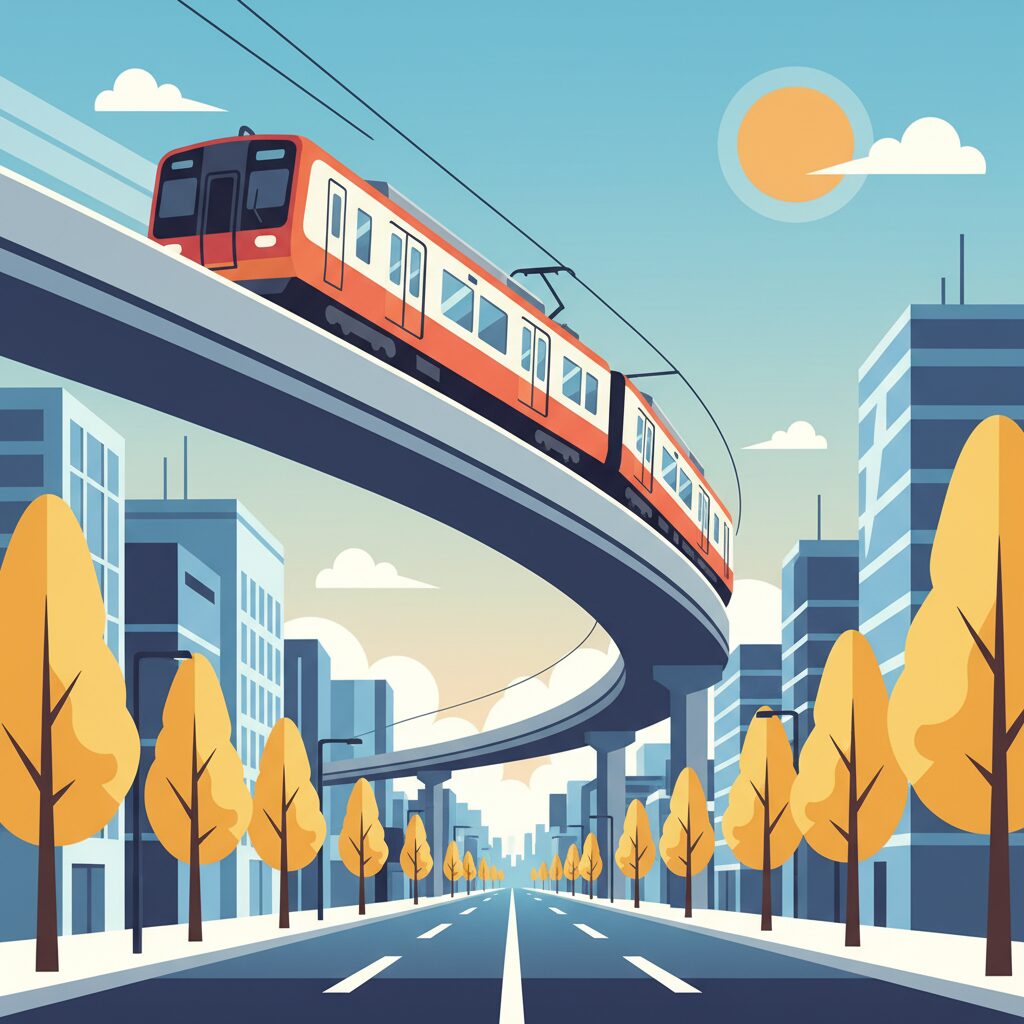
As an event planner from Tokyo, my life is about understanding the flow of people. I choreograph crowds, anticipate their movements, and try to create seamless experiences. But nothing prepared me for the daily, unscripted performance of the Osaka Metro Midosuji Line. This isn’t just a subway. It’s a river of humanity, a pulsing artery painted a defiant crimson, and if you want to understand the heart of Osaka, you have to learn its currents. In Tokyo, we have the Yamanote Line, a perfect, orderly circle of predictability. The Midosuji Line is a straight shot, a spear driven through the city’s core, connecting the polished business hub of Umeda in the north with the gloriously chaotic entertainment district of Namba in the south. Riding it is less about getting from point A to point B and more about experiencing a live cross-section of Osaka’s soul. It’s where the city’s unspoken rules, its pragmatism, and its raw energy are on full display. Forget your tourist maps; the real guide to Osaka is written in the way people board this train.
To deepen your journey into Osaka’s vibrant urban culture, consider exploring local tachinomi bars for fostering friendships as they offer a unique window into the city’s spirited social scene.
The Tale of Two Cities: Umeda Departures and Namba Arrivals
Every trip on the Midosuji line is a journey bridging two distinct worlds. The character of the train and its passengers shifts dramatically depending on your direction of travel and your proximity to the city’s two poles: Umeda and Namba. Though only a few stops apart, these areas embody completely different mindsets, with the train car serving as the transitional space where these two identities meet and coexist. Grasping this north-south divide is key to understanding the social fabric of the Midosuji Line. It’s not merely a matter of geography; it reflects the purpose and attitude of those on board. One end is about earning a living, the other about enjoying life, and the train is the vessel that ferries these ambitions back and forth throughout the day, every day.
The Northbound Current: The Corporate Ascent to Umeda
Board a northbound train from Namba or Tennoji in the morning, and you can sense a distinct change in the atmosphere. The energy becomes quieter, more focused, more… Tokyo-like, if I’m honest. Passengers form a sea of dark suits and crisp blouses. Laptops are tucked into sleek backpacks, and the prevailing scent is a blend of coffee and ambition. This is the commuter army heading towards the corporate strongholds of Yodoyabashi, Honmachi, and the final stop, Umeda. The silence in these cars isn’t relaxed; it’s purposeful. People are mentally gearing up for the day, scrolling through emails, reading financial news on their phones. There’s an unspoken understanding to preserve a bubble of professional decorum. You won’t see many boisterous groups or tourists with bulky luggage here. This is the business end of the line, where the mood is one of collective, quiet determination. Focus is sharp, movements efficient, and everyone silently committed to reaching their desk without unnecessary interruption.
The Southbound Flow: The Joyful Descent into Namba
Now, take the same line south from Umeda, especially in the evening or on weekends, and the transformation is remarkable. Dark suits give way to vibrant streetwear and casual attire. The quiet hum of the northbound train is replaced by a low, cheerful buzz filled with anticipation. You hear the rustle of shopping bags from Hankyu and Daimaru department stores, the crinkle of a 551 Horai pork bun wrapper. This current flows toward pleasure. Passengers are heading to the neon-lit streets of Dotonbori, the endless arcades of Shinsaibashi-suji shopping street, and the vibrant subcultures of Amerikamura. Faces are more relaxed, postures looser. Friends excitedly discuss dinner plans, couples map out their night. The tension of the workday fades with every stop. This is Osaka letting loose, and the Midosuji is the chariot carrying everyone to the festivities. The atmosphere feels lighter, more forgiving, filled with the promise of good food and good times.
The Midosuji Shuffle: A Masterclass in Fluid Dynamics
One of the biggest culture shocks for anyone accustomed to Tokyo‘s precise queuing is the boarding process on the Midosuji Line during rush hour. To the untrained eye, it may seem like pure chaos, but it is actually a sophisticated, unspoken system of fluid movement. While Tokyo features rigid, painted lines that people follow almost religiously, Osaka operates with what I call ‘suggested zones.’ Passengers gather roughly where the doors will open, forming more of a cluster than a strict line. This is where many foreigners, and even Tokyoites, often misinterpret the scene: they see the absence of a perfect line as a sign of rudeness. It’s not.
The Myth of the Line
In Osaka, the aim isn’t to create a flawless queue; it’s to get everyone on the train as efficiently as possible. The system depends on a collective, tacit understanding of give and take. When the train arrives, the cluster parts like the Red Sea to let passengers off, then smoothly refills the space. It’s a dance of subtle nudges, quick side-steps, and a soft “chotto, sumimasen” (a polite ‘excuse me’). This isn’t an aggressive push; it’s a form of communication, a way of saying, “I’m coming through, let’s make this work.” Those who stand stiffly, waiting for a perfectly clear path, risk being left behind. The key is to flow with the movement. You don’t shove, but you don’t hesitate either. You spot a gap and gently but assertively fill it. This exemplifies the Osaka mindset: less about strict rules, more about practical, flexible cooperation.
The Guardians at the Gate
Once on board, you’ll notice another interesting phenomenon: the ‘door guardians.’ These are passengers who board a crowded train and firmly position themselves right by the doors, making no effort to move deeper into the less crowded center of the car. In Tokyo, this behavior would draw some serious side-eye. Passengers are expected to shuffle inward to accommodate others. But on the Midosuji Line, this is common and widely accepted. The reason is pure pragmatism. The core stations—Umeda, Honmachi, Shinsaibashi, Namba—have extremely high passenger turnover. Most riders are traveling for only one to three stops. Moving farther inside means having to push your way back out shortly after. So, people claim their spot near the door, ready for a quick exit. It’s a silent agreement among short-distance travelers. The unspoken rule is: if you’re going a long distance, it’s your responsibility to navigate past the door guardians to reach the center. If you’re making a quick hop, you’re entitled to hold your place by the exit. This system prioritizes speed over spacious comfort.
The Acoustic Signature of the Red Line
Every subway line has its distinct soundscape, and the Midosuji line is no different. It challenges the usual stereotypes about both Japan and Osaka. It is neither completely silent nor overwhelmingly noisy. Instead, it occupies a comfortable, pragmatic middle ground that reveals much about the local culture.
The Comfortable Hum
The stereotype is that Osakans are loud and boisterous. While this may hold true in an izakaya, it doesn’t fully apply to the confined space of a subway car. The Midosuji isn’t the quiet, almost library-like atmosphere often found on Tokyo’s Chuo Line. You will hear conversations, but they remain at a respectful, low volume—what I call the ‘Midosuji hum.’ It’s the sound of friends catching up, older women sharing a laugh, and colleagues debriefing after work. There’s an inherent understanding of public and private space. You can talk with your companion but not so loudly that the entire car is drawn into the conversation. It’s a more relaxed take on public silence, reflecting a city that values community and connection while still respecting basic courtesy. The strict prohibition on phone calls, however, is just as firmly enforced here as anywhere else in Japan. That boundary is never crossed.
Reading the Signs, and the Seats
Seating etiquette is another subtle area where Osaka’s pragmatism shines, especially regarding priority seats, or ‘yusen-seki.’ In Tokyo, there’s intense social pressure to leave these seats vacant, even when the train is packed and no elderly, pregnant, or disabled passengers are present. It’s a form of performative respect. In Osaka, the approach is more practical. If the train is crowded and the priority seats are free, a healthy young person might sit down. However, they remain highly alert, not absorbed in their phone but scanning the car at every stop, ready to stand up the moment someone in need boards. The courtesy lies not in leaving the seat empty but in being constantly aware and willing to yield it immediately. It’s function over form—a philosophy deeply embedded in Osaka’s culture. Wasting a usable seat is seen as less logical than using it responsibly.
The Midosuji Gauntlet: Who Survives, Who Thrives
Surviving the daily commute on the Midosuji Line isn’t about physical strength; it’s about social intelligence and cultural adaptability. Your experience hinges entirely on your ability to let go of preconceived ideas about how public transport ‘should’ operate and instead embrace how it actually functions in Osaka. It’s a daily challenge of flexibility, and not everyone succeeds.
The Thriver Profile
You’ll thrive on the Midosuji Line if you consider yourself a ‘flow rider.’ You see the crowd at the doors as a system, not chaos. A gentle nudge isn’t taken personally but understood as communication. You value efficiency and make quick decisions, like skipping a seat if you’re only traveling two stops because it’s not worth the effort. You can read the vibe of the car, sensing whether it’s a quiet northbound morning commute or a lively southbound evening trip. You view the unspoken rules not as burdens but as clever, locally crafted solutions for moving millions daily. You find the rhythm within the disorder and learn to move with it.
The Struggler Profile
You’ll struggle if you’re a strict ‘rule follower.’ If you expect rigid lines, complete silence, and ample personal space, the Midosuji Line during rush hour will overwhelm your senses. You’ll be irritated by the door guardians, puzzled by the boarding process, and might interpret the straightforward, efficient communication as rudeness. The person who waits patiently for a perfectly clear, polite path will be waiting forever. The Midosuji Line doesn’t accommodate hesitation; it rewards active participation and flexible adaptation. The biggest challenge for newcomers, especially those from more orderly cultures or even Tokyo, is this clash between expectation and the pragmatic reality of commuting in Osaka.
The City’s Beating Heart
After months of riding this crimson line, I’ve come to view it as much more than just a means to get to work. It’s a moving reflection of the city itself. The Midosuji Line is direct, efficient, and unapologetically pragmatic. It doesn’t waste time with scenic detours; it goes straight to the core, much like the people of Osaka. It links the city’s ambition with its zest for life, carrying both in equal measure. Every gentle nudge during boarding, every practical seating choice, every shared laugh kept respectfully quiet—these are all part of the city’s unwritten social code. Riding this train offers a daily lesson in how Osaka functions. It’s not always polished, and it’s not always quiet, but it is always practical, always human, and always, unmistakably, alive. If you want to feel the heartbeat of this incredible city, just stand on any platform between Umeda and Namba and wait for the roar of the Red Dragon.