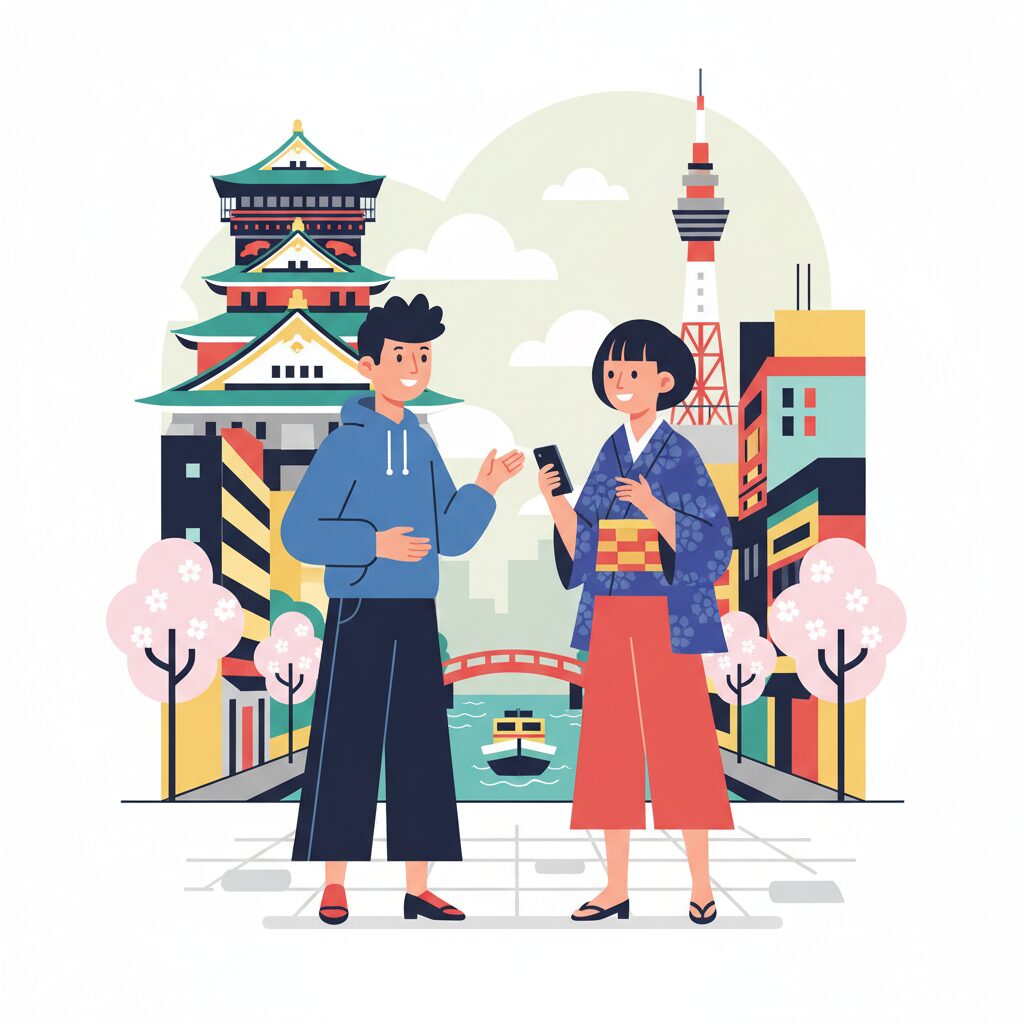
Step off the train at Umeda Station, and the first thing that hits you isn’t the humidity or the labyrinthine corridors. It’s the sound. A thick, vibrant hum of conversation, punctuated by loud laughter. People here don’t just occupy space next to each other; they seem to bubble over into each other’s lives. Stand on a street corner looking lost, and it’s a matter of minutes, maybe seconds, before an older woman, a salaryman on his lunch break, or a group of students will approach you. “Doko iku no?” Where you headin’? They won’t just point. They’ll start a conversation, ask where you’re from, and maybe tell you their favorite takoyaki spot on the way.
Now, take the 30-minute express train to Kyoto. The atmosphere shifts the moment you step onto the platform. The volume drops. People move with a graceful, measured purpose. They stand in neat lines, their faces composed, their interactions brief and formal. If you look lost here, you’ll likely remain lost until you find a police box or an official information desk. People will politely ignore your confusion, not out of malice, but out of a deep-seated respect for public privacy and personal boundaries. It’s a silence that can feel both serene and impenetrable.
This is the great paradox of the Kansai region. Two cities, so close you could commute between them for breakfast and dinner, yet they operate on fundamentally different social software. For a foreigner trying to build a life here, this difference isn’t just a quirky travel anecdote; it’s the key to everything. It dictates how you shop for groceries, how you interact with your neighbors, how you make friends, and ultimately, how you feel about your place in this corner of the world. Why is Osaka so loud, so open, so… interactive? And why is Kyoto its quiet, reserved sibling? The answer isn’t just “people are different.” It’s etched into the very stones of these cities, in their history, their economics, and their philosophies of what it means to live together.
This vibrant social energy in Osaka often transforms casual interactions into lasting community connections, much like the jouren experience found at local cafes.
The Echo of the Merchant’s Voice
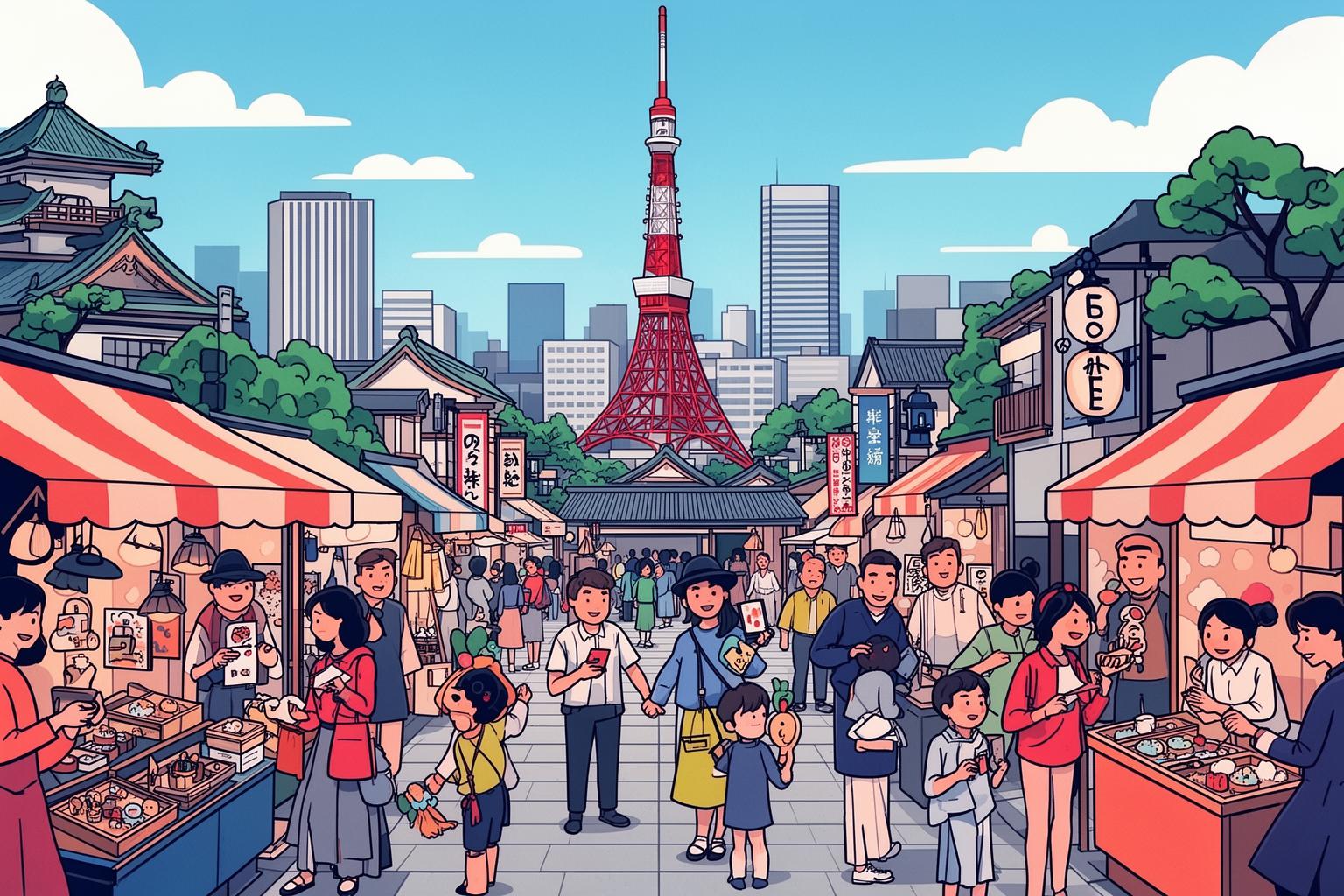
To truly understand Osaka, you need to momentarily set aside images of samurai and geisha. Instead, think of rice, warehouses, and abacuses. While Tokyo (then Edo) served as the shogun’s power base and Kyoto was home to the emperor’s court, Osaka was Japan’s kitchen—the lively, practical commercial center where the nation’s wealth was exchanged. This city was shaped not by warriors or nobles, but by merchants (shōnin). And that makes all the difference.
A Culture Born in the Marketplace
A merchant’s success relies on communication. It’s about quickly building rapport, sizing up character, negotiating, persuading, and closing deals. There’s no room for the layered, refined poetry of court life. You must be straightforward, clear, and a little charming. This pragmatism runs deep in Osaka’s DNA. The aim of conversation is often simply to connect and accomplish something—whether to sell a product or share a laugh. Formality is a tool, not an automatic mode. If it hinders a good deal or relationship, an Osaka native will likely set it aside.
That’s why a shopkeeper in the Tenjinbashisuji Shōtengai, Japan’s longest shopping arcade, might greet you with a teasing insult as you pass by: “Aniki, those shoes are way too flashy for you!” This isn’t rudeness; it’s an opening, an invitation to engage and banter back. In their own way, they’re initiating a negotiation—not for money, but for social connection. They want to see if you’re willing to play along. If you laugh and respond with a quip, you’re in. You’re no longer just a customer; you become part of the day’s entertainment. You may even receive a small discount (omake) or a piece of candy, not because you haggled, but because you connected.
Kyoto’s Imperial Refinement
By contrast, Kyoto society was molded over centuries as the imperial capital. Life there centered on a strict hierarchy, elaborate ceremonies, and subtlety as an art form. In a world of court intrigue, bluntness could be perilous. Communication became governed by unspoken rules and delicate nuances. Your status and reputation depended on your ability to “read the air” (kūki o yomu) and exhibit proper decorum. The person you spoke to wasn’t a potential business partner to win over, but a member of a complex social fabric where a single misstep could cause disgrace.
Though no longer tied to the emperor, this mindset still influences public life. A Kyoto shopkeeper will be impeccably polite, their service flawless, and their words measured. Yet, there remains a professional distance, a calm boundary seldom crossed. They provide a service, not seek a personal connection. The social contract upholds mutual respect for privacy and a quiet, shared space. A loud, teasing exchange would be seen as disruptive—a breach of the unspoken pact to preserve harmony (wa). The divide between public facade (tatemae) and private feelings (honne) is thicker and higher in Kyoto, while in Osaka, that boundary is often so low you can step right over it.
Welcome to the World’s Largest Comedy Club
If Osaka’s history as a merchant city forms its skeleton, its passion for comedy is its beating heart. This goes beyond the city being home to Yoshimoto Kogyo, the giant of Japanese comedy. The very structure of Japanese stand-up comedy, manzai, serves as a blueprint for everyday conversation here.
The Boke and Tsukkomi Dynamic
Manzai is a two-person act. One person, the boke, says something absurd, silly, or out-of-place, while the other, the tsukkomi, sharply corrects them, often with a light tap on the head or a witty retort. The humor arises from this rapid exchange. In Osaka, this dynamic isn’t limited to the stage; it’s everywhere. People are constantly, often subconsciously, looking for chances to take on one of these roles.
When a stranger speaks to you in Osaka, they’re often casting you in this little play. For example, if you wear a shirt featuring a large tiger, someone at the bus stop might turn to you and, deadpan, say, “Wow, that’s a scary-looking cat.” They’ve just played the boke by making an obviously silly comment. Now it’s your turn to be the tsukkomi.
What should you do? Many foreigners freeze here. You don’t have to be a professional comedian or deliver a killer punchline. The worst reaction is to ignore them or stare blankly, as this breaks the social contract. The second worst is to logically correct them with, “No, that’s a tiger.” The right response is simply to play along. A laugh, a smile, and a quick retort like “Nande ya nen!” (the quintessential Osaka phrase for “Why would you say that?!” or “No way!”) makes a perfect tsukkomi. Even just a playful groan or rolling your eyes works. You’ve completed the circuit—you’ve acknowledged their joke and played your part. The exchange concludes, a connection is made, and you both continue your day feeling a bit lighter.
This is why conversations in Osaka can feel random and full of energy. People are constantly “throwing the ball,” hoping you’ll throw it back. It’s a form of social grooming, a way to quickly build rapport and test the waters. It’s a fundamental mistake to see this as intrusive or nonsensical. It’s the local language of connection, spoken through humor.
The Quiet Appreciation of Kyoto
In Kyoto, humor is valued but takes a different form. It tends to be dry, witty observations or clever puns, shared among friends in private settings. The public space is not a stage. Imposing a boke/tsukkomi dynamic on a stranger would be seen as forward and somewhat disruptive. The focus is on smooth, predictable, and harmonious interactions. You compliment the weather, remark on the changing seasons, and stick to safe, elegant scripts. You don’t make a stranger the straight man in your impromptu comedy routine. The risk of misunderstanding or creating awkwardness is too high. It disrupts the wa.
The Art of Caring Loudly: Understanding Osekkai
There’s another layer to Osaka’s social fabric that often confounds newcomers: the culture of osekkai. Literally translated, it means something like “meddlesome” or “nosy,” which sounds quite negative. However, in Osaka, osekkai is a term of affection, describing a particular kind of intrusive yet well-meaning kindness.
Your Neighborhood Watch, Whether You Want It or Not
Osekkai is the elderly woman who stops you on the street to tell you your shirt tag is showing. It’s the butcher who chastises you for buying cheap vegetables at the nearby supermarket. It’s the man sitting next to you on the train who leans over to inform you that you’ve missed your stop, even though you’re intentionally traveling further. It represents proactive, unsolicited assistance. The most iconic figure is the “ame-chan obachan,” the quintessential older Osaka lady who carries a bag full of candy (ame-chan) and offers it to everyone—from crying children to bored teenagers to you, a grown foreigner. She’ll simply press one into your hand with a “Hai, kore tabe” (Here, eat this) and a knowing nod.
To outsiders, this can feel intrusive. Why is this stranger commenting on my clothes? Why do they care about where I shop? Who are they to hand me candy? It’s easy to misinterpret osekkai as criticism of your ineptitude. But that completely misses the point. Osekkai stems from a profound sense of community. It’s the belief that we are all in this together, and it’s everyone’s duty to look out for each other. Your affairs are their affairs because you belong to their community. They are not judging you; they are welcoming you. They treat you like family, and with family, there’s no need for formalities. You just dive in and help.
This custom is a direct legacy of the tightly-knit, densely populated merchant neighborhoods of old Osaka, where everyone knew one another, and survival depended on mutual aid. That spirit endures in the city’s covered shopping arcades and residential alleys. It’s a social safety net spun from casual, everyday interactions.
The Polite Distance of Kyoto
By contrast, Kyoto presents a clear difference. A Kyoto native would almost never openly correct a stranger’s appearance. Doing so would cause the person to lose face, a serious social taboo and an act of great disrespect. They might notice your shirt tag protruding and feel a sharp secondhand embarrassment for you, but they would remain silent. Intervening would imply you can’t manage your own affairs. Assistance is offered only when requested, or in very subtle, indirect ways. The boundary between individuals is sacred. This isn’t because they don’t care; rather, their way of showing concern is by respecting your personal space and autonomy. In Osaka, caring is loud and tangible; in Kyoto, it’s quiet and mindful of distance.
Navigating the Social Currents: A Practical Guide for Residents
So, what does all this mean for you, a foreigner trying to build a life in Kansai? It means you need to become socially bilingual—you must learn which “language” to use in each city.
When in Osaka…
- Embrace the Spontaneity: When a stranger talks to you, don’t shy away. See it as an opportunity. A smile and a simple response are enough. You don’t need a long conversation—just acknowledge the connection. Your daily life will feel richer and less lonely.
- Don’t Be Afraid of Jokes: You don’t have to be funny, but you should recognize when a joke is made at your expense. The easiest response is a good-natured laugh. Learning a simple “Nande ya nen!” will make you popular instantly.
- Accept the Candy: If an obachan hands you an ame-chan, accept it. It’s a sign of acceptance. Refusing is like declining a handshake. Simply say thank you, smile, and tuck it away. It’s a small ritual that means, “I see you, and I belong here.”
- Reconsider Osekkai: When offered unsolicited advice, try to hear the goodwill behind it. They’re not calling you stupid; they’re trying to help in the most straightforward way they know. A simple “Arigatou gozaimasu!” is an ideal response. You don’t have to follow the advice, but always appreciate the gesture.
When You Cross Into Kyoto…
- Lower Your Voice: Both literally and socially. Speak more softly and keep your conversations more contained. Be mindful of the peaceful atmosphere.
- Respect Personal Space: People here give you room, and you should do the same. Don’t expect the same casual interactions from strangers. Politeness in Kyoto is shown through non-intrusion.
- Exercise Patience: Friendships in Kyoto often develop slowly, requiring formal steps—proper introductions, shared activities over time. The warmth exists but is behind a door that opens inward, unlike Osaka’s outward openness. You must be invited in. A direct Osaka-style approach may come off as pushy or aggressive.
- Read the Subtle Cues: Pay attention to what’s left unsaid. Communication here is more nuanced. Praise is restrained; criticism is indirect. It’s a skill that takes time to master, but noticing this is the crucial first step.
Beyond the Stereotypes: Finding Your Place in Kansai
It’s important to remember that these are cultural frameworks, not rigid personality molds. You will encounter shy, quiet individuals in Osaka and loud, boisterous ones in Kyoto. Yet the fundamental social programming—the default expectations for public behavior—remains strikingly consistent and distinctive.
Many foreigners mistakenly group all of Kansai together, but truly thriving here requires understanding the profound differences between Osaka’s and Kyoto’s social philosophies. Neither is superior; they represent two different approaches to living collectively in a crowded environment.
Osaka’s approach is to break down boundaries, treating the entire city as one large, lively, and welcoming living room. It’s a city that draws you in, encourages participation, and offers a strong sense of belonging, even if it feels a bit overwhelming at first. Its energy is outward, visible, and vibrant on the surface.
Kyoto’s approach is to honor boundaries, viewing the city as a series of serene, private spaces sharing a public stage. It’s a city that provides anonymity and tranquility, requests your quiet respect, and rewards you with a profound sense of harmony and aesthetic grace. Its energy is inward, a subtle hum beneath the polished exterior.
Which you prefer depends on your personality. Do you seek connection and spontaneity, or do you value privacy and order? Answering this will reveal whether you feel more at home in the laughter-filled streets of Osaka or the peaceful lanes of Kyoto. And when that stranger in Osaka inevitably comments on your quirky shoes, you’ll understand why—and be ready with a smile.