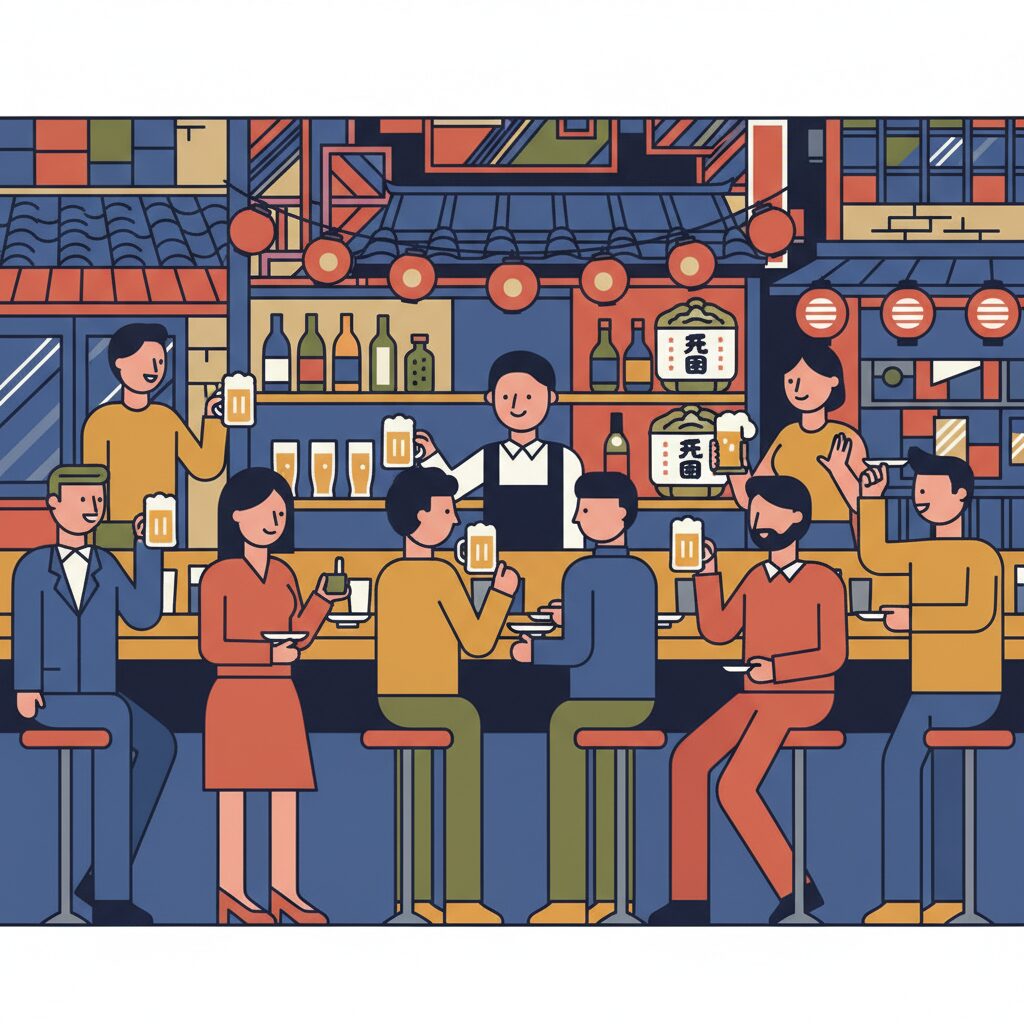
Step into an Osaka tachinomi on a Tuesday night. The air is thick with the smell of grilled skewers and cheap, strong chu-hais. It’s loud. Not with music, but with the clatter of plates and the rhythmic cadence of Kansai-ben. You see strangers, separated by mere inches at the worn wooden counter, laughing like old friends. A salaryman in a slightly loosened tie is gesturing wildly while telling a story to a younger couple he clearly just met. It seems so easy, so fluid. You think to yourself, “Osaka people are friendly. I can do this.” And you can, but it’s not a free-for-all. What looks like effortless social magic is actually a dance with its own set of unspoken steps. It’s a rhythm you have to feel before you can join in. The line between being a welcome participant and an awkward intruder is finer than a sheet of nori, and crossing it the wrong way can make for a very quiet, lonely drink.
This isn’t Tokyo, where personal space is a sacred temple and unsolicited conversation is often met with a polite but firm wall of indifference. Here, the walls are lower, more porous. But they still exist. The myth is that you can just walk in, say hello, and you’re instantly part of the family. The reality is that you have to earn your entry, not with money, but with social intelligence. You have to read the room, find your opening, and play your part. This is the real art of the tachinomi, and mastering it is a key to understanding the heart of Osaka itself—a city that values connection but despises pretense. Before we dive in, here’s a look at one of the city’s prime tachinomi battlegrounds, the Tenma district, where the night is always young and the counters are always crowded.
Enhance your understanding of Osaka’s intimate drink scenes by exploring this guide on Osaka tachinomi tango for practical tips on confidently finding your place at the counter.
Reading the Room: The Tachinomi Social Weather Report
Before you say a single word, your first task is to observe carefully. Be a social detective. Every tachinomi has its own unique microclimate, and your mission is to determine whether you’re stepping into a warm, inviting evening or a chilly, unwelcoming atmosphere. The biggest mistake is to rush in. You need to acclimate, watch, and wait for the social dynamics to shift in your favor. Think of it as stalking your prey—if your prey happens to be a friendly conversation with a stranger about fried chicken.
The Vibe Check: Is This a ‘Talker’ Bar?
Not all standing bars are the same. Some are meant for quiet reflection and a quick, solitary drink. Others buzz with chaotic social energy. You have to read the signs. Look around. Are people’s bodies angled toward each other despite being in different groups? Is laughter shared across the counter? Does the taisho, the master behind the bar, joke with customers while pouring drinks? These are green lights. A bar where the TV is the loudest noise, patrons stare intently at their phones or into their glasses, or everyone is clustered in tight, whispering circles—that’s a red light. This isn’t about judging the bar; it just means it’s not the right setting for your social experiment tonight. Some of Osaka’s best tachinomi are quiet, but they serve a different purpose. For conversation, you want a place already bubbling with social energy.
Group Dynamics: Spotting the Opening
Once you’ve found a “talker” bar, it’s time to analyze those inside. Who looks approachable? A group of five guys in matching company uniforms having a serious post-work discussion? Probably not your best option—they’re in their own private bubble. A young couple on a date, leaning close? Definitely leave them be. You’re searching for the frayed edges of the social fabric. The solo drinker casually scanning the room between sips. The pair of friends laughing loudly and already making eye contact with others. These are your targets. They came to the tachinomi not just to drink, but to soak in the atmosphere. Consciously or not, they’re open to interaction. Your goal is to find the person or group whose social circle is already welcoming, and then carefully step inside.
The Opener: More Than Just ‘Hello’
The first impression is crucial. A clumsy start can end a conversation before it even begins. You can’t simply turn to someone and ask, “So, where are you from?” That feels like an interrogation, not a conversation starter. In Osaka, the best openers are situational, indirect, and often revolve around the shared experience of being in that exact place at that precise moment. It’s about forming a small, temporary bubble of common ground.
The ‘Common Ground’ Strategy
The simplest and most effective approach is to comment on what’s immediately around you. Food is a universal language. Point to the delicious-looking dish the person beside you is eating. “Sumimasen, sore meccha oishisou desu ne. Nan desu ka?” (Excuse me, that looks amazing. What is it?). This is a brilliant tactic. It combines a compliment, a question, and genuine interest all in one. It comes across as non-threatening and provides an easy, natural way for them to respond. The same works for drinks. If they’re drinking a local sake you don’t recognize, ask about it. The ultimate icebreaker is sports. If a Hanshin Tigers game is on TV, you instantly gain entry into almost any conversation. A shared cheer after a home run or a collective groan after a strikeout can break down more barriers than an hour of small talk.
The Art of Complimenting (Osaka Style)
Osakans value a sincere compliment, but it must be done well. Don’t be generic. Saying, “I like your shirt,” is fine. Saying, “That’s a cool G-Shock, is it a limited edition?” is much better. It shows you’re observant. This isn’t about flattery; it’s about recognizing something unique about the person. It demonstrates that you see them as an individual, not just a random stranger. But be cautious: people in Osaka have a finely tuned radar for insincerity. If you don’t mean it, don’t say it. A fake compliment falls flat and makes you come across as trying too hard. Keep it genuine, keep it specific, and deliver it with a smile, not a leer.
Making the Most of the Taisho (The Master)
Never underestimate the influence of the taisho. The bar master is the conductor of the social orchestra. They know the regulars, set the atmosphere, and can be your biggest ally. Don’t overlook them. When you order, make eye contact. Ask for their recommendation. “Nani ga o-susume desu ka?” (What do you recommend?). Engage in light banter. Once you build a rapport with this central figure, your social standing rises dramatically. The taisho might even do the hard work for you by turning to another regular and saying, “Hey, Tanaka-san, this guy is from Canada. Can you believe he likes nankotsu (chicken cartilage)?” Just like that, you’ve been introduced. You’re no longer a total outsider; you’re the taisho’s foreign friend who enjoys unusual chicken parts.
The Conversation: Keep it Light, Keep it Moving

You’ve made contact. The conversation has started. Now what? The key is to grasp the pace and topics of tachinomi chatter. This isn’t the setting for your life story or a deep dive into existential philosophy. The atmosphere is light, casual, and often hilarious. You’re aiming for a friendly exchange, not a fierce competition. The objective is a shared moment of amusement, not an intense, soul-searching connection.
The Holy Trinity: Food, Baseball, and Friendly Complaints
If you get stuck, fall back on one of three topics. Food is always a safe bet. Debating the best takoyaki stand in Namba, the right way to make okonomiyaki (to mix or not?), or where to find the freshest sashimi can sustain a conversation far longer than expected. Next, baseball. As noted, the Hanshin Tigers are almost a religion here. Knowing the name of the current star player or being able to commiserate over their latest loss will get you instant respect. Third, and perhaps the most uniquely Osakan, is the art of the light complaint. Grumbling about the humidity, the crowded Midosuji Line, or the price of beer in Tokyo acts as social glue. It’s a shared inconvenience that unites people. Just keep it light. Nobody wants to hear your serious life struggles.
The Punchline is Everything: Osaka’s Passion for Humor
Here’s the biggest contrast between bar conversations in Osaka and Tokyo. In Tokyo, the purpose of a story might be to inform or recount an experience. In Osaka, the focus is almost always on the punchline. This is the home of manzai comedy, and the rhythm of boke (the funny one) and tsukkomi (the straight one) is woven into everyday talk. You don’t have to be a professional comedian, but you definitely need to appreciate a good joke. Laugh at their humor attempts. More importantly, don’t hesitate to be the joke yourself. Self-deprecating humor is a superpower in Osaka. Making fun of your clumsy chopstick skills or poor Japanese pronunciation shows you don’t take yourself too seriously—a highly valued trait. It signals you’re here to enjoy yourself, not to impress anyone.
The Exit Strategy: Know When to Fold ‘Em
Just as important as a smooth entrance is a graceful exit. A common error is to cling to a conversation and refuse to let go. A tachinomi interaction is meant to be fleeting. It’s a temporary connection, not a lifelong obligation. Overstaying your welcome can undo all the social goodwill you’ve just earned. Being able to read the signals that a conversation is ending is an essential skill.
The Graceful Bow-Out
How do you tell when it’s time to leave? Pay attention to their body language. If the person you’re chatting with begins turning back toward their original group, if their eyes start scanning the room again, or if they pull out their phone, these are your signs. The conversation has naturally run its course. Don’t try to prolong it. Let it end. A simple, friendly, “Ja, sorosoro ikimasu. Arigatou gozaimashita!” (Well, I’m going to get going. Thank you very much!) is all that’s needed. You can add, “Mata dokka de!” (See you around somewhere!). It’s casual and leaves things on a positive note. The perfect tachinomi interaction is like a firework: bright, enjoyable, and over before you realize.
The ‘Treating’ Trap: A Word on Buying Drinks
During your friendly conversation, someone might offer to buy you a drink. This signals a great success. Accept it with a sincere, “Ii desu ka? Arigatou gozaimasu!” (Is it really okay? Thank you!). Now, the tricky part. Your natural reaction might be to immediately offer to buy them a drink in return. You can do so, but don’t be overly insistent. The culture of ogori (treating) can be nuanced. Sometimes, the gesture is simply that—a gesture. Insisting on immediate repayment can make things feel transactional and awkward. A good guideline is to accept graciously, and if the conversation continues, you may offer the next round. If they decline, let it be. The default in tachinomi is wari-kan (splitting the bill or everyone paying their own way). Deviations from this are welcome but shouldn’t be forced.
Why It Matters: The Tachinomi as Osaka’s Living Room
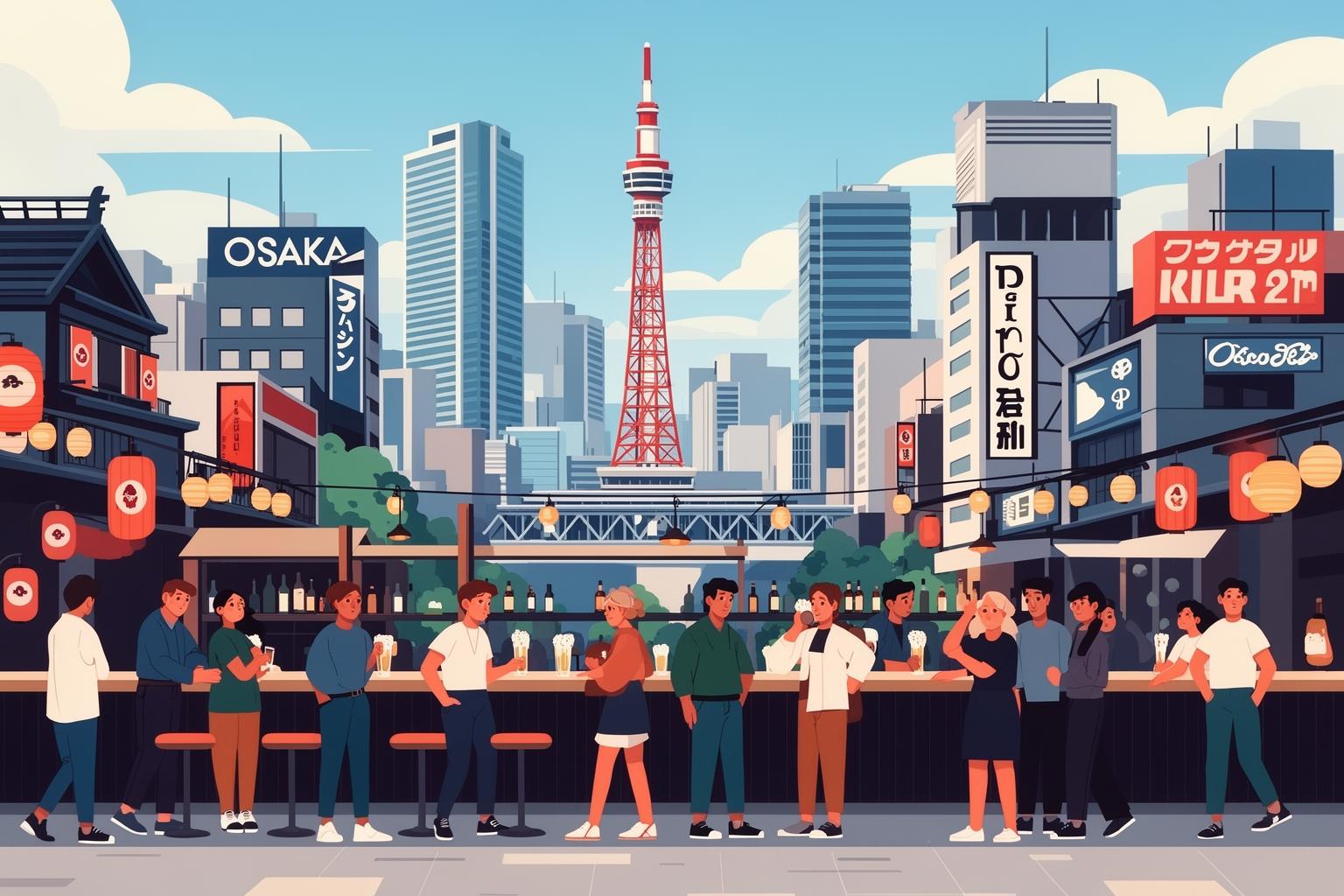
So why go through all this effort? Why master the intricate choreography of the standing bar? Because the tachinomi is much more than just a spot for an inexpensive drink. It’s a glimpse into the city’s soul. It encapsulates Osaka: quick, efficient, straightforward, and profoundly human. It’s where the city’s renowned friendliness isn’t merely a catchphrase; it’s a vibrant, living practice, guided by its own rules and rhythms. Here, people from every walk of life—construction workers, office ladies, students, shop owners—stand side by side, equals for the brief moments they share at the counter.
This is what sets it apart from many other places in Japan. Social barriers are lower, and the chance for spontaneous connection is greater. Life in Osaka isn’t confined to private, curated spaces like in Tokyo. It pours out into the shotengai, the parks, and most notably, the tachinomi. These bars serve as the city’s communal living room. Learning to navigate them is learning how Osaka functions. It’s not about being loud or aggressive. It’s about being observant, respectful, and open to sharing a laugh with a stranger. It’s about finding your place, whether for a drink or an evening, within the chaotic, warm, and wonderfully unpredictable rhythm of Osaka life.