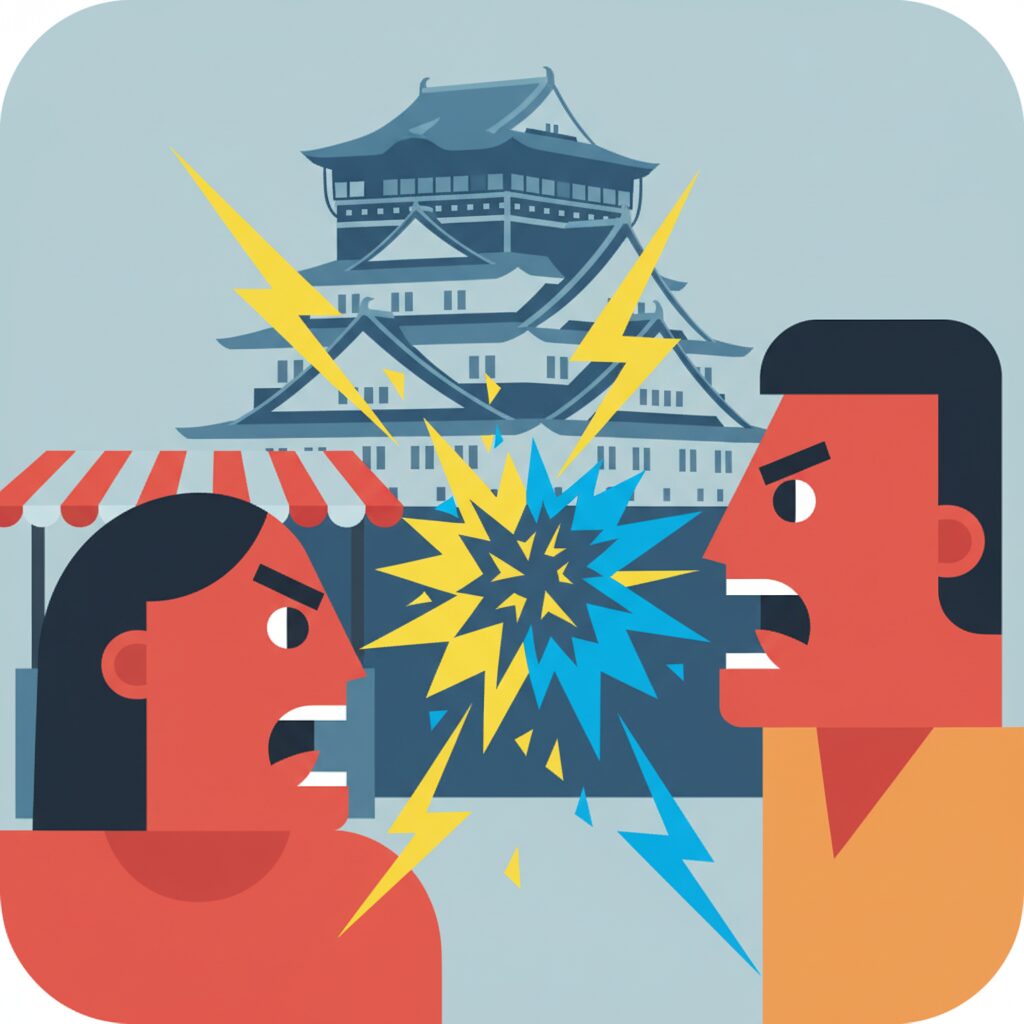
You’re standing in line for takoyaki in Namba, the scent of savory batter and dashi hitting the humid air. You’ve practiced your order. You step up and, in your best Japanese, ask for eight pieces with sauce and mayonnaise. The man behind the grill, a towel wrapped around his forehead, stops turning the octopus balls for a split second. He looks you dead in the eye and says, not unkindly, but with the force of a fastball, “Your accent is all over the place, but you’ve got a funny face. You’re not from around here, are ya?” In Tokyo, a similar exchange would be cushioned with polite phrases and gentle smiles. You might receive a quiet compliment on your efforts. But here, in the heart of Kansai, you get raw, unfiltered observation. A punch of honesty that leaves you wondering if you’ve been complimented or insulted. Welcome to Osaka, a city that doesn’t do subtlety. It’s a place where communication runs on a different engine, one that trades the polished chrome of formal politeness for the high-torque power of directness. For a foreigner navigating daily life, this can be the single most confusing cultural puzzle to solve. Is this friendliness or rudeness? Is it a sign of acceptance or dismissal? The truth is, it’s usually the former, wrapped in a package that the rest of Japan finds baffling and many newcomers find intimidating. This isn’t a city that keeps you at arm’s length with delicate pleasantries. It pulls you into a headlock, ruffles your hair, and asks you what’s really on your mind. To thrive here, you have to learn to decode this language of blunt affection, to understand the ‘honne’—the true feelings—that hide in plain sight. Let’s peel back the layers of Osaka’s famously straightforward communication style and discover the warmth that lies beneath the sharp edges.
For travelers seeking balance to counter Osaka’s raw directness, a visit to a spiritual retreat in Koyasan might provide the serene contrast needed to recharge.
The Myth of Japanese Indirectness: Osaka’s Exception to the Rule
Japanese culture worldwide is often associated with politeness, indirectness, and a strong respect for social harmony, founded largely on the ideas of ‘tatemae’ and ‘honne’. Grasping this duality is crucial to understanding how distinctly Osaka operates. It serves as the key that unlocks the city’s entire social system, revealing a logic that, though initially surprising, is deeply human and efficient.
Tatemae vs. Honne: The National Framework
Consider ‘tatemae’ as the public persona, a carefully crafted facade that values the group’s comfort over individual expression. It’s the polite agreement, the non-committal smile, the phrase “I’ll think about it” when the real answer is a firm no. ‘Tatemae’ acts as social lubricant, enabling a dense and intricate society to operate with minimal friction. It involves ‘reading the air’ (‘kuuki wo yomu’) and selecting words that uphold peace, even if they mask one’s true feelings, or ‘honne’. ‘Honne’ represents what lies behind the curtain: genuine opinions, desires, and emotions. Throughout much of Japan, especially in the formal environments of Tokyo’s business and social scenes, revealing one’s ‘honne’ too soon or to the wrong person is a significant social misstep. It is reserved for trusted friends, family, and colleagues, often shared cautiously after some drinks. This careful interplay is the standard mode of Japanese communication, a rhythm everyone is expected to learn and respect. It guarantees predictability and prevents conflict, but it can also create a sense of distance, leaving outsiders constantly guessing what others are truly thinking.
Osaka’s Shortcut to Honne
Osaka, by contrast, disrupts this delicate mechanism. Its people are known for taking the most direct path to ‘honne’. They frequently bypass the ‘tatemae’ preamble altogether or provide a greatly abbreviated version. This approach is not intended to be rude or disruptive. Rather, it stems from a distinct philosophy of connection shaped by the city’s history as a vibrant merchant center. For merchants, time is money and clarity is paramount. Ambiguity causes bad deals and wasted efforts. This mindset has deeply influenced Osaka’s social interactions. A straightforward statement is regarded as a mark of efficiency and, more importantly, trust. It conveys, “I see you as a genuine person, not just a stranger I must be polite to. I won’t waste your time or mine with social formalities.” Take shopping for clothes as an example. In a Tokyo boutique, trying on a shirt that clearly doesn’t suit you often prompts the clerk to say, “That is a very unique design, and the color is quite popular this season.” It’s a gentle, face-saving comment that leaves the choice entirely up to you. In a Shinsaibashi shop, however, the owner is more likely to lean in, squint, and say, “Nope, not for you. That color makes you look washed out. Take it off. This one here, the blue one, will make your eyes pop. Try it.” The first time you hear this, it might seem like a personal critique, but listening closely reveals the real message: “I am genuinely here to help you. I want you to look good, not just to make a sale.” They’ve skipped the formalities and treated you like a friend or a younger sibling they’re helping dress. This shortcut to ‘honne’ is an invitation to intimacy, offering a fast track to a more authentic relationship. It’s Osaka’s way of saying, “Let’s just be real with each other from the start.”
The Anatomy of Osaka-ben: More Than Just an Accent
The way people from Osaka speak is an essential element of their straightforward communication style. The local dialect, ‘Osaka-ben’, is not merely a set of distinct words and grammar; it possesses a unique musicality. It’s quicker, more melodic, and carries a sharp, percussive tone that might sound aggressive to newcomers. However, once you grasp its rhythm, you recognize it as the voice of a city that openly expresses its emotions.
The Language of Laughter and Logic
Standard Japanese, as spoken in Tokyo, tends to be more flat and monotone. It suits formal announcements and polite, reserved interactions. In contrast, ‘Osaka-ben’ is the language of ‘manzai’, the traditional Japanese stand-up comedy that began here. It’s a conversational exchange between a funny man (‘boke’) and a straight man (‘tsukkomi’). This dynamic is deeply woven into everyday speech. Someone might say something silly or exaggerated, and their partner quickly responds with a ‘tsukkomi’ phrase like “Nandeyanen!” (“Why the heck?!” or “You’ve gotta be kidding me!”). Elsewhere, this could seem like an argument’s start. In Osaka, it signals a lively, positive conversation. It’s a verbal volley, a playful back-and-forth that builds connection. Phrases that sound harsh when translated, like “Aho ka?” (“Are you an idiot?”), are often used with affection or disbelief. The directness of the language serves to create bonds, breaking down walls with shared laughter rather than building distance with formality. It invites participation, encourages not taking things too seriously, and fosters engagement on a more personal, emotional level.
“So, How Much Did You Pay For That?” – The Business of Banter
One of the most surprising aspects of Osaka communication for many foreigners is the openness about money. It’s common for a near-stranger to ask how much you paid for new shoes, your rent, or if you got a good deal on groceries. In many cultures, including other parts of Japan, such questions would be seen as extremely intrusive. But in Osaka, the merchant city (‘shonin no machi’), this openness is typical. Commerce, value, and practicality are not taboo topics; they form the foundation of local culture. Asking about price isn’t about judging financial status but about exchanging important information. It’s a communal sharing of market knowledge. The asker often evaluates your purchase while preparing to offer their own advice. If you say you paid ten thousand yen for a jacket, they might reply, “Not bad, but next week there’s a sale at the Umeda department store; you could’ve gotten it for eight thousand.” This isn’t criticism, but a helpful tip. It shows they regard you as part of the community, worthy of insider knowledge. This practical attitude permeates all areas of life. Osakans prize things that are ‘yasui-umai-hayai’ (cheap, delicious, and fast). They admire cleverness, good deals, and straightforwardness. Talking openly about money is simply another way to express this core value, connecting over the shared, practical realities of everyday life.
Reading Between the Lines (When There Aren’t Any)
After spending time in other regions of Japan, you become accustomed to searching for the hidden meaning behind polite language. You learn to interpret a hesitant “yes” as a possible “no” and a vague compliment as a gentle criticism. In Osaka, however, this skill can actually work against you. The challenge there isn’t reading between the lines; it’s accepting that, most of the time, there are no lines to read between. What is said is exactly what is meant, for better or worse.
Decoding Compliments and Criticisms
In a typical Japanese workplace, negative feedback is often given with great care, wrapped in layers of praise and softening expressions. A manager might say, “Thank you for your hard work on this report. The data you gathered is very thorough. Perhaps we could explore another way to phrase this conclusion to better align with the client’s perspective.” In an Osaka office, you’re more likely to hear, “This conclusion is no good. It’s confusing. Rewrite it so it’s easier to understand.” The bluntness can be jarring. It feels personal. But the underlying principle is respect for your time and ability. The Osaka mindset assumes you are strong and professional enough to handle direct feedback. The aim is to solve the problem as efficiently as possible, and avoiding the issue with polite pretense is viewed as a waste of everyone’s energy. They are not attacking you; they are attacking the problem. Similarly, compliments are often just as straightforward and specific. You won’t get a vague “Good job.” Instead, you’ll hear, “That presentation was great. Your explanation of the third quarter sales figures was especially clear.” This unfiltered feedback, both positive and negative, creates a work environment that can feel intense but is also refreshingly transparent. You always know exactly where you stand and what you need to do to improve.
The ‘Obachan’ Archetype: Masters of Direct Engagement
Nowhere is Osaka’s directness more perfectly exemplified than in the figure of the ‘obachan‘—the quintessential middle-aged woman of the city. Often stereotyped with a perm, bright leopard-print clothing, and a bicycle, the Osaka ‘obachan’ is a force of nature. She operates with a total absence of a social filter and a limitless, if sometimes overbearing, sense of community. She is the guardian of the city’s unwritten social rules. You will encounter her on the train, where she might loudly tell a group of teenagers to give up their seats. She will appear behind you in the supermarket line and comment on your basket. “Oh, you’re buying pre-cut vegetables? It’s much cheaper to buy them whole! Are you even eating properly?” She might see you struggling with a map and, rather than ask if you need help, simply grab it from you, point you in the right direction, and give you a lecture on the neighborhood. Central to the ‘obachan’ experience is the ‘ame-chan’, or little candies, that she carries in her purse. She will offer them to anyone and everyone: a crying child, a tired salaryman, a confused foreigner. The ‘ame-chan’ is not just candy; it’s a social tool. Accepting it means you’ve entered into a temporary pact. You are now her acquaintance, and she is entitled to speak with you. This behavior, which might be seen as an outrageous invasion of privacy elsewhere, is the lifeblood of Osaka’s community spirit. The ‘obachan’ views the city not as a collection of anonymous strangers but as her extended neighborhood. By engaging with you directly, even critically, she acknowledges your existence. She is telling you that you are part of her world. It is her tough-love way of caring for you and maintaining a human connection in the concrete jungle.
Navigating Daily Life: Practical Tips for the Foreign Resident
Grasping the theory behind Osaka’s communication style is one thing; living it day-to-day is quite another. It demands a mental adjustment and a willingness to modify your own reactions. Rather than defaulting to confusion or offense, you can learn to engage with the city on its own terms. With a few essential strategies, you can not only survive but genuinely thrive in this environment of radical honesty.
When to Laugh It Off
Much of what sounds like criticism or insult is actually an invitation to humor. The ‘manzai’ comedy culture is so deeply ingrained that teasing serves as a primary form of interaction. If a coworker points at your packed lunch and says, “That looks a bit sad and brown,” they’re not judging your cooking skills. They’re tossing you a conversational ball. The worst response is to become defensive or offended. The best response is to play along. Laugh and reply, “It’s my special diet for looking sad and brown!” The ability to engage in self-deprecation and witty banter is highly valued. It signals that you’re not overly sensitive and that you appreciate the playful nature of the exchange. Assume good intentions first. View the teasing as a sign of affection and a test of your sense of humor. If you can learn to laugh at yourself along with them, you’ll find doors opening to warmer, more genuine friendships.
When to Be Direct Back
While much of Japanese culture favors modesty and indirectness, in Osaka, you can gain respect by being straightforward. Osakans appreciate clarity, logic, and directness, especially in practical matters. Whether negotiating a contract, bargaining for a second-hand item at a Shitennoji flea market, or planning with friends, ambiguity only breeds frustration. Instead of saying, “I’m not sure if I can afford that price,” it’s better to say, “That’s too expensive. My budget is X. Can you do it for that price?” Rather than telling a friend, “Maybe we can meet up sometime next week,” it’s clearer to say, “Are you free Tuesday at 7 PM?” This directness isn’t considered pushy; it respects the other person’s time. By matching their straightforwardness, you demonstrate that you understand the local communication style and are on the same page, ready to get things done without unnecessary fluff.
The Tokyo vs. Osaka Code-Switch
It’s important to remember this communication style is highly regional. The rules in Osaka don’t apply to the rest of Japan. What’s seen as refreshingly honest in a Namba izakaya might come across as shockingly rude in a Ginza boardroom. Many Osakans are experts at switching codes. You can see this when a local businessperson takes a call from a Tokyo client. Their entire demeanor shifts—‘Osaka-ben’ disappears, replaced by perfectly polite standard Japanese (‘hyojungo’). Their posture straightens, their tone turns formal, and they bow to the phone when hanging up. The moment the call ends, they relax, sigh, and revert to their natural state, perhaps muttering, “Man, Tokyo folks are such a hassle.” For foreign residents, mastering this skill is vital. Be direct and playful with Osaka friends, but adopt a more reserved, ‘tatemae’-oriented style when interacting with people from other regions, in formal situations, or with elders. Recognizing context and adjusting your style accordingly shows high social intelligence in Japan.
The Payoff: The Warmth Behind the Bluntness
Living in Osaka can feel like a social rollercoaster. Some days, the directness is invigorating and efficient; other days, it can feel abrasive and draining. Yet for those who persevere, the rewards are substantial. The city’s communication style, despite its sharp edges, is ultimately meant to foster a deeper, more immediate human connection.
Building Genuine Connections Faster
The biggest advantage of Osaka’s shortcut to ‘honne’ is that you seldom have to wonder where you stand with someone. The social ambiguity that can slow down and frustrate forming close friendships in other parts of Japan is largely missing here. People tend to express their opinions about you, both positive and negative, relatively early in the relationship. This can be intense, but it also acts as a strong filter. It swiftly eliminates superficial or incompatible connections. If an Osaka local continues to engage with you, tease you, and speak directly, it’s a clear sign they like and accept you. Friendships feel solid because they are founded on honesty rather than a fragile façade of politeness. There’s a deep sense of security in knowing that those around you truly mean what they say, allowing you to relax and be your authentic self in ways that are harder in more high-context settings.
A City That Treats You Like Family
In the end, the bluntness, teasing, unsolicited advice, and nosy questions are all signs of a city that functions more like a sprawling, chaotic family than a distant metropolis. Family can be critical and annoying. They invade your personal space and tell you how to live. But they also care, celebrate your successes, and show up when you need support. Osaka’s communication style is a form of tough love. They might point out you’ve gained weight, but they’re also the first to share their food. They’ll criticize your choice of train line, yet personally guide you to the right platform so you don’t get lost. In a country where foreigners can sometimes feel like perpetual outsiders, kept at a polite but clear distance, Osaka grabs you and makes you one of its own. It doesn’t offer the serene, manicured harmony of other Japanese cities. Instead, it offers something much rarer and, for many, far more valuable: a loud, messy, and profoundly genuine sense of belonging.