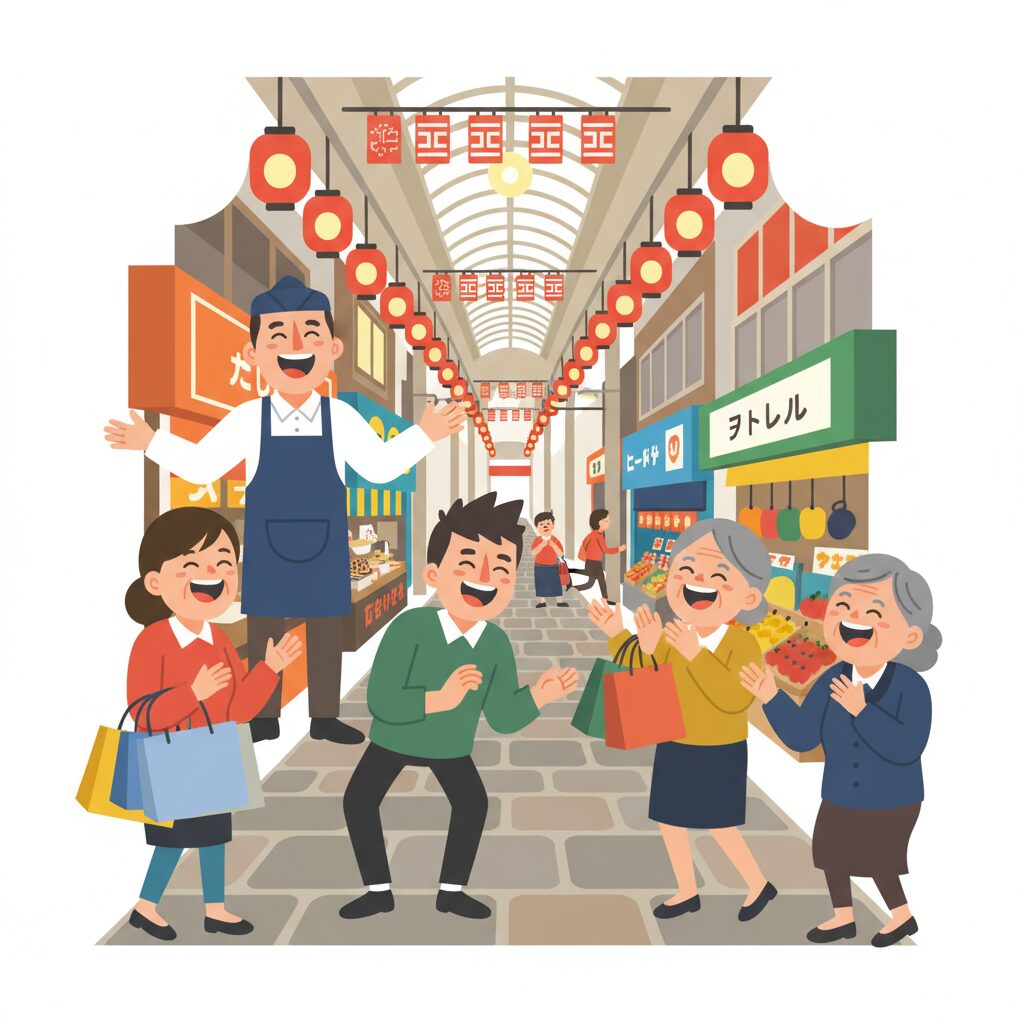
Step off the train in Osaka, and the air feels different. It’s not just the humidity hanging thick in the summer or the scent of takoyaki sizzling on a hot plate. It’s the sound. A symphony of boisterous greetings, rumbling bicycle bells, and laughter that echoes under the covered arcades of the city’s countless shotengai. Walk into a department store in Tokyo, and you’re met with a crisp, uniform “Irasshaimase!”—a welcome that’s polite, polished, and perfectly impersonal. It’s a transaction delivered with flawless precision. But here, in the sprawling, chaotic, and wonderfully human shopping streets of Osaka, that same greeting is just the opening note. What follows is an invitation, a challenge, a performance. It’s a conversation. For anyone who has navigated the subtle, unspoken rules of Japanese society elsewhere, the direct, playful, and sometimes teasing nature of an Osaka shopkeeper can feel like a cultural glitch. Is this rudeness? Is it a sales tactic? It’s neither. It’s the heart of Osaka’s merchant culture, a form of communication built on wit, warmth, and a shared understanding that a simple purchase can, and should, be a human connection. This isn’t about haggling in the traditional sense; it’s about participating in a daily ritual of playful banter, a verbal dance that defines life in this city. Learning its steps is a key to unlocking the real Osaka, a city that values a good laugh as much as a good deal.
The vibrant street banter finds an equally engaging echo in the local dining scene, where Osaka eat culture turns every meal into a shared celebration of community.
The Philosophy of the Punchline
Why does this culture of banter thrive so strongly in Osaka? It’s no coincidence; it’s embedded in the city’s very DNA. Osaka has been Japan’s commercial hub for centuries, a city of merchants known as the “nation’s kitchen.” In the world of commerce, standing out isn’t just about the quality of your tofu or the freshness of your fish. It’s about the relationship you cultivate with your customers. The shopkeepers, or akindo, of Osaka discovered long ago that a memorable personality and quick wit could earn loyalty far more effectively than a silent, deferential bow. This isn’t merely business; it’s entertainment. The entire city is infused with the culture of manzai, a traditional style of stand-up comedy featuring a straight man (tsukkomi) and a funny man (boke). This rhythm of setup and punchline extends beyond the stage; it plays out countless times daily in the shotengai. The shopkeeper might take on the role of the boke, making an outrageous claim about their produce. Your part as the customer is to be the tsukkomi, delivering the witty comeback that completes the joke. This shared performance dissolves the formal barrier between seller and buyer. In Tokyo, the dominant ethos is omotenashi, a concept of selfless, impeccable hospitality where the customer’s needs are anticipated and met with nearly invisible efficiency. The customer is treated like a guest, almost royalty. In Osaka, however, the customer is seen as a neighbor, a co-conspirator in the ongoing comedy of everyday life. The goal isn’t to raise the customer onto a pedestal but to bring them down to eye level, sharing a moment of genuine, unscripted interaction. It’s a philosophy that values humanity over hierarchy, and connection over mere consumption.
Decoding the Shotengai Dialogue
Navigating this interactive landscape can be daunting, yet it unfolds according to an unspoken script. It’s a dance with clear, though silent, steps. Mastery depends less on perfect grammar and more on attitude and timing. It’s about showing a willingness to engage with the game, going beyond the mere mechanics of a purchase.
The Opening Gambit
The interaction starts as soon as you express interest. In Tokyo, you might browse quietly, uttering a polite “Sumimasen” when ready to buy. In an Osaka shotengai, a lingering glance at a pile of shiny mikan serves as your cue. The shopkeeper, often a sharp-eyed obachan (auntie figure), won’t just say “Irasshaimase.” She’ll dive into a story. “Neechan, kono mikan, kinou made ki ni natta yatsu ya de! Amasugite mitsubachi yottekuru wa!” (Hey miss, these oranges were still on the tree yesterday! They’re so sweet the bees are swarming!). This isn’t merely a sales pitch; it’s the setup, the boke. A silent nod would end the performance. Instead, you respond by playing your part, the tsukkomi. A simple, “Honma ni? Hachi ni sasarehen?” (Really? I won’t get stung?) with a smile is sufficient. You’ve accepted the invitation. You’re in.
The Art of the Playful Jab
Once the connection is made, the next move is a gentle tease. Many non-Japanese, used to more formal interactions, may hesitate here. Criticizing a price, even jokingly, can seem rude. But within Osaka banter, it’s a vital move in the game. Looking at an impressive daikon radish with a thoughtful frown, you might say, “Uwaa, rippa na daikon ya naa. Demo chotto kyou no yuuhan ni wa zeitaku sugihen?” (Wow, that’s a magnificent daikon. But isn’t it a bit too extravagant for tonight’s dinner?). This isn’t an insult; it signals that you appreciate quality while remaining a savvy, budget-conscious shopper—a persona the shopkeeper recognizes and respects. It opens the door for a return jab. They might laugh, saying, “Anata, wakatteru naa! Kono daikon食べtara, hoka no daikon食べrarehen you ni naru de!” (You get it! Once you eat this daikon, you’ll never want to eat another!). Matching your energy, the negotiation turns into a shared tale about the legendary daikon.
The Counter and the Close
The shopkeeper’s reply to your playful jab is the heart of the performance. They might offer a small discount, though that’s not the real point. The true reward lies in the interaction itself. They may toss in a sprig of green onion for free, called omake, a little extra. This isn’t a calculated loss leader; it’s a gesture of goodwill, reflecting the connection you’ve just formed. “Kore mo motte iki! Sābisu ya!” (Take this too! It’s on the house!). The transaction ends not just with money exchanged for goods, but with shared laughter and a sense of community. You haven’t merely bought a daikon; you’ve taken part in a miniature play. You leave carrying not just groceries but a story and a feeling of belonging. The final phrase is often a warm, “Maido ookini!” — a classic Osaka expression meaning “Thanks for your continued patronage!” It conveys a relationship, a promise of future exchanges. It’s the curtain call on a successful performance.
Reading the Room: A Banterer’s Guide
Certainly, not every shopkeeper in every circumstance is prepared for a full manzai routine. The art of banter also requires keen observation. Forcing playful interaction where it isn’t welcomed is just as uncomfortable in Osaka as elsewhere. Understanding when to engage and when to stick to standard politeness is essential for smoothly navigating the city’s social dynamics.
Spotting the Right Partner
The perfect candidate for banter tends to openly signal their willingness. Look for shop owners, typically middle-aged or older, who are already engaging customers. They make eye contact with passersby and speak in a loud but cheerful, booming voice—not aggressive, but energetic. Often, they lean forward on their counters, fully engaged with their surroundings and customers. Their shop or stall feels like an extension of their living room—personal, a bit cluttered, and full of character. These seasoned veterans, masters of the craft, have practiced this daily theater for decades and will welcome new participants, regardless of their Japanese proficiency. They value the effort more than the perfect execution.
Knowing When to Hold Back
On the other hand, there are obvious signs that a quieter approach is preferable. Is the store extremely busy, with a long queue of impatient customers? Then it’s not the time for a casual chat—the priority is efficiency. Is the person behind the counter a young part-timer, likely a student? They may not be a local or may lack the confidence or authority to engage in the lively banter typical of the owner. In such cases, a standard polite exchange is the respectful and appropriate choice. Even in Osaka, high-end boutiques or department store counters tend to follow the more formal, Tokyo-style customer service. The sleek, quiet, minimalist setting signals a different set of social rules. The shotengai is the stage for this particular style of interaction; other venues follow a completely different script.
The Spectrum of Shotengai
It’s also important to recognize that not all shotengai are the same. They range widely in energy and personality. A large, famous arcade like Tenjinbashisuji, Japan’s longest, is its own universe—a high-energy, high-volume space where experienced shopkeepers excel at quick, witty exchanges with a steady flow of regulars and tourists. In contrast, a smaller, residential shotengai in a quiet neighborhood like Tamatsukuri exudes a gentler, more intimate atmosphere. Banter here tends to be less performative and more like sincere catch-ups between neighbors. Conversations move at a slower, more personal pace. The key is to tune into the energy around you. Begin by listening: What is the usual noise level and style of interaction? Then adjust your approach to match.
Essential Phrases for the Osaka Stage
Although attitude matters more than vocabulary, knowing a few key Osaka-ben phrases can demonstrate your eagerness to join in. It signals that you’ve done your homework and are making an effort to connect on a local level. Just attempting it often brings a smile and paves the way for a warmer interaction.
Your Starter Pack for Banter
Think of these as conversational tools. Instead of simply saying “Hontou desu ka?” (Is that really so?), try the more casual and expressive “Honma ni?” which carries a natural, slightly skeptical tone perfect for banter. When a shopkeeper makes an outrageous claim, a dramatic “Eeeh, uso yaan!” (No way, you’re kidding!) serves as the ideal tsukkomi response. To show appreciation, swap a standard “Ii desu ne” for “Meccha ee yan!” (That’s awesome!). The term meccha (very, super) is quintessentially Kansai and instantly adds a friendly emphasis. Another handy trick is to repeat the shopkeeper’s last word with a rising intonation, turning it into a question. If they say, “This is delicious, oishii de,” you can reply, “Oishii?” (Delicious, you say?). This simple tactic invites them to elaborate and keeps the conversation flowing.
The Ultimate Osaka Get-Out Clause: Shiran Kedo
One of the most iconic and useful Osaka phrases is “shiran kedo,” which literally means “I don’t know, though.” This magical phrase tacked onto the end of a sentence absolves the speaker of responsibility for what they just said. For example, a shopkeeper might say, “Kono sakana, nonde mo daijoubu ya de. Shiran kedo.” (You could probably eat this fish raw. But I don’t really know for sure.) It’s a way to offer an opinion, a joke, or advice with a playful layer of uncertainty. For a foreigner, using it shows a deep cultural understanding. You can also soften your own playful jabs with it: “Kono nekkuresu, watashi ni wa chotto hadesugiru kamo. Shiran kedo.” (This necklace might be a little too flashy for me. But who knows!). It’s a verbal wink that says, “I’m playing the game, but I’m not taking myself too seriously.”
The Great Divide: Tokyo’s Polish vs. Osaka’s Personality
This contrast in communication styles is one of the most striking differences between daily life in Tokyo and Osaka. It serves as a continual source of friendly rivalry and mutual misunderstanding. Grasping this divide is essential for anyone seeking to understand Japan’s cultural fabric.
Tokyo: The Customer as a Deity
In Tokyo, the unwritten rule is “Okyaku-sama wa kamisama desu”—the customer is a god. This principle shapes a service culture rooted in deference, precision, and minimizing any friction. Interactions are meant to be seamless and perfect. Staff are trained to be attentive yet unobtrusive, anticipating needs without being prompted. This fosters an atmosphere of exceptional comfort and reliability. You will almost never experience poor service in Tokyo. However, it can also come across as impersonal. By design, the relationship remains transactional. The professional boundary between staff and customer is strong and seldom crossed. For many, this represents the ideal—service that is efficient and discreet.
Osaka: The Customer as a Scene Partner
Osaka operates under a different philosophy: “Okyaku-san mo ningen ya”—the customer is human, too. Here, service isn’t about elevating the customer but about establishing common ground. The intent is to build a relationship, even if only briefly. A perfect, silent transaction can feel cold and incomplete. The shopkeeper wants to know what you’re cooking for dinner, to offer unsolicited tips on preparing the fish you just purchased, and to ask about your children. Outsiders, including people from Tokyo, often misinterpret this directness as nosy or pushy. Yet it stems from genuine curiosity and a desire to connect. A foreigner who embraces this warmth can quickly become part of the local community. Being a regular in an Osaka shop means being remembered, greeted by name, and treated like a neighbor rather than just a source of income.
The Foreigner’s Misreading
This is where the most frequent misunderstanding happens. A foreigner, accustomed to polite distance in service from their home country or other parts of Japan, might find Osaka’s directness abrasive. The quick-fire questions, playful teasing about your purchases, and unsolicited advice can feel overwhelming. It’s easy to mistake this for a hard-sell approach or a lack of respect. But in reality, it’s quite the opposite. This engagement is a sign of respect, indicating the shopkeeper sees you as more than a walking wallet—instead, as a person worth conversing with, a potential partner in dialogue. The silence and formal distance typical of Tokyo, while polite, can sometimes feel isolating to those used to a more conversational atmosphere. In Osaka, the noise, bustle, and banter are the sounds of a city that’s vibrant, involved, and eager to welcome you into its daily life. The key is to adjust your expectations: you’re not just a passive customer, but a participant invited to join the interaction.
A Sample Script: Buying Tomatoes in Tenma
Let’s go through a typical interaction to see how these elements come together. Picture yourself, a foreign resident, standing at a vegetable stall in the Tenma area, eyeing some ripe, red tomatoes. The owner, a cheerful man in his sixties with a booming voice, is watching you.
Shopkeeper: (Noticing your gaze) “Aniki! Sono tomato, me wo tsuketa na! Sore, marude houseki ya de!” (Hey brother! You’ve spotted them! Those tomatoes, they’re basically jewels!)
Analysis: This is the opening boke. He uses exaggeration and a friendly, informal address (Aniki) to draw you in.
You: (Picking one up, inspecting it with mock seriousness) “Houseki? Chotto omotai naa. Karetara nedan sagaru?” (Jewels? They’re a bit heavy. Does the price drop if they get scratched?)
Analysis: You’ve accepted the premise and thrown back your own joke, playing the tsukkomi. You match his playful tone.
Shopkeeper: (Laughing heartily) “Hahaha! Omoshiroi koto iu na! Anata no ude ni kakatteru wa! Kirei ni motte kaette ya!” (Hahaha! You’re a funny one! It’s all in your hands now! Carry them home carefully!)
Analysis: He acknowledges and enjoys your wit. The ice is completely broken. Now the real conversation begins.
You: (Continuing the character) “Jaa, mittsu morao ka na. Kyou no pasuta ni tsukaun yakedo, oishiku naru ka na?” (Alright, I’ll take three. I’m using them for pasta tonight, think it’ll turn out good?)
Shopkeeper: (Carefully bagging the tomatoes) “Atarimae ya! Kono tomato tsukattara, Itaria no shefu mo bikkuri suru de. Oishikunakattara, asu monku ii ni kite ee de! Shiran kedo.” (Of course! Use these tomatoes, and even an Italian chef will be surprised. If it’s not delicious, you can come back and complain tomorrow! Though I’m not taking responsibility.)
Analysis: He offers an exaggerated quality guarantee, building up the product while keeping the tone lighthearted. He finishes with the classic “shiran kedo,” the perfect comedic punctuation.
You: (Paying) “Wakatta. Maido ookini!” (Got it. Thanks as always!)
Analysis: You close with a classic Osaka phrase, showing you’re part of the local scene. You leave with your tomatoes and a smile, having successfully joined in the daily culture.
This five-minute exchange is more than just a transaction. It’s a shared moment of humanity, a tiny piece of theater. It captures the essence of what living in Osaka feels like. It’s not about getting the cheapest price; it’s about enriching your day. Embracing this spirit of playful interaction is the quickest way to feel less like a temporary resident and more like a true Osakan. It’s about realizing that in this city, the best things in life—a good laugh, a warm connection, and a perfect tomato—often come hand in hand.