
Walk into a certain kind of coffee shop in Osaka before eleven in the morning. It won’t look like the sleek, minimalist cafes you see plastered across social media. The chairs will likely be plush velvet, maybe a shade of burgundy or forest green, worn smooth by decades of regulars. The air will be thick with the rich, earthy scent of siphon-brewed coffee, mingling with the faint, sweet ghost of yesterday’s cigarette smoke. You’ll hear the quiet rustle of a newspaper, the low murmur of the daytime television, and the clink of ceramic on saucer. You approach the counter and order a coffee, a kōhī. The owner, a man they call the ‘Master,’ nods, turns to his well-worn equipment, and begins the ritual. You hand over a five-hundred-yen coin. A few minutes later, he brings you not just a cup of dark, aromatic coffee, but a tray. On that tray, beside your drink, sits a thick slice of golden toast, a perfectly boiled egg, and a small mound of cabbage salad with a whisper of dressing. You didn’t order this. You look confused, ready to point out the mistake. But there is no mistake. You’ve just stumbled into the heart of Osaka’s neighborhood life. You’ve discovered ‘Morning Service.’ This isn’t just about a cheap breakfast. This daily ritual, this plate of food that appears as if by magic, is a cultural artifact. It’s a key that unlocks the city’s mindset, revealing a deeply ingrained philosophy of value, community, and pragmatism that sets Osaka apart. It’s a quiet testament to a city that runs on a different operating system than its eastern counterpart, Tokyo. To understand Morning Service—or mōningu sābisu as it’s called—is to begin to understand the soul of Osaka itself, a city built on relationships, smart deals, and the comforting warmth of a place that knows your name. This is your guide to navigating that world, not as a tourist, but as a neighbor.
The city’s close-knit spirit is equally reflected in the everyday funny man and straight man dynamic that shapes authentic communication in neighborhoods across Osaka.
The Unspoken Contract of ‘Morning’

First, let’s break down the term. ‘Morning Service’ isn’t ‘service’ in the Western sense of attentive staff catering to your every desire. Instead, it’s a ‘set meal,’ a bundled offer, but one that operates on a unique and delightful psychological principle. You pay the price of the coffee, and the food arrives as an omake, a bonus, a small extra treat. This subtle semantic distinction is crucial. In Tokyo, you’ll find numerous breakfast sets clearly priced: ‘Coffee and Toast Set, 700 yen.’ It’s a straightforward transaction—you are purchasing a meal. But in Osaka’s kissaten, you buy a coffee, and the owner gives you breakfast as a thank-you for your patronage. This gesture is rooted in Osaka’s long history as Japan’s merchant capital. For centuries, shopkeepers here understood that business was not just about one sale; it was about building enduring relationships. Offering a little extra—a practice called omake—was a way to cultivate loyalty and make the customer feel they were receiving a genuinely good deal, something special. This isn’t about being cheap. Foreigners often mistakenly interpret this deep-seated appreciation for a good deal as stinginess, but that misses the point entirely. The local term isn’t ‘kechi‘ (stingy), it’s ‘kashikoi‘ (clever). Spending 500 yen on just a cup of coffee when you can pay the same 500 yen for coffee and a meal is simply inefficient. The Osaka mindset is one of practical optimization. Why wouldn’t you choose the option that gives you more value for your money? The Morning Service is the ultimate form of otoku, the feeling of getting exceptional value. It’s an unspoken agreement between the customer and the Master. The customer provides steady business, the lifeblood of a small, independent shop. In return, the Master offers a warm atmosphere, a good cup of coffee, and a bite to eat that transforms the whole exchange from a mere purchase into a partnership. This small, everyday act strengthens community ties, turning a simple commercial transaction into a ritual of mutual appreciation. It’s a subtle but profound difference in consumer culture—one that values cleverness and human connection over the cold, hard math of a menu price.
More Than a Meal: The Kissaten as a ‘Third Place’
The kissaten itself is a key element of this puzzle. It is not Starbucks. It is not a co-working space. Rather, it is what sociologists refer to as a ‘third place’—a setting that is neither home (the first place) nor work (the second place), but a vital pillar of community life. In Osaka, these establishments fulfill that role with a distinct local character. Step inside, and you find yourself in a time capsule. The decor often reflects mid-century Showa-era Japan: dark wood paneling, ornate light fixtures emitting a warm amber glow, and perhaps a slightly faded landscape painting on the wall. The soundtrack isn’t a carefully selected indie pop playlist; it’s the hum of the morning news playing quietly on a corner television, a sound so common it becomes a comforting part of the atmosphere. This is not a space made for passing trends. It is designed for permanence, comfort, and regular patrons. You will notice them: the elderly man in the corner seat, diligently folding his newspaper; two middle-aged women who own nearby shops, exchanging neighborhood gossip over coffee; the salaryman in a slightly rumpled suit, sneaking a moment of calm before heading to the office. This is the kissaten’s true role. It serves as the neighborhood’s analog social network, its living room. The Master of the shop acts as the network administrator, knowing who takes sugar, who prefers their toast lightly browned, and who’s recovering from a cold. A foreigner might enter, observe the quiet patrons and the absence of laptops, and feel as though they’ve stumbled into a private club. In a sense, they have. But it’s a club quietly and warmly welcoming to those who understand its purpose. Unlike the often anonymous and transient nature of cafes in a megalopolis like Tokyo, where efficiency and personal space dominate, the Osaka kissaten thrives on familiarity. It’s a place where you’re seen, your presence acknowledged and valued. It forms a fundamental part of the city’s social fabric, reinforcing the sense that Osaka, despite its size, is a collection of interconnected villages. Your local kissaten is where the macro-city becomes the micro-neighborhood, a place where you are never just another face in the crowd.
Reading the Air: Kissaten Etiquette for Foreigners
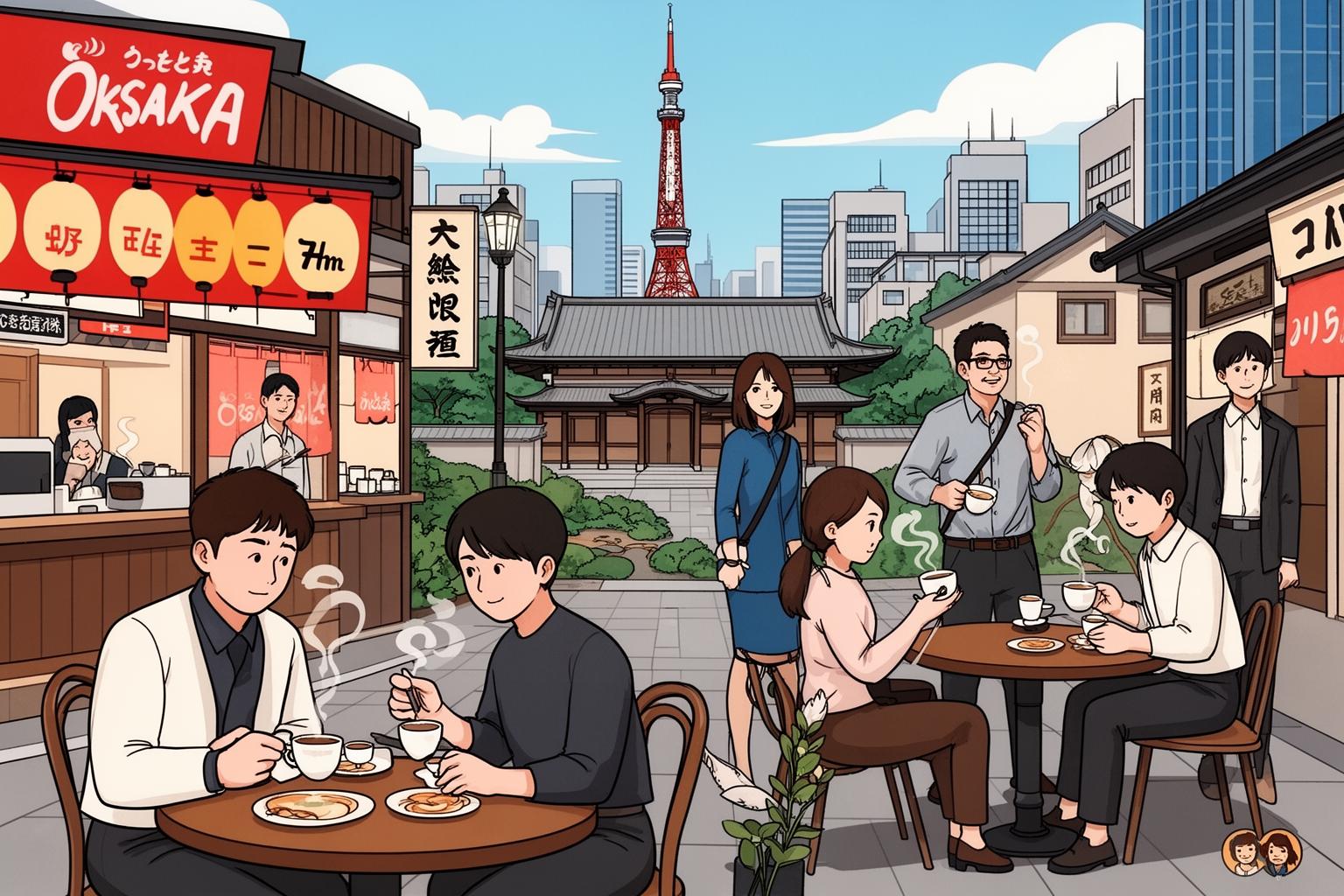
For a non-Japanese resident, navigating the kissaten requires some cultural sensitivity. The rules are unwritten, which can make them feel intimidating. The most common mistake is treating it like a modern café. Pulling out a laptop and noise-canceling headphones to work for four hours is a major faux pas. The kissaten follows a different pace. It’s about presence, not productivity. You enter, take a seat, order your drink (and receive your Morning Service), savor it at a relaxed but not indulgent speed, and then leave. You are occupying a seat that could be used by another regular. Staying for hours over a single cup of coffee violates the unspoken agreement. The space is meant for the community to cycle through. Customizing your order is generally discouraged. The Morning Service is served as is. Requesting a different bread, an egg-white-only omelet, or a side of avocado will likely be met with a polite but firm look of puzzlement. The charm of the system lies in its simplicity and efficiency for the one-person operation behind the counter. The Master has perfected a morning choreography of toasting, boiling, and brewing, and you are a guest enjoying the performance, not directing it. The relationship with the Master is important. A simple ‘Gochisousama deshita’ (‘Thank you for the meal’) when leaving goes a long way. If you become a regular, a simple nod or ‘Ohayo gozaimasu’ (‘Good morning’) when entering is expected. It’s about recognizing the human element. You’re not just a customer; you’re part of the shop’s life. Another potential issue is the smoke. Many old-school kissaten still allow smoking, or have sections that aren’t strictly separated. For many non-smokers, this can be a deal-breaker. But it honestly reflects what these places are: relics of a different era, preserving the habits of long-time patrons. Complaining about the smoke in a kissaten is like complaining about the books in a library. It’s part of the established atmosphere. Embracing the kissaten means accepting its character fully, from the worn velvet seats to the faint haze in the air. It’s an exercise in observing and adapting to a local rhythm—a valuable skill for anyone truly wishing to live in Osaka.
The Osaka DNA: Why ‘Morning Service’ Thrives Here
So why does Morning Service remain such a lasting and defining feature of Osaka, more than in other Japanese cities? It’s because this simple plate of toast and egg perfectly embodies the Osakan character, a concept locals sometimes refer to as Osaka-rashisa. It’s the city’s DNA presented on a small ceramic plate. At its heart lies the merchant’s spirit. As we’ve discussed, it’s the philosophy of kashikoi—clever value. But it goes even further. It represents a form of proactive hospitality, a gesture that says, “I value your business, so here is something extra.” This contrasts with the more reserved, reactive service style found elsewhere. An Osaka business owner aims to make a strong impression, ensuring you remember the value you received and return. The Morning Service is the most effective, low-cost marketing tool ever invented. Secondly, it reflects a certain earthiness and lack of pretension. Osaka food culture, from takoyaki to okonomiyaki, is famously hearty, delicious, and unceremonious. It’s konamon—flour-based food—the food of the people. Morning Service fits seamlessly within this tradition. It’s not an extravagant brunch with hollandaise sauce and mimosas. It’s toast, egg, and coffee. It’s sustenance. Simple, honest, and satisfying. This pragmatism is a hallmark of the city. While Tokyo may be chasing the next global trend, Osaka is content to perfect what has always worked. Lastly, and perhaps most importantly, it highlights the primacy of community. In a city where neighborhood bonds can be very strong, the kissaten serves as a local hub. The Morning Service acts as the gravitational force drawing people in daily, creating a routine that fosters connection. It ensures neighbors see one another, provides the elderly with a place to go, and offers the community a stable, physical gathering point. It stands as a bulwark against the anonymity of modern urban life. In Tokyo, your “third place” might be a highly specific, niche hobby group you travel across the city to join. In Osaka, it’s more likely the kissaten on your corner, populated by the same people you encounter at the local supermarket. The Morning Service isn’t just nourishing stomachs; it’s nurturing the social fabric of the neighborhood, one slice of toast at a time.
Finding Your Morning: A Practical Epilogue
As a resident or someone considering becoming one, your goal isn’t to discover the ‘best’ kissaten in Osaka. No list can ever be truly definitive. The best kissaten is the one that becomes yours. Finding it means exploring the city’s backstreets and its very heart. So, how should you start? Begin by moving away from the main train stations and the shiny shopping arcades. Immerse yourself in residential neighborhoods and the shotengai (local shopping streets), where life slows down from a rush to a calm pace. Watch for signs. A faded, sun-bleached plastic food model of the Morning Service set displayed outside is a classic clue. A revolving, tri-colored barber-pole-style lamp—signifying a coffee shop—is another unmistakable hint. Seek out names written in elegant, somewhat old-fashioned katakana script. Don’t be discouraged by a dark entrance or windows you can’t see through. These places aren’t designed with modern marketing ideas of bright, open storefronts. Their interiors offer a refuge from the outside world, not an extension of it. Open the door. The little bell that chimes marks your arrival. Take a seat, soak in the atmosphere, and order your coffee. When the tray appears accompanied by unexpected extras, you’ll know you’ve found the right spot. Finding your local kissaten is a rite of passage. It marks the moment you shift from merely occupying space in the city to truly engaging in its daily life. It’s where you’ll start to grasp your neighborhood’s rhythms, hear authentic Osaka-ben dialect, and perhaps feel for the first time the warm, practical, and deeply human embrace of this remarkable city. The coffee is only the beginning.