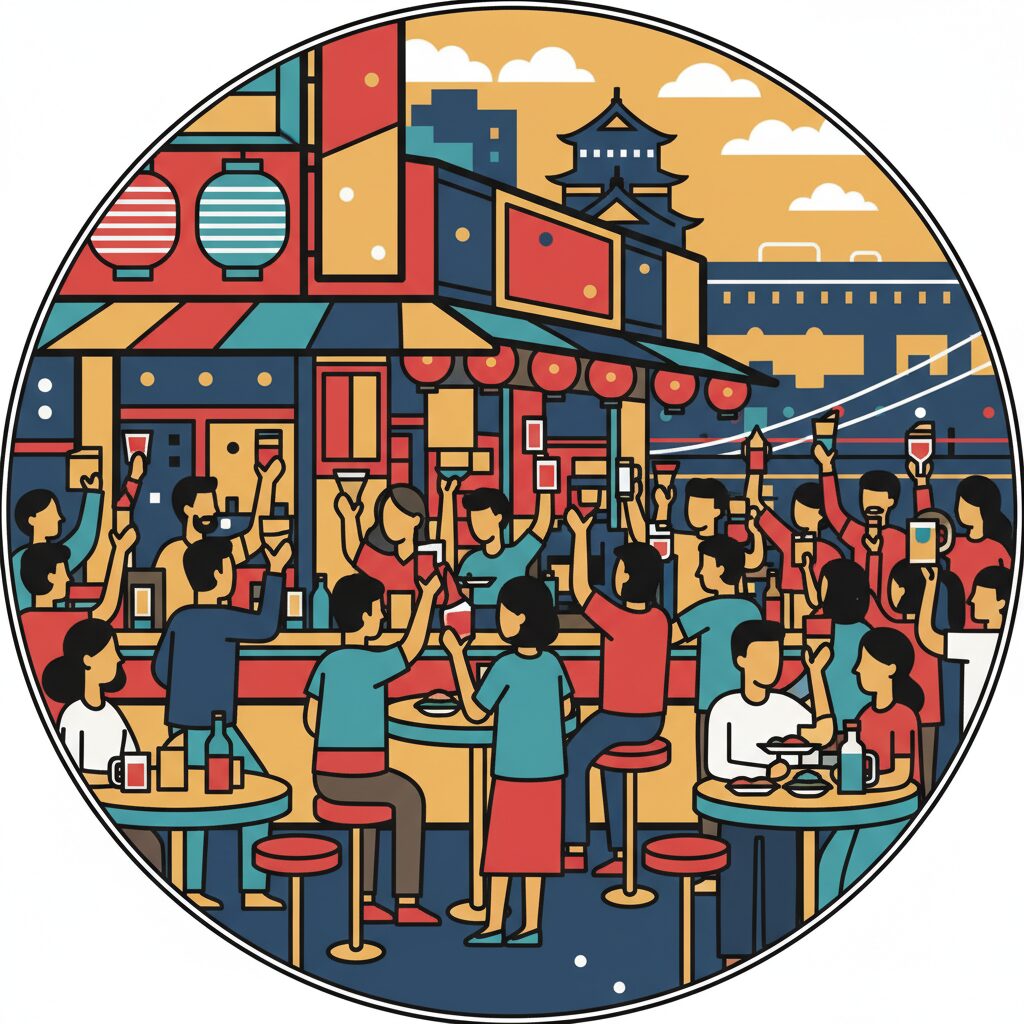
So you’ve landed in Osaka. You’ve navigated the train systems, found a decent apartment, and maybe you’ve even figured out how to separate your burnable trash from your plastics. You’re settling in. But then comes the hard part, the part nobody puts in the welcome packet: making actual, local friends. You might have come from Tokyo, where striking up a conversation with a stranger on the train feels like a social crime, or from a country where casual chats are the norm but you’re hitting a language and culture wall. You go out, you see groups of people laughing, and you feel like you’re watching a movie from behind a pane of glass. It’s a common story, the quiet loneliness of an expat life.
But here in Osaka, there’s a secret handshake, a social cheat code that blasts through that glass. It’s not a club, it’s not an event, and it doesn’t require a formal invitation. It’s the tachinomi, the standing bar. And it’s not just a place to grab a cheap drink. It’s an institution, a living, breathing expression of Osaka’s soul. Forget everything you know about reserved Japanese social etiquette. In the cramped, chaotic, and gloriously unpretentious world of the tachinomi, the rules are different. Here, talking to strangers isn’t just accepted; it’s the entire point. It’s where the city’s heart beats, one frothy beer and one plate of fried skewers at a time. This is your training ground, your social arena, and your fastest ticket to understanding what really makes this city tick. This is where you stop being a visitor and start becoming a part of the neighborhood fabric.
As you immerse yourself in Osaka’s bustling tachinomi scene where friendships take root, exploring local hacks such as discount ticket strategies can further enhance your journey toward truly living like a local.
The Tachinomi Blueprint: More Than Just a Bar Without Chairs
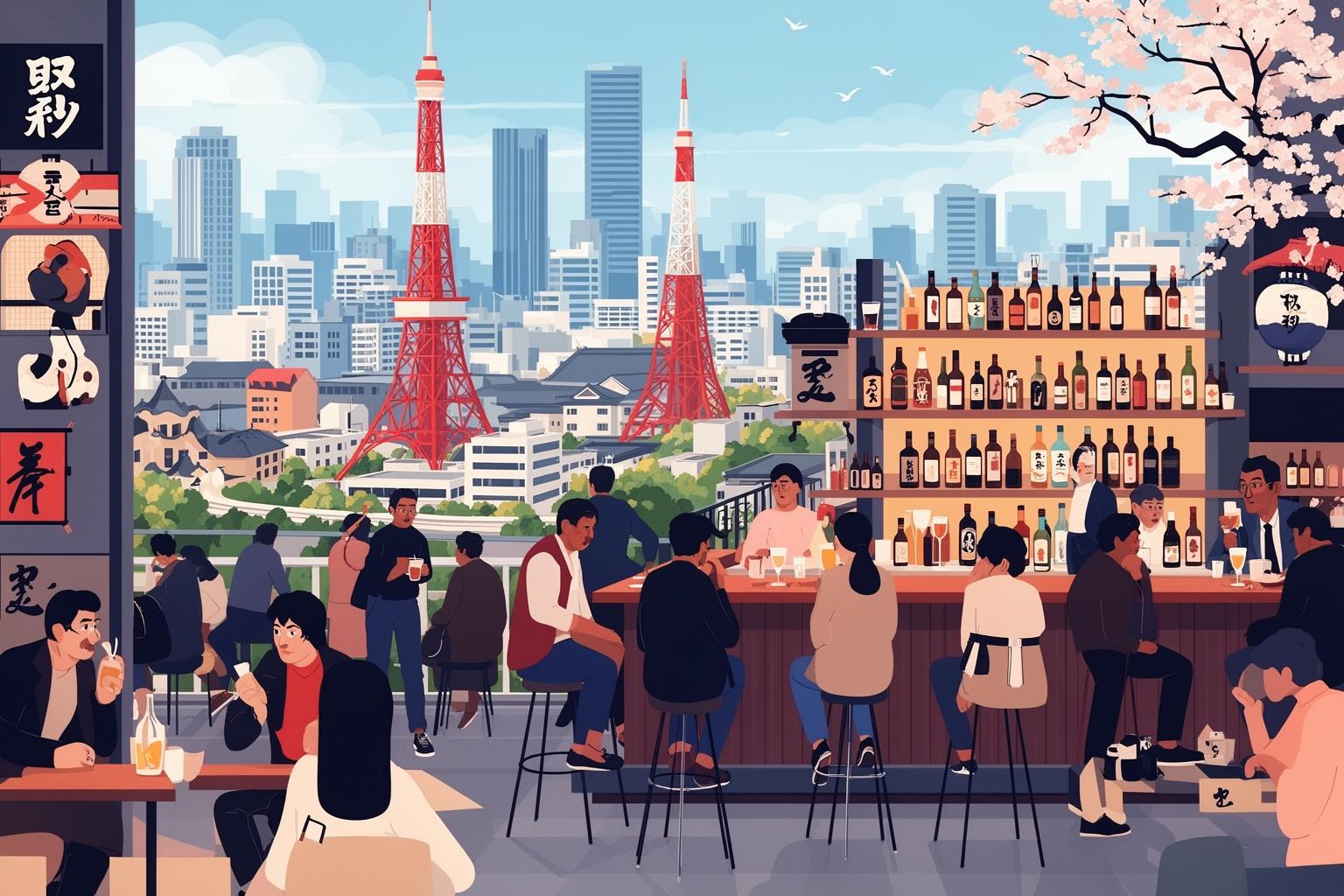
At first glance, a tachinomi appears defined by its absences. There are no chairs or private tables, no plush seating—just a counter, a bartender, and a crowd standing shoulder-to-shoulder. Yet this isn’t a design flaw; it’s a social engineering triumph. The lack of chairs creates a fluid, dynamic environment where boundaries dissolve. You’re not tethered to one group at a fixed table; you’re a free agent in a sea of potential conversations, drifting from one interaction to another. The close physical proximity fosters immediate social intimacy. You’re literally rubbing elbows with your future friends.
A Crash Course in Standing Bar Etiquette
Stepping into a classic tachinomi for the first time can feel like entering another world, especially one tucked beneath JR train tracks in places like Tenma or Kyobashi. The air thickens with the scent of grilled meat and cigarette smoke, while the crowd’s roar is punctuated by the rumble of passing trains. It’s sensory overload. Yet the system is elegantly straightforward. There’s no host to seat you. You find a small spot at the counter, catch the bartender’s eye, and place your order. More often than not, it’s kyasshu on—cash on delivery. You leave a 1,000 yen coin on the counter, and the bartender deducts the cost of each drink and dish until the money runs out. This simple setup lowers the barrier to entry. You’re not committing to a three-hour meal; you can swing by for a single beer and a plate of kushikatsu for under 500 yen and be on your way within twenty minutes.
The menu usually hangs on the wall, simple and direct: beer, highballs, chu-hai, sake, and a rotating selection of small, inexpensive dishes. Unsure what to order? Just point to what the person beside you is enjoying and say, “Are, hitotsu onegaishimasu” (One of those, please). Navigating the space is a dance—you learn the subtle shuffle and the quick “Sumimasen, chotto gomen” (Excuse me, just a moment) as you squeeze past someone heading to the restroom. Personal space is a shared asset, and everyone respects the unspoken rules of polite coexistence in tight quarters. It’s organized chaos, but once you accept it, you realize it’s designed to make you part of the whole.
The Unspoken Social Contract
The key rule of the tachinomi, the one that transforms the experience, is this: you are here to be social. This marks a fundamental shift from the formal decorum of a Tokyo izakaya. In Tokyo, you arrive with your group, stay with your group, and leave with your group. Interacting with other tables is rare, often viewed as an intrusion, with conversations treated as private bubbles. In an Osaka tachinomi, the entire bar is one large, porous conversation. The bartender plays the ringleader, cracking jokes and connecting patrons. The elderly man nursing his sake is just as likely to ask about your day as your closest friend.
For a foreigner, this is transformative. The feeling of being an outsider vanishes the moment someone leans over and asks, “Nii-chan, doko kara kitan?” (Hey buddy, where are you from?). This isn’t just a polite gesture—it’s an outright invitation to join in. Your answer often opens the door to follow-up questions about your home country and your thoughts on Osaka’s food. Your role isn’t to deliver a perfect, grammatically correct response but to show enthusiasm, smile, and return the question. The social contract hinges on mutual participation. If you stand silently staring at your phone, you break the unspoken rule. But if you open yourself up, even with broken Japanese, the entire bar will often rally to include you.
Why Osaka? The Cultural Soil for Tachinomi
The tachinomi is more than just a casual style of bar; it embodies Osaka’s distinctive cultural DNA. It simply wouldn’t exist in the same form within the more formal and reserved atmospheres of Tokyo or Kyoto. It arose from the very essence of this city, nurtured by its history, economy, and unique style of communication. To grasp the concept of the standing bar is to grasp the Osakan mindset—a perspective shaped by commerce and comedy.
The Merchant City DNA
For centuries, Osaka served as Japan’s commercial hub, known as the “nation’s kitchen.” It was a city filled with merchants, traders, and artisans—the shonin no machi. This heritage has deeply influenced the local character. The merchant mindset, or akindo seishin, is practical, straightforward, and fundamentally relational. Business wasn’t conducted through formal letters and strict protocols; it was done face-to-face, founded on trust, quick wit, and the ability to read people. Deals were closed over shared meals or quick drinks. This culture of open, efficient, and friendly negotiation extended naturally from the marketplace into social life.
The tachinomi perfectly expresses this spirit. It’s economical—maximizing social return for minimal investment of time and money. It’s efficient—eliminating time wasted on seating ceremonies or waiting for a final bill. And it’s relational—designed specifically to foster quick, easy connections that sustained the merchant class. Osakans prioritize substance over style, and function over form. Why spend on chairs and fancy decor when the true value lies in human connection? This practicality and emphasis on personal interaction form the foundation of the city’s social fabric, visible every night in its standing bars.
The Art of the “Tsukkomi”: Conversation as a Sport
If you’ve ever watched Japanese comedy, you know the duo act of the boke and tsukkomi. The boke is the goofy one, the airhead who says something absurd. The tsukkomi is the straight man who promptly fires back with a sharp, witty comeback, often paired with a light slap. In Osaka, this isn’t merely a comedic routine; it’s the underlying rhythm of daily conversation. Communication here is a contact sport—a playful exchange of jokes and retorts. And the tachinomi is the home field.
You see it all the time. A customer might loudly complain about the weather, acting as the boke. Without hesitation, the bartender or another guest responds with the tsukkomi: “What are you talking about? It’s perfect beer weather!” Everyone laughs, and a shared moment is born. This style of conversation is often misunderstood by outsiders as loud or aggressive. It’s not—it’s interactive, a sign of engagement. Silence tends to be seen as boredom or disinterest. Osakans are always on the lookout for a conversational partner to join the boke/tsukkomi exchange. When they ask a question, it’s not just small talk; it’s an invitation to play. Any effort to respond, however awkward, is welcomed. That’s why Osakans come across as so approachable—they’re wired to engage. They want you to join the game. The tachinomi is simply the place where that game never ends.
A Foreigner’s Field Guide to Conquering the Tachinomi
Grasping the theory is one thing, but actually crossing that threshold is another. It can feel daunting. You might worry about the language, the rules, or the regulars eyeing the unfamiliar face. However, with some preparation and the right mindset, you can not only survive your first tachinomi experience but truly enjoy it. The key is to treat it as an adventure—a low-pressure chance to practice your Japanese and get an authentic taste of local life.
Finding Your Spot: From Gritty Showa-era Joints to Modern Stand-ups
Tachinomi come in many varieties. They range widely, so finding one that suits your comfort level is essential. On one end, there are the classic Showa-era dives. Think of places like Tenma’s Tenjinbashi-suji Shotengai or the backstreets of Kyobashi. These spots tend to be small, somewhat rundown, and filled with long-time patrons who have been drinking there for years. The menus are handwritten, prices are very affordable, and the atmosphere is rich with authenticity. These can offer the most rewarding experiences but may also be the most intimidating to newcomers.
In the middle, you’ll find the “neo-tachinomi.” These are newer, stylish standing bars found in areas like Umeda, Fukushima, or Namba. They often focus on wine, sake, or craft beer, with food leaning toward creative Japanese-style tapas. The crowd tends to be younger, a mix of office workers and students. These spots serve as excellent entry points with a social, stand-up format in a cleaner, brighter, and less intimidating setting. At the other end of the spectrum are specialist bars—a sake brewery’s tasting room or a corner in a department store’s food hall—using the standing format for quick, focused tastings. Your game plan? Begin with a neo-tachinomi to get comfortable, then, once you feel more confident, dive into the gritty core of a classic joint. That’s where the true stories live.
Your Opening Lines (and How to Handle Theirs)
Fluency isn’t required to connect. In fact, being a foreigner is often your greatest advantage—it’s an instant conversation starter. Knowing a few basics will carry you far: a cheerful “Konnichiwa!” when entering, a clear “Biru, kudasai” (Beer, please), and a sincere “Oishii!” (This is delicious!). When someone speaks to you, don’t worry. You’ll get some standard questions—be prepared.
“Doko kara kitan?” (Where are you from?). Answer with a smile, naming your country. They’ll likely mention something familiar about it—maybe a city, a food, or a famous person. “Nihon wa nagai n?” (Have you been in Japan long?). Offer a simple reply; this helps them assess your Japanese level. And the quintessential Osaka question: “Hanshin fansu ka?” (Are you a Hanshin Tigers fan?). The Hanshin Tigers are the city’s cherished yet often unlucky baseball team. The right answer is always “Yes.” A passionate “Meccha suki desu!” (I love them!) will win you instant friends, and possibly a free drink. The secret is your attitude. Be open, friendly, and don’t be shy about laughing at your own mistakes. It’s the effort, not perfection, that counts.
The Joren (The Regulars): Your Key to the Inner Circle
Every great tachinomi has a core group of joren, the regulars. They are the gatekeepers and the soul of the place. They know the master by name, have their usual spot at the counter, and keep the bar’s unique vibe alive. Befriending the joren is your ultimate aim. At first, they might seem a bit closed off, but they’re generally welcoming to anyone who respects their space. The best way in is to become a regular yourself.
Don’t just stop by once. Return to the same spot, perhaps on the same day each week. Order a similar drink. The master will start to recognize you. The joren will see you’re more than just a tourist. Offer a small nod or a quiet “Otsukaresama desu” (a versatile greeting used at the end of the workday). Listen to their conversations. Sooner or later, one of them will include you. If the mood is right, buy someone a drink—a simple gesture that goes a long way. Once accepted by the joren, you’ll have a place that feels like your own, a community to return to, and a genuine window into everyday life in Osaka.
Tachinomi vs. the World: What It Reveals About Osaka
The standing bar is more than just a place to drink; it serves as a living museum of Osaka’s social philosophy. It is where the city’s abstract cultural values—pragmatism, humor, directness—take tangible form. By observing the dynamics of a tachinomi and comparing them to social settings elsewhere, you can uncover the essence of what makes Osaka fundamentally different from Tokyo and much of the rest of Japan.
The Anti-Tokyo Vibe: Efficiency Meets Humanity
Consider a typical night out in Tokyo. It involves careful planning and precision. You make a reservation, often weeks ahead. You arrive at a set time. You are shown to a private or semi-private table. Your experience is limited to your group, aiming for a perfect, seamless event within a closed system. The Osaka tachinomi stands in stark contrast. It is spontaneous, chaotic, and wonderfully inefficient in its pursuit of human connection. There are no reservations and no walls. The system thrives on serendipity.
This highlights a fundamental difference in the two cities’ approaches to life. Tokyo values order, privacy, and flawless execution, running on schedules. Osaka prioritizes flexibility, community, and human interaction, even if it’s a bit messy. The tachinomi’s open-floor plan symbolizes the city’s social fabric. It’s porous. Groups form, merge, and split apart. A conversation between two people can quickly escalate into a bar-wide debate about baseball. This preference for fluid, organic social interactions over rigid, planned events is one of the most refreshing and defining traits of daily life in Osaka.
“Kamahen, Kamahen”: The Philosophy of Not Sweating the Small Stuff
There’s a popular phrase you hear constantly in Osaka: “Kamahen, kamahen.” It’s the local dialect equivalent of “daijoubu” or “kinishinai,” meaning “Don’t worry about it” or “It’s no problem.” This phrase is more than just words; it’s a life philosophy and the invisible force driving the tachinomi culture. Accidentally knocked over someone’s drink? Kamahen, kamahen, they’ll say while someone else cleans it up. Struggling to explain your order in broken Japanese? Kamahen, the person next to you will help translate. Unsure of the bar’s rules? Kamahen, someone will gladly explain them.
This attitude reduces the social anxiety that often affects foreigners in Japan. In a culture that can place great importance on precision, Osaka provides a space of grace. There’s higher tolerance for imperfection and a genuine willingness to assist others. This creates an environment where it feels safe to try, to err, and to be yourself. The tachinomi is the ultimate kamahen zone—a judgment-free space where the only expectation is a desire to connect. This relaxed, forgiving spirit is key to making Osaka so livable and welcoming for outsiders.
The Misconception: “Loud and Aggressive” vs. “Engaged and Interactive”
One of the most persistent stereotypes about Osakans is that they are loud, brash, and even somewhat aggressive compared to other Japanese. From a Tokyo perspective, where public conversation is often quiet and indirect, this may seem true. But the tachinomi offers the perfect setting to challenge this misconception. What an outsider might interpret as “loud” is actually “engaged.” What appears “aggressive” is truly “interactive.”
Osaka’s communication style is a participatory democracy. People speak up, laugh loudly, interject, and tease. They’re not broadcasting into silence; they’re actively creating a lively, shared atmosphere. In a tachinomi, this is on full display. The bartender banters with customers. Customers banter with one another. It’s a collaborative performance. For a foreigner, the lesson is vital: don’t shy away from the energy—lean into it. A quiet observer might be left alone, mistaken for disinterest. But the moment you join in—with a laugh, a question, or a compliment about the food—you become part of the show. You realize it’s not aggression; it’s a passionate, open-hearted invitation to join the community.
Conclusion: Your First Drink is Your First Step

Ultimately, a tachinomi is much more than just a bar without chairs. It embodies a microcosm of Osaka itself. It captures the city’s merchant spirit, its comedic tempo, and its warm hospitality, all condensed into a standing-room-only space. It’s where the unwritten rules of Osaka life come alive, where the city’s soul is fully revealed. For any foreigner feeling lost in a new culture, yearning for that elusive sense of belonging, the standing bar is the answer. It’s a bridge made of affordable beer and fried chicken, connecting you directly with the local community.
Don’t treat it merely as a tourist curiosity. Make it a part of your daily life. Find a spot in your neighborhood that feels comfortable. Let the master recognize your face, then learn your name. Let the regulars see that you intend to stay. Your Japanese will improve, your confidence will build, and before long, you’ll find yourself on the other side of the conversation, sharing the merits of the Hanshin Tigers with a newcomer. That’s when you’ll know you’ve done more than just learn to live in Osaka—you’ve become part of it. The journey begins with a single step, crossing the threshold and approaching the counter. No chairs, no reservations, and absolutely no pretense necessary.