Step off the Shinkansen at Shin-Osaka, and you feel an immediate shift in the urban rhythm. Where Tokyo hums with a polished, corporate sheen—a city of glass towers, silent train cars, and impeccably choreographed service—Osaka growls. It’s a city with its sleeves rolled up, a place where the air carries a faint scent of cooking oil and industry, and where the prevailing sound is not the quiet shuffle of commuters but the clang of metal, the sizzle of an okonomiyaki grill, and the boisterous laughter of a deal being struck. Many foreigners, and indeed many Japanese from other regions, mistake this for a lack of refinement. They see the grit and hear the direct, unvarnished dialect, and conclude that Osaka is simply Tokyo’s rough-and-tumble country cousin. This is a fundamental misreading of the city’s soul. To truly understand Osaka, you must look past the gleaming facades of Umeda and the tourist throngs of Namba. You need to peer into the backstreets, into the small, family-run eateries, the cluttered hardware stores, and the humming, street-level workshops known as machi-kōba. This is the city’s engine room. The prevalence of small and medium-sized enterprises (SMEs), overwhelmingly family-owned, is not just an economic statistic here; it is the central organizing principle of Osakan life. It dictates how people work, speak, and interact. It fosters a culture of fierce pragmatism, relational trust, and an unapologetic focus on results over appearances. This is not the Japan of corporate manuals and silent consensus. This is the Japan of the merchant, the artisan, and the entrepreneur, a legacy that shapes every aspect of daily existence in the city that was once, and in many ways still is, the nation’s kitchen.
To further experience Osaka’s unique blend of culinary heritage and practical living, you might also learn how to master the Sozai aisle in local supermarkets.
The Merchant’s Soul: Why Family is the Foundation
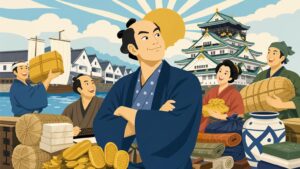
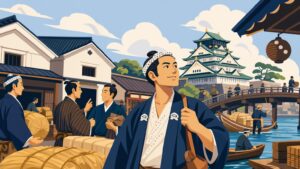
To understand why small family businesses are so deeply woven into Osaka’s identity, you need to look back at history. During the Edo period (1603-1868), Tokyo (then Edo) was the political hub, a city of samurai and bureaucrats, while Osaka was known as Tenka no Daidokoro—the Nation’s Kitchen. It served as Japan’s commercial center, a bustling port where rice, the currency of the realm, was collected, stored, and traded. This city wasn’t founded on inherited status or government decree; it thrived on credit, contracts, and careful calculation. Osaka’s heroes were not stoic warriors but savvy merchants, the shōnin, who built dynasties not with swords but with abacuses and meticulously kept ledgers. This history forged a distinctly different civic mentality. In Tokyo, social value was linked to rank and loyalty to a feudal lord. In Osaka, your value was your word, your reputation, your shin’yō (trust or credit). A merchant who could not be trusted was doomed. This principle resonates strongly today. Business in Osaka is fundamentally relational. A long-term relationship with a supplier you’ve known for three decades is far more valuable than a marginally cheaper deal with a newcomer. Deals are often finalized not with lengthy legal contracts but with a handshake and mutual understanding, a belief in a long-term partnership. This legacy also explains the city’s relentless pragmatism. The old merchants had no patience for the elaborate, time-consuming rituals of the samurai. Their focus was on the deal, the product, and the bottom line. This ethos endures in the modern Osakan’s directness, a trait often mistaken for brashness.
Uchi no Mise: The Shop as an Extension of Home
Step inside any long-established neighborhood tofu shop, print workshop, or corner tavern, and you’re not just entering a business; you’re entering the family’s life. The very phrase used for one’s own business, uchi no mise, literally means “our house’s shop.” Often, this is a physical reality. In older neighborhoods, it’s common to find a two- or three-story building where the ground floor houses the workshop or store, and the upper floors serve as the family’s living quarters. The boundary between work and home not only blurs but often disappears altogether. The workday isn’t a nine-to-five shift; it’s a way of life. The father may be the master craftsman, the mother (okami-san) manages the books and customers, and the children grow up surrounded by the sights and sounds of the trade, learning its language and skills through osmosis. This arrangement profoundly influences the nature of customer service. The service you get in a family-run Osaka business is rarely the flawlessly polite, script-driven performance typical of a Tokyo department store. It’s much more personal, and at times, more intrusive. The owner of the local vegetable stand doesn’t just sell you tomatoes; she asks why you haven’t visited for a week, remarks on your children’s growth, and offers unsolicited but genuinely helpful advice on cooking the daikon you’re buying. She remembers how you like your onions and might toss in an extra one for free—a little bonus known as omake. This isn’t a sales tactic learned in a training seminar; it’s a natural outgrowth of a long-term relationship. You are not a transaction; you’re a neighbor, part of the extended ecosystem of the shop. For outsiders, this can feel overly familiar, but for locals, it’s the foundation of community life. This is the true meaning behind the cliché that “Osaka people are friendly.” It’s not superficial warmth; it’s the ingrained behavior of people whose livelihoods depend on nurturing a web of strong, personal, community-based relationships.
The Roar of the Machi-kōba: Forging the City’s Backbone
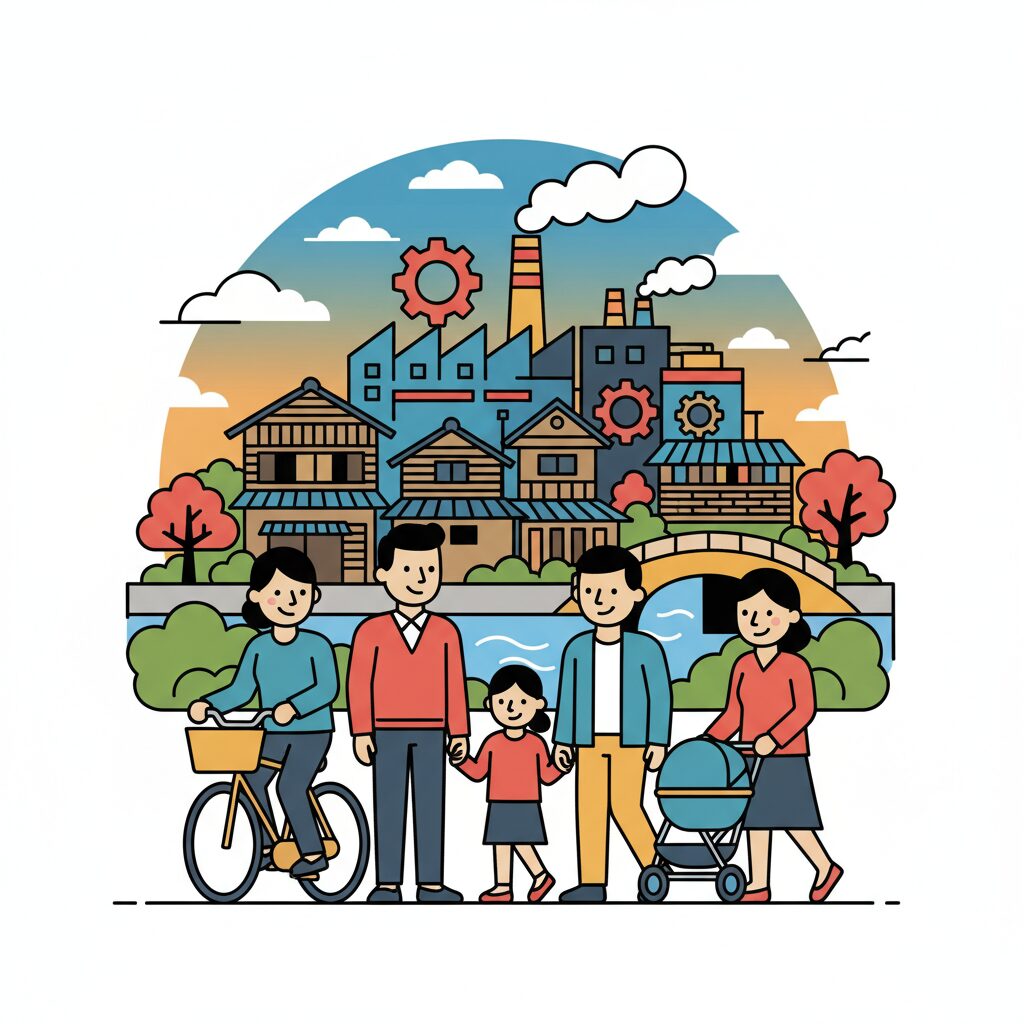
While the merchant spirit shapes Osaka’s commercial identity, its industrial core pulses within the thousands of small workshops known as machi-kōba. These are not large, automated factories set in sterile industrial zones. Instead, they are small, often family-run operations nestled within residential neighborhoods, sometimes occupying little more than the space of a two-car garage. Walking through areas like Higashi-Osaka, renowned for its concentration of machi-kōba, offers a unique urban soundscape. The rhythmic clang of a metal press, the high-pitched whir of a lathe, and the hiss of a welding torch blend into the neighborhood’s ambiance alongside the chatter of children playing in the streets. The air carries a distinctive scent—a metallic, oily tang that embodies monozukuri, the art and spirit of crafting. These workshops are the unsung pillars of Japan’s manufacturing strength. They don’t produce finished goods under their own brand, but excel in specialization. One machi-kōba might craft a specific type of screw with unmatched precision, the next might specialize in polishing a certain metal alloy to a mirror finish, and another might focus on creating intricate molds. Together, they form a vast, complex, and highly efficient horizontal supply chain. A single part for a car, medical device, or even a satellite may pass through the skilled hands of a dozen family-run workshops before completion. This collaborative network was famously illustrated by the Maido-1 satellite project, where several Higashi-Osaka SMEs combined their expertise to build and launch a satellite, showcasing their collective skill and ambition.
The Pragmatism of the Shokunin
The culture within a machi-kōba distills the Osaka mindset. It is guided by the spirit of the shokunin, the devoted artisan or craftsman. A shokunin dedicates their life to the relentless pursuit of perfection in their craft, leaving no space for pretense or inefficiency. Respect is earned not through fancy titles or university degrees but through proven skill. The shachō (company president) is often on the factory floor, hands as greasy as those of the workers, fine-tuning a machine or inspecting a part. The emphasis is squarely on the quality of the work. This environment fosters a distinct communication style. There is little tolerance for corporate jargon, long meetings, or vague, indirect language. Problems are stated clearly, solutions are proposed straightforwardly, and feedback is delivered without sugarcoating. A “no” means a “no,” not “maybe we can explore other possibilities later.” For those used to the more cushioned communication typical of large corporations, this can be striking. But within the machi-kōba context, it’s simply the most efficient way to accomplish the task. Wasting time on unnecessary pleasantries is regarded as waste, and in the world of monozukuri, waste is the greatest sin. This directness is often paired with the concept of A-un no Kokyū, or “the respiration of A and Un.” It describes the perfectly synchronized, intuitive communication between people who have worked together for a long time. It’s the master and apprentice completing a complex task with barely a word spoken, or two collaborating workshop owners understanding each other’s needs from a single phone call. This unspoken understanding acts as the lubricant that keeps the entire machi-kōba ecosystem running smoothly—far removed from the memo- and email-driven culture of the modern office.
How It Shapes Work, Life, and the Osaka Psyche
The prominence of this SME culture shapes a social and professional environment that stands in stark contrast to Tokyo’s. While the typical route to success in Tokyo might involve graduating from a prestigious university and advancing within a major multinational corporation or government ministry, the Osaka dream often takes a different form. Here, true success is being a shachō of your own company—being your own boss. Tremendous respect is given to those who have built a business from the ground up or have successfully inherited and expanded the family enterprise. The pressure on the atotsugi (the heir) is enormous, as they bear the legacy of generations. This entrepreneurial spirit is deeply ingrained in social interactions. The famed Osaka greeting, “Mōkarimakka?” (“Making a profit?”) followed by the typical response, “Bochi bochi denna” (“So-so”), perfectly illustrates this. A Tokyoite might find such a question about financial status startlingly direct, even impolite. But in Osaka, it serves as a conversation opener and a sign of camaraderie. It immediately acknowledges the shared reality that everyone is hustling to make a living in a competitive commercial world. It’s a way of saying, “I see you. I understand the game. How are things going for you?” This mentality nurtures a culture where people are constantly seeking opportunities, discussing business, and exchanging information. A casual conversation at a local bar can quickly shift into a business discussion, and new ventures often emerge from talks between neighbors.
The Blurring of Boundaries
This blending of work and life, exemplified by families living above their shops, carries significant consequences. On one hand, it generates a strong sense of purpose and dedication. The business transcends being just a job; it becomes the family’s identity and future. Decisions are made swiftly, without layers of bureaucracy, enabling remarkable agility. It also promotes a close-knit community. The local shōtengai (shopping arcade) is more than a cluster of stores; it’s a network of families linked through generations. They support each other’s businesses, celebrate life events together, and look out for one another. The local factory owner dines at the noodle shop run by a family down the street, who then purchase their tools from the neighborhood hardware store. This generates a resilient, hyper-local circular economy. However, this lack of separation also brings challenges, especially for outsiders. For non-family employees, advancing within the company can be nearly impossible when top roles are reserved for the owner’s descendants. The workplace culture is often insular, with unspoken rules and expectations shaped by the family’s personal dynamics. The pressure to socialize after work hours is intense, as these gatherings are vital for building the trust needed to be welcomed into the inner circle, or uchi. For a foreigner seeking employment, joining a small Osaka company means understanding that you are not just taking on a job but entering a complex, pre-existing social ecosystem with its own history and unwritten rules.
What Foreigners Often Misunderstand
Living and working in Osaka demands a recalibration of expectations, particularly for those coming from Western corporate cultures or other regions of Japan. The city’s distinctive business culture can result in several common misunderstandings. The most frequent one is confusing directness with rudeness. In a business negotiation, an Osaka counterpart might bluntly reject a proposal by saying, “Sonna nedan, muri ya!” (“That price is impossible!”) without any of the softening phrases typical elsewhere. This is not an offense; rather, it is an honest, immediate evaluation and an invitation to start a genuine negotiation. Taking offense is a misstep; the appropriate response is to engage with equal directness, perhaps with some humor, and aim for a realistic compromise. Another challenge is gaining entry into the inner circle. Osakans are outwardly warm and welcoming to customers and acquaintances (soto, or outsiders). However, earning the deep trust necessary to be regarded as part of the uchi (the in-group) takes time. This trust, or shin’yō, is not developed through networking events or polished presentations but through consistent, dependable actions over time. Being punctual, fulfilling promises precisely, paying bills promptly, and showing loyalty by regularly supporting their business are the behaviors that build genuine credibility. A third source of confusion is the local perspective on style versus substance. In the machi-kōba environment, appearances carry little weight. A highly skilled engineer in an oil-stained work uniform commands far more respect than a visiting executive in an expensive suit. The priority is on product quality and process efficiency. Lavish offices, glossy PowerPoint slides, and corporate buzzwords are often met with skepticism. What counts is what you can do and create. Recognizing this clarifies the absence of pretense in many Osaka business settings. The emphasis is on the work itself, not the performance of work.
The Future of the Family-Run City
Osaka’s traditional economic model faces its share of challenges. Like the rest of Japan, the city is grappling with a demographic crisis. The kōkeisha mondai, or succession problem, is particularly severe. Many aging family business owners and machi-kōba have no children or have offspring who have chosen different career paths, putting the future of these long-established enterprises at risk. Additionally, global competition and the decline of domestic manufacturing present significant threats. Nonetheless, it would be a mistake to dismiss this resilient city. The same spirit of pragmatism and innovation that built Osaka is now being harnessed to address these modern issues. A new generation of owners is combining traditional craftsmanship with advanced technology, discovering new markets online, and producing unique, high-value products. Collaborative initiatives, like the satellite project, demonstrate a forward-looking approach where small workshops join forces to compete globally. The essence of Osaka’s identity remains intact. It is a city founded by and for people who make things, sell things, and cultivate relationships. Here, your family name and reputation hold more weight than your job title. Living in Osaka means being part of this intricate, human-scale economy. It involves appreciating the skill in a perfectly crafted metal piece, recognizing the trust behind a handshake deal, and cherishing the community found within your local shopping arcade. The hum of workshops and the candid, friendly exchanges among shopkeepers are more than just background noise; they represent the lasting, vital heartbeat of a truly unique city.