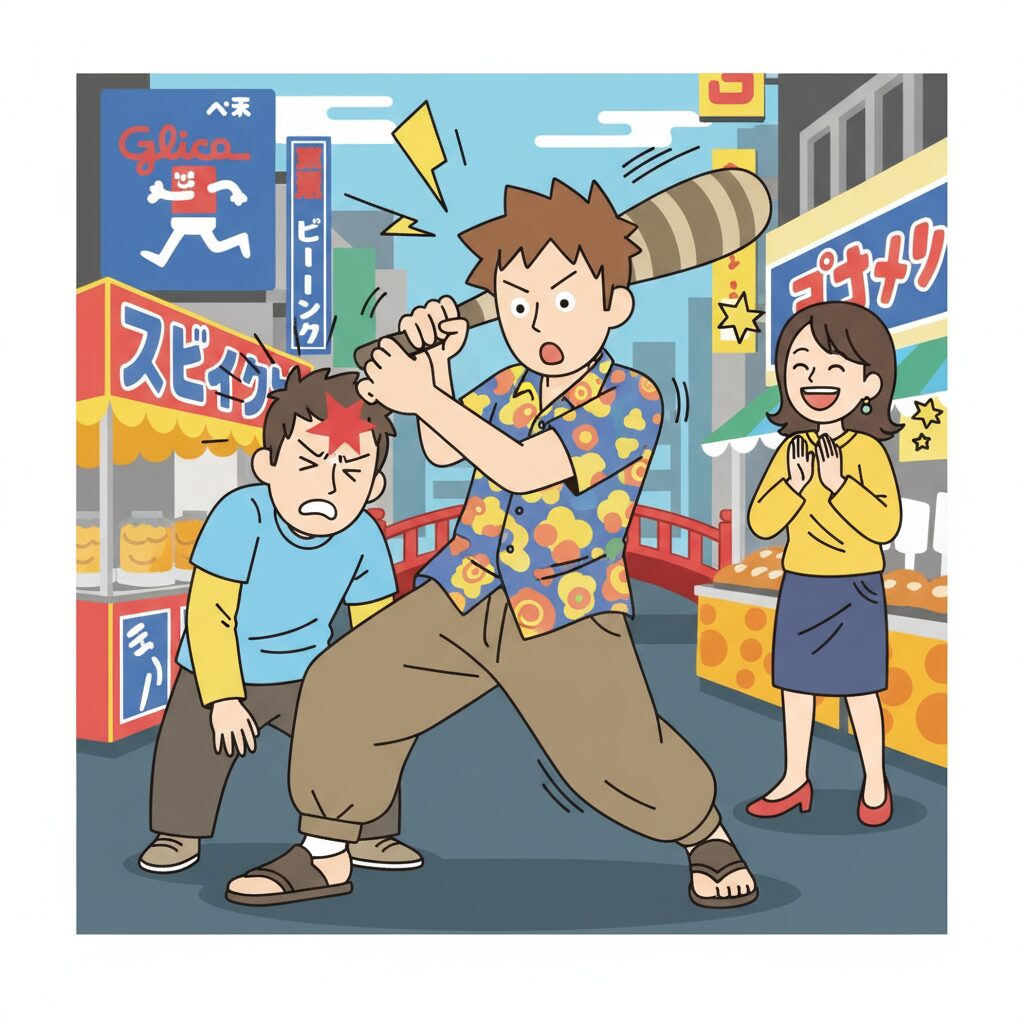
The first time it happened, I was utterly lost. I was standing in a tiny, cluttered electronics shop in Nipponbashi, holding a power adapter and asking the elderly shopkeeper, in my most polite Japanese, if it would work in China. He squinted at the adapter, then at me, and declared with a perfectly straight face, “No, this will probably explode. A big explosion.” I froze. Was he serious? Was I about to buy a miniature bomb? My confusion must have been written all over my face, because he suddenly broke into a huge, wheezing laugh, slapped his knee, and said, “Just kidding, of course it’ll work!” His wife, who had been dusting a shelf nearby, chimed in without missing a beat, “Stop scaring the customers, you old fool!” He just grinned wider. In that moment, I realized conversation in Osaka wasn’t just about exchanging information. It was a sport. A performance. And I had just been served the opening volley.
This is the world of ‘boke’ and ‘tsukkomi’, the fundamental rhythm of Osaka’s humor. It’s a comedic duet that plays out thousands of times a day on street corners, in shops, and over dinner tables. The ‘boke’ is the absurd, silly, or slightly-off statement—the joke’s setup. The ‘tsukkomi’ is the sharp, witty comeback that points out the absurdity, acting as the punchline. To the uninitiated, it can sound like good-natured bickering, or even genuine criticism. But to understand this dynamic is to hold the key to the heart of Osaka’s social life. This isn’t just about telling jokes; it’s a way of building rapport, of showing affection, and of turning the most mundane interactions into a shared moment of levity. It’s the city’s unique pulse, a constant, playful back-and-forth that says, “I see you, and I’m ready to play.” This is the stage for Osaka’s daily comedy, and you’re invited to join the cast.
Osaka’s penchant for playful interaction finds its parallel in the region’s shift toward tech-powered hotel innovations, where cutting-edge technology is redefining the guest experience.
The Rhythm of Conversation: Boke and Tsukkomi in the Wild
To truly understand Osaka, you need to grasp its rhythm. It’s a conversational two-step—a call and response that forms the backbone of the local dialect and attitude. At its heart are two opposing yet perfectly complementary roles: the ‘boke’ and the ‘tsukkomi’. Think of them as the setup and punchline, the straight man and the comic, all combined into a fast-paced exchange.
What is ‘Boke’? The Art of the Straight Face
The ‘boke’ (ボケ) serves as the joke’s foundation. It involves an act of playful absurdity. The person playing the ‘boke’ says something deliberately incorrect, exaggerated, or simply silly. The trick to a good ‘boke’ lies in the delivery—it’s often voiced with a completely serious expression, as if the speaker truly believes the nonsense they’re expressing. This deadpan dedication is what makes the inevitable ‘tsukkomi’ so gratifying.
You can see it everywhere. Walk through Kuromon Market and spot a vendor showing off a huge, gleaming tuna. A friend might look at it thoughtfully and say, “That seems a bit small for an appetizer, don’t you think?” That’s a ‘boke’. Or maybe you’re waiting for a train, and the automated announcement says it’s arriving on platform two. The person next to you might quietly say, “I thought it would be coming by helicopter today.” That’s a ‘boke’. It’s a deliberate, gentle break in reality, a small crack in the everyday routine, inviting someone to notice and respond.
What is ‘Tsukkomi’? The Punchline That Connects
If the ‘boke’ is the setup, then the ‘tsukkomi’ (ツッコミ) is the knockout punch. It’s the quick, sharp comeback that points out the silliness of the ‘boke’. The classic, nearly stereotypical ‘tsukkomi’ phrase is “Nande ya nen!” (なんでやねん!), which roughly means “Why would you say that?!” or “What the heck?!” It’s like a playful tap on the arm, a way of saying, “I hear your nonsense, and I’m calling you out.”
Returning to our examples: to the friend who called the giant tuna a small appetizer, the ‘tsukkomi’ would be, “That’s bigger than your head! What are you talking about?” To the person expecting a helicopter train, you’d reply, “Nande ya nen! This is JR, not a secret agent movie!” The ‘tsukkomi’ closes the loop. It affirms the joke by recognizing it, and it brings the conversation back to shared reality—after everyone has enjoyed the brief plunge into absurdity. It’s a key act of connection. Offering a ‘tsukkomi’ demonstrates you’re paying attention, you’re quick on your feet, and most importantly, you share the same wavelength. It’s like a conversational high-five.
Osaka vs. Tokyo: A Tale of Two Conversations
One of the most noticeable differences a newcomer observes when moving between Japan’s two largest urban centers is the soundscape of human interaction. The conversational approach is so distinct that it can feel like crossing a cultural boundary, not merely a shinkansen line. The difference goes beyond accents; it’s about the fundamental purpose of a conversation.
Tokyo’s Polish vs. Osaka’s Playfulness
A typical service interaction in Tokyo is a model of refined efficiency and politeness. It’s smooth, respectful, and frictionless. The language is precise, rich with honorifics, aiming to create a comfortable yet clearly defined space between speaker and listener. The objective is harmony, or ‘wa’ (和), achieved by minimizing disruption and ambiguity. It’s professional and highly pleasant but seldom personal.
Now, step into a shop in Osaka. That polished exterior often gives way to a lively, playful, and sometimes chaotic energy. The goal isn’t merely a seamless transaction; it’s forging a human connection, with humor as the quickest path there. An Osaka shopkeeper might remark on your T-shirt, loudly ask where you’re from, and then crack a joke about it. They might engage in playful haggling over a price that was never negotiable, just for the enjoyment of the exchange. The invisible barrier common in Tokyo conversations is actively dismantled. Here, harmony is found not in polite distance but in shared laughter.
The Unspoken Invitation to Play
This difference in style creates a landscape of unspoken rules. In Tokyo, a casual compliment might receive a humble, formulaic deflection. “Your bag is lovely.” “Oh no, not at all, it’s quite old.” The exchange is polite and closed.
In Osaka, that same compliment is often treated as an opening serve in a game of verbal tennis. “Your shirt is really cool.” The reply might be, “This thing? My dog has better clothes!” This is a classic ‘boke’—an absurd self-deprecation meant to be challenged. It’s an invitation. The expected reply isn’t agreement but a returned ‘tsukkomi’: “No way, your dog doesn’t have that good of taste!”
Ignoring this invitation—by simply nodding politely—can be seen as cold or ‘noritsukkomi’ (ノリツッコミ), someone who doesn’t know how to respond to the joke. While not a major social mistake, it does halt the connection. In Osaka, a bit of silliness is a conversational hook, a way to test if you’re willing to engage beyond surface level. To participate is to be accepted.
Navigating the Nuances: A Foreigner’s Guide to Tsukkomi
For someone not accustomed to a steady stream of Japanese comedy duo shows, this rapid-fire exchange can feel overwhelming. The boundary between a joke and an insult may appear unclear, and the pressure to respond appropriately can be intimidating. But don’t worry. Cracking the ‘tsukkomi’ code relies less on comedic brilliance and more on grasping the intention.
Common Misunderstandings: Is Everyone Angry at Me?
The biggest concern for foreigners experiencing this for the first time is mistaking the ‘tsukkomi’ for sincere criticism. A sharp “Nande ya nen!” or a pointed remark about your sock choice might come across as a personal slight. It’s important to realize that it’s almost always the opposite. A ‘tsukkomi’ signals familiarity and affection. No one bothers to engage in playful teasing with someone they dislike or feel distant from.
Think about it like this: a stranger to whom you’re politely formal will receive a nod and a bow. A friend whose outfit you fix before a date might get a light smack and a “Straighten your collar, you look like a mess!” The ‘tsukkomi’ is the verbal form of that friendly nudge. This is especially true with the famed Osaka ‘obachan’ (middle-aged women), who are the undisputed masters of this art. If an ‘obachan’ at the supermarket jokes about you buying instant ramen again with a “Cooking for one again, huh?”, she isn’t criticizing you; she’s welcoming you into her world. Getting a ‘tsukkomi’ from an ‘obachan’ is a rite of passage—it means you’re no longer just a stranger.
How to React: Your Part in the Duet
You don’t have to be a seasoned comedian to handle this. Your reply can be straightforward. Here’s a simple guide.
First, the easiest and always-appropriate response is to just laugh. A genuine smile and chuckle show you’ve caught the intent, even if you don’t have the words to respond in kind. You’ve acknowledged the ‘boke’, appreciated the humor, and the social exchange is complete. No one will think less of you.
Second, if you feel a bit more confident, try a simple verbal ‘tsukkomi’. You don’t need a perfectly polished sentence. The phrase “Honma?” (ほんま?), meaning “Really?”, said with a skeptical yet laughing tone, works wonders. The classic “Nande ya nen!” is your all-purpose answer. Even with a poor accent, the effort will be warmly received. It’s the willingness to engage that counts.
Third, for the advanced player, you can initiate your own ‘boke’. This is high-risk, high-reward. For example, if you spot a famous landmark like Tsutenkaku Tower and confidently remark, “Wow, Tokyo Tower looks great today,” you’re throwing down a comedic challenge. The enthusiastic, joyous “NANDE YA NEN!” you get back will be the sound of truly connecting with Osaka’s spirit.
Why Does This Culture Exist? A Peek into Osaka’s Soul
This distinctive conversational style didn’t simply emerge spontaneously. It is interwoven with the city’s unique history, its economic significance, and its proud, unabashed identity as Japan’s capital of laughter. Grasping the origins of this humor clarifies why it is so deeply ingrained in the local character.
The Merchant’s Wit
For centuries, Osaka was known as ‘tenka no daidokoro’ (天下の台所), or “the nation’s kitchen.” It served as a thriving commercial center where rice, produce, and goods from across Japan were traded. In this highly competitive setting, merchants needed more than just quality products—they needed personality. They had to be quick-witted, establish instant rapport, and be memorable. Humor proved to be a powerful business asset. A sharp, witty exchange could break the ice, build trust, and make customers feel like friends. This verbal agility—the skill to banter and haggle with a smile—became highly valued. The boke-tsukkomi dynamic is the modern reflection of that marketplace wit, a social style that prioritizes cleverness and connection over rigid formality.
Entertainment as Identity
It is impossible to discuss Osaka humor without referencing Yoshimoto Kogyo. Founded in Osaka over a century ago, it is Japan’s entertainment giant, specializing in comedy. The company transformed ‘manzai,’ the traditional two-person stand-up comedy based entirely on the boke-tsukkomi structure, into a nationwide phenomenon. Generations of Osakans have grown up with this format as their primary entertainment. Comedians are local celebrities, and their speech patterns and rhythms have permeated the city’s everyday dialect. People don’t just watch comedy; they live it. The rhythm of a manzai routine mirrors everyday conversations with neighbors. It’s a shared cultural language and a profound source of civic pride.
Living in a Sitcom
The cumulative result of this history is that daily life in Osaka often feels like you’ve stepped onto a sitcom set. Interactions are rarely merely functional. The cashier doesn’t just scan your items; they quip about your heavy basket with a groan, “Training for the Olympics?” The barber doesn’t just cut your hair; they bemoan finding a single gray hair as if it were a national disaster. This isn’t nosiness; it’s a communal performance. It’s a way of saying, “We’re all in this together, so let’s at least have a laugh about it.” This atmosphere nurtures a unique sense of shared identity. The city pulses with personality, a chorus of voices eager to engage, joke, and connect.
So, Should You Play Along?
Living in Osaka means you will inevitably be drawn into this conversational dance. The question isn’t if, but how you will respond. No one expects a foreigner to instantly master the lightning-fast reflexes of a seasoned ‘tsukkomi’ expert. The pressure isn’t to be funny; it’s to be open.
The key takeaway is to understand the intent behind the words. A playful jab is a sign of inclusion. An absurd remark is an invitation to connect. A sharp comeback is a gesture of affection. When you see these interactions not as conflicts but as opportunities for play, the entire city reveals itself in a new light.
Embrace the performance. Laugh at the ‘boke’. Try a simple ‘tsukkomi’ when you feel brave. Don’t worry about being perfect. The simple act of participating—of showing you understand the joke—is more than enough. Learning to appreciate this verbal art is one of the most rewarding parts of life here. It’s the moment you stop merely observing Osaka and start becoming part of its lively, hilarious, and deeply human rhythm.