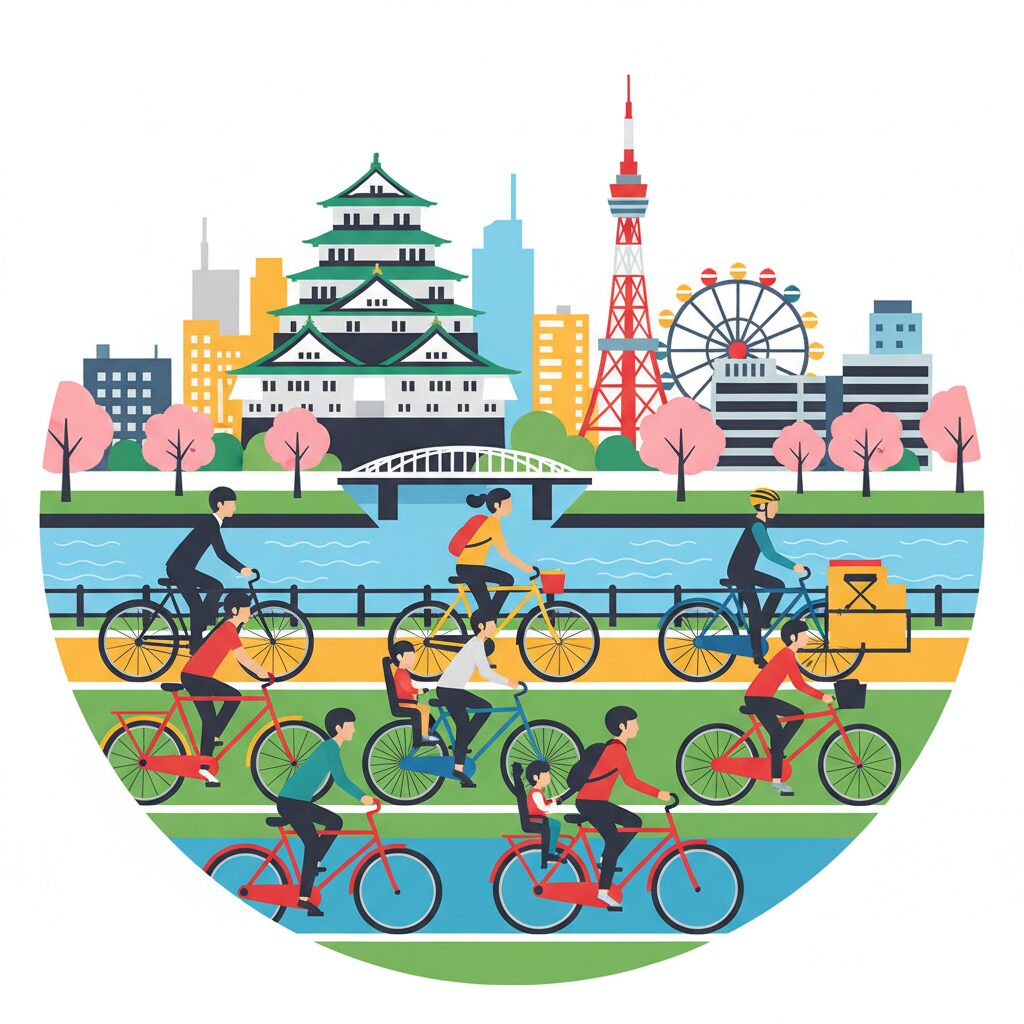
Step off the train in Osaka, and the first thing you notice isn’t a landmark. It’s the motion. A relentless, fluid, and seemingly chaotic river of bicycles flows through every street, alley, and sidewalk. This isn’t the orderly, almost hesitant cycling you might see in Tokyo, where riders often seem like guests on the road. Here, the bicycle is not just a mode of transport; it’s a vital organ of the city, an extension of the rider’s own body, pulsing with the same pragmatic and impatient energy that defines Osaka itself. For the newly arrived foreigner, this ballet of bells, baskets, and bravado can feel like a test. A confusing, intimidating dance where you don’t know the steps. The official traffic laws seem to be mere suggestions, replaced by a complex, unspoken code that everyone but you appears to understand instinctively. How does this system function without collapsing into daily disaster? What are the invisible rules that govern this urban ecosystem? This is not about the laws written in a book; this is about the reality lived on the pavement, a window into the very soul of Osaka’s practical, get-it-done culture.
Visitors curious about how everyday traditions shape Osaka’s vibrant rhythm can also delve into the nightly sentō experience to witness another facet of the city’s dynamic social fabric.
The Holy Trinity: Mama-chari, Umbrella, and Smartphone

Before you can grasp the rules of the road, you must first familiarize yourself with the tools of the trade. The Osaka cyclist is a multitasking expert, a pragmatic creature of habit who has mastered the art of navigating urban life with peak efficiency. Their setup is not about style or sport; it’s a finely calibrated machine for living. This holy trinity of gear—the bike, weather protection, and connection to the world—reveals everything you need to understand about the city’s priorities.
The Mama-chari: Osaka’s Urban SUV
The iconic Osaka bicycle is the mama-chari, or “mom’s chariot.” Forget sleek, lightweight road bikes or minimalist single-speeds common in other global cities. The mama-chari is the antithesis of a status symbol. It stands as a declaration of pure, unfiltered utility. These are the city’s heavy-duty workhorses, designed with a low, step-through frame for easy mounting, even when heavily loaded. Nearly all come equipped with a large front basket, a sturdy rear rack, a built-in wheel lock, and a rock-solid kickstand that keeps the bike stable under the most demanding loads. Many include one or two child seats, effectively turning them into family vehicles. You’ll see mothers ferrying children to daycare, office workers in suits heading to the station, and grandmothers hauling a week’s worth of groceries from the local shotengai shopping arcade. The mama-chari embodies the Osaka mindset: function always outranks form. It’s not about appearance; it’s about getting the job done. In Tokyo, a broader variety of bicycles reflect personal style and hobbies. In Osaka, the overwhelming prevalence of the humble mama-chari signifies a shared focus on the practical necessities of daily life.
The Art of the One-Handed Ride
One of the first things that surprises newcomers is seeing locals cycling with remarkable ease using only one hand. The other hand is almost always occupied, either holding a smartphone to their ear or, more impressively, holding a full-sized umbrella during a sudden downpour. This practice, known as kasa-sashi unten, is technically illegal and undeniably risky. Yet, it is completely normal. To outsiders, it may look like a reckless disregard for safety. To Osaka locals, it’s a perfectly rational solution to a common problem. “It’s raining, I need to get home, and I don’t want to get wet. What else can I do?” This single act highlights a core aspect of the Osaka psyche: rules serve as guidelines, and personal convenience often justifies bending them. It’s a calculated risk, a display of practiced skill developed over a lifetime of navigating the city. They’re not aiming to be rebels; they’re simply trying to get through their day efficiently. Some bikes even come fitted with special clamps on the handlebars meant to hold an umbrella, physically embodying this rule-bending pragmatism. The smartphone habit is similar—a response to the modern demand for constant connectivity, with efficiency taking precedence over strict safety adherence.
Sidewalks vs. Streets: The Fluid Battlefield
The most perplexing aspect for foreigners is often not what people are riding, but where they are riding. In many Western countries, cycling on the sidewalk is considered a major taboo. In Osaka, however, it’s the norm. This isn’t because people are deliberately trying to intimidate pedestrians; rather, it’s a practical response to the urban environment.
Why Everyone Rides on the Sidewalk
Officially, bicycles are classified as vehicles and should be ridden on the road, specifically on the left side. In reality, Osaka’s streets are frequently a chaotic mix of speeding taxis, large delivery trucks, and buses, leaving little space and even less margin for error. Dedicated bike lanes are scarce, a near utopia in most areas of the city. For the average person on a heavy, slow mama-chari, the street feels like a dangerous trap. The sidewalk, by contrast, offers the least resistance and is seen as a safer option. Consequently, most daily cycling occurs on pedestrian walkways. Police presence is limited, and enforcement is lenient, fostering an unspoken understanding that this is simply the way things are done. This creates a completely different dynamic compared to Tokyo, where sidewalk cycling is less frequent and more often challenged. In Osaka, the sidewalk is not merely for walking; it is a shared-use corridor, a dynamic space where rules are negotiated moment by moment.
The Sidewalk Dance: Pedestrians and Cyclists
What may seem like chaos to the untrained eye is actually a highly coordinated, non-verbal dance. Pedestrians in Osaka possess an almost sixth sense for approaching cyclists. They don’t jump out of the way in panic but make subtle, nearly unconscious adjustments, gently drifting to one side to clear a path. Cyclists, in turn, excel at reading the crowd, predicting movements, and smoothly weaving through the tightest gaps with calm confidence. The key is continuous, predictable motion. The biggest mistake a foreigner can make—whether as a pedestrian or cyclist—is to freeze. Hesitating breaks the flow and causes confusion. A sudden stop or panicked sidestep is far more dangerous than maintaining your course and trusting the other party to make their own slight adjustment. This system relies on a strange form of mutual trust and shared spatial awareness: the cyclist trusts the pedestrian to make way, and the pedestrian trusts the cyclist’s skill to avoid collision. It’s an assertive, high-stakes ballet that usually works with remarkable efficiency.
The Soundscape of the Streets: Bells, Shouts, and Silence
Communication is essential for navigating the crowded streets of Osaka, yet it is seldom verbal. The sounds—and the silence—of cycling in the city form another layer of an unwritten code that outsiders can easily misinterpret.
The Bell: A Tool of Last Resort
In many cultures, a bicycle bell serves as a friendly, polite way of saying, “Excuse me, coming through.” In Osaka, however, it often carries the opposite meaning. A gentle, single ding might be acceptable, but a sharp, repeated ringing is frequently perceived as an aggressive demand to make way. It’s the sound equivalent of a car horn, signaling impatience and often seen as rude. The most skilled Osaka cyclists ride almost entirely in silence, relying on their ability to anticipate foot traffic flow and spotting open paths before they materialize. They are like ninjas on wheels, gliding through crowds with barely a whisper of tire on pavement. When sound becomes absolutely necessary to avoid a collision, a soft, muttered “suimasen” (the versatile Japanese word for “excuse me” or “sorry”) is often preferred. It feels more personal and less startling than a mechanical bell—a human acknowledgment amid anonymous movement.
The “Abunai!” Moment
Near-misses do occur, and when they do, the response is distinctively Japanese—and perhaps uniquely Osakan. There are no loud, dramatic confrontations or angry exchanges common in other parts of the world. Instead, the moment is typically marked by a sharp intake of breath, a quick, almost automatic bow of the head, or a muttered “abunai” (dangerous). The main aim is to defuse the situation and move on as swiftly as possible. There is a collective understanding that urban life is inherently risky and that close calls are inevitable. Dwelling on the incident or escalating conflict serves no practical purpose—it wastes time and disrupts the flow. This swift resolution embodies the city’s relentless forward drive: acknowledge the risk, adjust, and keep moving. It captures the urban hustle in a brief, non-confrontational exchange.
Parking Pandemonium: The Art of Finding a Spot
Your journey on an Osaka bicycle doesn’t end when you stop pedaling. The final challenge is finding a parking spot—a daily contest of wits that balances convenience against regulations in a striking display of organized chaos.
The “Official” vs. “Unofficial” Parking System
Near nearly every train station and major commercial building, you’ll encounter official bicycle parking lots, known as churinjo. Some are free, while others charge a small fee. They are generally neat and orderly but are often completely full. This is where the unofficial system comes into play. Any available stretch of railing, any inconspicuous patch of public space, or any sufficiently wide sidewalk becomes a potential parking spot. Outside supermarkets, convenience stores, and apartment buildings, you’ll see vast arrays of bicycles lined up with surprising precision. This isn’t random dumping. An unwritten etiquette governs this illegal parking: you must not block building entrances, leave clear paths for pedestrians, and align your bike neatly with the others, maintaining order within the disorder. It’s a community-driven system born of necessity, another example of Osaka’s residents inventing practical solutions when official infrastructure falls short.
The Inevitable “Silver-san” Showdown
This unofficial system is in constant tension with the authorities. The front lines of this conflict are manned by the “Silver-san,” retired gentlemen working as parking enforcement officers, easily recognized by their silver-grey uniforms. Their task is to manage the chaos. They patrol the streets, marking illegally parked bikes with brightly colored paper notices. These tags serve as warnings: leave your bike too long, and it will be impounded. Recovering it requires a trip to a distant depot and a considerable fee. For Osaka locals, this is part of a calculated game. “Will I return before the Silver-san make their rounds?” “Is this spot too conspicuous?” They weigh the convenience of parking right by their destination against the risk of impoundment. It’s a daily gamble that perfectly reflects the Osaka attitude toward inconvenient rules. It’s not about defiance for its own sake but a pragmatic cost-benefit analysis. In Tokyo, there is a stronger sense of obligation to follow the rules and park in designated areas even if it means a five-minute walk. In Osaka, that five-minute walk is seen as an inefficiency to be eliminated from the day, even if it means playing cat and mouse with the authorities.
What This Says About Osaka Culture
The daily habits of cyclists in Osaka are more than just peculiarities; they directly mirror the city’s core cultural values. The bicycle serves as a lens through which one can grasp how Osaka thinks and functions at a fundamental level.
Pragmatism Over Protocol
The key lesson from Osaka’s streets is that effectiveness takes precedence over strict adherence to rules. Rules are viewed as initial guidelines rather than rigid commands. When a rule proves inefficient or unrealistic, the people of Osaka collectively create practical alternatives. Riding on sidewalks, parking against railings, or cycling while holding an umbrella—these are all adaptive strategies. This reflects a culture of problem-solvers who see systems and quickly devise ways to make them work better. Outsiders, especially from more rule-focused societies, might interpret this as rudeness or a lack of civic responsibility. Yet locally, it is simply common sense—a reflection of the merchant city’s spirit, where outcomes matter more than prescribed methods.
High-Context and High-Trust Environment
The seemingly chaotic system works because it relies on unspoken understandings and a strong foundation of implicit trust. This is a high-context culture in motion. Everyone is expected to grasp their role in the sidewalk dance and to be familiar with parking etiquette. Such dependence on non-verbal signals and shared assumptions can be challenging for foreigners. One must read the environment—the street—and respond appropriately without explicit instructions. This engenders a remarkable level of trust: you trust that the grandmother cycling toward you can avoid a collision, just as she trusts you to stay on your path. This collective, self-regulating order develops organically from the bottom up, rather than being imposed from above.
The “Kansai Individualism”
Although Japan is often seen as a collectivist society, the Kansai region, especially Osaka, exhibits a distinct streak of individualism. This is not the rugged individualism typical of the West, but rather a sense of self-reliance and personal responsibility. The mindset is, “I’ll handle my own affairs, you handle yours, and let’s avoid interfering with each other.” The assertive, confident cycling style illustrates this attitude. Cyclists take control of their own journey, weaving through traffic with the expectation that others will do the same. This contrasts with the Kanto region around Tokyo, where there is usually a stronger focus on moving as a group and strictly following established protocols to preserve harmony. Osaka’s individualism is about having the confidence and skill to navigate your own path in a busy and complex environment.
A Foreigner’s Survival Guide to Osaka Cycling
Grasping the culture is one thing; navigating it successfully is another. For any foreigner wishing to join the flow of cyclists, here are some practical tips to keep in mind.
Be Predictable, Not Polite
Your natural impulse might be to be overly cautious and courteous, stopping to let pedestrians cross or signaling others to go ahead of you. However, this often causes more problems than it solves. Sudden stops disrupt the flow and create confusion. The best approach is to be predictable. Maintain a steady, moderate pace and communicate your intentions through your body language. Trust that others will interpret your movements and adjust accordingly. Blend into the current, don’t try to resist it.
Develop Situational Awareness
Life on an Osaka sidewalk requires a 360-degree awareness. You must stay alert to your surroundings at all times. Bicycles can come from unexpected side streets. Pedestrians may step out of shops without looking. Other cyclists might be trying to overtake you. Keep your head moving, listen for the telltale whir of wheels behind you, and never assume you have the right of way, even when you technically do.
Embrace the Mama-chari
While it might be tempting to buy a fast, lightweight road bike, the humble mama-chari is the best choice for navigating the city. Its upright riding position provides better visibility. Its weight and sturdiness offer stability on uneven pavement. Its basket is essential for daily errands. Most importantly, it signals to everyone that you’re part of the local traffic rather than a tourist or sports cyclist. It helps you sync with the rhythm of the city.
Know the Real Risks
Although most interactions are governed by unwritten rules, official laws still apply. Police occasionally conduct crackdowns, and you can be fined for infractions like riding while intoxicated, using headphones, or running red lights. Despite the usually smooth sidewalk dance, accidents do occur. Having your bike impounded is a real and costly inconvenience. Understand the local customs, but don’t forget the legal framework behind them. The key to thriving as a cyclist in Osaka is to strike a careful balance between following the unspoken code and respecting the official laws.