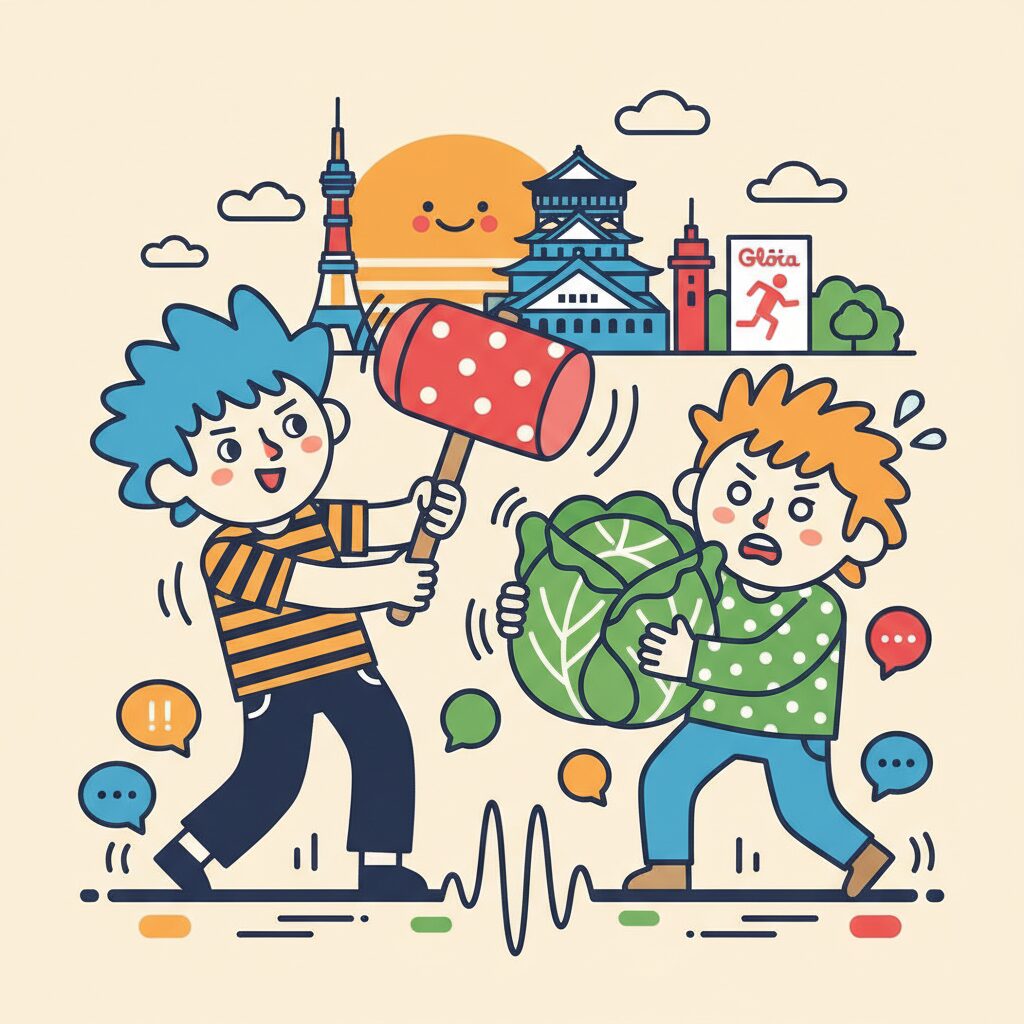
My first real taste of Osaka wasn’t takoyaki or okonomiyaki; it was a verbal slap from a woman selling pickles. I was in a covered shopping arcade, a shotengai, mesmerized by the sheer variety of pickled daikon. I’d been staring for a solid minute, lost in thought. Suddenly, the shop owner, a woman with a perm that defied gravity, leaned over the barrels and said, “You gonna buy one or just try to figure out its life story?” She wasn’t angry. Her eyes were crinkling with mischief. Her husband, who was bagging up some ginger for another customer, chuckled without looking up. I felt my face flush, a mix of embarrassment and utter confusion. In most places in Japan, this kind of direct, unprompted comment from a stranger would be unthinkable. But here, the other customers just smiled. I stammered an apology and pointed at a random bag. As she handed it to me, she winked. “It’s a good one. Has a very dramatic backstory.” In that moment, I realized Osaka operated on a completely different set of conversational rules. It was a place where language wasn’t just for politeness or information exchange. It was a sport. And I had just been tagged in.
This is the world of the tsukkomi, the conversational cornerstone of daily life in this city. It’s a concept born from comedy but practiced on every street corner, in every train car, and across every dinner table. It’s a form of banter that can feel abrasive to the uninitiated, a style that favors a sharp retort over a gentle nod. But to truly understand Osaka, to peel back the layers of its reputation for being loud, brash, and endlessly energetic, you have to understand the art of the everyday tsukkomi. It’s the key to unlocking the city’s unique brand of human connection, a connection forged not in quiet agreement but in shared, boisterous laughter.
The lively spirit of Osaka’s tsukkomi culture extends into every facet of daily life, much like the challenges of navigating the Osaka bicycle lifestyle where freedom and frustration collide.
What Even Is a ‘Tsukkomi’? Beyond the Comedy Stage
The word itself doesn’t have a straightforward English equivalent. It’s often described as a “retort,” a “comeback,” or the role of the “straight man” in a comedy duo. While all are accurate, none fully encompass its role within Osaka society. It’s less a specific action and more a conversational instinct—a reflex to keep the flow of social interaction going, even if it means giving it a playful but firm nudge.
Deconstructing the ‘Boke’ and ‘Tsukkomi’ Dynamic
To grasp the tsukkomi, you first need to understand its counterpart: the boke. These terms originate from manzai, a traditional Japanese stand-up comedy style for which Osaka is well known. In a typical manzai pair, the boke is the foolish character, the one who says something absurd, nonsensical, or downright silly. The tsukkomi is the straight man, who reacts to the absurdity with sharp remarks, a reproachful tone, and sometimes a playful smack with a paper fan. The boke sets up the joke, and the tsukkomi delivers the punchline by pointing out the folly. The humor emerges from that clash.
In everyday life in Osaka, this dynamic is constantly at play—just without the stage or the paper fan. It’s a fluid, rapid exchange where people shift roles instinctively. The aim isn’t to perform; it’s to connect.
The Everyday ‘Boke’: Finding Humor in the Mundane
A daily-life boke isn’t about being genuinely foolish. It’s about introducing a small, amusing twist into a conversation. It might be a slight exaggeration, an obvious mistake, or feigned ignorance. You step outside into a light drizzle and dramatically declare, “Well, I guess I need to build an ark.” That’s a boke. You attempt to pay for your groceries with your transit card. That’s a boke. You tell a friend you’re so exhausted you could sleep for a year. That, too, is a boke.
These are tiny, humorous gestures. You’re deliberately inserting a minor absurdity, a small rip in the fabric of normal conversation. Essentially, you’re tossing a conversational ball to your partner, silently asking, “Will you play along?”
The ‘Tsukkomi’ as Social Glue
The tsukkomi is the act of catching that ball and bouncing it back. If you say you must build an ark, the Osakan reply isn’t a dull, factual “It’s not raining that hard.” That’s a Tokyo-style response. The Osaka reply is the tsukkomi: “Don’t be ridiculous—you’d make a terrible captain,” or “Fine, but don’t expect me to help gather the animals.”
This retort isn’t meant to insult. It’s a form of validation. It signals, “I hear your joke, I recognize its silliness, and I’m joining in.” A tsukkomi closes the loop. It acknowledges the boke and transforms a simple comment into a shared moment of humor. Ignoring a boke is like dropping the conversational ball. It comes across as cold, distant, and somewhat sad. The tsukkomi is the engine driving Osakan social life, turning everyday exchanges into small performances of mutual understanding.
The Osaka vs. Tokyo Communication Divide
Foreigners who have lived in Tokyo before relocating to Osaka often undergo a form of culture shock. The communication styles aren’t merely different; they are nearly opposite. Grasping this contrast is essential to feeling comfortable amid Osaka’s relentless banter.
Tokyo’s Taciturn Polish: The Art of Reading the Air
In Tokyo, as in much of Japan, social harmony is paramount. The key concept is kuuki wo yomu, or “reading the air.” This subtle skill involves perceiving the mood, the unspoken intentions, and the social hierarchy of a situation without explicit expression. Communication tends to be indirect, layered, and careful. You avoid causing friction. You don’t put people on the spot. You infer meaning instead of stating it outright. A direct contradiction or sharp retort can be seen as disruptive, aggressive, and deeply impolite. The ideal conversation is like a smooth surface, with complex currents flowing quietly beneath.
Osaka’s Vocal Vibe: The Art of Making the Air
Osaka rejects this entire philosophy. People here don’t just read the air; they create it, shape it, and fill it with noise, laughter, and opinions. The aim isn’t to keep a calm surface but to make lively waves together. Harmony isn’t about avoiding conflict but about the playful interaction of a boke and a tsukkomi.
Interrupting isn’t necessarily rude; it shows engagement. Asking a direct, personal question isn’t intrusive; it demonstrates interest. And delivering a well-timed tsukkomi to a friend, colleague, or even a stranger is the ultimate expression of social inclusion. By teasing you, they signal that you’re part of the group, that usual rules of polite distance don’t apply. They feel comfortable enough to joke with you.
The Train Station Test
A perfect example of this difference is what I call the Train Station Test. Imagine someone trips on the stairs at a busy station. In Tokyo, the typical reaction is often practiced ignorance. People might look away, pretending not to have noticed. This comes from kindness; they want to spare the person the embarrassment of being seen vulnerable. Harmony is maintained by allowing the person to regain dignity in private.
In Osaka, the response is quite the opposite. It’s very likely an older woman (obachan) would be the first to speak up, shouting something like, “Whoa, careful there! The stairs aren’t going anywhere!” or “Are you trying to fly?” This is followed by a chuckle and an offer of help. The comment, the tsukkomi, breaks the tension and immediately reframes the embarrassing fall as a minor, slightly funny incident to share. It transforms a moment of personal shame into one of communal connection. The Osakan belief is that the quickest way to overcome embarrassment is to laugh about it—together, right away.
How to Spot a ‘Tsukkomi’ in the Wild: A Foreigner’s Field Guide
Once you recognize what you’re looking for, you’ll notice the boke-tsukkomi dynamic everywhere. It’s the city’s underlying rhythm. For a foreigner, these exchanges might be confusing at first, but they almost always serve as invitations to connect, disguised as gentle teasing.
The Shopkeeper’s Welcome Wagon
Local shopkeepers, especially in the older shotengai arcades, are masters of this art. They use tsukkomi as a customer service tool. It’s how they create rapport and transform a simple transaction into a memorable experience.
If you take too long deciding between two items, they might say, “They’re both good, just close your eyes and point! We don’t have all day!” This isn’t a real complaint about your time; it’s a playful nudge to get you to decide and spark a conversation. If you’re buying a single onion, the vendor might dryly say, “Big party tonight, huh?” The joke acknowledges the small size of your purchase while also engaging you personally. It’s a performance of familiarity, a way to treat you like a regular even if it’s your first visit.
The Compliment with a Twist
In Osaka, even compliments often come with a layer of tsukkomi. A straightforward, sincere compliment can feel a bit too formal and distant. Adding a playful jab at the end makes it feel warmer and more personal. It’s a way of saying, “I like you enough to tease you.”
You might show off your new jacket, and a friend will say, “Oh, that looks great on you! Must have been expensive, you big spender.” The tsukkomi playfully mocks your spending, a common subject in Osakan humor. Or, if you nail a difficult Japanese phrase, a local might say, “Your Japanese is really good! You almost don’t sound like a foreigner… almost.” That little twist at the end is the punchline. It brings you both back to a comfortable, equal level and prevents the praise from creating distance.
The “Why?” That Isn’t a Question
The quintessential tsukkomi phrase you’ll hear echoing through Osaka’s streets is nande ya nen! Literally, it means “Why is that?” but it’s closer in meaning to “What the heck?!” or “You’ve got to be kidding me!”
It’s important to know this is almost never a genuine question. It’s a verbal punctuation mark, an exclamation of disbelief at a boke. If your friend shows up wearing two different socks, you don’t ask, “What is the reason for your mismatched socks?” You shout, “Nande ya nen!” It’s the sound of the tsukkomi landing the punch. It’s a pure reaction, a reflex that signals the absurdity has been noticed and is being thoroughly enjoyed.
Navigating the Banter: To ‘Tsukkomi’ or Not to ‘Tsukkomi’?
So, you’re living in Osaka, surrounded by a continuous flow of playful teasing. How should you respond? And is it worth trying to join in? The good news is that expectations for foreigners are fairly flexible, and your role is often assumed by default.
Your Role as the Foreigner: The Ever-Present ‘Boke’
As a non-Japanese person living in Osaka, you naturally become a walking boke. This isn’t an insult; it’s actually a great advantage. Your minor language errors, occasional confusion about social customs, and mispronunciation of station names—all these create perfect, inadvertent boke moments. You become a steady source of gentle, amusing absurdity.
When a local laughs and delivers a tsukkomi in response to your mistake, they aren’t mocking you maliciously. Instead, they’re taking a perfect chance to interact with you in the most Osakan way possible. They are inviting you into their cultural game. A tsukkomi aimed at you is actually a sign of acceptance. It means they feel comfortable enough to drop the usual foreigner-Japanese formality and treat you simply as another person.
How to Respond: Laughter Is Your Best Tool
The single most important skill for thriving amid Osaka’s banter is learning not to take it personally. The standard response to a tsukkomi is just to laugh. That’s all. You don’t need a clever comeback. You don’t need to get defensive or explain yourself. A smile, a chuckle, or a full laugh shows you understand the spirit of the exchange. You get the joke. By laughing, you complete the comedic pair. You accept the tsukkomi, and the social connection is successfully formed.
If the pickle lady teases you, laugh and buy the pickles. If a coworker points out you used the wrong word, laugh and say “Oops!” You have fulfilled your role perfectly.
Trying Your Own ‘Tsukkomi’ (Advanced Stage)
Should you attempt to deliver your own tsukkomi? This is advanced territory. A good tsukkomi demands precise timing, native-level nuance, and a deep understanding of your relationship with the person you’re addressing. A poorly timed or clumsily worded tsukkomi can fall flat—or worse, come off as genuinely rude.
That said, it’s not impossible. Start small and with close friends. If someone familiar says something obviously silly, a well-timed “Nande ya nen!” can earn you major points. But mostly, focus on being a good receiver. Being an appreciative audience to Osaka’s endless comedy is more than enough to help you fit in.
The Soul of the City: Why This Humor Matters
This conversational style is more than just a quirky habit; it’s the audible heartbeat of the city, embodying its history, economy, and overall philosophy on human relationships.
A Legacy of Merchants and Performers
Unlike Tokyo, which developed as the political and military stronghold of the samurai class, Osaka has always been a city of merchants, artisans, and entertainers. In the business world, being quick-witted, personable, and able to establish rapport immediately was essential. Humor served as a tool of the trade—breaking down barriers, negotiating, and closing sales. This fostered a culture that prized directness, pragmatism, and clever wordplay over the rigid formality of the warrior class. The spirit of the marketplace, with its endless haggling and lively chatter, is ingrained in the city’s DNA.
Moreover, Osaka is the undisputed capital of Japanese comedy. The entertainment giant Yoshimoto Kogyo is headquartered here, and for over a century it has produced the country’s most famous comedians. The manzai seen on television is simply a polished version of the banter heard on the streets. In Osaka, everyone is a part-time comedian, and every conversation can become a stage.
More Than Just Jokes: A Philosophy of Connection
At its core, the culture of tsukkomi is about bridging gaps. It serves as a way to combat the isolation and anonymity of modern city life. A sharp, witty remark from a stranger is a way of saying, “I see you. You’re not just another face in the crowd. We are both here now, on this street corner—let’s share a laugh.”
This is the true foundation of Osaka’s famous “friendliness.” It’s not a passive, smiling warmth; it’s an active, engaged, and often loud form of interaction. It may be surprising at first, but it’s profoundly human. The city refuses to let social exchanges become sterile or impersonal. Instead, it insists on discovering humor, flaws, and shared absurdities in everyday life, using them to build a bridge—no matter how small—between two people. Living in Osaka means learning to cross that bridge, one laugh at a time.